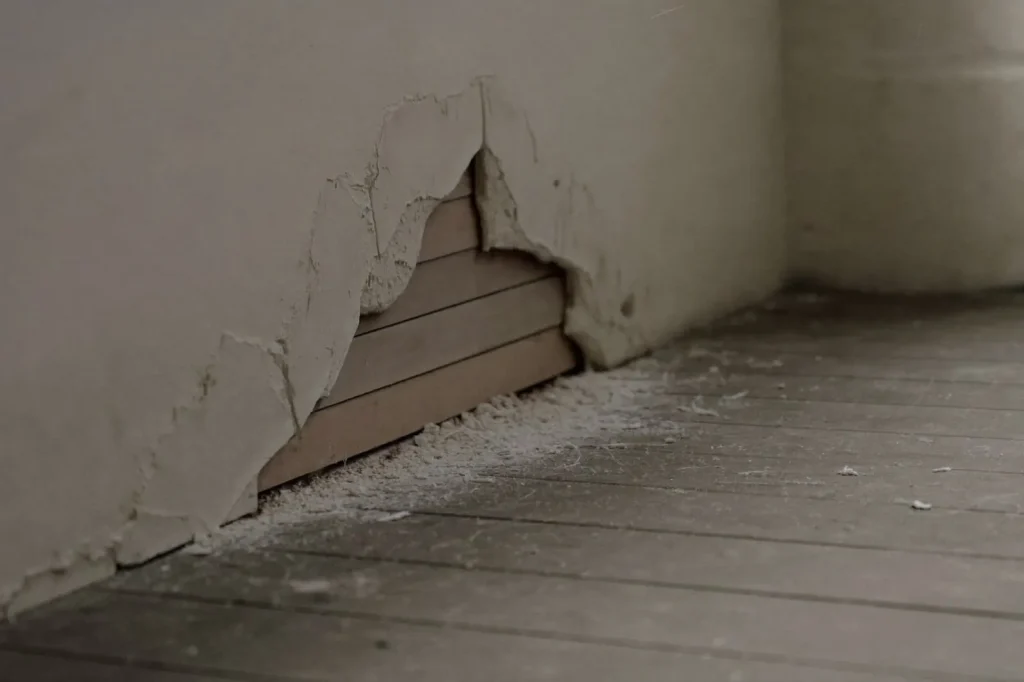
The short answer
Does plaster have asbestos? Sometimes, and it depends on the layer. EPA’s 1990 operations guide lists acoustical plaster, decorative plaster and textured coatings as products that may contain asbestos, while the traditional lime base coat used cattle or hog hair as its fiber. OSHA presumes troweled surfacing in buildings constructed by 1980 is asbestos until a lab clears every layer.
Which coat of a lath and plaster wall could contain asbestos: scratch, brown, finish or texture?
A plaster wall is a stack, not one material. National Park Service Preservation Brief 21 describes three-coat work over wood or metal lath: a scratch coat and a brown coat of 3/8 inch each, made of lime putty, sand, water and animal hair, under a finish coat about 1/8 inch thick that carried a much higher share of lime putty, little aggregate and no fiber. Paint, texture and later patches sit on top of that.
The fiber in the traditional recipe was hair. The NPS brief, written for the Interior Department in 1989, says the fiber came from cattle or hog hair, which is why the common search phrase “horsehair plaster” points at the base coats. Asbestos enters the record in the outer layers: Appendix G of EPA's 1990 Green Book lists acoustical plaster, decorative plaster and textured paints and coatings among materials that may contain asbestos, and says asbestos content in building products ranged from about 1 percent to nearly 100 percent.
None of that tells you what is in a particular wall. Plasterers mixed base coats on site, finish coats were gauged with gypsum, and walls were patched for decades. EPA’s guidance on telling asbestos by eye is blunt: “you can’t tell whether a material contains asbestos simply by looking at it, unless it is labeled,” per EPA's homeowner asbestos page. Every coat in the drawing above is a separate sample.
How did plaster change from 1890s lime to 1930s rock lath, and where do the asbestos rules land?
National Park Service Preservation Brief 21 gives the building history. Until the end of the 19th century, plasterers used lime plaster; manufacturing changes then made gypsum usable, and around 1900 gypsum began to be used as a plastering material. Gypsum and lime were combined in base and finish coats in the early 20th century, and gypsum plaster, the brief notes, “did not require a fibrous binder.”
The lath changed too. Metal lath, patented in England in 1797, spread in parts of the United States toward the end of the 19th century. Rock lath, a gypsum core under a paper face, was in use as early as 1900, and by the late 1930s it “was used almost exclusively in residential plastering,” per National Park Service Preservation Brief 21. Over rock lath the job became two coats, one base coat and a finish.
The federal rules arrive much later. EPA's asbestos actions timeline records that EPA banned spray-applied surfacing asbestos material for fireproofing and insulating in 1973, the Consumer Product Safety Commission barred asbestos in wall patching compounds in 1977, and EPA banned spray-applied surfacing materials for purposes not already banned in 1978. Today’s spray standard, 40 CFR 61.146, still forbids spraying material with more than 1 percent asbestos on buildings, structures, pipes and conduits. None of those bans covered hand-troweled plaster by name, which is why OSHA’s presumption, not a ban date, decides how a wall built by 1980 is treated.
Plaster type by era: what each source says and which federal category applies
The table pairs each plaster product with the era the National Park Service or EPA gives for it, the source that names it as a possible asbestos product, and the category it falls in if a lab finds more than 1 percent. OSHA’s 29 CFR 1926.1101(b) defines surfacing material as material “sprayed, troweled-on or otherwise applied to surfaces (such as acoustical plaster on ceilings and fireproofing materials on structural members).”
| Plaster product | Era, per source | What the source says | Category if over 1% asbestos |
|---|---|---|---|
| Lime base coats (scratch, brown) | Until the early 1900s, per NPS | NPS recipe: lime, sand, water, cattle or hog hair; asbestos not in the recipe | Troweled on, so OSHA surfacing; PACM if the building was built by 1980 |
| Gypsum base coats | From about 1900, per NPS | NPS: needed no fibrous binder; mixes varied by maker and job | Same as above |
| Finish coat (lime putty gauged with gypsum) | All eras | EPA 1990 Green Book lists decorative plaster | OSHA surfacing; friable under 40 CFR 61.141 if it crumbles by hand when dry |
| Acoustical plaster (troweled or sprayed) | School and office stairwells and hallways, per EPA Region 4 | EPA Green Book lists acoustical plaster; OSHA names it in the surfacing definition | OSHA surfacing; Class I removal |
| Sprayed fireproofing plaster on steel | Spray use for fireproofing banned 1973, per EPA | OSHA names fireproofing on structural members as surfacing | OSHA surfacing; Class I removal |
| Textured paint, skim and patching compound | Patching ban 1977 | EPA lists textured paint and patching compounds on walls and ceilings; CPSC 16 CFR 1304 | OSHA surfacing when sprayed or troweled on; ask the inspector to record which |
| Rock lath (gypsum board lath) | From 1900; near exclusive in homes by the late 1930s, per NPS | EPA Green Book lists wallboard and joint compounds | OSHA Class II names wallboard |
Sprayed ceiling texture is the plaster cousin most people meet first, and its ban dates and scraping rules are on our popcorn ceiling asbestos page. In US usage, plasterboard means drywall, so a search for asbestos in plasterboard belongs on our asbestos in drywall page, which covers wallboard and joint compound.
Does 100-year-old plaster have asbestos, or only plaster from the 1940s to 1970s?
A house built in the 1920s sits at the hinge of the NPS history: lime base coats were giving way to gypsum, and rock lath had been available since about 1900. The original hair bound base coats described in National Park Service Preservation Brief 21 list no asbestos, so an untouched 100-year-old brown coat is the layer least often named on federal product lists. That is a reading of the recipe, not a test result.
Three things change the answer for an old wall. First, the finish and texture coats may be younger than the wall: a 1910 house can carry a 1960s skim coat or acoustical finish. Second, patches made before the CPSC’s 1977 ban on asbestos consumer patching compounds under 16 CFR 1304 sit on many old walls. Third, OSHA’s PACM presumption in 29 CFR 1926.1101(b) covers surfacing in any building constructed no later than 1980, which includes every 100-year-old building. Age alone does not clear a wall; a lab result on each layer does.
Why must a lab analyze each plaster layer separately instead of averaging the wall?
Because averaging can hide an asbestos layer. EPA's 19 December 1995 multi-layer clarification (60 FR 65243) restates EPA’s long-standing policy that “each layer in a multi-layered system was to be analyzed as a separate material,” with no dilution by combining an asbestos layer with non-asbestos layers. A labelled calculation shows why: using the NPS thicknesses, a 1/8 inch finish coat at 5 percent asbestos ground together with 3/4 inch of asbestos-free scratch and brown coat is 0.125 of 0.875 inch, about 14 percent of the core, so the average reads about 0.7 percent, under the 1 percent line, according to simple thickness weighting.
The 1995 notice allows one narrow alternative: layers of a single core may be composited first using the gravimetry section of EPA/600/R-93/116, and if the composite exceeds 1 percent the system is treated as asbestos-containing and the layers analyzed one by one. The only stated exception to layer-by-layer analysis is wallboard where asbestos joint compound sits only at the joints and nail holes.
For counts, EPA’s school rule in 40 CFR 763.86(a) is the federal benchmark: at least 3 bulk samples from each homogeneous area of friable surfacing of 1,000 square feet or less, 5 up to 5,000 square feet, and 7 above that. Under 40 CFR 763.87(c), one sample over 1 percent makes the whole homogeneous area asbestos-containing, while clearing it needs every required sample at 1 percent or less. The same section bars compositing separate samples.
Ask the lab whether it reports each layer of a plaster core on its own line, and ask the inspector to label which coat each result belongs to. Published per-sample and per-layer fees are compared on our asbestos testing cost page, and what an inspector must hold by state is on our certified asbestos inspector page.
Does OSHA treat plaster in a building built by 1980 as asbestos until tested?
For workers, yes. 29 CFR 1926.1101(b) defines presumed asbestos containing material (PACM) as “thermal system insulation and surfacing material found in buildings constructed no later than 1980,” and paragraph (k)(1) tells employers and building owners to treat sprayed or troweled-on surfacing as asbestos-containing unless they rebut it. Removing surfacing ACM or PACM is Class I work, the strictest of OSHA’s four classes.
Rebuttal has a set route under paragraph (k)(5): an inspection meeting AHERA, or bulk samples collected the way 40 CFR 763.86 describes, taken by an accredited inspector or a certified industrial hygienist, and analyzed by a lab in a recognized program such as NIST’s NVLAP or the AIHA round robin. The exposure limits behind the rule are 0.1 fiber per cubic centimeter as an 8 hour average and 1.0 f/cc over 30 minutes, per paragraph (c) of 29 CFR 1926.1101. Choosing a lab with the right accreditation is covered on our asbestos testing lab page.
Is asbestos plaster friable under 40 CFR 61.141, and does NESHAP apply to a house?
Plaster is judged by the hand pressure test in 40 CFR 61.141: material over 1 percent asbestos that “when dry, can be crumbled, pulverized, or reduced to powder by hand pressure” is friable, and friable material is regulated asbestos-containing material automatically. EPA Region 4 NESHAP guidance notes that troweled-on acoustical plaster and other materials can become crumbled or powdered with time, weather and mechanical damage, so the test is run on the plaster as it is now. The categories and the RACM test are set out on our friable asbestos page.
The same section defines a facility to exclude “residential buildings having four or fewer dwelling units,” so the federal NESHAP notice and work practice rules generally do not reach a homeowner opening one plaster wall in a detached house. EPA's homeowner asbestos page adds that federal law does not require inspectors or removers in detached single-family homes to be accredited, though some states and localities do. Apartment buildings with 5 or more units, schools and offices are facilities.
Should you remove plaster walls from an old house, or test and keep them?
Federal guidance leans toward keeping sound plaster. EPA's homeowner asbestos page says material in good condition that will not be disturbed “should be left alone,” and that sampling done incorrectly can be more hazardous than leaving the material in place. National Park Service Preservation Brief 21 makes the building case: three-coat plaster “is unmatched in strength and durability,” resists fire, reduces sound transmission, and is expensive to replace.
Testing comes first when work will cut, drill, sand or demolish. Ask the inspector for a core through every coat at each homogeneous area, for results per layer, and whether any coat is friable. If a layer tests over 1 percent and the plan is to remove it, removal of surfacing ACM is Class I work under 29 CFR 1926.1101, with a regulated area and respirators required, which is a job for an abatement contractor rather than a renovation crew.
Out of scope: health effects. This page reads building history, regulations and EPA guidance only; for health information see EPA's Learn About Asbestos page and CDC’s Agency for Toxic Substances and Disease Registry.
Questions people actually ask
How do I know if my plaster walls have asbestos?
Only a lab result tells you. EPA says asbestos cannot be identified by looking unless the material is labeled, and its homeowner page advises against taking samples yourself. An accredited inspector takes cores through every coat and sends them for polarized light microscopy; under EPA’s 1995 clarification each layer is analyzed separately, and any layer over 1 percent asbestos counts.
Is plaster toxic to breathe when you cut or sand it?
Health questions are outside this page, so here is what regulators set. If any plaster layer contains asbestos, OSHA’s construction standard 29 CFR 1926.1101 caps worker exposure at 0.1 fiber per cubic centimeter over 8 hours and 1.0 f/cc over 30 minutes, and requires respirators for Class I removal. Test before sanding or cutting any plaster in a building constructed by 1980.
Is there asbestos in plasterboard?
In the US, plasterboard means drywall or gypsum board, including the rock lath that NPS says was used almost exclusively in residential plastering by the late 1930s. EPA’s 1990 Green Book lists wallboard and joint compounds as possible asbestos products, and OSHA names wallboard removal as Class II work. Joint compound is the layer to sample alongside the board.
Can a home test kit check plaster for asbestos?
A mail-in kit sends a sample to a lab, so the analysis can be the same polarized light microscopy an inspector uses. The weak point is collection: EPA advises homeowners not to sample, and a chip that misses the 1/8 inch finish coat or a texture layer tests the wrong material. Ask the lab whether it reports each layer of the chip separately, as EPA’s 1995 layered-sample policy expects.
Was asbestos added to horsehair plaster?
The traditional recipe in National Park Service Preservation Brief 21 (1989) lists lime, sand, water and cattle or hog hair for the base coats, with no asbestos. The asbestos products EPA’s 1990 Green Book names are acoustical plaster, decorative plaster and textured coatings, usually the outer layers. Hair in a sample does not clear the other coats, so each is still tested.
Sources
- National Park Service Preservation Brief 21, Repairing Historic Flat Plaster: Walls and Ceilings, Marylee MacDonald, U.S. Department of the Interior, October 1989. Retrieved 9 November 2026.
- EPA's 1990 Green Book, Managing Asbestos in Place, EPA 20T-2003, July 1990, Appendix G, via the Whole Building Design Guide. Retrieved 9 November 2026.
- EPA's asbestos actions timeline, EPA Actions to Protect the Public from Exposure to Asbestos, U.S. EPA. Retrieved 9 November 2026.
- EPA's Learn About Asbestos page, Learn About Asbestos, U.S. EPA. Retrieved 9 November 2026.
- EPA's homeowner asbestos page, Protect Your Family from Exposures to Asbestos, U.S. EPA. Retrieved 9 November 2026.
- 29 CFR 1926.1101, OSHA Asbestos standard for construction, paragraphs (b), (c), (h) and (k), via Cornell LII. Retrieved 9 November 2026.
- 16 CFR 1304 and 16 CFR 1304.3, CPSC Ban of Consumer Patching Compounds Containing Respirable Free-Form Asbestos, via Cornell LII. Retrieved 9 November 2026.
- 40 CFR 61.141 and 40 CFR 61.146, Asbestos NESHAP definitions and standard for spraying, via Cornell LII. Retrieved 9 November 2026.
- 40 CFR 763.83, 40 CFR 763.86 and 40 CFR 763.87, EPA AHERA definitions, sampling and analysis rules, via Cornell LII. Retrieved 9 November 2026.
- EPA's 19 December 1995 multi-layer clarification, Asbestos NESHAP Clarification Regarding Analysis of Multi-Layered Systems, 60 FR 65243, via govinfo.gov. Retrieved 9 November 2026.
- EPA Region 4 NESHAP guidance, U.S. EPA Region 4, Asbestos/NESHAP Regulated Asbestos Containing Materials Guidance, Internet Archive copy captured 24 September 2009. Retrieved 9 November 2026.
- The cross-section and timeline are drawn from the sources above. Our methodology sets out the standing rules.
This page reads building history, regulations and EPA guidance; it reports no sampling or testing of its own and is not legal advice. Ask your state asbestos program whether a state rule is stricter than the federal rules described here, and ask your inspector for results per plaster layer.
More rules pages sit on our standards hub.