The short answer
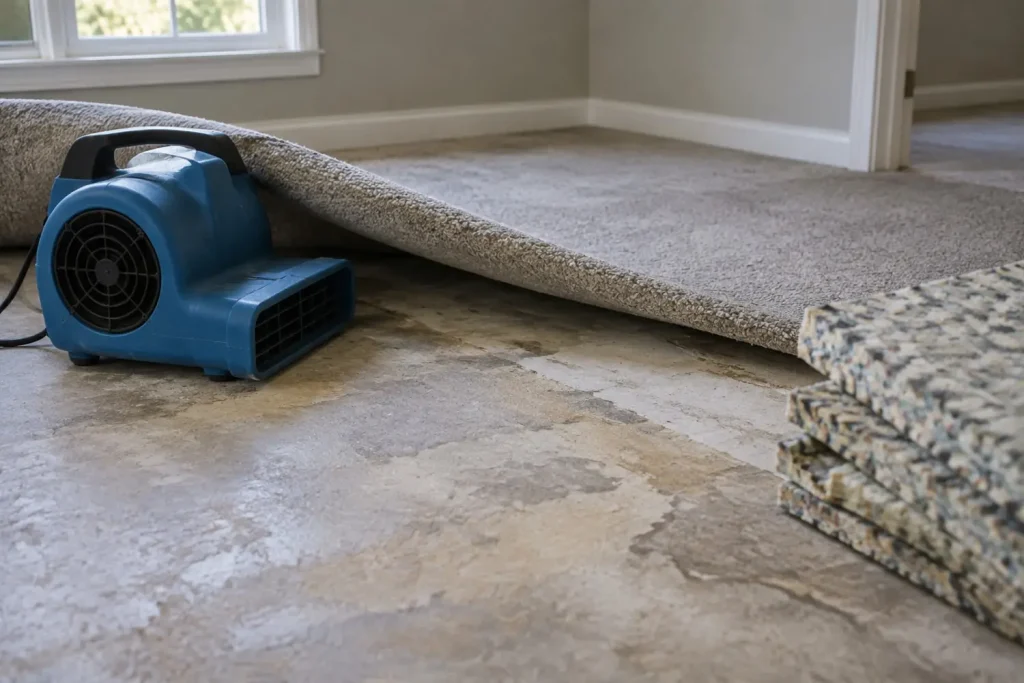
To dry wet carpet you save the face fibre and bin the underlay. On anything beyond a small clean spill, standard practice is to extract hard, pull and discard the pad, float the carpet over an air mover and run a dehumidifier in the same closed room. Clean water caught inside roughly 48 hours is usually salvageable. Grey or black water, or a clean loss left past that window, means both layers go.
Key takeaways
- The pad is the sponge. Carpet face fibre releases water reasonably well; a bonded urethane pad holds it against the subfloor and costs a fraction of the carpet to replace.
- Water category decides the outcome before drying technique does. Category 3 removal is not a judgement call under ANSI/IICRC S500.
- Household fans move air but do nothing about humidity. Without a dehumidifier in a closed space you are relocating moisture, not removing it.
- Extraction beats airflow by a wide margin. Every litre lifted with a wand is a litre that never has to be evaporated and condensed.
- The subfloor is the thing that actually stays wet, and it is the reading that should end the job, not the feel of the carpet.
- Delamination and shrinkage on re-stretch are how a carpet that ‘dried fine’ still fails two weeks later.
On this page
- The underlay is the answer
- The 48-hour window
- Category decides it first
- The method, in order
- Why extraction beats airflow
- Floating the carpet
- The dehumidifier is not optional
- Check the subfloor, not the carpet
- DIY against professional, honestly
- How a dried carpet still fails
- Carpet and pad types change the odds
- The decision, on one page
- Questions people actually ask
Most advice on wet carpet treats the carpet as one thing. It is two things stacked on a third, and they behave completely differently wet. That separation is most of the decision, and it is why a technician who immediately starts cutting the pad out is not being destructive. They are saving the expensive layer by sacrificing the cheap one.
The underlay is the answer
A carpeted floor is a face fibre bonded to a backing, laid over a separate cushion, laid over a subfloor. The face fibre is mostly nylon, polyester or polypropylene: synthetic, non-absorbent filaments that hold water between them rather than inside them. Move enough air over and under that layer and the water leaves.
The cushion underneath does the opposite. Bonded urethane, the speckled multicoloured pad in most homes, is reconstituted foam scrap. It is open-celled, thick, and sits flat against the subfloor, so it holds a large volume of water in exactly the place where air cannot reach it. It is also the cheapest component in the assembly. That combination, hard to dry and cheap to replace, is why the standard answer on a real loss is to remove it.
| Layer | How it behaves wet | Relative replacement cost | Usual decision |
|---|---|---|---|
| Face fibre and backing | Synthetic filaments hold water between fibres rather than inside them. Releases water quickly once air reaches both faces. | Highest of the three | Save it, if category and timing allow. |
| Cushion or pad | Open-cell foam sitting flat on the subfloor. Holds a large volume and blocks airflow to the deck beneath it. | Lowest of the three | Remove and replace on anything past a small clean spill. |
| Subfloor | Plywood or OSB absorbs slowly and releases slowly. Stays wet longest and is invisible until the pad comes up. | Structural, replaced only if it has failed | Dry in place, and measure it rather than guessing. |
Why replacing the pad is cheaper than drying it
Drying a pad in place means extra equipment days on the slowest-drying element in the room, with no way to verify the result except by lifting it anyway. Equipment bills per unit per day, so those days have a price and the pad does not. Cutting it out on day one shortens the dry, opens the subfloor to airflow, and removes the material most likely to hold an odour.
The 48-hour window, and what it really means
The figure quoted everywhere is 48 hours. It is a rule of thumb rather than a standard, useful as long as you know what it proxies for. Two things happen as the hours pass: amplification becomes likely on the organic content present in any occupied floor, and the water degrades in category as it picks up soil from the pad, the deck and the backing.
EPA mold cleanup guidance puts the general guidance at drying wet materials within 24 to 48 hours to prevent mould growth. That is the origin of the number. It is not a countdown that resets, and it is not a guarantee either way: a thin cut-pile carpet on a concrete slab in a dry, warm, well-ventilated room behaves better at 60 hours than a thick plush over bonded pad in a closed humid basement does at 30.
| Elapsed time | Typical condition | Usual scope |
|---|---|---|
| Under 24 hours, clean water | Category 1 still intact. Pad wet, subfloor beginning to take on moisture. | Extract, remove pad, float and dry carpet in place. |
| 24 to 48 hours, clean water | Category holding but degrading. Subfloor wet, odour beginning in the pad. | Same scope, expect a longer dry and a subfloor reading that governs the finish. |
| Beyond 48 hours, clean water | Commonly reclassified upward. Amplification likely in the pad and along the backing. | Pad out without discussion. Carpet is a case-by-case call against measured condition. |
| Beyond roughly 72 hours, any source | Widely treated as Category 3 regardless of how the loss started. | Both layers out. Clean and dry the deck, then reinstall new. |
Category decides it before technique does
Drying technique only matters on a loss that is allowed to be dried. The water category, defined in S500 by how contaminated the water is, settles that question first, and it settles it for the pad and the carpet separately.
Category 1 clean water
A burst supply line, a tub left running, an overflowing sink with nothing in it. There is nothing in the water to inactivate, so the only enemy is time. Carpet is routinely saved. The pad still usually comes out on anything beyond a spill you could handle with towels, because leaving it extends the dry and traps water on the deck.
Category 2 grey water
Washing machine or dishwasher discharge, a toilet overflow with urine but no solids, a failed sump. The pad goes out without argument. The carpet is a genuine case-by-case call: it can be cleaned and sanitised if it is reached quickly and the backing is intact, and it is often not worth the effort on an older or lower-grade carpet that was near replacement anyway.
Category 3 black water
Sewage, rising surface water, storm surge, or any water that has stood long enough to have degraded there. Both layers come out. The reason is not squeamishness, it is verification: you cannot confirm that the inside of a tufted pile and its backing have been cleaned, and a standard that cannot verify an outcome does not permit it. Our guide to the IICRC water categories sets out where each source lands and why.
The method, in the order that matters
Sequence is not cosmetic here. Doing these in the wrong order wastes days of equipment time and can lock water into the subfloor.
| Step | What happens | Why it sits here in the order |
|---|---|---|
| 1. Stop the source and document | Shut the supply, photograph conditions, take baseline moisture readings on unaffected material of the same type. | No baseline, no way to prove the floor is dry at the end. |
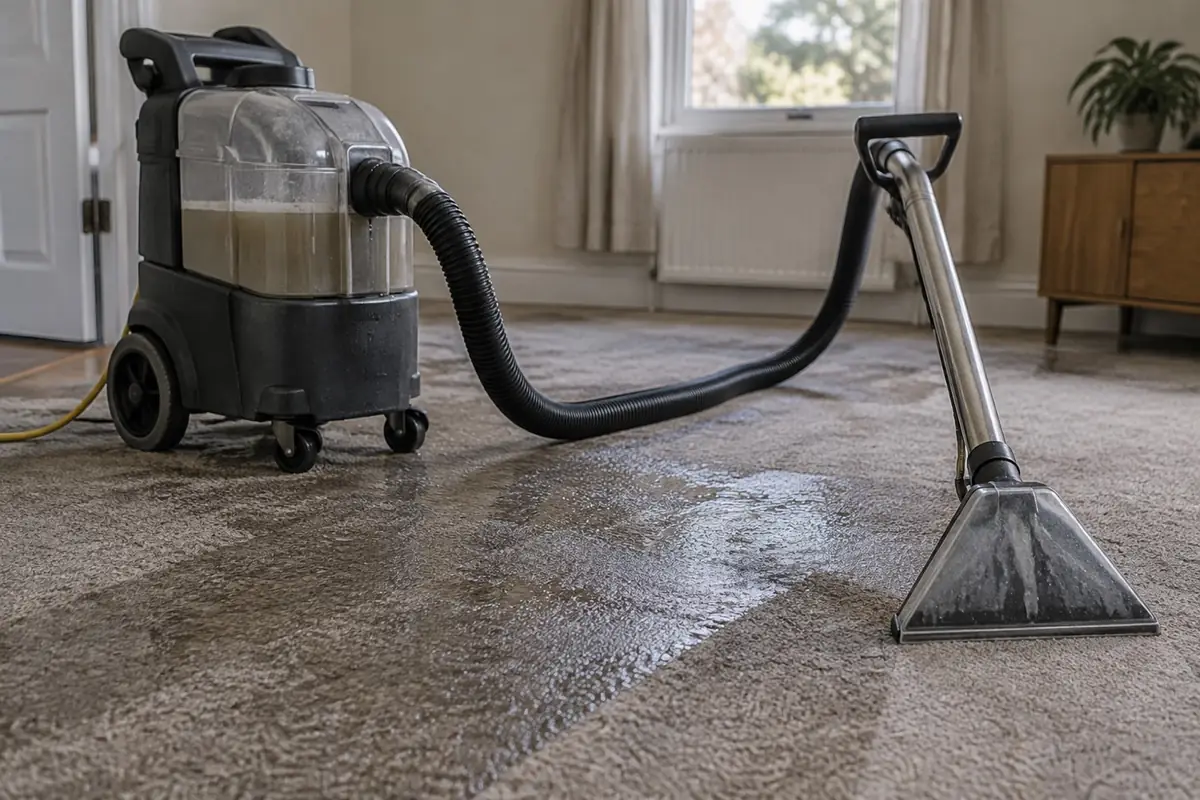
| 2. Extract | Wand or weighted extraction over the whole wet area, repeated passes until the wand stops pulling water. | Removes bulk liquid mechanically. Nothing else in the process is close to this efficient. |
| 3. Lift and remove the pad | Cut the carpet free at the tack strip on one or two edges, roll back, cut the pad into strips, bag and remove. | Opens the subfloor to air and deletes the slowest-drying layer. |
| 4. Float the carpet | Lay the carpet back down and direct an air mover under it so the sheet lifts and air passes across both faces. | Doubles the evaporating surface and dries the deck at the same time. |
| 5. Dehumidify in a closed space | Run a dehumidifier in the same room, doors and windows shut. | Airflow only moves vapour. Something has to remove it from the air or it re-condenses on the coolest surface in the house. |
| 6. Monitor and finish on readings | Daily moisture readings on carpet, pad area and subfloor against the baseline. | Carpet feels dry long before the deck under it is. The subfloor reading ends the job. |
| 7. Re-install and re-stretch | New pad, carpet re-stretched and re-seamed where needed. | A carpet that dried loose and was not re-stretched will ripple. |
Why extraction beats airflow, by a lot
The most common mistake on a do-it-yourself dry is going straight to fans. Evaporation is a phase change, slow and energy-hungry; lifting liquid water with suction is neither. Every litre pulled out with a wand never has to be evaporated into the room air and condensed back out of it.
There is also a large gap between extraction tools. A consumer wet vacuum has a small motor, a small orifice and no weight on the head. A weighted professional tool adds the technician’s body weight to compress the pile and squeeze water up into the airstream, and truck-mounted units go further again. The same carpet extracted properly starts its dry with far less water in it, and finishes days earlier.
The repeat-pass rule
Extraction is not one pass. Water migrates back into the pile from the pad and the backing, so the wand stops, waits and pulls again. On a pad-out job it happens twice: once through carpet and pad to get the bulk out, and again on the bare deck once the pad is gone.
Floating the carpet
Floating means detaching the carpet along an edge and putting an air mover under it so the sheet balloons and air runs across the backing as well as the face. It is the biggest-return move in the process, and the one most home attempts skip because it means pulling the carpet off the tack strip.
| Configuration | Surfaces exposed to moving air | Subfloor drying | Typical use |
|---|---|---|---|
| Fan pointed at the carpet from across the room | Face only, and only where air actually lands | None. The deck is sealed under carpet and pad. | What most people do first. Weakest option. |
| Air movers at floor level, carpet down | Face, along the direction of throw | Minimal | Acceptable only on a small, fast, clean spill with the pad dry. |
| Carpet floated, pad removed | Face and backing, plus the bare subfloor | Direct | Standard practice on a real loss. |
| Carpet removed entirely | Subfloor only | Direct and fastest | Category 3, delaminated carpet, or a floor being replaced anyway. |
Do not float a carpet you intend to keep for weeks
Floating stretches the carpet and stresses the backing. It is a drying position, not a storage position. Carpet left ballooning longer than the dry requires is likelier to delaminate along a seam and to need a full re-stretch afterwards.
The dehumidifier is not optional
Air movers do not dry anything. They accelerate evaporation by breaking the saturated boundary layer sitting on a wet surface, which moves water from the carpet into the room air. If nothing removes it from the room air, the room reaches equilibrium and evaporation slows to nothing. Worse, that vapour finds the coldest surface available and condenses there, which is how a wet living room becomes a damp problem in a wall cavity or a cold bedroom down the hall.
This is why professional drying is done in a closed space. Opening windows helps on a dry cool day and hurts on a humid one, because you are importing vapour. The controlled version is doors shut, dehumidifier running, air movers on wet surfaces, and the humidity in the room deliberately held below the air outside.
Check the subfloor, not the carpet
Carpet feels dry to the hand while the plywood beneath it still holds water, and that mismatch causes most of the jobs that come back. The face fibre is synthetic and releases water fast; the deck absorbs slowly, gives it up slowly, and has been sitting under a saturated pad.
| Material | Meter type | What you are comparing against |
|---|---|---|
| Carpet face and backing | Non-penetrating or pin with carpet probe | A dry area of the same carpet in the same room. |
| Plywood or OSB subfloor | Pin meter set to the wood species scale | An unaffected section of the same deck, same room, same day. |
| Concrete slab | Non-penetrating meter, plus relative humidity probe where the slab will be covered again | An unaffected area of the same slab. Slabs release moisture for a long time. |
| Bottom plate and lower wall | Pin meter behind the baseboard | The same plate in a dry part of the room. |
Water does not stay under the carpet
Check the wall line. Water travels along the deck to the perimeter and wicks up into the bottom plate, the drywall and any insulation in the cavity. A carpet dry that ignores the walls is a partial job, and the wall is often the part that fails later. Our guide to wet drywall and when to cut it covers the height decision and the inspection holes that make it defensible.
DIY against professional, honestly
There is a real DIY case and it has clear edges. A small, clean, recent spill on carpet over a slab, where you can lift an edge, check the pad and get air under it, is a job a homeowner can do. The boundaries are equipment capability and the ability to verify a result.
| Capability | Household kit | Professional kit | Practical effect |
|---|---|---|---|
| Extraction | Consumer wet vacuum, small orifice, no weight | Weighted wand or truck-mounted extraction | Determines how much water has to be evaporated, and therefore how many days the dry takes. |
| Airflow | Box fans and pedestal fans | Centrifugal and axial air movers positioned for surface velocity | Fans move room air. Air movers are aimed to strip the boundary layer off a wet surface. |
| Humidity control | Usually nothing, or a small domestic unit | Refrigerant or desiccant dehumidifier sized to the space | Without this you relocate moisture rather than remove it. |
| Verification | Touch, smell | Pin and non-penetrating meters with a documented dry standard | This is the difference between finishing and stopping. |
| Cavity access | None | Inspection holes, cavity ventilation, thermal imaging to direct where to look | Water at the wall line is invisible without it. |
The honest DIY boundary
- Clean water only, and you know the source with certainty.
- Small area, roughly one room or less, and you got to it the same day.
- You are able and willing to lift an edge and look at the pad and the deck rather than guessing from the top.
- You have or can hire a dehumidifier, not just fans.
- The loss did not reach a wall cavity, cabinetry, or a lower floor.
If this is going through an insurance claim, the calculation changes again. Most policies require reasonable steps to prevent further damage, and a partial dry that later becomes a mould claim is a difficult conversation. Our cost guide sets out how mitigation is priced and what a defensible estimate contains.
How a carpet that dried fine still fails
Two failure modes account for most of the complaints that arrive after a dry that looked successful, and neither is visible on the day the equipment comes out.
Delamination
Tufted carpet has a primary backing holding the tufts and a secondary backing laminated to it. Prolonged wetting and the stress of floating can break that bond. The symptom is a carpet that feels loose or bubbled underfoot, or a backing that peels away in a sheet when an edge is lifted. It is not repairable in place, so checking while the carpet is still up saves doing the job twice.
Shrinkage and the re-stretch
Some carpets, particularly older ones with jute or other natural secondary backings, shrink as they dry, so the carpet no longer reaches the tack strip it came off. Synthetic-backed carpet usually behaves, but any floated carpet needs re-stretching with a power stretcher when it goes back down. Laid back loose it will ripple within weeks, and the ripples are permanent once walked on.
Odour, which is usually the pad talking
A musty smell after a dry almost always traces to material left in: the pad, a tack strip, or the deck under a spot that never got airflow. Deodorising a carpet whose pad was saved treats a symptom. If odour persists after a documented dry, lift and look rather than spray.
Carpet and pad types change the odds
Construction underneath matters more than the look on top.
| Construction | Drying behaviour | Salvage odds on Category 1 |
|---|---|---|
| Synthetic cut pile over bonded urethane pad | Face dries readily once floated. Pad is the constraint. | Good, with prompt pad removal. |
| Wool or wool-blend | Natural fibre absorbs into the fibre itself, dries slower, and can shrink or distort. | Moderate. Slower dry and a higher chance of dimensional change. |
| Berber or loop pile | Dense low loops hold water and resist extraction passes. | Moderate. Expect more extraction passes. |
| Carpet tile with attached cushion | Cushion is bonded to each tile, so it cannot be separated. | Poor beyond a small clean spill. Usually replaced tile by tile. |
| Glued-down commercial carpet, no pad | No cushion layer, but the adhesive bed traps water against the slab. | Variable. Adhesive condition governs it more than the carpet does. |
| Any carpet over a rubber slab or waffle pad | Closed or semi-closed cell holds water at the deck and blocks vapour movement. | Poor. Pad removal is effectively mandatory. |
The decision, on one page
Four questions settle almost every wet carpet, in this order.
- What was the water? Category 3 ends the discussion. Category 2 means the pad goes and the carpet is assessed. Category 1 opens the full save option.
- How long has it been wet? Under 48 hours on clean water is the strong case. Past roughly 72 hours, treat it as contaminated regardless of source.
- Can you get air to both faces and the deck? If the pad cannot come out, or the carpet cannot be floated, the honest answer is that you are not drying it, you are waiting.
- What do the meters say about the subfloor? Not the carpet. The deck reading against an unaffected baseline is what finishes the job.
Where the loss ran past the carpet into walls, cabinetry or a wood floor, the carpet is no longer the hard part. Our companion guides on wet drywall and hardwood floor water damage cover those materials, and they answer the same underlying question: dry in place, or remove. Our methodology sets out how we source and label everything on this site.
Questions people actually ask
Can wet carpet be saved?
Usually yes on clean water caught within about 48 hours, provided the pad is removed, the carpet is floated over an air mover and a dehumidifier runs in the same closed room. On grey water the carpet is a case-by-case call. On black water it is removed.
Do I have to replace the carpet pad?
On anything beyond a small clean spill, yes. Bonded urethane pad is open-celled, sits flat against the subfloor and is the cheapest part of the assembly. Drying it in place takes extra equipment days, blocks airflow to the deck and cannot be verified without lifting it anyway.
How long does wet carpet take to dry?
A contained clean-water loss with the pad removed and equipment correctly placed typically runs three to five days, governed by the subfloor rather than the carpet. Drying is finished when the deck matches a documented dry standard taken from unaffected material, not when a set number of days has passed.
Will fans alone dry my carpet?
No. Air movers increase evaporation, which moves water from the carpet into the room air. Without a dehumidifier removing it from that air, the room reaches equilibrium, evaporation stalls and the vapour condenses on the coldest surface it can find.
Is a wet vac enough, or do I need professional extraction?
A consumer wet vacuum will remove useful volume from a small fresh spill. A weighted professional wand or a truck-mounted unit removes substantially more, which directly shortens the dry because every litre lifted mechanically is a litre that never has to be evaporated and condensed out again.
What is delamination and how do I know if it happened?
Delamination is the secondary backing separating from the primary backing that holds the tufts. The carpet feels loose or bubbled underfoot, or the backing peels away in a sheet when an edge is lifted. It is not repairable in place, so it is worth checking while the carpet is still up and before a new pad goes down.
Does the carpet need re-stretching after it dries?
Yes, if it was floated or detached from the tack strip. Carpet laid back loose ripples within weeks and those ripples become permanent once walked on. Some carpets, especially older ones with natural secondary backings, also shrink as they dry and will not reach the strip without a power stretcher.
Sources
- Institute of Inspection, Cleaning and Restoration Certification, ANSI/IICRC S500 Standard for Professional Water Damage Restoration, 5th edition, 2021. Water categories, the porous material removal principle, and the dry standard measured against unaffected material. Sold by IICRC; we describe its framework rather than reproduce it.
- EPA mold cleanup guidance. United States Environmental Protection Agency, on drying wet materials within 24 to 48 hours and on moisture control as the controlling factor in mould growth. Retrieved 23 September 2026.
- Carpet assembly and construction descriptions reflect standard tufted carpet manufacture: face fibre, primary backing, laminated secondary backing, and a separate cushion layer.
- Timing thresholds, salvage odds and equipment comparisons here are indicative field practice compiled from the sources above, not the output of a controlled drying trial. No such trial was conducted.