The short answer
A Tyvek biohazard suit has published US viral penetration data only in the Tyvek 800 grade with taped seams: DuPont lists ASTM F1670 and F1671 passes for it and for taped Tychem, not for Tyvek 400, 500 or 600. Tyvek 400 is a particle and light splash suit that DuPont calls not appropriate once it is getting wet.
Which Tyvek and Tychem suits have published F1670 and F1671 results?
Three of the nine hooded styles below do. The name is retail language: the DuPont biological hazard page heads its viral section “Tychem Biohazard Suits” and titles the Tyvek section “Hazardous Remediation and Modesty Garments”. We read each style’s DuPont product page and cross-checked the DuPont SafeSPEC product filter, which tags Tyvek 800, Tychem 2000 and Tychem 4000 for both ASTM methods and Tyvek 400, 500 and 600 for neither.
| Suit and style | Seam | ASTM F1670 and F1671 | EN 14126 (Europe) | Liquid figure or barrier | Fabric weight |
|---|---|---|---|---|---|
| Tyvek 400, TY127S page | Serged | None listed | None listed | Water head 45 in (AATCC 127) | 1.2 oz/yd2, 5.9 mil |
| Tyvek 500, TY198S page | Serged, external | None listed | Yes: ISO 16603 Class 3, ISO 16604 Class 2 | Water head 48 in (AATCC 127) | 41.5 g/m2 |
| Tyvek 600, TY198T page | Serged and over-taped | None listed | Yes: ISO 16603 named; ISO 16604 not named in the feature list | Water head 48 in (AATCC 127) | 41.5 g/m2 |
| Tyvek 800, TJ198T page | Taped | Passes both | Yes: ISO 16603 and ISO 16604 | Over 25 kPa (DIN EN 20811) | 59 g/m2 |
| Tychem 2000, QC127S page | Serged | Not claimed on this page | None listed | Tyvek coated with 1.25 mil polyethylene | 2.5 oz/yd2, 10 mil |
| Tychem 2000, QC127B page | Bound | Not claimed on this page | None listed | Tyvek coated with 1.25 mil polyethylene | 2.5 oz/yd2, 10 mil |
| Tychem 2000, QC127T page | Taped | Passes both | None listed | Tyvek coated with 1.25 mil polyethylene | 2.5 oz/yd2, 10 mil |
| Tychem 4000, SL127B page | Bound | Not claimed on this page | None listed | Barrier film laminated to Tyvek | 3.6 oz/yd2, 12 mil |
| Tychem 4000, SL127T page | Taped | Passes both | None listed | Barrier film laminated to Tyvek | 3.6 oz/yd2, 12 mil |
Read the third column against the second. Tychem 2000 is one fabric sold with three seams, and only the taped QC127T page carries the line “Meets the U.S. industry requirements for blood (ASTM F1670) and viral penetration (ASTM F1671)”. The DuPont Tychem 2000 overview sheet limits the claim the same way, to “fabrics with taped seams”, and the DuPont Tyvek 800 overview sheet says the same of Tyvek 800.
Tyvek 500 and 600 sit in a gap most retail pages blur. Both carry the European infective agent claim under EN 14126, and DuPont’s summary lines mention bloodborne pathogens, yet neither is tagged for the US methods. The 600 page is also inconsistent inside itself: its feature list names ISO 16603 only, while SafeSPEC files it under a combined “ISO 16603 / 16604” tag. Ask DuPont for the class report before relying on a viral result for that grade.
Why does the seam decide whether a suit counts?
Because the fabric is rarely the weak point. The DuPont technical paper on bloodborne pathogens says seams and closures “generally offer less barrier protection than the fabric” and are typically left out of the test specimen, so it tells buyers to request seam data under ASTM F1671 from the supplier. ASTM F1671 itself covers “materials or certain material constructions (for example, seams)” and does not address “design, overall construction and components, or interfaces” of garments.
The practical check takes one letter. DuPont style codes end in the seam: TY127S is serged, QC127B is bound, QC127T is taped, per the part listings on its product pages. A listing that says “Tychem 2000” without that final letter has not told you the thing that controls the viral claim. DuPont also warns on the TY127S page that serged and bound seams are degraded by some hazardous liquids, naming strong acids.
Is Tyvek 400 ever the right suit around blood?
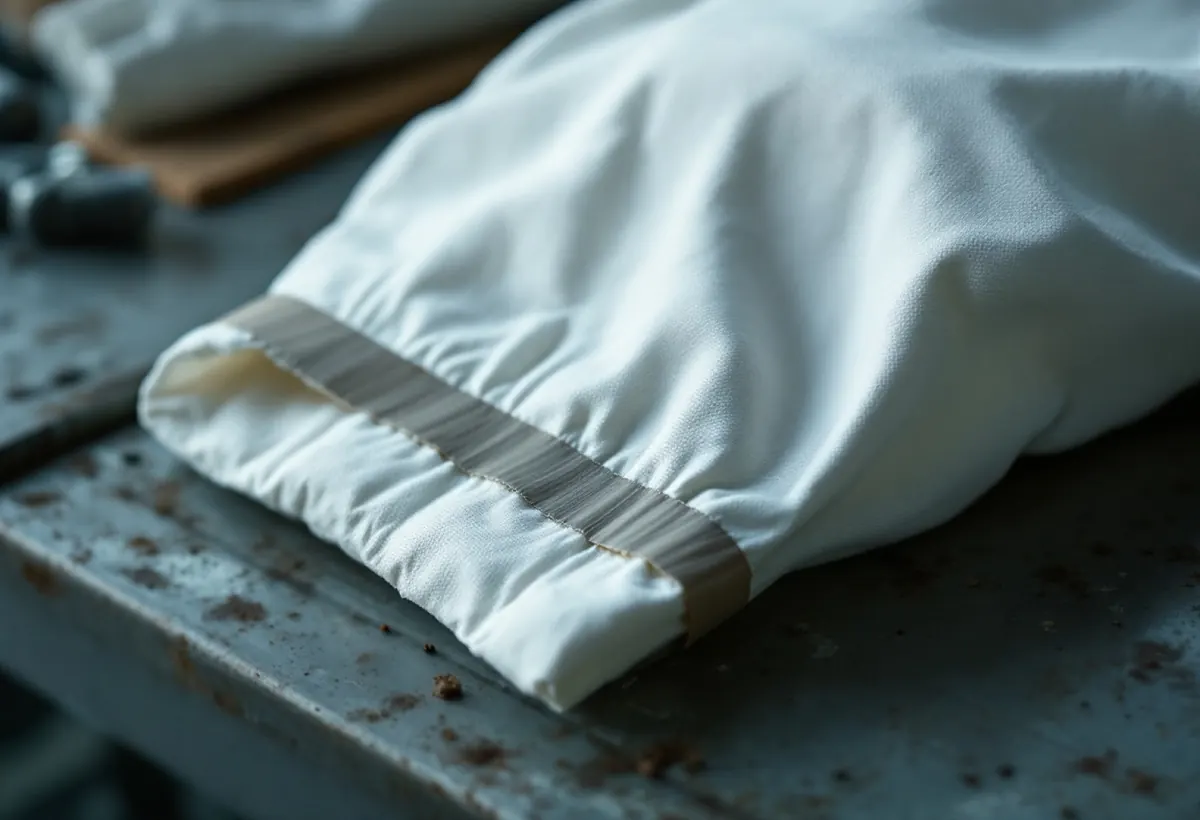
Yes, for dry or light contact, with a hard stop. The DuPont biological hazard page says Tyvek 400 coveralls “may be suitable for hazardous remediation, crime scene investigation, or as a modesty garment”. The TY127S page sets the stop: not appropriate if liquid is dripping or running, the suit is wet to the touch, or spotting shows on skin or clothes underneath.
The DuPont technical paper on bloodborne pathogens, dated 2014, gives the one number that sizes this: Tyvek fabric blocked synthetic blood at 2 kPa (0.3 psi), which DuPont calls “some degree of protection”. The same paper says that if moderate to large volumes of body fluid are expected, taped Tychem should be considered. That text sorts tasks roughly this way, with the employer’s hazard assessment under 29 CFR 1910.132(d) still deciding, and the job steps themselves live on our page on biohazard cleanup.
- Tyvek 400 territory: dry particulate, bagging items with no free liquid, supervision outside the wet zone. DuPont rates the fabric as a barrier to particles down to 1.0 micron.
- Taped Tyvek 800 or taped Tychem territory: saturated carpet or mattresses, kneeling or leaning on wet material, cutting out soaked subfloor. DuPont names kneeling in a pool of liquid as a case that can exceed the 2 psi test.
- Any grade: under 1910.1030(d)(3)(vi), a penetrated garment comes off immediately or as soon as feasible.
Scene work itself, from scoping to waste, belongs to crime scene cleanup.
What does a pass at 13.8 kPa prove, and what can it not prove?
It proves a material specimen kept a virus surrogate out under set lab conditions. ASTM F1671 pressurizes the cell to 13.8 kPa (2 psig) and uses Phi-X174 bacteriophage in a liquid adjusted to the low end of the surface tension range for blood and body fluids, 0.042 to 0.060 N/m. F1670 is the synthetic blood screen that comes first, and materials passing it “should then be tested” under F1671. A pass on F1670 alone is not a viral result.
It does not prove field safety. ASTM F1671 notes that some studies suggest mechanical pressures above 345 kPa (50 psig) during clinical use, 25 times the test pressure by our arithmetic, and says the method “does not simulate all the physical stresses” on clothing. The DuPont technical paper on bloodborne pathogens is blunter: it calls 2 psi an arbitrary value and says a garment that passes may not provide an adequate viral barrier in all conditions. ASTM also limits inference to Hepatitis B, Hepatitis C and HIV, with other pathogens assessed case by case.
Tyvek 400 vs 600: what does the extra $2.49 a suit buy?
Sealed seams and a European bio claim, on nearly the same fabric weight. At 2X, per the Enviro Safety Products listings, the TY127S is $187.89 per 25 and the Enviro Safety Products TY198T is $250.19 per 25, a $2.49 gap per suit by our arithmetic. DuPont’s own figures put the fabrics close: 1.2 oz/yd2 for 400 and 41.5 g/m2 for 600, which converts to 1.2 oz/yd2, with water head of 45 and 48 inches.
The difference is construction and rating. Per the TY198T page, the 600 is a Type 4, 5 and 6 garment with serged and over-taped seams, a self-adhesive chin flap and thumb loops, while the 400 has no Type rating listed on its US page and serged seams. DuPont still says the 500 and 600 “may not be appropriate if spotting is observed”, and points to taped Tychem 2000 or 4000 for a higher liquid barrier. A 600 is a better splash suit, not a viral-rated one in the US sense.
Tychem 2000 vs Tyvek 800: which for heavy fluids and disinfectant?
Both pass the same two tests, so comfort and chemistry decide. The DuPont Tyvek 800 overview sheet says Tyvek 800 sits between Tyvek 600 and serged Tychem 2000, and that it offers comfort advantages over Tychem 2000 from weight and water vapor permeability. By weight the gap is 59 g/m2 against 2.5 oz/yd2, about 85 g/m2 by our conversion. Tychem 2000’s stated job is different: the DuPont Tychem 2000 overview sheet claims at least 30 minutes against more than 40 chemical challenges, and the SL127T page claims more than 124 for Tychem 4000.
Disinfectant is the question nobody selling these suits answers, and it matters on this work. DuPont publishes normalized breakthrough times per fabric, and alcohol or peroxide can break through in under 10 minutes on a fabric that passes the blood test.
| Fabric | Sodium hypochlorite 5.25% to 6% | Isopropyl alcohol 70% | Hydrogen peroxide |
|---|---|---|---|
| Tyvek 500 and 600 | Over 480 min | Not listed | Under 10 min at 30% |
| Tyvek 800 | Over 480 min | Under 10 min | Not listed |
| Tychem 2000 | Over 480 min | Under 10 min | Over 480 min at 30% |
| Tychem 4000 | Over 480 min at 15% | Over 480 min | Over 480 min at 30% |
Tychem 4000 is the outlier on that table. If a scope calls for repeated alcohol contact, match the disinfectant named on the job against the fabric on SafeSPEC before buying a case. The same fabric question comes up on a different exposure in sewage damage cleanup.
Which OSHA rule applies: 1910.1030 or Levels A to D?
For blood, 29 CFR 1910.1030, and it never names a fabric. Paragraph (d)(3)(i) makes PPE “appropriate” only if it does not let blood or other potentially infectious materials reach work clothes, skin, eyes or mouth “under normal conditions of use and for the duration of time” it is used, and the employer provides it at no cost. Paragraph (d)(3)(xi) says the type depends on “the task and degree of exposure anticipated”, and (d)(3)(xii) adds hoods or shoe covers when gross contamination can be anticipated.
So a listing saying “OSHA compliant” is not a spec. The DuPont technical paper on bloodborne pathogens says the rule mandates no specific test and that no garment satisfies it in all situations. DuPont’s softer DuPont SafeSPEC FAQ wording is that Tyvek and all Tychem garments “could be considered” under 1910.1030. The materials the rule reaches start with the question of what is a biohazard.
Levels A to D come from a different rule. 29 CFR 1910.120(a)(1) covers five operations: government-required cleanup at uncontrolled hazardous waste sites, RCRA corrective actions, voluntary cleanup at recognized sites, treatment, storage and disposal facilities, and emergency response to hazardous substance releases. Appendix B to 1910.120 describes the ensembles, from a totally encapsulating suit with SCBA or supplied air at Level A to coveralls and safety glasses where no known hazard exists at Level D. SafeSPEC tags Tyvek 400, Tyvek 600, Tychem 2000 and Tychem 4000 for Levels C and D, and shows no Level tag on Tyvek 800. Those letters rank skin and respiratory protection against chemical hazards, not blood barrier, and they are unrelated to laboratory biohazard levels.
What does each suit cost per suit in published listings?
Per the listings below, taped Tyvek 800 runs about 1.5 to 1.9 times a Tyvek 400 per suit at 2X in the Enviro Safety Products and Gorvex, and taped Tychem 4000 reaches $48.83 per suit at Gorvex. Case prices rise with size, so the table holds size constant.
| Style and size | Per case | Case price | Per suit | Seller |
|---|---|---|---|---|
| Tyvek 400 TY127S, 2X | 25 | $187.89 | $7.52 | Enviro Safety Products |
| Tyvek 600 TY198T, 2X | 25 | $250.19 | $10.01 | Enviro Safety Products |
| Tyvek 800 TJ198T, 2X | 25 | $281.09 | $11.24 | Enviro Safety Products |
| Tyvek 800 TJ198T, 2XL | 25 | $348.17 | $13.93 | Gorvex |
| Tychem 4000 SL127T, 2XL | 6 | $292.98 | $48.83 | Gorvex |
| Tychem 2000 QC127T, 2XL | 4 | CAD 227.95 | CAD 56.99 | Hansler Smith (Canada) |
Kits hide the grade. Per the Arrowhead Forensics listing, its Standard Biohazard Kit is $25.05 with “Tyvek suit with hood and boots”, 13 mil gloves, a KN95, towelettes and a 10 gallon bag, and the listing does not state which Tyvek grade or seam the suit uses. Ask before treating any kit as more than the Tyvek 400 line of the table above.
For contractors: five things to get from the supplier before buying a case
- The full style code, including the seam letter. QC127S and QC127T are different answers to the F1671 question.
- F1671 seam data, in writing. DuPont’s own paper tells end users to request it, because fabric results may not describe the seam.
- The breakthrough time for your disinfectant, by concentration, from SafeSPEC. A 70% isopropyl wipe and a 5.25% bleach solution give opposite results on Tychem 2000, per the QC127T table.
- Fire exposure. DuPont warns Tyvek 400, 500, 600 and 800 will burn and possibly melt and should not be worn near heat, open flames, sparks or any ignition source.
- The rest of the ensemble. 1910.1030(d)(3)(x) requires masks with eye protection or chin-length face shields when splash or spray is anticipated, and gloves under (d)(3)(ix). A suit alone satisfies neither, and it is no respirator.
DuPont also lists asbestos abatement as a Tyvek 400 application, for particles rather than liquid, and the breathing side of that work is the respirator for asbestos removal. Other rule explainers sit on the standards hub.
Questions people actually ask
Is a Tyvek suit waterproof?
Not in the sense a rain suit is. DuPont rates Tyvek 400 at 45 inches of water head under AATCC 127 and says it is not appropriate once liquid is dripping or it feels wet. Tyvek 800 reports over 25 kPa (more than 100 inches), and DuPont calls it liquid tight against pressurized spray. Seams and the zipper remain the likely entry points.
Can you wash and reuse a Tyvek suit after biohazard work?
DuPont describes Tyvek 400 as a limited use fabric, and its caution tells users to stop wearing a garment that is torn, worn or punctured. Under 29 CFR 1910.1030(d)(3)(vii) and (viii), PPE comes off before leaving the work area and goes in a designated container for storage, washing, decontamination or disposal. DuPont publishes no wash-and-reuse barrier data on the pages reviewed.
What do crime scene cleaners wear?
OSHA’s 29 CFR 1910.1030 sets the categories, not a brand: gloves, a protective body garment, masks with eye protection, and hoods or shoe covers where gross contamination is expected. DuPont lists crime scene investigation and cleanup as a biological hazard application and offers Tychem 2000 with taped seams for viral protection. Grade selection follows the employer’s assessment under 1910.132(d).
Is a Tyvek suit flame resistant?
No. DuPont states garments made of Tyvek 400, 500, 600 and 800 will burn and possibly melt, and that melting can increase burn severity even when worn over flame resistant clothing. A Class 1 result under 16 CFR 1610 is a wearing apparel flammability rating and does not make the suit flame resistant. Tychem 2000 SFR and Tyvek 400 SFR are separate DuPont lines sold under its secondary flame resistant protection range.
What size Tyvek suit should I order?
Go by chest and height, not your shirt size. DuPont’s TY127S chart fits a 42 3/4 to 46 1/4 inch chest and 5 ft 8 in to 6 ft 2 in height at XL, and a 45 1/4 to 48 3/4 inch chest and 6 ft to 6 ft 4 in at 2X. Taped styles run smaller ranges in places: QC127T stops at 5X where QC127S reaches 7X.
Does a Tyvek suit stop airborne particles?
DuPont states Tyvek 400, 500, 600 and 800 fabrics are a barrier to particles down to 1.0 micron in size, and lists lead and asbestos abatement among Tyvek 400 applications. That figure describes the fabric, not leakage at the zipper, wrists or face opening, and it says nothing about inhalation. DuPont’s TY127S page tells users to add respiratory, eye, head, hand and foot protection per the hazard assessment.
Sources
- DuPont biological hazard page, DuPont Personal Protection, Biohazard PPE and Suits. Retrieved 2 November 2026.
- DuPont technical paper on bloodborne pathogens, DuPont, Protective Clothing and Bloodborne Pathogens, H-93124-3 (09/14). Retrieved 2 November 2026.
- DuPont SafeSPEC FAQ and DuPont SafeSPEC product filter: bloodborne pathogen filter tags by fabric, DuPont. Retrieved 2 November 2026.
- DuPont Tyvek 800 overview sheet and DuPont Tychem 2000 overview sheet, DuPont, dated 0726 in the file name, hosted by distributors. Retrieved 2 November 2026.
- DuPont product pages: TY127S page, TY198S page, TY198T page, TJ198T page, QC127S page, QC127B page, QC127T page, SL127B page, SL127T page: seam, physical properties, permeation tables and warnings. Retrieved 2 November 2026.
- ASTM F1671/F1671M-22, ASTM International, scope and significance sections. Retrieved 2 November 2026.
- 29 CFR 1910.1030, Bloodborne pathogens; 29 CFR 1910.132(d), hazard assessment; 29 CFR 1910.120(a)(1), HAZWOPER scope; Appendix B to 1910.120, levels of protection. OSHA. Retrieved 2 November 2026.
- Prices: Enviro Safety Products (TY127S), Enviro Safety Products (TY198T), Enviro Safety Products (TJ198T), Gorvex (TJ198T), Gorvex (SL127T), Hansler Smith (Canada) (QC127T, CAD), Arrowhead Forensics (kit A-4501). Retrieved 2 November 2026.
- Per-suit figures, unit conversions and ratios are our arithmetic on the figures above. We did not test any garment. Our methodology sets out the standing rules. Tyvek, Tychem and SafeSPEC are trademarks of DuPont affiliates; this page is not affiliated with DuPont.
Garment selection is the employer’s duty under 29 CFR 1910.132(d), and DuPont revises its data. Confirm the current style, seam and test report with the supplier and with DuPont’s SafeSPEC before use.