The short answer
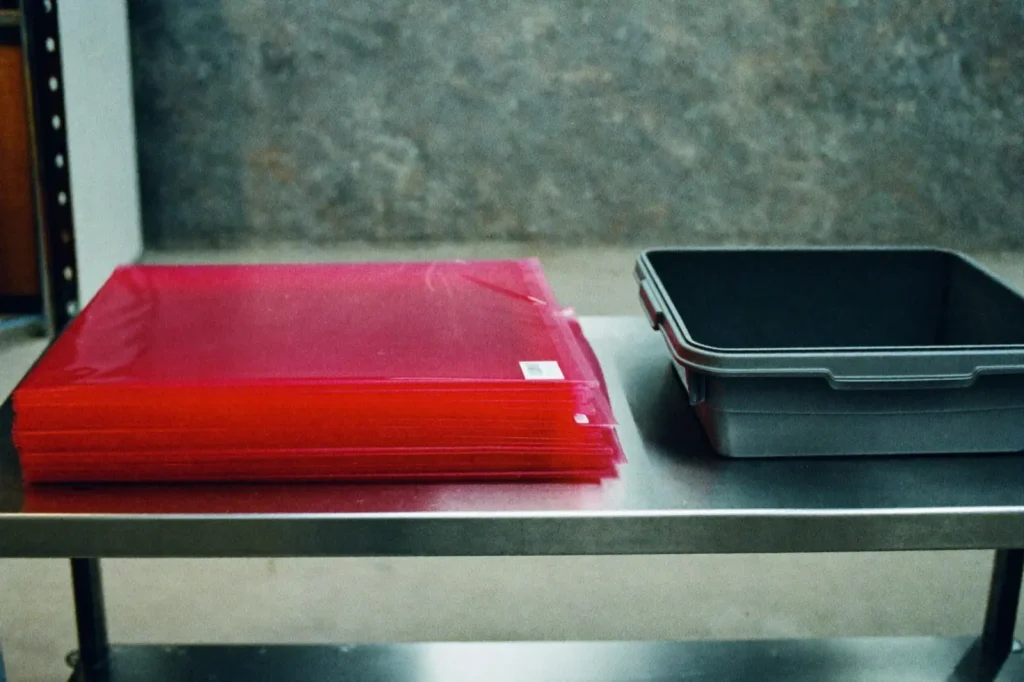
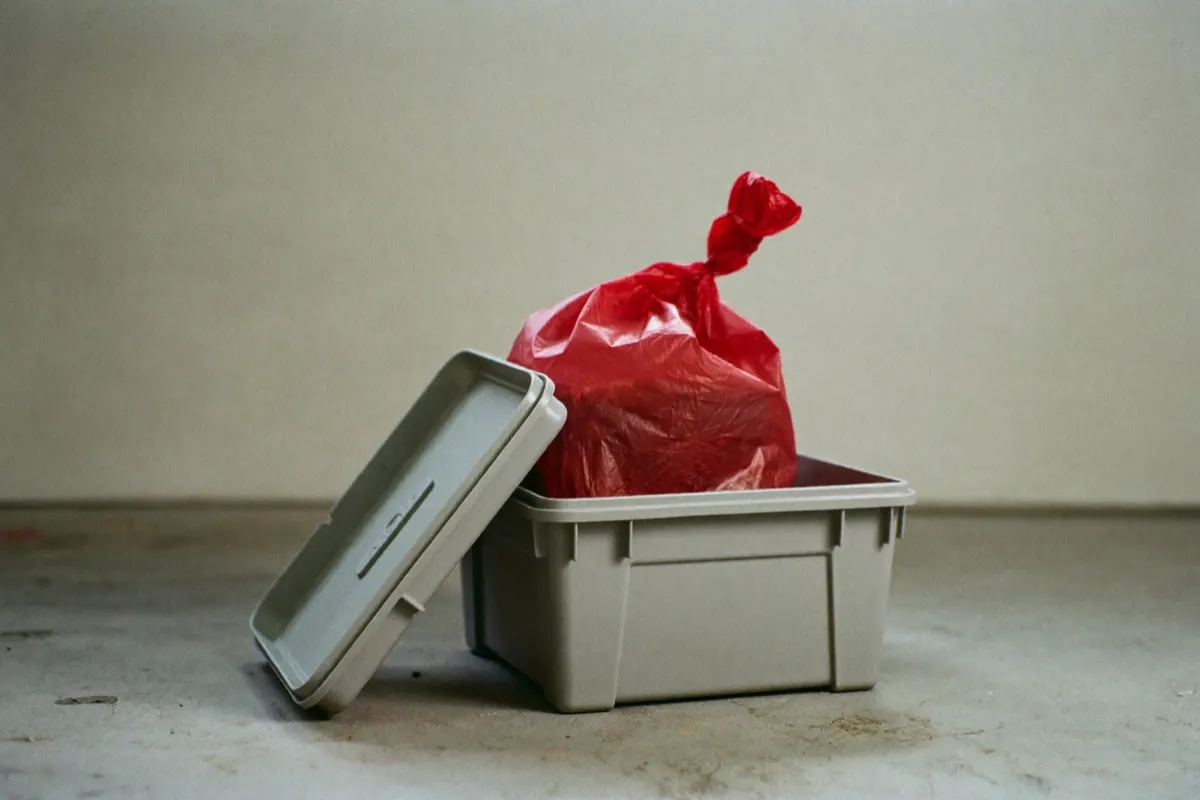
Biohazard bags are red, closable plastic bags for regulated medical waste, and a compliant bag passes two lab tests rather than a thickness: 165 grams on the ASTM D1709 dart drop and 480 grams on the ASTM D1922 tear test, the figures in 49 CFR 173.197 and California and Florida law. OSHA accepts a red bag in place of a biohazard label.
What is the legal spec for a biohazard bag? 165 g impact, 480 g tear
The federal numbers sit in the DOT hazardous materials rules. 49 CFR 173.197 paragraph (e)(1)(i) says a plastic film bag used as an inner packaging for solid regulated medical waste must be marked and certified by its manufacturer as passing ASTM D1922, the pendulum tear test, and ASTM D1709, the free-falling dart impact test, with “an impact resistance of 165 grams and a tearing resistance of 480 grams in both the parallel and perpendicular planes” relative to the bag’s length.
The same paragraph caps the bag at 175 L (46 gallons), and paragraph (e)(1)(iii) limits a filled bag to 10 kg (22 lb) when it rides in a wheeled cart or bulk outer packaging, per the eCFR text. Liquids are a different packaging: paragraph (e)(2) requires a rigid inner packaging, so a bag of free liquid is never the compliant answer.
California HSC 117630 copies the 165 g and 480 g figures into state law and adds a split: a bag used only inside the facility needs manufacturer certification to ASTM D1709 alone, while a bag lining a USDOT approved container headed for the road must be certified to both D1709 and D1922. Florida’s Florida rule 64E-16.004 names the test editions, ASTM D-1709-91 and D-1922-89, and caps lead, mercury, hexavalent chromium and cadmium in the bag dye at 100 ppm combined.
Does mil thickness tell you whether a red bag is legal?
No. Neither 49 CFR 173.197 nor California HSC 117630 nor Florida 64E-16.004 sets a thickness; each sets a dart impact mass in grams and a tear resistance in grams. A thick bag made from a brittle resin can fail the dart, and a thin bag of a tougher film can pass both tests, which is why the rules measure performance and not gauge.
The MicroCare Pro Tector technical bulletin, revision 05/22, is a published example: its red infectious waste bags are listed at 1.3 mil and as meeting 165 g on ASTM D1709 and 480 g on ASTM D1922, in 10, 12 and 25 gallon sizes. The same bulletin warns against using the bag as the primary container for sharps, which matches the OSHA rule that sharps go in puncture resistant containers.
What to ask a supplier, in order: does the carton or spec sheet state ASTM D1709 at 165 g and ASTM D1922 at 480 g; is the bag marked and certified by the manufacturer, as 49 CFR 173.197(e)(1)(i) requires for cart and box liners; and does the print include the symbol and wording your state names. A listing that only quotes mil or microns answers none of the three.
Biohazard bag requirements in 7 jurisdictions, with citations
Search results for this keyword are mostly supplier listings and study guides that quote 165 and 480 without saying whose rule they come from. The table below reads each rule directly; a cell reading not set means the text is silent, as of 8 November 2026.
| Jurisdiction | Rule | Colour | Strength test | Closure and marking |
|---|---|---|---|---|
| Federal, OSHA | 29 CFR 1910.1030 (d)(4)(iii)(B), (g)(1)(i) | Red, or any colour with a label | No numeric test | Closable, contains contents, closed before removal |
| Federal, DOT | 49 CFR 173.197 (e)(1) | Not set | 165 g D1709, 480 g D1922, both planes | Max 175 L; no leak inverted 5 min |
| California | California HSC 117630; HSC 118280 | Red; yellow for trace chemo; white for pathology | D1709 inside; D1709 and D1922 for transport | Tied; rigid container labelled BIOHAZARD on lid and sides |
| Florida | Florida rule 64E-16.004; 64E-16.005 | Red, impermeable | 165 g D-1709-91, 480 g D-1922-89 | Symbol 6 in on bags 19 x 14 in or larger; generator name and address |
| New York | 10 NYCRR 70-2.2 (b), (d)(1) | Red plastic | Strong enough to resist ripping, tearing or bursting | Universal sign or the word biohazard; name and address before transport |
| New Jersey | N.J.A.C. 7:26-3A.11 | Not set | Sufficiently strong to prevent tearing or bursting | Rigid, leak resistant, sealed; biohazard bags presumed regulated waste |
| Texas | 30 TAC 326.19 | Not set | Defers to 49 CFR 173.134 | Rigid outer container, sealed, impervious to moisture |
Two quirks matter in practice. New Jersey’s N.J.A.C. 7:26-3A.11 paragraph (f) presumes that any waste in a bag labelled Biohazard or carrying the symbol is potentially infectious and must be managed as regulated medical waste, so using red bags for ordinary trash turns it into regulated waste. Texas’s 30 TAC 326.19, effective 26 May 2016, writes no bag spec of its own and points the outer container to the DOT rules in 49 CFR 173.134 and 173.196.
Symbol size and colour on the print, from 1 inch on small Florida bags to 6 inch DOT markings, are covered on our biohazard symbol page.
Red, yellow, white, black or clear: who assigns each bag colour?
Colour codes online present yellow, black and blue as if they were federal law. Only red is written into the rules read for this page, and yellow means two different things depending on who is talking: California HSC 117630 uses it for trace chemotherapy waste, while the NIH Rocky Mountain Laboratories waste guide puts radioactive waste in yellow bags.
| Bag colour | What goes in it | Who says so | Conflict or condition |
|---|---|---|---|
| Red | Regulated medical waste; OSHA lets red replace the label | 29 CFR 1910.1030 (g)(1)(i)(E); California HSC 117630; 10 NYCRR 70-2.2; Florida rule 64E-16.004 | Required by CA, NY and FL |
| Yellow | Trace chemotherapy waste in California | California HSC 117630 (c) | NIH Rocky Mountain Labs uses yellow for radioactive waste |
| White | Pathology waste in California | California HSC 117630 (c) | Container also labelled Pathology Waste or PATH |
| Black or brown | Non-biohazard lab waste at NIH Rocky Mountain Labs | NIH Rocky Mountain Laboratories waste guide | No statute read here assigns black |
| Clear | General refuse; outer bag after autoclaving at NIH Rocky Mountain Labs | NIH Rocky Mountain Laboratories waste guide | Under OSHA a clear bag of regulated waste needs a label |
California pairs colour with words on the outer container. HSC 118275 requires “Chemotherapy Waste” or “CHEMO” on the lid and sides for trace chemo containers, “Pathology Waste” or “PATH” for pathology waste, and “HIGH HEAT” or “INCINERATION ONLY” for pharmaceutical waste regulated as medical waste. A yellow bag without that container label is not compliant there.
How must a full biohazard bag be closed, boxed and labelled for pickup?
OSHA sets the floor in 29 CFR 1910.1030 paragraph (d)(4)(iii)(B): the container must be closable, built to contain all contents and prevent leakage, labelled or colour coded, and closed before removal, and a second container is required if the outside of the first is contaminated. The DOT, state and labelling layers stack on top of that.
California’s HSC 118280 subdivision (a) says bags “shall be tied to prevent leakage or expulsion of contents” and then go into a rigid container with tight fitting covers. DOT’s 49 CFR 173.197 paragraph (e)(1)(ii) asks for closure with a minimum of entrapped air and a bag that can be held upside down for 5 minutes without leaking. Florida’s 64E-16.005 puts the generator’s name and address on each bag unless treatment happens on site.
Small loads can skip some of this. 49 CFR 173.134 paragraph (c)(1) excepts regulated medical waste moved by a private or contract carrier from the INFECTIOUS SUBSTANCE label when the outer packaging carries the OSHA BIOHAZARD marking, and from the 173.197 packaging rules when it is in a rigid non-bulk packaging meeting 173.24, 173.24a and the OSHA standard. Regulated medical waste ships as UN3291 under the same section. Hauler choice and treatment are covered in biohazard waste disposal.
How long can a filled red bag sit before pickup? 24 hours to 90 days
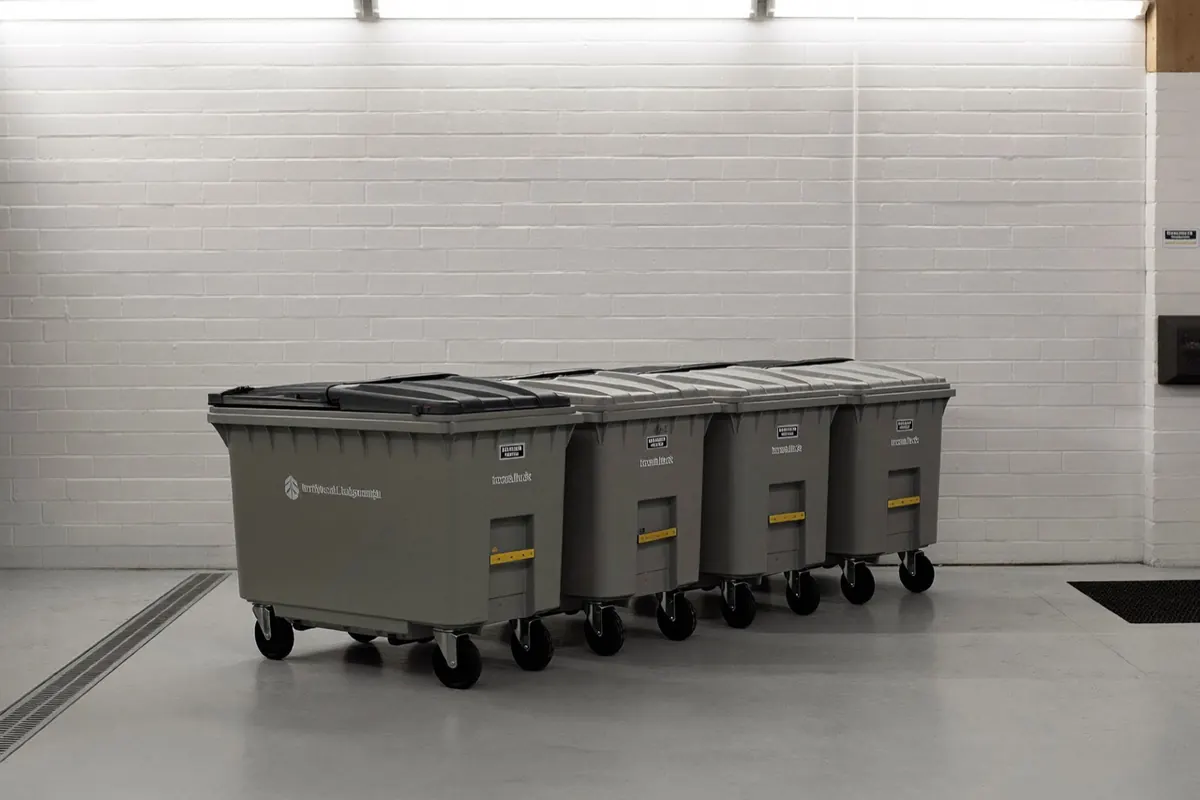
Hold time is a state rule, and the clocks differ. 10 NYCRR 70-2.2 paragraph (f) lets non-sharps waste stay in a patient care area for no more than 24 hours and in a clinical laboratory for 72 hours before it moves to storage, where paragraph (g)(3) allows 30 days, or 60 days for a site generating under 50 pounds a month that accepts no outside waste.
California’s HSC 118280 subdivision (e) ties the limit to volume and temperature: 7 days above 0 C for generators of 20 pounds or more a month, 30 days for smaller generators, and 90 days when the waste is kept at or below 0 C. Florida’s Florida rule 64E-16.004 starts a 30 day clock when the first non-sharps item goes into a red bag, not when the bag is full.
What goes in a red bag on a cleanup job, and what never does?
The OSHA definition in 29 CFR 1910.1030 paragraph (b) decides it. Regulated waste means liquid or semi-liquid blood or other potentially infectious materials, items that would release them if compressed, items caked with dried material that could release it during handling, contaminated sharps, and pathological and microbiological wastes. Carpet pad that drips when squeezed qualifies; a dry, lightly spotted wipe may not.
Three things stay out of the bag. Sharps go into closable, puncture resistant, leakproof containers under paragraph (d)(4)(iii)(A). Free fluids above 20 cubic centimetres need break-resistant, tightly lidded containers under N.J.A.C. 7:26-3A.11 paragraph (c)2, and DOT 173.197(e)(2) also requires rigid packaging for liquids. Ordinary trash stays out because, in New Jersey at least, a biohazard bag makes its contents regulated waste by presumption.
Weight is the last limit. The NIH Rocky Mountain Laboratories waste guide asks labs to keep biohazard bags to about 25 lb, and DOT caps a bag riding in a cart at 10 kg (22 lb). The PPE worn while filling bags is compared on our Tyvek suit page.
For contractors
On a trauma or unattended death job, the cleanup employer owes its own crew compliance with 29 CFR 1910.1030: red or labelled bags, closed before removal, and a second container for any soiled outer surface. The scope, pricing and state licensing angle sit on crime scene cleanup and biohazard cleanup, and related rules on the standards hub.
Questions people actually ask
What are biohazard bags used for?
They hold regulated waste as OSHA defines it in 29 CFR 1910.1030: liquid or semi-liquid blood or other potentially infectious materials, items that would release them if compressed, items caked with dried material, and pathological and microbiological waste. Sharps are the exception and go in puncture resistant containers instead.
Can biohazard bags go in the regular trash?
Not while untreated. OSHA 1910.1030 paragraph (d)(4)(iii)(C) requires disposal under federal, state and local rules, and state codes such as New York’s 10 NYCRR 70-2.2 require name and address labels and a secondary container before off-site transport. Waste that has been decontaminated no longer needs the label under paragraph (g)(1)(i)(I).
Are biohazard bags puncture resistant?
No standard bag is rated for sharps. The bag rules test dart impact at 165 g and tear at 480 g, which measure film toughness, and OSHA sends contaminated sharps to closable, puncture resistant, leakproof containers. The MicroCare bulletin for its 1.3 mil red bags says not to use them as the primary container for sharps.
Can you autoclave a biohazard bag?
Yes, where the facility’s waste plan allows on-site treatment. The NIH Rocky Mountain Laboratories guide has biohazardous lab waste double-bagged, autoclaved and then placed in a clear bag, and OSHA 1910.1030 paragraph (g)(1)(i)(I) drops the labelling requirement once regulated waste is decontaminated.
What size are biohazard bags?
Sizes vary by maker. The MicroCare Pro Tector line lists 10, 12 and 25 gallon bags, and the DOT caps a film bag lining a cart or bulk outer packaging at 175 L (46 gallons) under 49 CFR 173.197. Florida ties symbol size to bag size: 6 inches on bags 19 by 14 inches or larger.
Sources
- 29 CFR 1910.1030, Occupational Safety and Health Administration, bloodborne pathogens standard, paragraphs (b), (d)(4)(iii) and (g)(1). Retrieved 8 November 2026.
- 49 CFR 173.197 and 49 CFR 173.134, Pipeline and Hazardous Materials Safety Administration, via eCFR. Retrieved 8 November 2026.
- California HSC 117630, HSC 118275 and HSC 118280, California Medical Waste Management Act, via california.public.law. Retrieved 8 November 2026.
- Florida rule 64E-16.004 and 64E-16.005, Florida Department of Health, Florida Administrative Code, rule text via flrules.org. Retrieved 8 November 2026.
- 10 NYCRR 70-2.2, New York State Department of Health, via Cornell Legal Information Institute. Retrieved 8 November 2026.
- N.J.A.C. 7:26-3A.11, New Jersey Department of Environmental Protection, via Cornell Legal Information Institute. Retrieved 8 November 2026.
- 30 TAC 326.19, Texas Commission on Environmental Quality, effective 26 May 2016, via Cornell Legal Information Institute. Retrieved 8 November 2026.
- NIH Rocky Mountain Laboratories waste guide, National Institutes of Health. Retrieved 8 November 2026.
- MicroCare Pro Tector technical bulletin, MicroCare Medical, revision PW1/PP06 05/22. Retrieved 8 November 2026.
- Hold times in the chart are copied from the cited rules, with hours converted to days. Our methodology sets out the standing rules.
Rules change and local programs add their own. Ask your state medical waste program which bag test, colour and hold time apply to your generator category, and ask the hauler what outer container it accepts.