The short answer
The biohazard symbol is the three-crescent trefoil that OSHA requires on labels for containers of regulated waste, blood and other potentially infectious materials under 29 CFR 1910.1030(g)(1), in fluorescent orange or orange-red with contrasting lettering. Dow Chemical designed it in 1966 under a National Cancer Institute contract, and its three parts carry no hidden meaning.
Key takeaways
- OSHA fixes colour and legend, not size: fluorescent orange or orange-red, the symbol plus the word BIOHAZARD, lettering in a contrasting colour.
- A red bag or red container may stand in for the label under 1910.1030(g)(1)(i)(E).
- DOT wants a marking at least 6 inches on a side on bulk medical waste packaging, orange with a black symbol.
- Florida sets 6 inch and 1 inch minimum symbol diameters by container size.
- The 1967 Science paper picked the design for uniqueness and memorability, not for meaning.
Where is the biohazard symbol legally required? 15 contexts and the rule for each
Most pages on the symbol stop at a definition. The rule that actually applies depends on the object carrying it: OSHA governs workplace containers and labels in 29 CFR 1910.1030, the Department of Transportation governs packages on the road, the CDC and NIH set laboratory door practice in the BMBL, and state medical waste codes add wording and size. The table reads each rule as published and was compiled on 8 November 2026. Sibling rules on hazard definitions and containment sit in the standards section.
| Where it appears | Rule | Colour | Wording or size |
|---|---|---|---|
| Container of regulated waste | 29 CFR 1910.1030 (g)(1)(i)(A) to (C) | Fluorescent orange or orange-red, contrasting symbol | Symbol plus BIOHAZARD |
| Red bag or red container | 29 CFR 1910.1030 (g)(1)(i)(E) | Red substitutes for the label | None required by OSHA |
| Sharps container | 29 CFR 1910.1030 (d)(4)(iii)(A); Florida rule 64E-16.004 | Labelled or colour coded | Symbol at least 1 in across in Florida |
| Refrigerator or freezer holding blood | 29 CFR 1910.1030 (g)(1)(i)(A) | Fluorescent orange or orange-red | Symbol plus BIOHAZARD |
| Contaminated equipment | 29 CFR 1910.1030 (g)(1)(i)(H) | Fluorescent orange or orange-red | Must also state which portions remain contaminated |
| Contaminated laundry bag | 29 CFR 1910.1030 (d)(4)(iv)(A)(2) | Labelled or colour coded | Other marking allowed if all laundry is handled under Universal Precautions |
| Trauma or crime scene waste container | 29 CFR 1910.1030 (d)(4)(iii)(B) | Labelled or colour coded, closed before removal | Symbol plus BIOHAZARD |
| HIV or HBV research lab entrance | 29 CFR 1910.1030 (g)(1)(ii) | Fluorescent orange-red | Agent name, entry rules, director name and phone |
| BSL-2 or BSL-3 lab entrance | BMBL 6th edition, Section IV | Not specified | Biosafety level, contact, PPE, entry and exit procedures |
| Accident prevention tag | 29 CFR 1910.145 (f)(4) and (f)(8) | Fluorescent orange or orange-red, recommended in Appendix A | Signal word readable at 5 ft |
| Bulk packaging of medical waste on the road | 49 CFR 172.323 | Orange background, black symbol and letters | BIOHAZARD, at least 6 in on each side |
| Non-bulk package shipped by a common carrier | 49 CFR 172.432; 49 CFR 173.134 (c)(1) | White background INFECTIOUS SUBSTANCE label | Private carriers may use the OSHA BIOHAZARD marking instead |
| Florida waste package | Florida rule 64E-16.004 (2)(b) | Symbol red, orange or black on a contrasting ground | BIOMEDICAL WASTE, BIOHAZARDOUS WASTE, BIOHAZARD, INFECTIOUS WASTE or INFECTIOUS SUBSTANCE |
| California waste container | California Health and Safety Code 118280 (c) | Any colour | Biohazardous Waste or the symbol, and BIOHAZARD on lid and sides |
| New York primary waste container | 10 NYCRR 70-2.2 (b)(1) | Not specified | The universal warning sign or the word biohazard |
Two rows explain most confusion. The OSHA standard lets a red bag replace the label entirely under paragraph (g)(1)(i)(E), which is why a plain red bag with no printed symbol can still be compliant at work, while Florida’s 64E-16.004 requires the symbol and a phrase on every package regardless of colour. Bag strength, colours and closure belong to our biohazard bag spec sheet.
Once the waste is decontaminated, OSHA paragraph (g)(1)(i)(I) says it no longer needs a label or colour coding, and paragraph (g)(1)(i)(G) exempts individual containers placed inside a labelled outer container. Who hauls and treats the waste after that is covered in biohazard waste disposal.
What colour must a biohazard sign be: fluorescent orange, orange-red, red or black?
Federal workplace labels have one answer. 29 CFR 1910.1030 paragraph (g)(1)(i)(C) says labels “shall be fluorescent orange or orange-red or predominantly so, with lettering and symbols in a contrasting color”, and paragraph (g)(1)(ii)(B) uses fluorescent orange-red for research lab entrance signs. OSHA repeats the same colour in Appendix A to 29 CFR 1910.145 paragraph (f), but there it is only a recommendation: the appendix opens by saying the standard does not specifically mandate tag colours.
Transport flips the scheme. 49 CFR 172.323 paragraph (c) requires an orange background with a black symbol and black letters on the bulk packaging marking, and paragraph (d) allows it on a plain white square-on-point the size of a placard. The DOT INFECTIOUS SUBSTANCE label under 172.432 must have a white background, so a shipped box can legitimately carry a white label while the bag inside is red.
States widen the palette. Florida rule 64E-16.004 paragraph (2)(b) accepts a red, orange or black symbol on any contrasting background, and California Health and Safety Code 118280 paragraph (c) lets containers be any colour if the wording is there. Green, blue or yellow novelty versions sold as decals are not named in any rule read for this page, so they do not satisfy the OSHA label colour on a regulated container.
How is the biohazard symbol drawn? The A to H proportions from 1978
The OSHA rule fixes the shape by picture, not by numbers: 29 CFR 1910.145 paragraph (f)(8)(ii) says the symbol on biological hazard tags “shall conform to the design shown”, and the printed CFR figure is an undimensioned drawing. The numbers come from the NIH Laboratory Safety Monograph, pages 113 and 114, which proportions every part from one basic unit A.

Read as geometry, three outer circles 30 units across sit 11 units from the centre, and three inner circles 21 units across sit 15 units out and cut each crescent. A centre hole 6 units across connects to the cut-outs through slits 1 unit wide, each crescent’s tips are held 4 units apart, and a ring 3.5 units wide shows only inside the cut-outs. Scaling is linear, so a symbol 6 inches tall at its widest crescent keeps exactly these ratios.
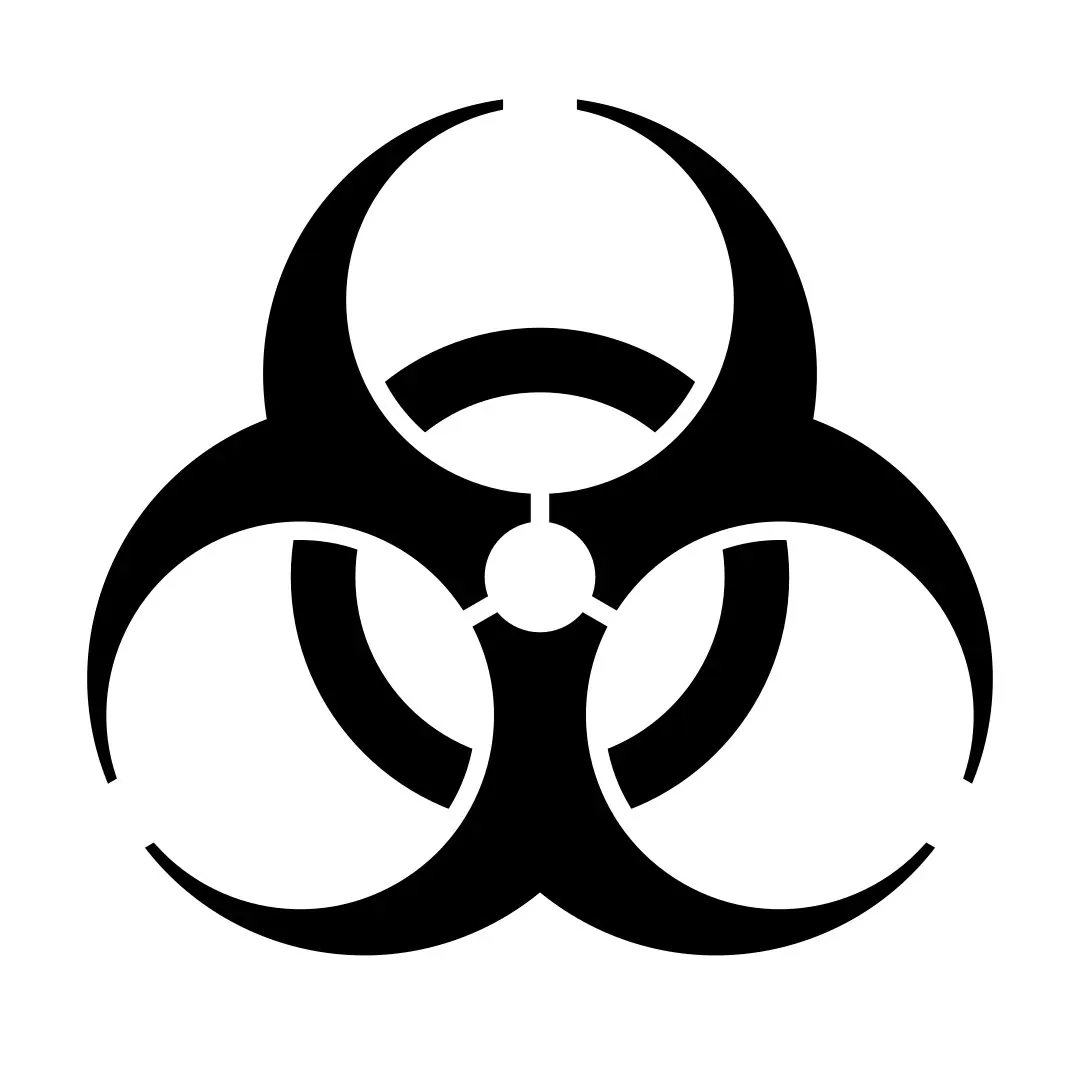

The monograph also sets placement rules that labels on the market do not always follow: the symbol is “a fluorescent orange or an orange-red color”, any background works if the contrast is sufficient, and wording “never should” be superimposed on the symbol itself, according to the text reproduced by Auburn University from pages 113 and 114.
Who designed the biohazard symbol in 1966, and does it mean anything?
Charles L. Baldwin of the Dow Biohazards Research and Development Department, Pitman-Moore Division of The Dow Chemical Company in Indianapolis, and Robert S. Runkle of the National Cancer Institute in Bethesda published the design as “Biohazards Symbol: Development of a Biological Hazards Warning Signal” in Science, 13 October 1967, volume 158, pages 264 and 265. The abstract in PubMed record 6053882 says the need surfaced during Public Health Service contract work on containment facilities for virus research, that a literature search found no universal signal, and that the National Institutes of Health was recommending the symbol.
The Science History Institute account dated 26 June 2025 gives the process: Dow artists drew more than 40 designs, 6 went to final testing, 300 subjects saw them mixed with 18 familiar marks, and a week later saw 60 symbols to test recall. The winner scored top for memorability and lowest for meaningfulness, and Baldwin’s brief was a mark that was “memorable and meaningless”.
That last point settles the meaning question. Pages that say the three crescents stand for a chain of infection, or that the ring is a cell wall, cite nothing from the 1967 paper, whose selection criteria per the PubMed abstract were “uniqueness” and “memorability”. The symbol means what the rules define: OSHA’s 29 CFR 1910.145 paragraph (e)(4) says it signifies “the actual or potential presence of a biohazard”. How OSHA, DOT and the states define the hazard itself is set out in what is a biohazard.
Adoption followed. The Science History Institute records that the CDC and OSHA adopted the mark, ANSI accepted it as a standard in 1969, and ISO declared it a global standard in 1986. The ISO standard number and edition were not opened for this page, so none is quoted here.
How big must a biohazard sign or label be? From 1 inch to 6 inches
OSHA’s 29 CFR 1910.1030 sets no minimum size for labels; paragraph (g)(1)(i)(D) only requires the label to be affixed “as close as feasible to the container” by string, wire, adhesive or another method that prevents loss. For tags, 1910.145 paragraph (f)(4)(ii) makes the signal word readable at 5 feet (1.52 m) or more.
Hard numbers come from DOT and the states. Per the text of 49 CFR 172.323, the BIOHAZARD marking must measure at least 152.4 mm (6 inches) on each side, on two opposing sides of bulk packaging under 3,785 L (1,000 gallons) and on every side and end above it. Florida ties diameter to container size: 6 inches on bags and outer containers 19 by 14 inches or larger, 1 inch on smaller bags and on sharps containers.
What must a biohazard sign on a lab door say under BMBL Section IV?
The CDC and NIH BMBL 6th edition, revised June 2020, splits the levels. At Biosafety Level 1, item 5 of the standard practices says “a sign is posted” at the entrance when infectious materials are present, without requiring the symbol. At BSL-2 and BSL-3, item 5 reads “a sign incorporating the universal biohazard symbol is posted at the entrance”.
Both levels list the same posted information: the laboratory’s biosafety level, the supervisor’s or responsible person’s name and telephone number, PPE requirements, general occupational health requirements, and the procedures for entering and exiting; agent information follows institutional policy, per the BMBL text. The animal facility criteria in Section V repeat the rule for animal rooms. The levels themselves are explained on our biosafety levels page.
A remediation crew entering a trauma scene is not a BSL lab, and the BMBL is guidance, not a rule. The enforceable text for that crew is 29 CFR 1910.1030: the containers they fill take the label or red colour, and the job scope is set out in biohazard cleanup and crime scene cleanup.
Can you copy and paste the biohazard symbol? U+2623 and free PNG files
Yes. The Unicode Character Database lists code point U+2623 as “BIOHAZARD SIGN”, next to U+2622 “RADIOACTIVE SIGN”, and the Unicode DerivedAge file dates the range 261A to 266F, which includes it, to Unicode 1.1. Type it in HTML as ☣ and it renders as ☣ where the font has the glyph.
For a PNG or SVG, the black version on Wikimedia Commons is released into the public domain by its author under PD-self, with blue, orange, red and yellow variants linked from the same file page. A downloaded file is fine for training slides; a regulated container still needs a label in the OSHA colour with the word BIOHAZARD, per 1910.1030 paragraph (g)(1)(i)(B).
Tattoo and apparel use sits outside every rule on this page. Baldwin objected to the symbol on neckties in a 2001 New York Times interview, the Science History Institute records, because it “was not designed to be used sartorially”.
Questions people actually ask
What does the biohazard symbol mean?
It marks the actual or potential presence of a biological hazard. OSHA’s 29 CFR 1910.145 paragraph (e)(4) defines that as infectious agents presenting a risk or potential risk to the well-being of people, and uses it on equipment, containers, rooms, materials and experimental animals. The design itself was chosen in 1966 to be memorable and meaningless, so its parts have no separate meaning.
Is the biohazard symbol always orange?
No. OSHA labels under 1910.1030 must be fluorescent orange or orange-red with contrasting lettering, but red bags may replace the label, DOT bulk markings are orange with a black symbol, the DOT infectious substance label has a white background, and Florida accepts a red, orange or black symbol on any contrasting background.
Is a biohazard sign the same as a biosafety level sign?
Not quite. The BMBL 6th edition requires the universal biohazard symbol on entrance signs at BSL-2 and BSL-3, while BSL-1 entrances need a sign with the same posted information but no symbol. The sign states the level, a contact name and phone number, PPE and entry and exit procedures.
When was the biohazard symbol invented?
Dow Chemical’s biohazards team began the work in 1966 under a National Cancer Institute contract, and Charles Baldwin and Robert Runkle published it in Science on 13 October 1967. According to the Science History Institute, ANSI accepted it as a standard in 1969 and ISO adopted it worldwide in 1986.
Does decontaminated waste still need the biohazard label?
No. OSHA’s bloodborne pathogens standard, 29 CFR 1910.1030 paragraph (g)(1)(i)(I), says regulated waste that has been decontaminated need not be labeled or color-coded. State medical waste codes may still dictate how treated waste is documented, so check the treatment record your state requires before discarding it as ordinary trash.
Sources
- 29 CFR 1910.1030, Occupational Safety and Health Administration, bloodborne pathogens standard, paragraphs (b), (d)(4) and (g)(1). Retrieved 8 November 2026.
- 29 CFR 1910.145, OSHA specifications for accident prevention signs and tags, paragraphs (e)(4), (f)(4), (f)(8) and Appendix A, via eCFR, with the printed CFR figure in the July 2024 CFR edition on govinfo.gov. Retrieved 8 November 2026.
- 49 CFR 172.323, 49 CFR 172.432 and 49 CFR 173.134, Pipeline and Hazardous Materials Safety Administration, via eCFR. Retrieved 8 November 2026.
- BMBL 6th edition, Biosafety in Microbiological and Biomedical Laboratories, CDC and NIH, revised June 2020, Sections IV and V. Retrieved 8 November 2026.
- Baldwin, C. L. and Runkle, R. S., “Biohazards Symbol: Development of a Biological Hazards Warning Signal”, Science, 13 October 1967, 158(3798), 264 to 265, with the abstract in PubMed record 6053882, National Library of Medicine. Retrieved 8 November 2026.
- Science History Institute, “The Biohazard Warning Symbol”, Patrick H. Shea, 26 June 2025. Retrieved 8 November 2026.
- NIH Laboratory Safety Monograph, pages 113 and 114, National Institutes of Health, 1978, as reproduced in “The Biohazard Symbol”, Auburn University. Retrieved 8 November 2026.
- Florida rule 64E-16.004, Florida Department of Health, Storage and Containment, Florida Administrative Code, via flrules.org. Retrieved 8 November 2026.
- California Health and Safety Code 118280, Medical Waste Management Act, via california.public.law. Retrieved 8 November 2026.
- 10 NYCRR 70-2.2, New York State Department of Health, via Cornell Legal Information Institute. Retrieved 8 November 2026.
- Unicode Character Database (UnicodeData.txt) and DerivedAge.txt, Unicode Consortium. Retrieved 8 November 2026.
- Wikimedia Commons, File:Biohazard_symbol.svg, public domain, and File:Biohazard_Symbol_Specification.png, CC BY-SA 4.0, used only to cross-check dimensions. Retrieved 8 November 2026.
- The construction drawing is our own rendering of the published dimension table. Our methodology sets out the standing rules.
This page describes published rules. Your state medical waste program and your employer’s exposure control plan decide which of them apply to a given container.