The short answer
Mold in insulation usually grows on what the insulation holds, not on the insulation itself: dust, kraft paper facing, or the wet wood and drywall beside it. Glass and stone fibres are not mold food, but EPA guidance says wet fiberglass and cellulose should be discarded and replaced, and fixing the water source comes first.
Key takeaways
- Owens Corning FastBatt data sheet reports its ASTM C1338 fungi pass for ‘fiberglass only’. The kraft facing is outside that result.
- EPA 402-K-01-001 Table 1 says ‘Discard and replace’ for both fiberglass and cellulose insulation, even inside the 24 to 48 hour clean water window.
- Darkened fiberglass around a ceiling light is usually a filtration line. The ENERGY STAR guide to sealing and insulating says dirty insulation ‘is still okay to use’ once the leak is sealed.
- The FEMA NFIP Technical Bulletin 2 (2025) rates closed-cell foam acceptable below flood level and every fibrous insulation, plus open-cell foam, unacceptable.
- Replacement has a target: the ENERGY STAR recommended R-values table runs from R30 to R60 for an uninsulated attic, by climate zone.
- Installers owe a dated, signed receipt showing coverage area, thickness and R-value under 16 CFR 460.17.
On this page
Whether mold grows depends on the material, the facing, the dust load and how long it stayed wet, and the primary documents disagree in one place that matters. This page sets them side by side.
What you are looking at: dirty, wet or moldy
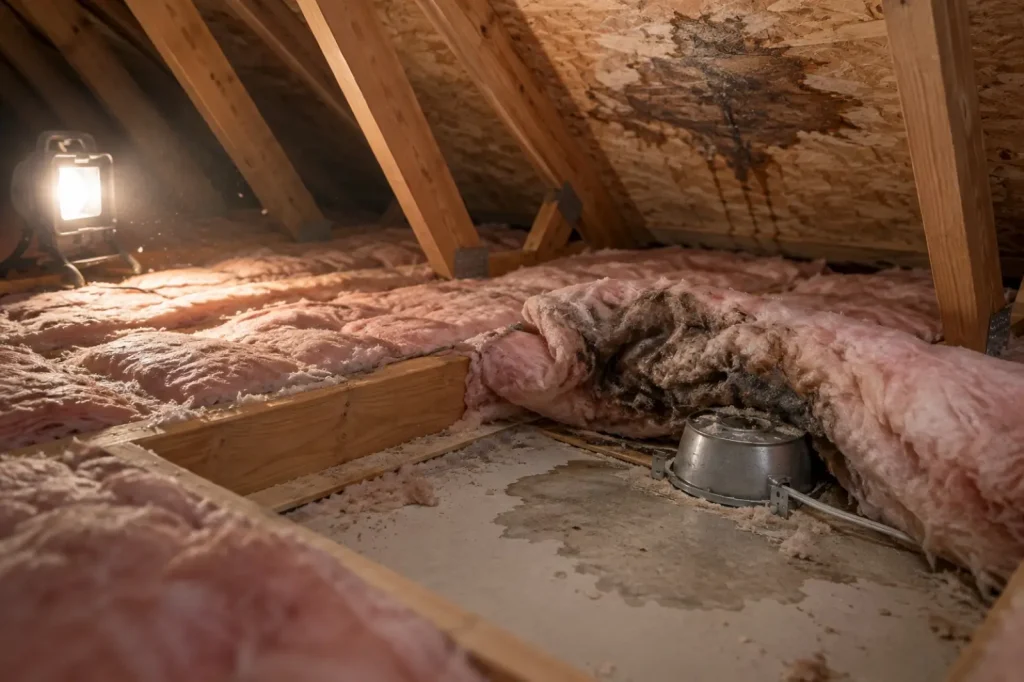
The most common false alarm is a dark band in fiberglass. The ENERGY STAR guide to sealing and insulating explains that darkened insulation ‘is the result of filtering dusty air from the house’, that in cold weather the same spots may show frost and in warmer weather water staining, and that ‘although the insulation is dirty, it is still okay to use. There’s no need to remove and replace.’ The fix is air sealing the gap underneath.
| What you see | What it usually is | Decision |
|---|---|---|
| Grey or black band on top of fiberglass, around lights, wires or top plates | Filtration line: dust from leaking house air | Keep. Seal the leak, push the insulation back |
| Frost in winter or water stains in summer at the same spots | Warm moist house air condensing at the leak | Seal the leak; check the wood above for wetting |
| Fuzzy growth or spotting on kraft paper facing | Mold on the facing, a paper food source | Replace the batt |
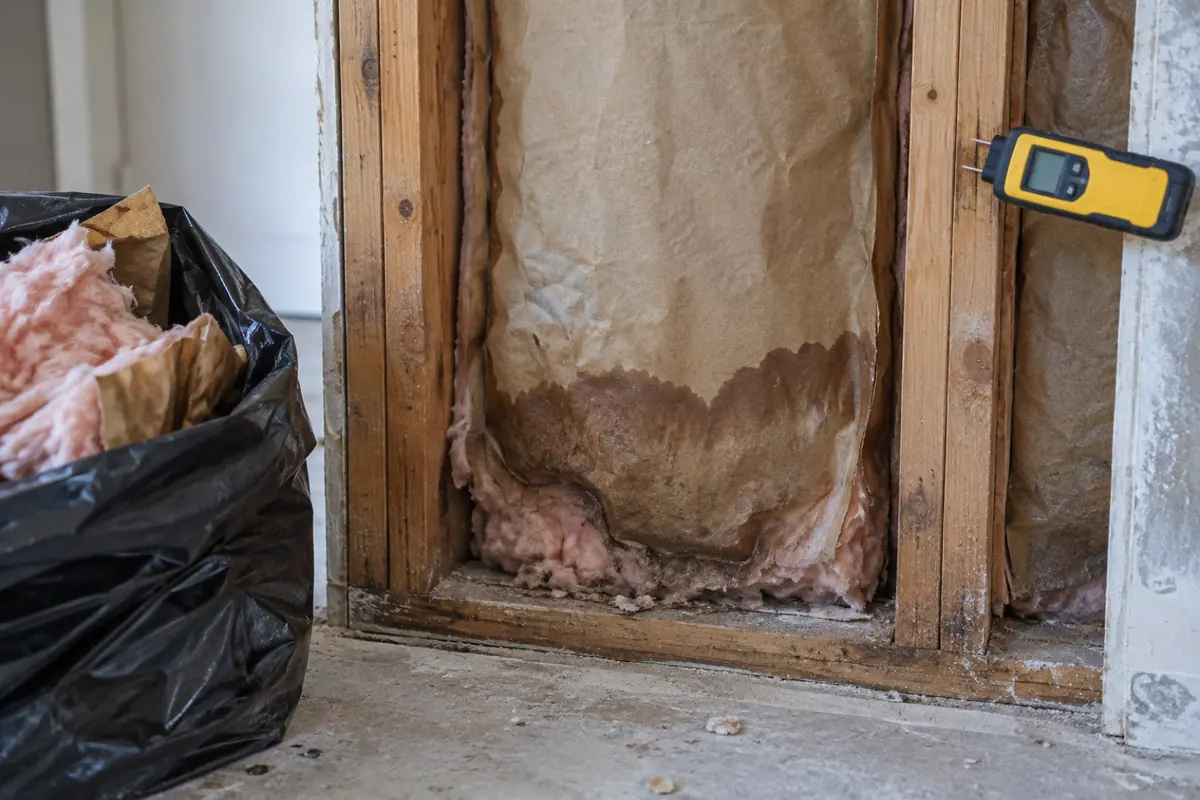
| Clumped, compressed or heavy batts | Water saturation | Replace; find the water |
| Spotting on the drywall or framing behind the batt | Mold on the substrate the insulation hid | Remove the insulation to treat the substrate |
| Lightweight grey or brown pebbles, pea-sized and flaky | Possibly vermiculite | Do not disturb; test first |
When unsure, lift the batt: the substrate behind it tells you more than the insulation does.
Mold in insulation, type by type
No single source makes this comparison: what mold feeds on in each insulation, against what the documents say once wet.
| Insulation type | Mold food source | Keep or replace when wet | Source |
|---|---|---|---|
| Fiberglass batt, unfaced | Not the glass; dust that collects in it | EPA: discard and replace. Knauf: dry rapidly if no mold | EPA 402-K-01-001; Knauf EcoRoll data sheet |
| Fiberglass batt, kraft faced | The kraft paper facing, plus dust | Replace; Knauf says replace if the facing degraded | Owens Corning FastBatt data sheet; Knauf EcoRoll data sheet |
| Cellulose, loose or dense pack | Paper fibre; borate treatment resists growth | EPA: discard and replace | EPA 402-K-01-001; Herrera (2005) |
| Mineral wool batt | Not the stone fibre; dust | No EPA row; FEMA rates it unacceptable for floods | ROCKWOOL Comfortbatt data sheet; FEMA NFIP Technical Bulletin 2 (2025) |
| Open-cell spray foam | Not the foam per C1338; dust | Absorbs water; FEMA unacceptable | Elastochem 500 data sheet; FEMA NFIP Technical Bulletin 2 (2025) |
| Closed-cell spray foam and rigid foam | Not the foam; dust and any paper facer | FEMA acceptable; clean if intact | FEMA NFIP Technical Bulletin 2 (2025) |
Mold on fiberglass insulation
The Owens Corning submittal sheet states that because of its inorganic fibres the insulation ‘is not a food source for mold’. The detail is on the Owens Corning FastBatt data sheet: its ASTM C1338 fungi resistance pass is marked ‘fiberglass only’, the kraft facing ‘will burn’ and ‘acts as a vapor retarder’. The Knauf EcoRoll data sheet puts it plainly: fiberglass ‘will not sustain mold growth’, but ‘mold can grow on almost any material when it becomes wet and contaminated’. Andersen and colleagues (2011) report Phoma and Stachybotrys associated with glass fibre materials in more than 5,300 samples from water-damaged buildings, without separating insulation from other glass fibre products.
Cellulose and wet cellulose
The Cel-Pak cellulose specification sheet describes an all-borate cellulose meeting ASTM C739, with fungi resistance rated acceptable. Herrera (2005) found sodium polyborate treated cellulose in half-scale wall units precluded growth of 5 common fungal species for at least 124 days. That resistance does not change the EPA line for wet cellulose, which is recycled paper: discard and replace.
Mineral wool
The ROCKWOOL Comfortbatt data sheet lists ASTM C1338 fungi resistance as passed and water vapour sorption of 0.05 vol% under ASTM C1104. That describes humid air, not flooding; FEMA still rates mineral wool unacceptable below flood level.
Spray foam: open-cell against closed-cell
Per the BASF ENERTITE G data sheet and the Elastochem 500 data sheet, open-cell content is 98%. Both report no growth under ASTM C1338, but the Elastochem sheet lists water absorption of 34% by volume under ASTM D2842, and the FEMA NFIP Technical Bulletin 2 (2025) rates open-cell foam unacceptable for floods while rating closed-cell foam acceptable. BASF also notes cured foam is yellow or off white, so a yellow foam surface is not by itself a sign of yellow mold.
Rigid foam board
Rigid boards sold as closed-cell foam fall under FEMA’s acceptable row. Whether a board can be cleaned depends on its facer, so read the product data sheet before deciding.
Wet insulation mold: what EPA actually says
The rule most often paraphrased comes from Table 1 of EPA 402-K-01-001, Mold Remediation in Schools and Commercial Buildings, titled ‘Guidelines for Response to Clean Water Damage within 24 to 48 Hours to Prevent Mold Growth’. Insulation is the only material on it, with ceiling tiles, that gets an unconditional discard even before mold appears.
| Water-damaged material | EPA Table 1 action (quoted) |
|---|---|
| Fiberglass insulation | Discard and replace. |
| Cellulose insulation | Discard and replace. |
| Ceiling tiles | Discard and replace. |
| Wallboard (drywall) | May be dried in place if there is no obvious swelling and the seams are intact. If not, remove, discard, and replace. |
| Carpet and backing | Remove water with water extraction vacuum; dehumidify; accelerate drying with fans. |
| Wood surfaces | Remove moisture immediately; dehumidifiers, gentle heat and fans. |
Contrast that with the Knauf EcoRoll data sheet, which says wet insulation showing no evidence of mold ‘should be dried rapidly and thoroughly’, and replaced if mold shows or the facing has degraded. One reading of the gap: EPA writes general guidance for buildings, Knauf writes about its own product. Where a loss is clean water, caught early, unfaced and accessible, drying may be defensible; elsewhere, EPA’s rule is the one a scope can cite. Mold already present follows Table 2: under 10 square feet is a small job (see DIY mold remediation); above it, containment steps up.
Flood ratings by insulation type
FEMA defines a flood damage-resistant material as one that survives direct and prolonged contact with floodwater, meaning at least 72 hours, with no more than cosmetic repair. The FEMA NFIP Technical Bulletin 2 (2025) rates insulation in two lines, and the superseded Technical Bulletin 2 (2008) graded the same groups on a five-class scale, which shows how far apart they are.
| Insulation (FEMA wording) | 2025 rating | 2008 class |
|---|---|---|
| Sprayed polyurethane foam or closed-cell plastic foams | Acceptable | Class 5: highly resistant to floodwater |
| Fiberglass, mineral wool: batts, blankets or blown | Unacceptable | Class 3: resists clean water, not floodwater |
| Cellulose, cotton, open-cell plastic foams | Unacceptable | Class 2: not resistant to clean water |
For a flood scope: fibrous and open-cell insulation comes out; intact closed-cell foam can be cleaned.
Mold in attic insulation, walls and crawl spaces
Attic. The ENERGY STAR guide to sealing and insulating lists wet or damp insulation indicating a leaky roof, and moldy rafters, as problems that may need a contractor; removal is covered on attic mold removal.
Walls. Wet batts in a wall come out with the drywall, and the drying is covered on water damage in walls.
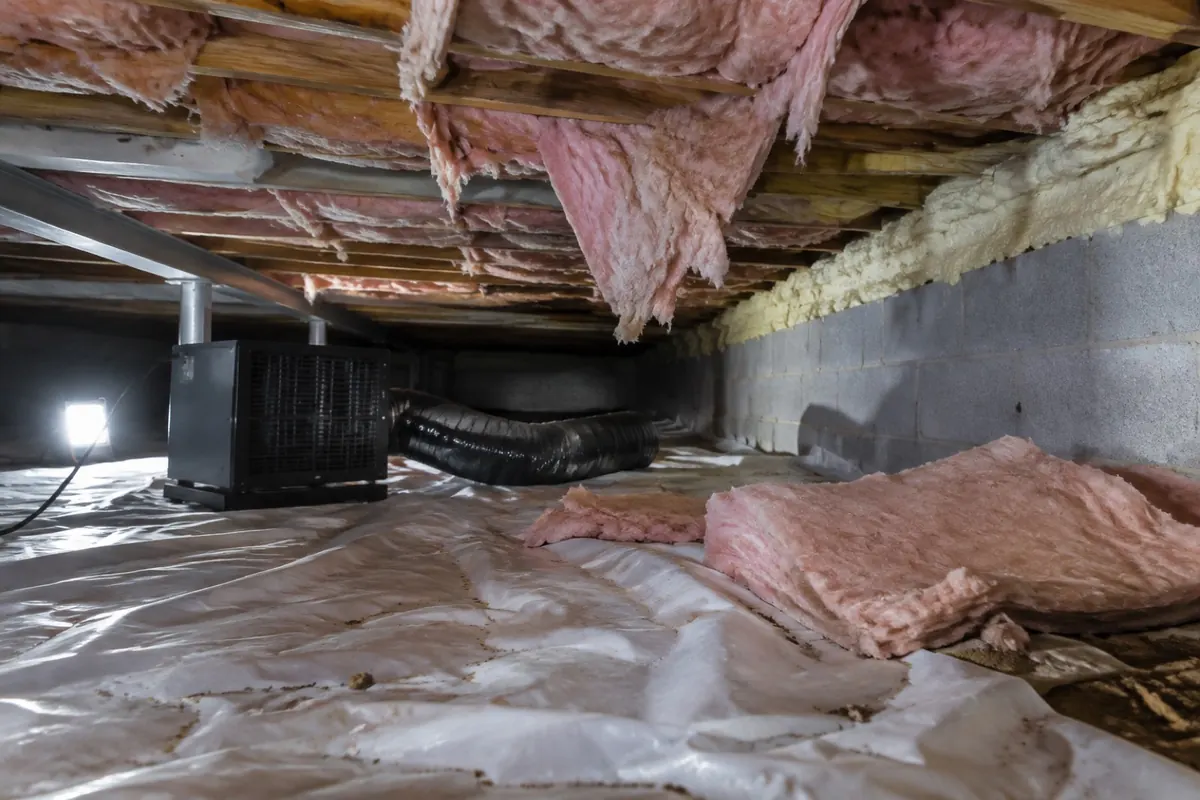
Crawl space. The USDA Forest Products Laboratory Wood Handbook names soil moisture as the main source of crawl space condensation, which is why batts sag there; see crawl space mold remediation.
In all three, the Wisconsin State Laboratory of Hygiene glossary lists Acremonium, often found with Stachybotrys, indoors in fiberglass insulation and cellulose materials under chronic wet conditions, water activity 0.9 to 0.98. Chronic dampness, not one wet day, is the pattern.
The removal method for wet or moldy insulation
Seven steps, each against the generic method.
- Stop the water first. Why this differs: Generic mold advice starts with cleaning. Insulation re-wets from the same roof leak, condensation or pipe, so EPA’s first step, fix the water problem, comes first here.
- Rule out vermiculite before touching loose fill. Why this differs: The ENERGY STAR guide says not to disturb vermiculite until an approved lab has tested it. No other mold job has this gate.
- Bag it where it lies. Why this differs: EPA Method 4: seal materials in plastic inside containment, double-bagged in 6-mil polyethylene. Carrying loose batts through the house spreads what they hold.
- Inspect what the insulation hid. Why this differs: Framing, sheathing and drywall behind wet insulation were wet too, out of sight. Dry them to a measured standard before closing up.
- HEPA vacuum the cavity once dry. Why this differs: EPA Method 3 is applied after the material is thoroughly dried, not while it is wet.
- Air seal before reinsulating. Why this differs: If the pattern was a filtration line, new insulation over the same gap repeats it. The ENERGY STAR guide seals leaks before adding insulation.
- Reinstall to the target R-value. Why this differs: Replacement is the point at which an under-insulated attic can be corrected, and the FTC receipt records it.
Putting the R-value back
The ENERGY STAR recommended R-values page publishes retrofit targets for wood-framed homes, based on the 2021 International Energy Conservation Code. For crawl space or basement walls it lists R13 batt in zones 3, 4A and 4B and R19 batt in zones 4C and 5 to 8.
| Climate zone | Attic, uninsulated | Attic, 3 to 4 inches present | Floor |
|---|---|---|---|
| 1 | R30 | R25 | R13 |
| 2 | R49 | R38 | R13 |
| 3 | R49 | R38 | R19 |
| 4A and 4B | R60 | R49 | R19 |
| 4C, 5 and 6 | R60 | R49 | R30 |
| 7 and 8 | R60 | R49 | R38 |
Under 16 CFR 460.17, an installer must give a dated, signed contract or receipt showing coverage area, thickness and R-value; for loose fill it adds initial installed thickness, minimum settled thickness and the number of bags. The rule forbids multiplying an R-value per inch by the inches installed.
When it is bigger than the batt
- Vermiculite: the ENERGY STAR guide describes a lightweight, pea-size, flaky grey mineral and says not to disturb it until tested. Go to asbestos insulation before anything else.
- Growth on sheathing or rafters above the insulation, which moves the job to the roof deck; see signs of mold in attic.
- Floodwater or sewage: EPA notes OSHA requires protective equipment and containment for contaminated water.
- Insulation wet for more than 48 hours, which EPA Table 1 sends to its Table 2 remediation guidelines.
- Recurrence after replacement: the water or the air leak is still there.
For contractors: scope, line items and what adjusters ask
Scope insulation as its own line items, apart from the mold work it uncovers: removal by area, bagging and disposal, cavity cleaning, then replacement to a stated R-value. Cite EPA Table 1 for discard, FEMA TB 2 for flood losses, and the manufacturer sheet when you propose drying instead.
| Record | Why it is asked for |
|---|---|
| Insulation type, facing and depth | Sets the EPA, FEMA and manufacturer rule that applies |
| Water source and dates | EPA’s 48 hour line and policy wording both turn on time and cause |
| Moisture readings of framing and drywall behind | Proves what was wet beyond the insulation |
| Area removed, bags, disposal | Matches EPA Method 4 and the invoice |
| Replacement R-value, thickness, area, receipt | Required by 16 CFR 460.17; supports the replacement line item |
For coverage, point owners to their own policy, their state insurance department and a licensed professional. Wider job costs: mold remediation cost.
Questions people actually ask
Can mold grow on fiberglass insulation?
Not on the glass itself. Owens Corning states its inorganic fibres are not a food source for mold, and its ASTM C1338 fungi pass covers the fiberglass only. Mold grows on dust collected in the batt, on kraft paper facing, and on wet wood or drywall behind it. Knauf notes mold can grow on almost any material once wet and contaminated.
Do I need to replace wet insulation?
EPA’s Table 1 in its mold remediation guide says to discard and replace wet fiberglass and cellulose insulation, even when responding within 24 to 48 hours of clean water damage. Knauf says unfaced fiberglass with no mold may be dried rapidly and thoroughly. Saturated, clumped, faced or floodwater-soaked insulation should come out.
Is the black stuff on my attic insulation mold?
Often it is dust. The ENERGY STAR sealing and insulating guide says darkened insulation around penetrations results from filtering dusty air leaking from the house, and that dirty insulation is still okay to use once the leak is sealed. Growth on the facing, sheathing or drywall, or a water history, points to mold.
Which insulation is most resistant to mold?
No insulation is immune once it is dirty and wet. Closed-cell spray foam and closed-cell plastic foams are the only insulation FEMA Technical Bulletin 2 rates acceptable for flood exposure. Mineral wool and unfaced fiberglass are not mold food, and borate-treated cellulose resisted five fungal species for 124 days in a 2005 study.
Can you clean mold off insulation?
Not reliably. EPA says porous materials with mold may have to be thrown away because mold fills their empty spaces and crevices and can be impossible to remove completely. Fibrous insulation is that kind of material. Intact closed-cell foam is the exception that can be cleaned.
What R-value should replacement attic insulation be?
ENERGY STAR recommends R30 in zone 1, R49 in zones 2 and 3, and R60 in zones 4 to 8 when an attic is uninsulated, which is the condition after full removal. The installer must give a receipt with area, thickness and R-value under the FTC rule at 16 CFR 460.17.
What this page does not cover. Health effects and medical questions are out of scope; see the health information linked from EPA's mold cleanup page and speak to a doctor. Asbestos in vermiculite is covered on our asbestos insulation page, and insulation in HVAC equipment belongs to our sister site thehvacbrief.com.
Sources
- EPA 402-K-01-001: Mold Remediation in Schools and Commercial Buildings, US EPA, September 2008, Tables 1 and 2. Retrieved 30 October 2026.
- EPA's mold cleanup page, updated 4 June 2026, and EPA's brief guide to mold and moisture, updated 18 February 2026, US EPA. Retrieved 30 October 2026.
- ENERGY STAR guide to sealing and insulating: A Do-It-Yourself Guide to Sealing and Insulating with ENERGY STAR, EPA and DOE, 2008 edition. Retrieved 30 October 2026.
- ENERGY STAR recommended R-values: Recommended Home Insulation R-Values, based on 2021 IECC Table R402.1.3. Retrieved 30 October 2026.
- 16 CFR 460.17: FTC R-value Rule, via Cornell LII. Retrieved 30 October 2026.
- FEMA NFIP Technical Bulletin 2 (2025): Flood Damage-Resistant Materials Requirements, January 2025, Table 2. Retrieved 30 October 2026.
- Technical Bulletin 2 (2008): August 2008 edition, Table 2, via Montana DNRC. Retrieved 30 October 2026.
- Owens Corning FastBatt data sheet (April 2026), Owens Corning submittal sheet (February 2026), Knauf EcoRoll data sheet (2024), CertainTeed CertaPro kraft batt data sheet (undated), ROCKWOOL Comfortbatt data sheet (July 2026) and Cel-Pak cellulose specification sheet (2009). Retrieved 30 October 2026.
- Herrera (2005): Assessment of Fungal Growth on Sodium Polyborate-Treated Cellulose Insulation, J Occup Environ Hyg 2(12):626 to 632, PMID 16282166. Retrieved 30 October 2026.
- BASF ENERTITE G data sheet; Elastochem 500 data sheet (Rev 5). Retrieved 30 October 2026.
- Andersen and colleagues (2011): Associations between Fungal Species and Water-Damaged Building Materials, Appl Environ Microbiol 77(12):4180 to 4188. Retrieved 30 October 2026.
- Wisconsin State Laboratory of Hygiene glossary, undated. Retrieved 30 October 2026.
- USDA Forest Products Laboratory Wood Handbook, chapter 14, FPL-GTR-282, 2021. Retrieved 30 October 2026.
- Our methodology sets out the standing rules for sourcing and corrections.
Manufacturer statements apply to the named products. Check the data sheet for the insulation actually installed.
More in our mold hub.