The short answer
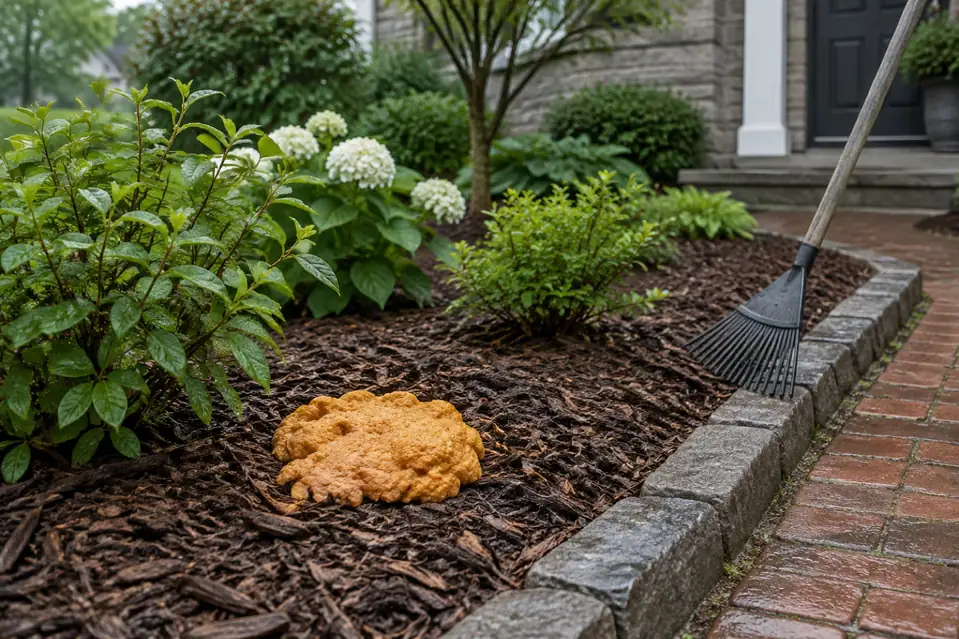
Orange mold is a colour label that covers three different kinds of organism. On garden mulch it is usually a slime mold such as Fuligo septica, which is not a true mold. In a shower or toilet it is usually a bacterial film or iron staining. On wood or food it can be a true fungus. Each one needs a different response.
Key takeaways
- Dog vomit slime mold is not a fungus. Thomas Volk of the University of Wisconsin-La Crosse places Fuligo septica in the Myxomycota and says its plasmodium eats mostly bacteria.
- Pink to red bathroom film is usually the bacterium Serratia marcescens, per North Dakota State University Extension, feeding on soap residue.
- Orange-brown stains on well water fixtures can be iron; according to Penn State Extension, a survey found excessive iron in 17% of Pennsylvania private water supplies sampled.
- On wood, the USDA Forest Products Laboratory Wood Handbook, chapter 14 records orange fungal stains and decay growths that can be strikingly yellow or orange.
- Neurospora, an orange mold, appears in blooms after urban and suburban fires, according to Perkins and Davis in Applied and Environmental Microbiology.
On this page
What you are looking at
Colour describes, it does not identify. The EPA mold course, chapter 1 says molds come in many colours, and several orange things are not molds at all. The sorter below covers a slime mold, a bacterium, a mineral and true fungi.
| Orange growth | Organism type | Where | Action |
|---|---|---|---|
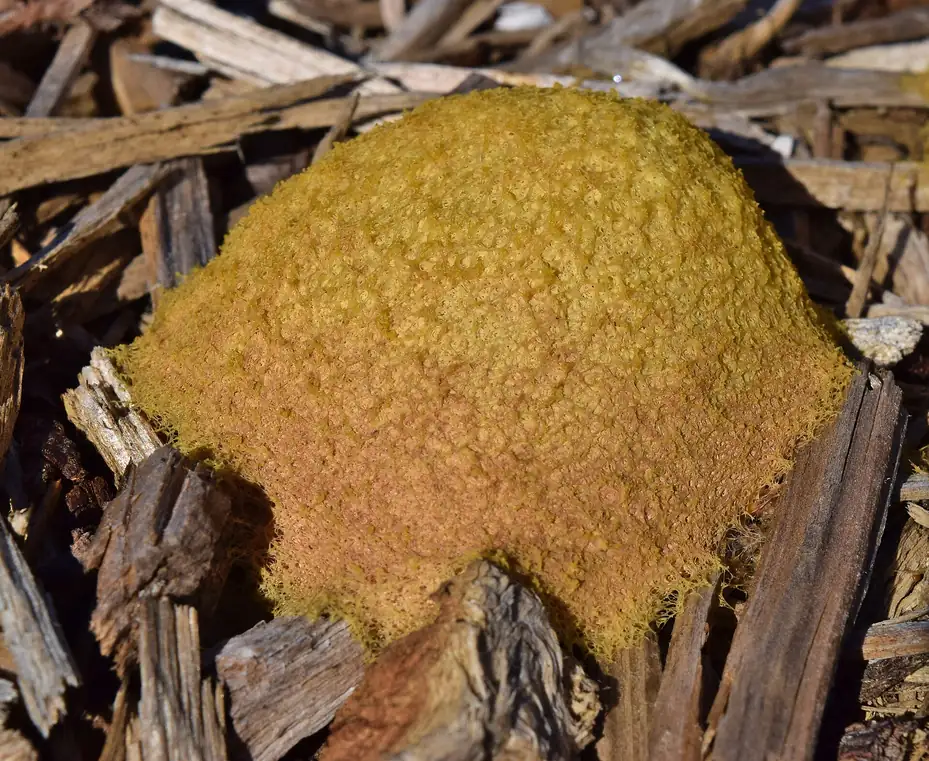
| Foamy yellow to orange blob on mulch, overnight | Slime mold (Fuligo septica) | Bark mulch, lawns, rotted logs | Scoop and bag or rake to dry; no pesticide |
| Pink to orange-red film on grout, drains, toilet bowl | Bacterium (Serratia marcescens) | Bathrooms, pet bowls | Scrub and disinfect; see mold in shower |
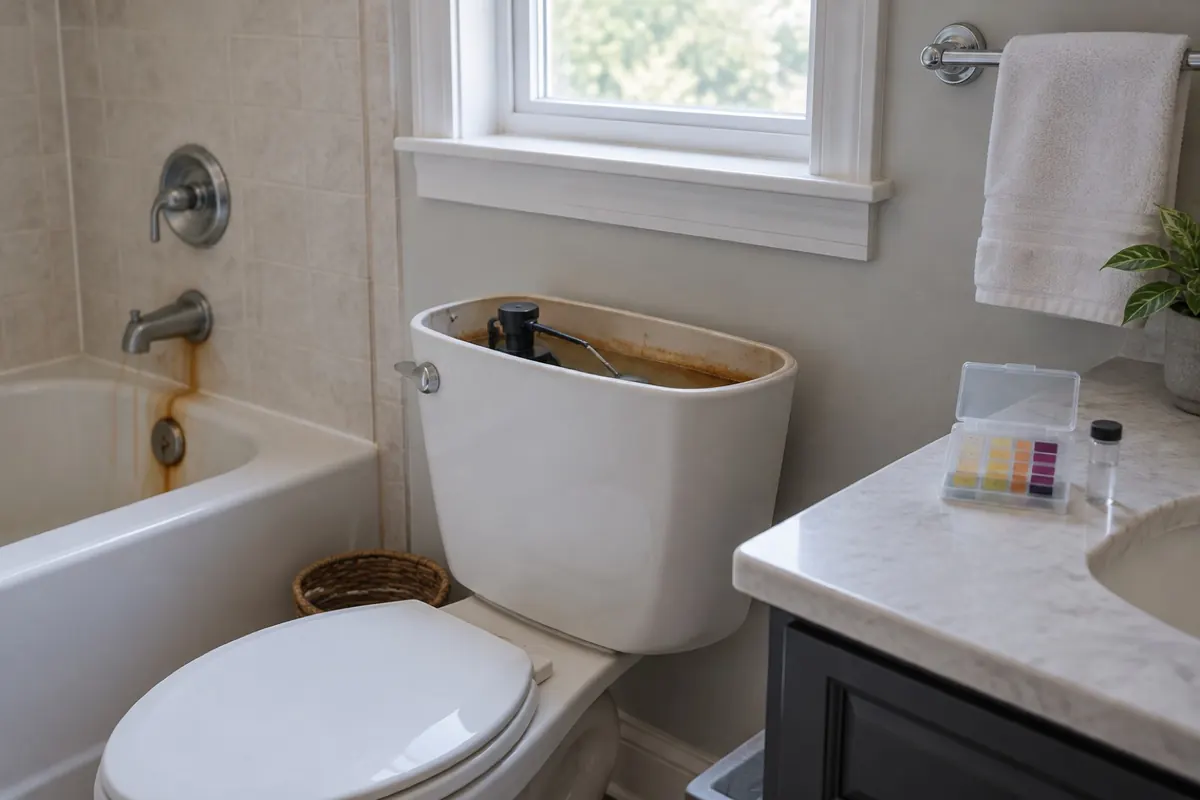
| Orange-brown stain, rusty slime, oily sheen in tank | Mineral (iron) or iron bacteria | Fixtures fed by well water | Lab water test; well disinfection by a well contractor |
| Orange powdery bloom on charred or steamed wood | Fungus (Neurospora, Chrysonilia stage) | Fire-damaged framing, lumber yards, bakeries | Dry and remove as mold; document the fire link |
| Orange streaks or fans on lumber | Fungus: stain or decay | Sapwood, wet framing | Meter and probe; decay needs structural review |
| Orange cups on bare soil | Fungus (Aleuria aurantia) | Paths, new lawns, disturbed ground | Leave it; not a building problem |
| Orange fuzz on food | Fungus | Bread, fruit, cheese | USDA FSIS rules |

Which orange growth is this? Five questions
- Is it outdoors on mulch, lawn or a rotted log, and did it appear overnight? Slime mold. Why this differs from generic advice: mold cleaners are pointless on an organism that extension services say leaves on its own.
- Is it a pink to red film in a wet bathroom spot? Serratia, a bacterium. Why: it lives on soap residue in standing water, so drying the surface matters more than any product.
- Is the house on a private well, and is the stain orange-brown or slimy in the toilet tank? Iron or iron bacteria. Why: the fix is water treatment, and no surface cleaner reaches the well.
- Is it on wood that was burned, steamed or soaked? Likely a true fungus; on fire jobs, think Neurospora. Why: its spores are activated by heat, so it follows the fire.
- Is it fuzzy or powdery on any other indoor material? Treat it as mold. CDC says you do not need to know the type. Why: colour does not change the method.
Orange slime mold on mulch: Fuligo septica
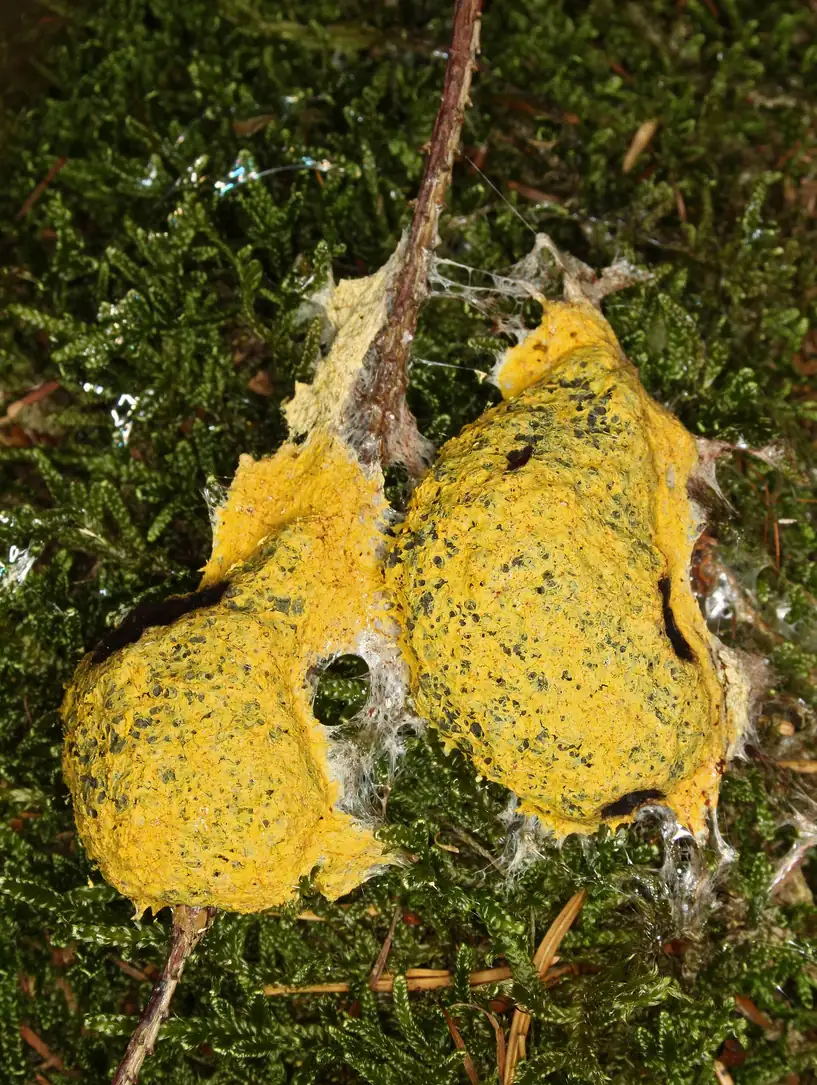
Thomas Volk of the University of Wisconsin-La Crosse calls the dog vomit slime mold, Fuligo septica, really not a fungus at all and places it in the phylum Myxomycota. Its feeding stage, the plasmodium, is a blob of protoplasm without cell walls that eats mostly bacteria. One reader’s patch on his page measured about 6 inches across. Washington State University Extension counts over 900 species of slime molds.
Oregon State University Extension describes fresh slime mold as bright yellow or orange to white or shiny black, appearing seemingly overnight, usually after summer rain, then turning brown and releasing spores as it dries. University of Arkansas Cooperative Extension says slime molds can be orange, yellow, green or even blue and turn up on lawns, mulch and decaying wood in summer. Extension services agree it does not harm plants. They disagree on the hose, so here is the spread.
| Extension source | Removal advice | Note |
|---|---|---|
| Oregon State University Extension | Rake it out to speed drying, compost it, or hose it off | Do not use pesticide; it disappears on its own |
| University of Arkansas Extension | Rake it off, wash it off with a strong spray, lightly turn the mulch | No chemical treatment mentioned |
| Washington State University Extension | Scoop it up with a pitchfork or shovel into a bag | Hosing will not remove the problem; keep the area drier |
| Cornell school IPM program | Shovel it out, hose down the residue | No pesticides registered in New York for slime mold on mulch |

Orange mold in shower and toilet: usually not mold
North Dakota State University Extension says pink or red film in toilets, sinks, tiles and shower stalls is the bacterium Serratia marcescens, feeding on phosphorus or fatty residue such as soap scum and surviving as chlorine dissipates from standing water. Our mold in shower page owns that cleanup. On well water, the orange is often iron instead.
| What you see | Likely cause | Action | Source |
|---|---|---|---|
| Pink to red slimy film on grout, drains, bowl | Serratia marcescens | Scrub, then a chlorine bleach solution, then dry surfaces after use | NDSU |
| Orange or brown stain in sinks and laundry | Dissolved iron oxidising | Water test; treatment at point of entry | Penn State |
| Rusty, sticky slime, oily sheen, feathery growth in the tank | Iron bacteria | Lab test, then cleaning and disinfection by a well contractor | MDH |
| Fuzzy or powdery spots on caulk or ceiling | Mold | Mold method; see mold in shower | EPA |
Penn State Extension recommends no more than 0.3 mg/L of iron in drinking water and notes private wells are not subject to those standards. The Minnesota Department of Health says a laboratory test confirms iron bacteria.
Orange mold on wood
The USDA Forest Products Laboratory Wood Handbook, chapter 14 says fungal stains on wood are most often blue, but that various shades of yellow, orange, purple and red are sometimes encountered, and that the exact colour depends on the organism and the wood. It separates surface mold from stain by depth, and both from decay.
| On the wood | Likely | Test | Action |
|---|---|---|---|
| Orange streaks or spots inside sapwood | Fungal stain | Does not surface off; the FPL says typical sap stain penetrates the sapwood | Cosmetic unless the wood stays wet |
| Orange fuzz or powder sitting on the surface | Mold | Brushes or sands off softwood | Clean; see mold on wood |
| Orange fans, sheets or strands | Decay fungus | The FPL says fresh decay growth may be strikingly yellow or orange | Probe for softness; structural review |
| Orange powdery bloom on charred or steamed wood | Neurospora | Context: fire, steaming, lumber yard | Dry, remove growth, document |
| Moist then powdery colony, white to pink or orange | Possibly Acremonium | Only a lab can say | Sample if it matters; see mold testing |
The University of Adelaide mycology unit describes Acremonium colonies as compact and moist at first, then powdery, suede-like or floccose, in white, grey, pink, rose or orange, and mostly isolated from dead plant material and soil. Moisture decides the outcome: per the FPL, serious decay needs wood above its fiber saturation point of about 30%, and air-dried wood at 20% or less gives a reasonable margin of safety.
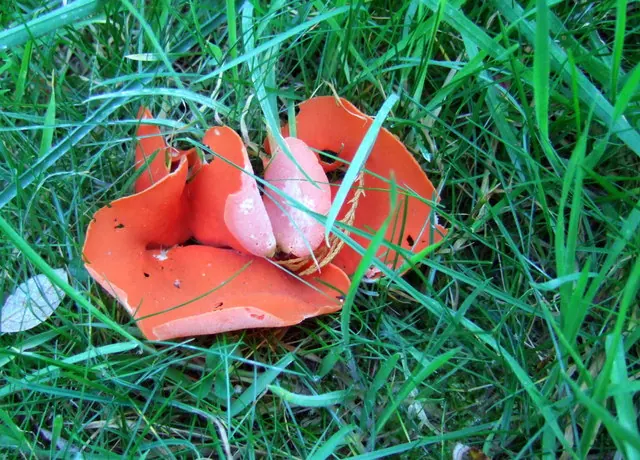
Orange cups on the ground nearby are a different fungus. NatureSpot describes Aleuria aurantia as large orange cups that resemble orange peels strewn on the ground, in disturbed soil along paths and in gardens. It does not grow on lumber.

Orange mold after a fire
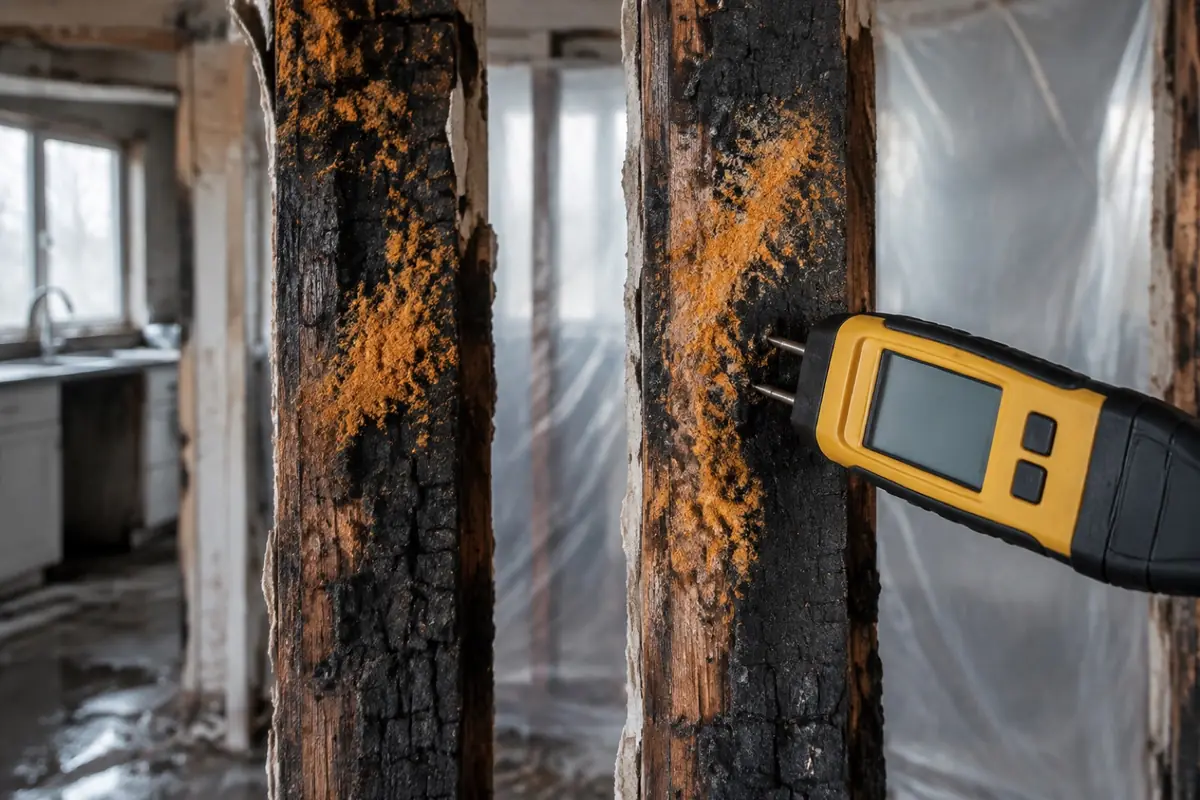
Perkins and Davis in Applied and Environmental Microbiology explain why an orange bloom can follow a fire. The conidiating Neurospora species are conspicuous for their distinctive orange colour and powdery spores, their dormant ascospores are activated by heat, and blooms occur on burned vegetation. The paper records orange blooms following urban and suburban fires and occurrences in lumber yards, plywood factories, on steamed logs and in contaminated bakeries. The vegetative stage goes by the names Monilia sitophila and Chrysonilia sitophila.
On a fire job, orange powder on charred, soaked framing is a moisture signal: suppression water plus heat. Remove it like any mold once the structure is dry; the job sequence is on our fire damage page.
Orange mold on food
The USDA FSIS fact sheet Molds on Food lists Neurospora and Monilia among molds found on meat, poultry and many other foods, and says the spores give mold its colour. Its rules do not change for orange: discard bread, soft fruit, soft cheese, jams and cooked leftovers; for hard cheese and firm produce, cut off at least 1 inch around and below the spot. Do not sniff moldy food. For the fridge itself, see mold in refrigerator.
What to do for each
| Organism | Method | Why this differs from generic advice |
|---|---|---|
| Slime mold on mulch | Scoop into a bag on a dry day; turn the mulch; reduce watering | It is not a fungus; WSU says drier ground discourages it, and extension sources advise against pesticide |
| Serratia film | Scrub, apply chlorine bleach solution 10 to 20 minutes per NDSU, then dry after every use | The organism returns in standing water, so drying is the prevention |
| Iron staining or iron bacteria | Water test at an accredited lab; well contractor disinfects | MDH says physical removal and chlorination happen in the well, not the bathroom |
| Mold on hard surfaces | Detergent and water, dry completely | EPA’s instruction applies to every colour |
| Mold on porous material | Bag and discard if moldy | EPA says porous materials may have to be thrown away |
| Decay on wood | Stop the water; probe; repair or replace members | A cleaning product cannot restore lost strength |
For true mold indoors, the EPA's Mold Cleanup in Your Home says areas under about 10 square feet are usually a do-it-yourself job; the line and steps are on DIY mold remediation. The EPA mold course, chapter 6 sets minimum gear: gloves, goggles and an N-95 respirator. Why colour never changes the answer is in black mold vs regular mold.
Signs it is bigger than the spot
| What you see | What it usually means | Next step |
|---|---|---|
| Orange fans or strands on wood that feels soft | Active decay | Structural assessment |
| Orange bloom on framing after fire suppression | Wet structure plus heat-activated fungus | Dry, remove, and document for the claim file |
| Rusty slime and sheen returning in the toilet tank | Iron bacteria in the well or plumbing | MDH says eliminating them can be difficult; call a well contractor |
| Pink to orange film back within days | Standing water, residue, or a stagnant line | Dry surfaces; check seldom-used fixtures |
| Fuzzy growth over more than about 10 square feet | Beyond EPA’s homeowner-scale guidance | Professional scope |
| Slime mold indoors on carpet or wood | A persistent wet, organic surface inside | Find the water; treat the material as water damaged |
The last row is our reasoning, not a recorded case: University of Arkansas Cooperative Extension lists decaying wood among slime mold sites, so one indoors means something has stayed wet.
For contractors
Orange growth tests the scope line more than any other colour, because most of it is not remediation work. Slime mold on landscaping is not a line item, Serratia is cleaning, and iron belongs with water treatment. Orange fungal growth on wet framing, especially after a fire, is a mold scope.
| Document | Why it belongs in the file |
|---|---|
| Organism type, with a photo and location | Keeps slime mold and iron staining out of a mold scope |
| Water source: well or municipal | Routes iron to water treatment, a separate trade |
| Moisture content of orange-stained wood | Separates cosmetic stain from decay against FPL thresholds |
| Fire timeline and suppression water | Links Neurospora growth to the covered event |
| Measured area of true mold | Places the job against EPA’s line |
On claims, the ISO HO 00 03 sample form hosted by the Insurance Information Institute excludes mold, fungus or wet rot, with a give-back for such loss hidden in walls, ceilings or floors from accidental discharge of plumbing, heating or air conditioning systems or a household appliance. How a fire policy treats post-fire growth depends on the form and endorsements, so the owner’s policy, their state insurance department and a licensed professional decide.
What this page does not cover. Health effects of mold, bacteria or slime molds are outside our scope; CDC and EPA publish that guidance.
Questions people actually ask
Is orange mold dangerous?
This page does not assess health effects; CDC and EPA publish that guidance. The useful question is what the orange thing is. Slime mold on mulch, iron staining and Serratia film each have their own fix, and true mold indoors is handled like any other color, since CDC says you do not need to know the type.
What is the orange slime mold in my mulch?
Usually Fuligo septica, the dog vomit slime mold. Thomas Volk of UW-La Crosse says it is not a fungus and that it eats mostly bacteria. Oregon State Extension says it appears overnight after summer rain, then dries brown and releases spores. Scoop it into a bag or rake it to dry.
What is the orange mold in my shower?
Usually not mold. NDSU Extension identifies pink or red film in showers and toilets as the bacterium Serratia marcescens, which feeds on soap residue. On well water, orange-brown stains are often iron, which Penn State Extension says causes orange or brown stains in sinks and laundry.
Is orange mold on wood rot?
Sometimes. The USDA Forest Products Laboratory says fresh growths of decay fungi may be strikingly yellow or orange, and that fungal stains in orange shades occur in sapwood. Surface fuzz that brushes off sound wood is mold. Soft or spongy wood under orange growth needs a structural look.
Why does orange mold grow after a fire?
Perkins and Davis, writing in Applied and Environmental Microbiology, report that Neurospora spores are activated by heat and that orange blooms occur on burned vegetation and after urban and suburban fires. On a fire job, the bloom also signals framing that stayed wet after suppression.
Can I eat food with orange mold if I cut it off?
Only hard cheese and firm fruits or vegetables. USDA FSIS says to cut at least 1 inch around and below the spot on those, and to discard bread, soft produce, soft cheese, jams and cooked leftovers. Color does not change the rule, and FSIS also says not to sniff moldy food.
How do I get rid of orange mold?
Identify it first. Scoop slime mold off mulch; scrub Serratia film and apply bleach solution for 10 to 20 minutes as NDSU advises; test well water for iron. For true mold, EPA says scrub hard surfaces with detergent and water, dry them, and discard moldy porous materials.
Sources
- Thomas Volk of the University of Wisconsin-La Crosse, Fuligo septica, Fungus of the Month, June 1999. Retrieved 30 October 2026.
- Oregon State University Extension, slime mold story, June 2023, reviewed 2025. Retrieved 30 October 2026.
- University of Arkansas Cooperative Extension, Slime mold reference desk entries, 2010 to 2018. Retrieved 30 October 2026.
- Washington State University Extension, Stevens County, 27 July 2016. Retrieved 30 October 2026.
- Cornell's school IPM program, undated blog post. Retrieved 30 October 2026.
- North Dakota State University Extension, Red Substance in Tub, Toilet Is Bacteria, 9 August 2010. Retrieved 30 October 2026.
- Minnesota Department of Health, Iron Bacteria in Well Water, updated 7 January 2026. Retrieved 30 October 2026.
- Penn State Extension, Iron and Manganese in Private Water Systems, updated 29 May 2025. Retrieved 30 October 2026.
- USDA Forest Products Laboratory Wood Handbook, chapter 14, Biodeterioration of Wood, USDA Forest Service, 2021. Retrieved 30 October 2026.
- Perkins and Davis in Applied and Environmental Microbiology, Evidence for Safety of Neurospora Species for Academic and Commercial Uses, 66(12), December 2000, CC BY 4.0 via eScholarship. Retrieved 30 October 2026.
- University of Adelaide mycology unit, Acremonium description. Retrieved 30 October 2026.
- NatureSpot, Orange Peel Fungus, undated. Retrieved 30 October 2026.
- USDA FSIS fact sheet Molds on Food, last updated 22 August 2013, Internet Archive capture of 4 October 2026. Retrieved 30 October 2026.
- EPA mold course, chapter 1 (updated 18 February 2026), EPA mold course, chapter 6 (updated 1 December 2025) and EPA's Mold Cleanup in Your Home (updated 4 June 2026), EPA. Retrieved 30 October 2026.
- CDC, Mold, updated 26 September 2024. Retrieved 30 October 2026.
- Fixr, mold remediation cost guide, updated 29 August 2025. Retrieved 30 October 2026.
- ISO HO 00 03 sample form hosted by the Insurance Information Institute, form HO 00 03 10 00, ISO 1999. Retrieved 30 October 2026.
- Real photographs are Wikimedia Commons files under the licences in their captions; scene illustrations are generated. Nothing here was tested or inspected by us. See our methodology and the mold hub.
Identification from colour is provisional. A laboratory sample, or a water test for iron, is the reliable answer.