The short answer
How to get rid of cat urine smell depends on how deep the urine went. Find every spot with a blacklight on dry surfaces, soak each one to its full depth with an enzyme cleaner and let it dwell, then dry it. Replace soaked pad and baseboards, and seal a dry subfloor with a shellac primer. Vinegar and perfume only mask it.
Key takeaways
- Two chemistries, two smells. According to Robins et al., J. Feline Med. Surg. 2022, ammonia and the thiol MMB are the principal products of the enzymatic breakdown of urea and felinine.
- Entire males excrete about 3 times the felinine of castrated males, per Hendriks et al., Physiol. Behav. 1995.
- Ammonia cleaners can draw a cat back to the spot, per the ASPCA litter box guidance.
- Bleach on urine is a hazard: the Washington State Department of Health warns bleach and ammonia make chloramine gases, and lists urine as an ammonia source.
- A blacklight shows dry surface deposits, not depth.
- Read the primer sheet: KILZ Original data sheet and Zinsser Europe B-I-N data sheet both say not for floors, so ask the maker before sealing a subfloor.
On this page
Most pages ranking for this question are product blogs that end in a bottle. The bottle is sometimes the right answer, but only for urine that has not gone deeper than the bottle can reach. This page follows the urine down through each layer and sets the point where cleaning stops and sealing or replacement starts.
What you are looking at
Two patterns matter, and they put urine in different places. The ASPCA urine marking guidance says marks are usually deposited on vertical surfaces, sprayed by a standing cat, and are typically smaller than a full void. A squatting cat leaves a puddle that soaks downward. Spraying hits baseboards, drywall and the backs of furniture; puddles hit carpet, pad and subfloor.
| What you notice | What it usually means | Check next |
|---|---|---|
| Sharp ammonia smell near one spot | Older urine; bacteria have converted urea to ammonia | The pad and subfloor under it |
| Musky, catty sulfur note | Felinine-derived thiols such as MMB | Vertical surfaces; often a marking cat |
| Smell worse on humid or rainy days | Dried residue re-wetting | The layer below the one you cleaned |
| Yellow ring on carpet or wood | Urine stain; may already be permanent | Lift the carpet edge; look at the pad |
| Glow under UV light | A dried deposit, or a false positive | Confirm by smell close up |
| Musty, earthy smell instead | Possibly mould, not urine | Moisture in the floor |
The three-stage chemistry of cat urine odour
Fresh urine is not what you smell weeks later. Cleanfax (Ullah, 2016) explains that urea is odourless and that bacteria producing the enzyme urease degrade it to ammonia, the sharp smell of an old spot; ammonium salts, the article notes, are odourless too. The second source is specific to cats. Felinine is a sulfur amino acid in cat urine, and Miyazaki et al., Chem. Biol. 2006 showed that cauxin, a urinary enzyme, produces it, and found 3-mercapto-3-methylbutan-1-ol (MMB) and related sulfur compounds in the air above cat urine.
Robins et al., J. Feline Med. Surg. 2022 names MMB and ammonia as the principal products of the enzymatic breakdown of felinine and urea. That is why a dried stain is a reservoir, not a finished event: the precursors are still there for microbes to keep working on, and moisture helps. Cleanfax states plainly that humidity can increase odours.
The chart explains the tomcat smell. Hendriks et al., Comp. Biochem. Physiol. 1995 cites around 95 mg a day for entire males against about 19 mg for entire females, and Hendriks et al., Physiol. Behav. 1995 reports entire males at 2.0 g of felinine per litre of urine. More felinine means more MMB to come.
What about uric acid crystals?
Cleaner labels often blame uric acid crystals that reactivate when humid. The peer-reviewed work cited here identifies urea-derived ammonia and felinine-derived thiols as the principal odour sources; this page’s source search found no primary study measuring uric acid crystals in household cat urine stains. The practical lesson is the same either way: dried residue re-wets and smells again, so test a treated spot on a humid day.
| Compound | Where it comes from | Smell | What changes it |
|---|---|---|---|
| Urea | Main nitrogen waste in urine | None | Bacterial urease turns it into ammonia (Cleanfax) |
| Ammonia | Urea broken down by urease | Sharp, eye-watering | An acid converts it to an odourless ammonium salt |
| Felinine | Made via cauxin (Miyazaki) | Little of its own | Breaks down to MMB over time |
| MMB and related thiols | Felinine breakdown (Robins) | Catty, sulfurous | Oxidation; an oxidizing litter removed detectable MMB in Robins |
Why an enzyme cleaner for cat urine works and vinegar alone does not
Vinegar is an acid. Per the CRI, white vinegar is 5% acetic acid, used to lower alkalinity, so it can neutralize ammonia. It does nothing to the felinine reservoir or the MMB it produces, which is why a vinegar-treated spot smells catty again later. Mixed with bleach, the Washington State Department of Health warns, an acid gives off chlorine gas.
The ASPCA litter box guidance recommends an enzymatic cleanser designed to neutralize pet odours. Makers describe biological ingredients that break down the urine; the Rocco and Roxie FAQ says it needs contact and time, 10 minutes or overnight for older spots and a couple of days for old stains, and that a steam cleaner’s heat can deactivate it. This page found no independent peer-reviewed comparison of enzyme products on household stains, so the case rests on ASPCA guidance and the chemistry: they target the residue that keeps generating odour, which vinegar and perfume leave behind.
| Source | What it says | Where it disagrees |
|---|---|---|
| ASPCA litter box guidance | Enzymatic cleanser; no ammonia-based cleaners | Ammonia can attract the cat back |
| Carpet and Rug Institute urine entry | Blot, pretest, detergent at 1/4 teaspoon per cup, vinegar at 1 cup per 2 cups water | The solution list on its urine entry includes household ammonia, which ASPCA advises against for cats |
| Rocco and Roxie FAQ | Fully wet, dwell, air dry; no steam cleaner | Contradicts heat-first carpet cleaning |
| Washington State Department of Health | Bleach plus ammonia makes chloramines; urine contains ammonia | Rules out bleach on fresh urine |
| Cleanfax (Ullah, 2016) | Pad and backing need direct application or needle injection, often 2 or 3 times | Surface sprays never reach the pad |
Finding it with a UV blacklight, and its limits
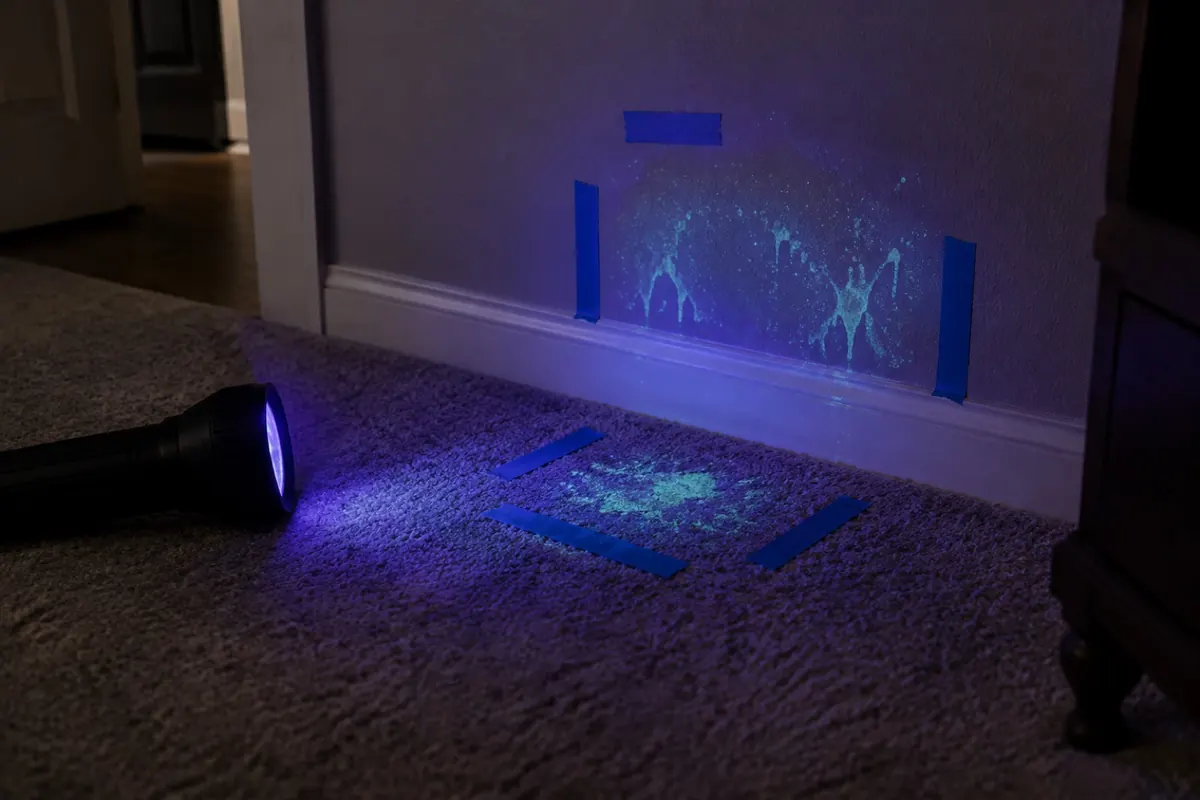
Forensic work supports the blacklight, with conditions. Miranda et al., Sci. Justice 2014 found body fluid fluorescence was lower when samples were moist and stayed constant once dry, up to the 60 days studied. So search dry surfaces in a dark room, and mark each glow with tape.
| Finding | What it tells you | Limit |
|---|---|---|
| Bright patch on carpet or baseboard | A dried deposit on the surface | Nothing about depth into pad or subfloor |
| No glow on a wet or freshly cleaned spot | Fluorescence is lower when moist | Not proof the spot is clean |
| Glow on laundered fabric or rugs | Possibly optical brighteners | The CRI notes laundry detergents can contain fluorescent dyes |
| Spatter pattern low on a wall | Spray marking | Check the back of the baseboard too |
Surface by surface: depth, treatment, replace threshold
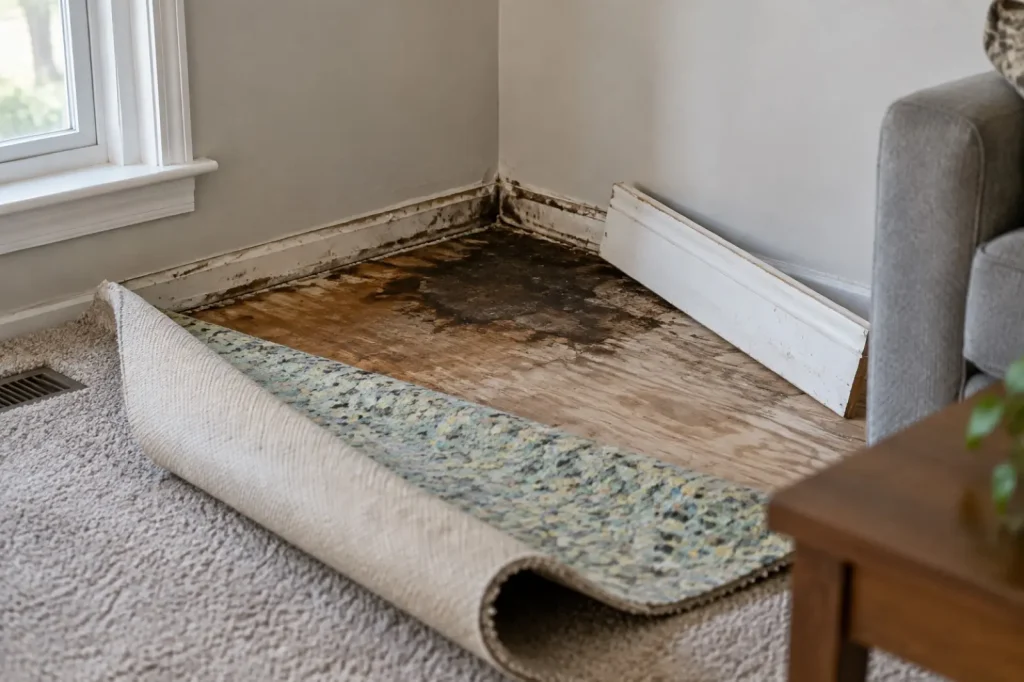
No published study measures urine penetration in millimetres by material, so the depth column names layers. Cleanfax (Ullah, 2016) notes repeated urination impregnates carpet backing and fibres and can damage subflooring, especially wood or unsealed concrete.
| Surface | How deep urine goes | Treatment | Replace threshold |
|---|---|---|---|
| Tile, sealed vinyl, glass | Stays on top; grout absorbs | Enzyme or detergent, rinse | Grout or caulk that still smells |
| Carpet face | Through fibres to the backing | Blot, saturate with enzyme past the stain edge, dwell, air dry | When odour control costs more than the carpet (Cleanfax) |
| Pad | Absorbs whatever passes the backing | Direct application or needle injection (Cleanfax) | Usually replace the section under the spot |
| Wood subfloor | Into the grain and seams | Enzyme, dry to 12% or less, shellac primer | Delaminated, soft, or smelling through primer |
| Concrete slab | Into pores of unsealed concrete | Enzyme with long dwell, dry, primer rated for masonry | Rarely replaced; seal or cover |
| Baseboard | Wicks into the unfinished back | Remove, check the back, treat or discard | Back is stained or smells |
| Drywall | Paper face and gypsum at the bottom edge | Enzyme, dry, primer | Odour through primer; cut the bottom |
| Washable fabric | Through the weave | Enzyme soak, wash per the care label, air dry | Odour after repeated washes |
Cat pee smell in carpet and pad
- Blot fresh urine, never scrub. The CRI says work from the edges inward. Why this differs: scrubbing spreads urine into a wider pad patch.
- Saturate past the stain edge. Cleanfax says pad and backing need direct application. Why: a surface spray treats fibres while the reservoir stays in the pad.
- Dwell, then air dry. Overnight for older spots, per Rocco and Roxie. Why: generic advice to steam clean first adds heat that deactivates the product.
- Lift an edge if it returns. Why: repeat failures point to the pad or subfloor, not the face; see why pad is replaced, not dried.
Cat urine on subfloor and concrete: seal, with the data sheet open
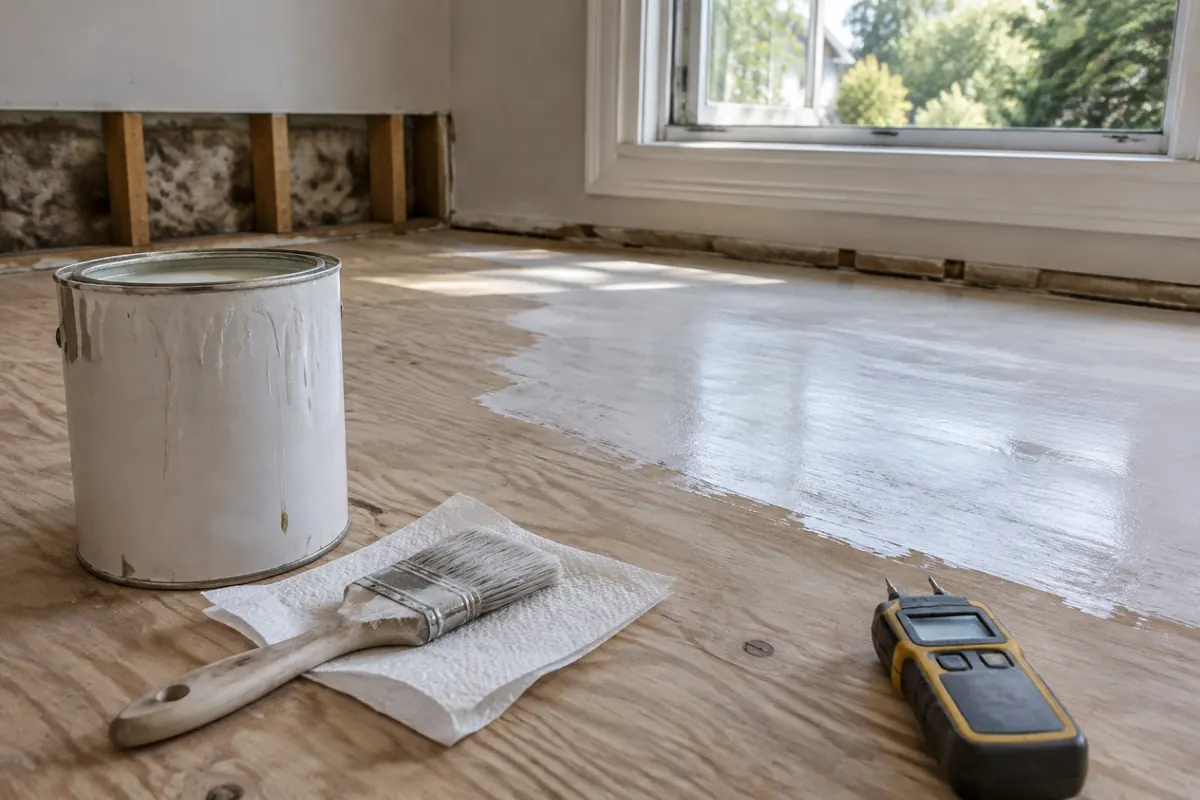
Once carpet and pad are up, a stained subfloor is usually sealed rather than replaced, after an enzyme treatment and a full dry. The data sheets matter more than forum advice here.
| Product | Odour claim on the sheet | Floors | Substrate condition |
|---|---|---|---|
| Zinsser Europe B-I-N data sheet | Seals urine odours and other animal odours | Not recommended for floors | Per the sheet, under 12% moisture and 70% RH |
| Zinsser B-I-N spray data sheet | Seals odours from water and fire damage | Not addressed; interior only | Clean, dry, sound |
| Zinsser ODORLESS bulletin | Points to B-I-N for long-term odour sealing on warm humid days | Not for floors | 12% maximum moisture |
| KILZ Original data sheet | Seals pet, food and smoke odours | Not for use on floors | Masonry cured at least 90 days |
Read literally, every sheet that addresses floors excludes them. Whether a subfloor that will be covered counts is not answered on the sheets; KILZ prints a technical service line, 1-877-KILZ-PRO, and that question belongs there before you commit. Measure moisture first, because a shellac coat over damp wood fails. Our subfloor water damage guide covers drying, meters and when sheathing has to be replaced.
Concrete is porous and alkaline. The ODORLESS bulletin rates that primer for surfaces up to pH 12.5, poured concrete included, and the KILZ sheet requires masonry cured at least 90 days. Give enzyme cleaner a long dwell on a slab, dry it, then prime or cover.
Drywall and baseboards: where spraying ends up
Marking goes on vertical surfaces, per the ASPCA, so check the bottom of the wall even when the carpet is clean. Pull the baseboard: its unfinished back and the drywall edge behind it are where urine wicks. A cheap baseboard with a stained back is replaced, not cleaned. Treat drywall paper with enzyme, dry it, then prime; the KILZ sheet lists drywall as a recommended surface. If odour comes through primer, cut out the bottom of the wall; our wet drywall guide covers cut height.
Clean, seal or replace: which situation are you in?
| Situation | Do this | Escalate if |
|---|---|---|
| One fresh spot on carpet | Blot, enzyme, dwell, air dry | It smells again on a humid day |
| Old spot, ammonia smell | Lift the carpet; enzyme the pad and subfloor | Pad is stained wider than the carpet |
| Spray marks on walls | Pull baseboards; enzyme and prime drywall | Odour through primer |
| Several rooms, years of use | Remove carpet and pad; seal subfloors | Odour persists after sealing |
| Many cats, saturated house | Professional odour work | Hoarding-level conditions |
Signs it is bigger than the visible spot
- Odour with no glow anywhere: the urine is below the surface.
- Soft, dark or delaminating subfloor: a structural repair.
- Smell spreading through the house when the heat runs; EPA's guide to air cleaners notes home furnace filters target particles, not gases.
- Odour that survives sealing: professional work, sometimes including an ozone treatment in an empty building.
For contractors
| Record | Why |
|---|---|
| UV map on dry surfaces, photos with tape marks | Defines scope beyond what the customer can see |
| Moisture readings on subfloor before priming | Per the Zinsser sheets, substrate moisture must not exceed 12% |
| Pad and baseboard removed by room, with reasons | Removal lines need a reason |
| Product, dwell and number of applications | Callbacks are usually a skipped dwell |
| Primer brand and the floor-use question asked | The sheets exclude floors |
| Policy wording, if a claim is filed | The ISO HO 00 03 05 11 form excludes under Coverage A and B loss caused by discharge or release of waste products by any animals, and by animals owned or kept by an insured. Whether a policy responds is for the carrier and the state insurance department. |
Price by layer; see how Xactimate pricing works. More odour work is under the fire, smoke and odour hub, and skunk odour is on our skunk smell page.
Not covered here. Why a cat soils the house is a behaviour and veterinary question. The ASPCA litter box guidance says a veterinary check comes first, and the AAFP and ISFM house-soiling guidelines (2018) are the reference for vets; this page gives no veterinary advice.
Questions people actually ask
Does vinegar get rid of cat urine smell?
Partly. White vinegar is about 5% acetic acid according to the Carpet and Rug Institute, so it can neutralize ammonia. It does not remove the felinine residue that keeps producing the catty thiol MMB, so the smell tends to return. Never mix it with bleach, which releases chlorine gas.
What is the best enzyme cleaner for cat urine?
This page found no independent peer-reviewed ranking. The ASPCA recommends an enzymatic cleanser designed for pet odours. Use it generously enough to reach the pad, leave it to dwell, overnight for older spots per one maker’s FAQ, and air dry without steam, since heat can deactivate it.
Why does cat urine smell come back when it is humid?
Dried residue re-wets. Robins and colleagues identify ammonia and the thiol MMB as products of the breakdown of urea and felinine, and the precursors remain in a dried stain. Cleanfax notes humidity can increase odours. A treated spot should be judged on a humid day.
Can I use bleach on cat urine?
Not on urine itself. The Washington State Department of Health warns that bleach mixed with ammonia produces toxic chloramine gases and lists urine as a source of ammonia. Clean the urine out first with an enzyme or detergent product, rinse, and never mix cleaning chemicals.
Will a blacklight show old cat urine?
Usually, on dry surfaces. A forensic study by Miranda and colleagues found body fluid fluorescence stayed constant once dry, up to 60 days, and was lower when moist. It shows the surface only, and laundry brighteners can glow too, according to the Carpet and Rug Institute.
Can you paint over cat urine on a subfloor?
Only after enzyme treatment and a full dry. According to Zinsser’s European B-I-N sheet, it seals urine odours and needs substrate moisture under 12%. Both it and the KILZ Original sheet say not for floors, so ask the manufacturer before sealing a subfloor.
Why does male cat urine smell so strong?
Felinine. Hendriks and colleagues report entire males excrete about 3 times the felinine of castrated males per kilogram of bodyweight, and felinine is the precursor of the sulfurous thiol MMB that gives cat urine its catty smell. Castrated males still excrete it, at lower levels.
Sources
- Miyazaki et al., Chem. Biol. 2006, 13(10):1071, PubMed. Retrieved 30 October 2026.
- Hendriks et al., Physiol. Behav. 1995, 58(3):467, with 1996 erratum, PubMed. Retrieved 30 October 2026.
- Hendriks et al., Comp. Biochem. Physiol. 1995, 112(4):581, PubMed. Retrieved 30 October 2026.
- Robins et al., J. Feline Med. Surg. 2022, 24(2):123, PubMed. Retrieved 30 October 2026.
- Miranda et al., Sci. Justice 2014, 54(6):427, PubMed. Retrieved 30 October 2026.
- ASPCA litter box guidance and ASPCA urine marking guidance. Retrieved 30 October 2026.
- AAFP and ISFM house-soiling guidelines (2018), J. Feline Med. Surg., PubMed. Retrieved 30 October 2026.
- Carpet and Rug Institute urine entry, Urine, Dry. Retrieved 30 October 2026.
- Rocco and Roxie FAQ. Retrieved 30 October 2026.
- Washington State Department of Health, undated. Retrieved 30 October 2026.
- Cleanfax (Ullah, 2016), The Remediation of Urine, 1 January 2016; trade press. Retrieved 30 October 2026.
- KILZ Original data sheet, No. 1000, revised 5/2019. Retrieved 30 October 2026.
- Zinsser B-I-N spray data sheet, BIN-08, rev. 120822. Retrieved 30 October 2026.
- Zinsser Europe B-I-N data sheet, French-language, undated. Retrieved 30 October 2026.
- Zinsser ODORLESS bulletin, TDB-BEO 350, rev. 111808. Retrieved 30 October 2026.
- EPA's guide to air cleaners, updated 1 October 2026. Retrieved 30 October 2026.
- ISO HO 00 03 05 11 form, ISO 2010, Maine Bureau of Insurance copy. Retrieved 30 October 2026.
- The male ratio is arithmetic on Hendriks et al. Nothing here was tested by us; see our methodology.
Test any cleaner on a hidden area, never mix cleaning chemicals, and follow the primer label and ventilation rules.