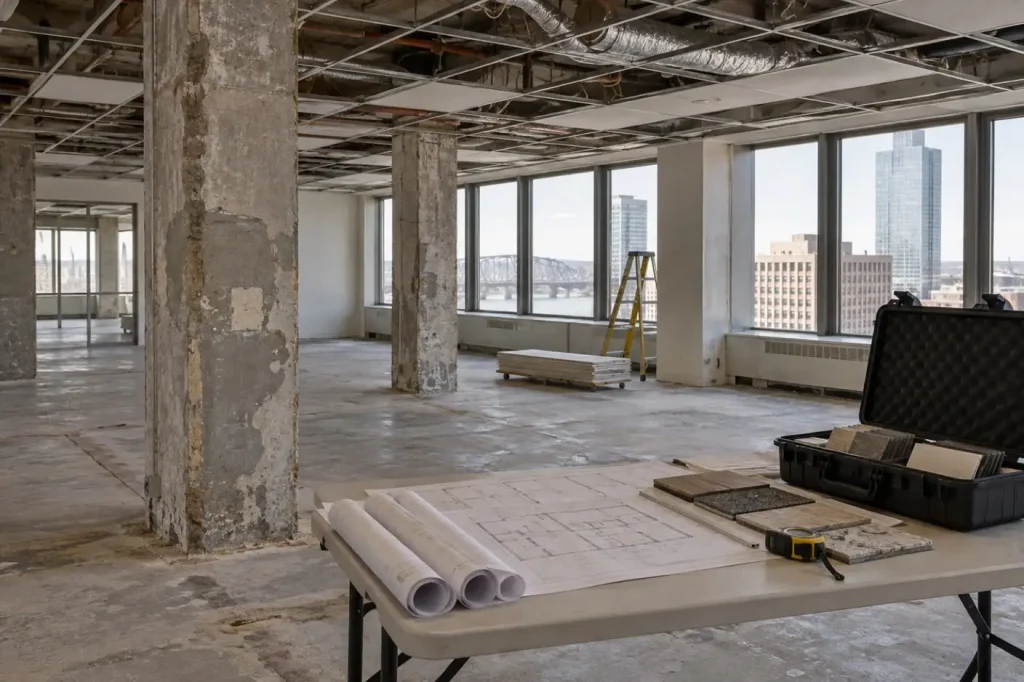
The short answer
An asbestos survey is a structured search of a building for asbestos-containing materials that ends in a report locating, quantifying and assessing each one. ASTM E2356-26 defines three types: baseline, project design and pre-construction. The law decides which you need: AHERA in schools, the asbestos NESHAP before renovation or demolition, and OSHA before construction work.
Key takeaways
- The current ASTM standard is E2356-26, and it names three survey types, not two. Specifications written to E2356-18 cite a superseded edition.
- A baseline survey avoids destructive testing; a pre-construction survey breaks into concealed spaces that the work will open.
- The NESHAP covers the affected part of the facility, nonfriable material included, and a demolition needs a notice even when the survey finds no asbestos.
- OSHA puts the duty on the building owner, and its general industry rule keeps the records for the duration of ownership.
- The UK splits surveys into a management survey and a refurbishment and demolition survey under HSE’s HSG264. Those terms have no standing in US law.
- New York requires a survey before any demolition, renovation, remodel or repair, regardless of construction date.
On this page
- Survey or inspection?
- The three ASTM E2356 survey types
- Which law calls for which survey
- The AHERA management-plan inspection
- Pre-renovation and pre-demolition surveys
- OSHA: the building owner’s duty
- UK only: management and refurbishment and demolition surveys
- What the survey report must include
- Which survey do you need?
- For contractors
- Questions people actually ask
The pages ranking for this term are consultants’ service pages and a UK blog. They rarely say which survey type the job needs or which rule asks for it. This page sets the survey types against the rules that trigger them. Who may do the work, and the AHERA inspector training, are on our asbestos inspection page.
What this page does not cover: health, which belongs with the EPA homeowner guidance and a doctor, and prices, which are on our asbestos testing cost page. UK material is labelled UK throughout.
Survey or inspection: one job, several names
The words differ by rulebook, not by the work. US federal law says inspection; ASTM, New York and the UK say survey.
| Rulebook | Word used | What it requires |
|---|---|---|
| AHERA, schools | Inspection | 40 CFR 763.85: identify all friable and nonfriable ACBM |
| Asbestos NESHAP | Thoroughly inspect | 40 CFR 61.145(a): the affected facility or part |
| OSHA construction | Determine presence | 29 CFR 1926.1101(k)(2): presence, location and quantity |
| New York Code Rule 56 | Asbestos survey | By a certified New York State Asbestos Inspector |
| ASTM E2356-26 | Comprehensive building asbestos survey | Locate, identify, quantify and assess |
| UK, HSG264 | Management or R&D survey | UK only; see the UK section |
ASTM draws the useful line: per its Note 2, collecting one or a few samples to check a single material does not constitute a survey. A survey covers a defined area, records what was not inspected and why, and ends in an assessed report.
The three ASTM E2356 survey types
ASTM’s product page, last updated 27 February 2026, lists E2356-26 as the active edition of the Standard Practice for Comprehensive Building Asbestos Surveys, under Committee D22. Its scope covers locating, identifying, quantifying and assessing asbestos-containing materials, and excludes air and dust sampling. Per ASTM E2356-26, section 4.2, the three types are:
| Baseline survey | Project design survey | Pre-construction survey | |
|---|---|---|---|
| Area | Building or facility wide | Areas the abatement affects | Planned limits of construction |
| Destructive testing | Avoided | Often required | Required if concealed spaces will be breached |
| Assumed material | Allowed in some cases | Typically confirmed by sampling | Followed by project design if ACM found |
| Used for | Long-term management, O&M, OSHA signage | Abatement plans and specifications | Renovation or demolition with no survey |
| NESHAP | Not stated by ASTM | Not stated by ASTM | Satisfies thorough inspection, per ASTM |
Two scope notes matter in practice. ASTM’s Note 1 says a baseline survey is sometimes called an AHERA survey but also covers materials AHERA excludes, and section 4.5 brings in exterior equipment and crawl spaces. Section 4.4 tells the surveyor to document why any functional space was not inspected. ASTM’s Note 3 adds that EPA’s 7 August 2015 letter, ADI item A150001, accepts the pre-construction survey for the NESHAP thorough inspection.
The latest gap is the longest, at 8 years, so many specifications still cite E2356-18. Ask which edition your contract names.
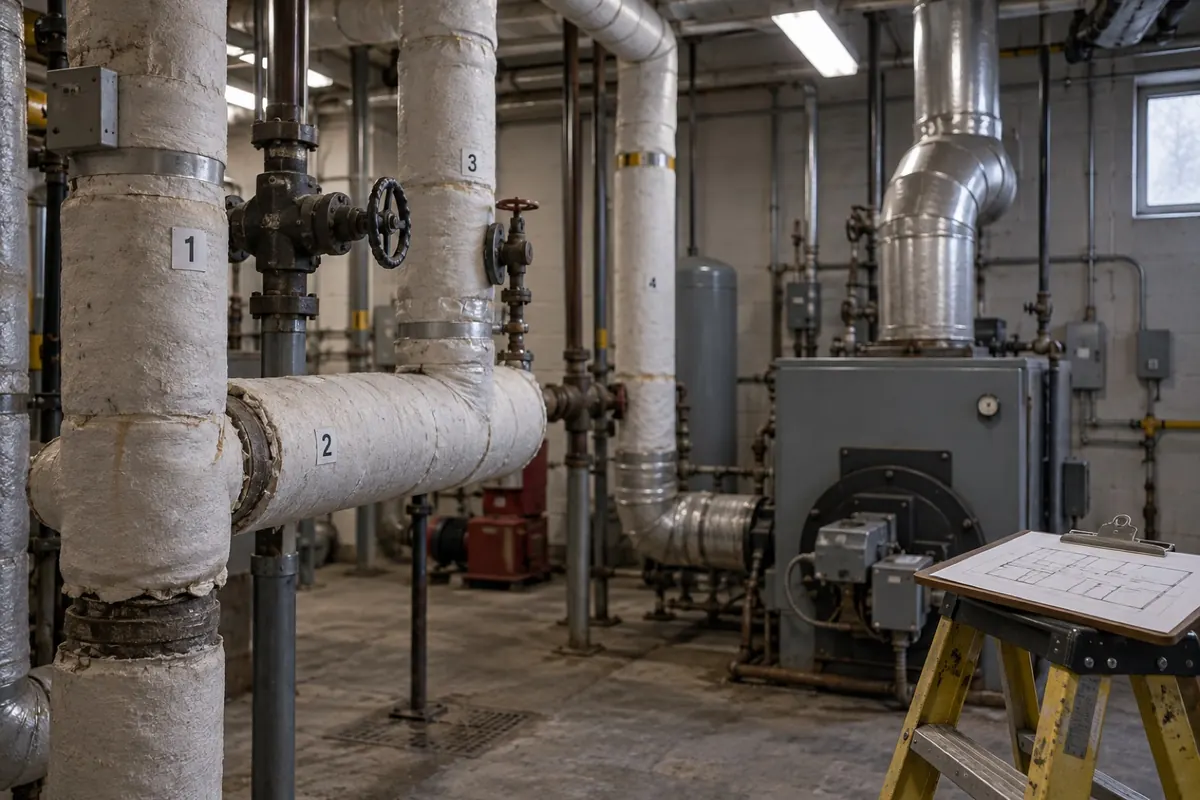
Which law calls for which survey
| Trigger | Rule | Survey scope | Notes |
|---|---|---|---|
| Using a building as a school | AHERA, 763.85 and 763.93 | Every school building, all ACBM | Reinspect every 3 years |
| Renovating or demolishing a facility | NESHAP, 61.145(a) | Affected facility or part | Excludes houses of four or fewer units, per 61.141 |
| Construction work in a building | OSHA, 1926.1101(k) | The work site | Owner determines before work begins |
| Permit in New York | Code Rule 56 | Building or portion worked on | Regardless of construction date |
| UK non-domestic premises | CAR 2012, regulation 4 | Reasonably accessible parts | UK only |
States add their own rules on top; the federal set is summarized on our sibling page on asbestos regulations.
The AHERA management-plan inspection
In schools the survey feeds a management plan. Per 40 CFR 763.93(e), an accredited management planner writes it, and it must hold, for each inspection, a blueprint or description locating each homogeneous area and the exact location of each bulk sample, the lab analyses, the assessments, the response actions with a schedule, and plans for reinspection, operations and maintenance and periodic surveillance.
| Clock | Rule | What happens |
|---|---|---|
| Every 6 months | 763.92(b) | Visual check of all known or assumed ACBM; record changes |
| Every 3 years | 763.85(b) | Reinspection by an accredited inspector |
| Each school year | 763.93(g)(4) | Written notice that plans are available |
| Within 5 working days | 763.93(g)(3) | Plan available to the public on request |
Within one 3-year reinspection cycle that is 6 surveillance visits. Sampling minimums for the inspection itself are in 40 CFR 763.86 and on our inspection page.
Pre-renovation and pre-demolition asbestos surveys
40 CFR 61.145(a) requires the owner or operator, before work starts, to thoroughly inspect the affected facility or part of it for asbestos, including Category I and Category II nonfriable material. 40 CFR 61.141 excludes residential buildings of four or fewer dwelling units, though the Florida DEP FAQ notes the exclusion fails where the house is part of a larger project or was used commercially, and that the rules have no exclusion date.
A pre-demolition asbestos survey covers the whole building. Full removal and notice duties start at 260 linear feet on pipes, 160 square feet on other components or 35 cubic feet off components, per 61.145(a)(1), but a demolition below those amounts, even with no asbestos, still needs a notice under 61.145(a)(2), which the Florida DEP FAQ confirms.
| Notice item, 61.145(b)(4) | What the survey must supply |
|---|---|
| (iv) Size, age, present and prior use | Building description |
| (v) Procedure and analytical methods | Survey method and lab method |
| (vi) Amount of RACM to remove | Linear feet, square feet or cubic feet |
| (vi) Category I and II left in place | Quantities not removed before demolition |
| (vii) Location to floor or room | Room-level locations |
Per 40 CFR 61.145(c)(1), RACM is removed before demolition, except Category I nonfriable material not in poor condition, Category II unlikely to crumble, material encased in concrete and kept wet, and material that was not accessible for testing and is found only once demolition begins. Surveys therefore list inaccessible areas by name. Our asbestos abatement page covers the removal.
OSHA: the building owner’s duty
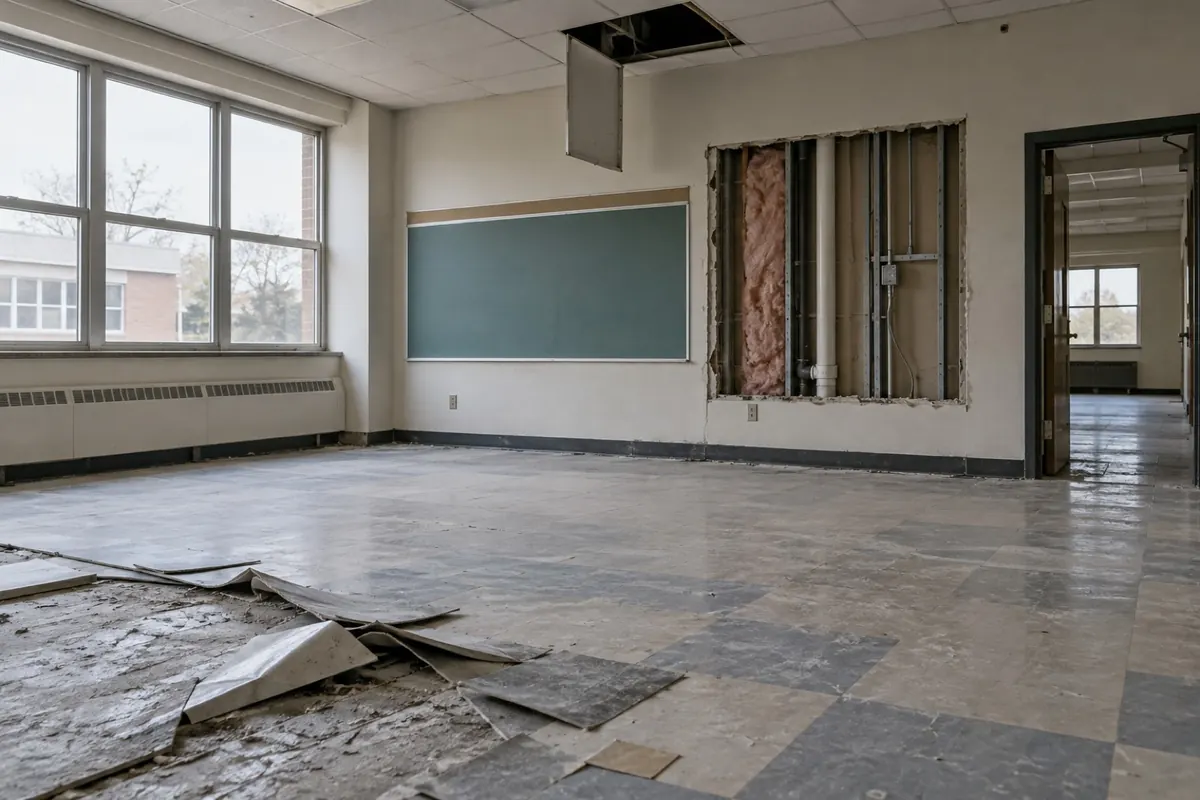
Under 29 CFR 1926.1101(k)(2), building and facility owners must determine the presence, location and quantity of asbestos and presumed asbestos before construction work begins, and tell bidding employers, their own employees, other employers on site and tenants. Per (k)(1), thermal system insulation and surfacing material in buildings constructed no later than 1980, and asphalt and vinyl flooring installed by then, are treated as asbestos unless rebutted. Per (k)(5), rebuttal takes an AHERA inspection or sampling by an accredited inspector or certified industrial hygienist.
The general industry rule, 29 CFR 1910.1001(j)(3), has owners keep those records for the duration of ownership and transfer them to the next owner. The survey is a property record; definitions are on our asbestos containing material page.
UK only: management and refurbishment and demolition surveys
This section describes Great Britain’s rules. They do not apply in the US, but many searches use the UK terms.
The HSE HSG264 page lists Asbestos: The survey guide, HSG264, second edition 2012, written for surveyors and for dutyholders of non-domestic premises. The duty comes from regulation 4 of the Control of Asbestos Regulations 2012, which requires an assessment of whether asbestos is present, an inspection of reasonably accessible parts, and a written plan where it is. HSE HSG264 names two types.
| Management survey | Refurbishment and demolition survey | |
|---|---|---|
| Purpose | Find ACMs that normal use and maintenance could disturb, and assess condition | Find all ACMs in the work area, or the whole building for demolition |
| Intrusion | Minor intrusive work | Fully intrusive and destructive |
| Presuming | Allowed, with condition assessed | Condition normally not assessed |
| Occupancy | Building in use | Unoccupied areas; checked fit for reoccupation after |
| Closest ASTM type | Baseline | Pre-construction |
HSG264 also says properties built in 2000 or later can be grouped as asbestos free, while pre-2000 properties are classed as possibly containing ACMs, and that survey organisations can show competence through ISO/IEC 17020 accreditation from UKAS.
What the survey report must include
No single US rule prints a survey report format outside schools. The checklist below combines what each rulebook asks for, which makes it a fair test of any asbestos survey report.
| Report item | Why | Required or advised by |
|---|---|---|
| Type of survey and scope, with exclusions and reasons | Shows what was not looked at | ASTM 4.4; HSG264 para 136 |
| Areas not accessed, named, and presumed ACM | Inaccessible material changes the demolition plan | HSG264 paras 134, 140; 61.145(c)(1) |
| Each homogeneous area with exact sample locations | Lets the abatement firm find it | 763.93(e)(3) |
| Quantities in linear feet, square feet or cubic feet | Feeds the NESHAP notice | 61.145(b)(4)(vi) |
| Lab name, method, analyst and date | The notice must state methods | 763.93(e)(3); 61.145(b)(4)(v) |
| Condition and potential for disturbance | Sets priorities | ASTM 1.4.5; EPA homeowner guidance |
| Drawings marked with ACM locations | Becomes the register | ASTM 1.4.6; HSG264 para 137 |
| Materials sampled and found negative, listed apart | Ends later arguments | HSG264 para 141 |
Lab method detail, including why a negative floor tile result may need TEM, is on our asbestos testing lab page.
Which survey do you need? The decision path
Stop at the first step that fits.
- A school? AHERA inspection and management plan, reinspected every 3 years.
- Demolishing anything but a house of four or fewer units? Whole-building pre-demolition survey, then a NESHAP notice even if nothing is found.
- Renovating a commercial, public or larger residential building? Pre-construction survey of the work area, then a project design survey if asbestos is found.
- Owning a building where trades will work? A baseline survey meets OSHA’s duty to know what is there and, done to OSHA’s rebuttal standard, lifts the presumption on materials that test negative.
- In New York? A survey by a certified inspector before any demolition, renovation, remodel or repair, unless the building is assumed to contain asbestos.
- A house, no permit rule, undamaged material? The EPA homeowner guidance says intact material that will not be disturbed needs no testing.
For contractors
- Scope. Ask for the survey type, edition and date before you price. A baseline survey avoided destructive testing, so it may not cover the wall you are opening.
- Duty. The owner must tell bidders what is there under 1926.1101(k)(2); put that request in writing.
- Documentation. Keep the report, drawings and lab results with the job file; owners must keep them for the duration of ownership.
- What an adjuster asks for. The pre-loss survey if one exists, the post-loss survey of the affected area, and the NESHAP notice if one was filed.
- The line item. Survey, lab analysis and abatement are three lines, ideally from separate firms, as EPA advises.
Every standard we cover is indexed on the standards hub, and the state programmes are on our accreditation map.
Questions people actually ask
What is an asbestos survey?
A structured search of a building, or the part about to be worked on, for asbestos-containing materials. The surveyor inspects, samples or presumes suspect materials, has samples analyzed, assesses condition and writes a report with locations, quantities and drawings. ASTM E2356-26 defines baseline, project design and pre-construction surveys.
Is an asbestos survey required?
Often. AHERA requires school inspections, the asbestos NESHAP requires a thorough inspection before renovating or demolishing most buildings other than houses of four or fewer units, and OSHA requires owners to determine what is present before construction work. New York requires a survey before any demolition, renovation, remodel or repair, regardless of construction date.
How much will an asbestos survey cost?
It depends on building size, the number of homogeneous areas, how intrusive the survey must be and lab turnaround. Scope drives it: a pre-demolition survey is destructive and covers the whole building, while a baseline survey avoids destructive testing. Our asbestos testing cost page compares published survey and lab price lists from named firms.
Is it worth getting an asbestos survey?
Where a rule requires one, it is not optional. Where none does, a survey replaces presumptions with results: OSHA treats insulation and surfacing in buildings from 1980 or earlier as asbestos until rebutted, and HSE notes that presuming makes the dutyholder manage some non-asbestos materials as if they were.
What is a pre-demolition asbestos survey?
A whole-building survey before demolition, built to find all asbestos, including inside walls, floors and ceilings, so it can be removed first. In the US it answers the NESHAP thorough inspection duty in 40 CFR 61.145(a). In the UK the equivalent is HSE’s refurbishment and demolition survey.
What should an asbestos survey report include?
The survey type and scope, areas not accessed and why, each homogeneous area with sample locations, quantities, lab name and method, a condition assessment, marked-up drawings and a separate list of materials found negative. Those items come from ASTM E2356-26, the AHERA plan rule, the NESHAP notice rule and HSG264.
What is the difference between a management survey and a refurbishment and demolition survey?
Both are UK terms from HSE’s HSG264. A management survey finds asbestos that normal occupancy and maintenance could disturb, with minor intrusion. A refurbishment and demolition survey is fully intrusive, finds all asbestos in the work area or whole building, and is done in unoccupied areas.
Sources
- ASTM E2356-26, Standard Practice for Comprehensive Building Asbestos Surveys, ASTM product page (active edition, updated 27 February 2026) with scope and section 4. Retrieved 18 October 2026.
- 40 CFR 763.85, 40 CFR 763.86, 40 CFR 763.92 and 40 CFR 763.93, AHERA. eCFR, Title 40 as of 15 October 2026. Retrieved 18 October 2026.
- 40 CFR 61.141 and 40 CFR 61.145, asbestos NESHAP. eCFR. Retrieved 18 October 2026.
- 29 CFR 1926.1101 (b), (k) and 29 CFR 1910.1001 (j)(3). eCFR, Title 29 as of 14 October 2026. Retrieved 18 October 2026.
- New York DOL survey notice, P232 (January 2026), 12 NYCRR 56-5.1. Retrieved 18 October 2026.
- Florida DEP FAQ, modified 17 October 2025. Retrieved 18 October 2026.
- EPA homeowner guidance, EPA, updated 25 June 2026. Retrieved 18 October 2026.
- HSE HSG264, Asbestos: The survey guide, second edition 2012, and the HSE HSG264 page (updated 7 August 2025). Retrieved 18 October 2026.
- regulation 4 of the Control of Asbestos Regulations 2012, legislation.gov.uk. Retrieved 18 October 2026.
- Sample-count and cycle figures are arithmetic on the rules above. No survey was carried out for this page. Our methodology sets out how we source everything.
Standards and rules change, and states, cities and UK nations add their own. Confirm with your state asbestos programme, delegated NESHAP agency or HSE before relying on this for a project.