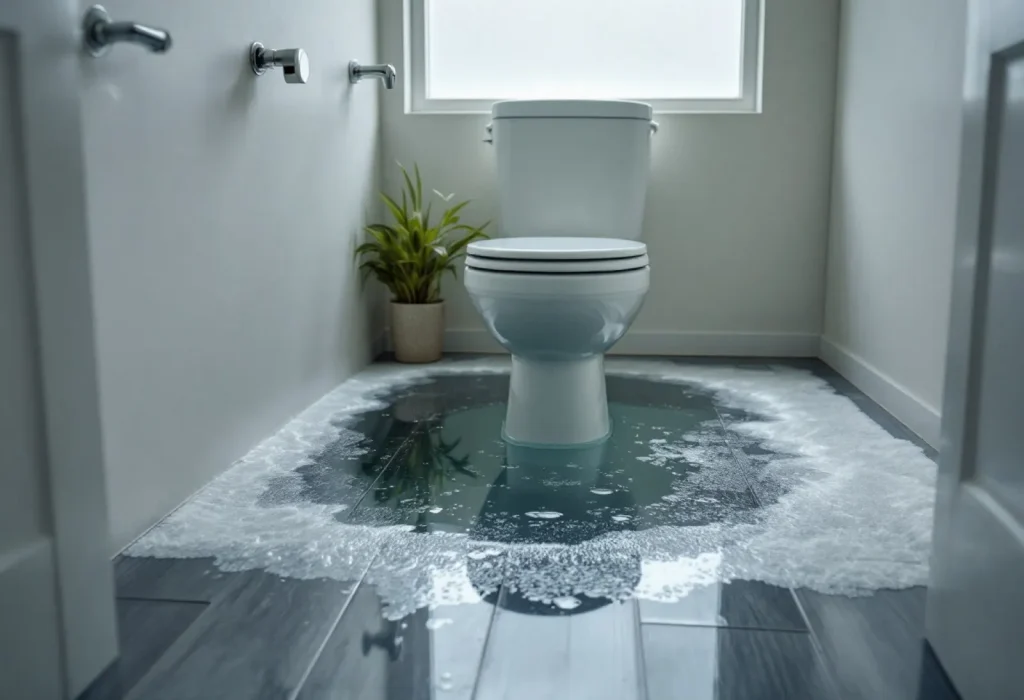
The short answer
Toilet overflow water damage is Category 1, 2 or 3 water depending on the source: a cracked tank or burst supply line is clean Category 1, a bowl overflow with urine but no feces is Category 2, and backflow from beyond the toilet trap is Category 3 whatever its colour. Gray water left untreated longer than 48 hours may be reclassified as Category 3.
Tank, bowl or beyond the trap: which category is your overflow?
Restorers sort water by contamination, not by how it looks. The Northern Arizona University Water Damage Restoration Guideline, written to the IICRC S500 standard for professional water damage restoration, gives toilet specific examples in all three categories, which is unusual and is why it is the reference used here instead of a contractor summary. The question to answer first is where the water was when it left the fixture.
| What overflowed | Category | Wording in the NAU guideline |
|---|---|---|
| Cracked or broken tank, failed supply line or fill valve | Category 1, clean water | Broken toilet tanks and bowls that do not contain contaminants or additives; broken domestic supply lines |
| Bowl overflow with some urine, no feces | Category 2, gray water | Overflows from toilet bowls with some urine (no feces) |
| Bowl overflow carrying feces | Category 3, black water | Falls outside the no feces Category 2 example and inside the sewage definition of Category 3 (our reading) |
| Water rising out of the bowl from the drain line | Category 3, black water | Toilet back flows that originated beyond the toilet trap, regardless of visible content or color |
| Tank cleaner tablet or chemical additive in the tank | Not Category 1 | The Category 1 example covers tanks and bowls without contaminants or additives only |
Two lines in that list do most of the work. The Category 2 example is limited to urine with no feces, so a bowl overflow with feces in it does not fit there and lands in the sewage definition of Category 3. And the backflow rule is explicit: water that came up from beyond the trap is black water even when it looks clear, because it has been in the drain line shared with every other fixture. A toilet that overflows on its own, without a flush, while a tub or washer drains is the classic sign of that second case.
The general system, including what Classes 1 to 4 mean for drying load, is covered on our page about IICRC water categories.
Does a clean tank overflow stay Category 1 after 48 hours?
Not reliably. The Northern Arizona University Water Damage Restoration Guideline says clean water that has contact with structural surfaces and contents may deteriorate in cleanliness as it dissolves or mixes with soils and other contaminants, and as time elapses. It gives no hour figure for that first step. A tank leak that ran across a sealed tile floor and was mopped in 20 minutes is a different job from the same water wicking into a carpet that was walked on for years.
For the second step it does give a number: gray water in a structure that remains untreated for longer than 48 hours may change to Category 3, and Category 2 water that is not removed promptly may be reclassified as Category 3. Time and temperature, the same document says, aggravate Category 2 contamination significantly. A urine only overflow found on Monday morning after a weekend away is therefore treated as black water.
The drying clock runs alongside. The EPA brief guide to mold and moisture says to dry water damaged areas and items within 24 to 48 hours to prevent mold growth, and that in most cases mold will not grow when that window is met. That window counts from when the water arrived, not from when someone noticed the stain downstairs.
Carpet pad, drywall, vinyl plank, subfloor: keep, clean or discard by category?
The table is the part no ranking page gives you: each common bathroom and below bathroom material against all three categories, with the rule that decides it. The Northern Arizona University Water Damage Restoration Guideline supplies the hard lines on carpet, drywall and insulation; EPA Table 1 water damage guidance supplies the wallboard test and the hard flooring and wood rules, which EPA states are written for clean water.
| Material | Category 1 | Category 2 | Category 3 |
|---|---|---|---|
| Carpet | Can be dried if not wet more than 48 h (NAU) | Can be dried if not wet more than 48 h (NAU) | Remove and replace, any duration (NAU) |
| Carpet cushion (pad) | Listed by NAU among coverings to assess; no separate rule | Listed by NAU among coverings to assess; no separate rule | Ask whether it goes with the carpet; NAU rule names carpeting |
| Drywall (gypsum board) | Dry in place if no swelling, seams intact (EPA); replace if drying not started in 48 h or not dry in 72 h (NAU) | Same 48 h start and 72 h finish test (NAU) | Outside EPA Table 1, which is for clean water; trained crew (NAU) |
| Wall or ceiling insulation | Remove; cannot be adequately dried and reused (NAU) | Remove (NAU) | Remove (NAU) |
| Ceiling tiles | Discard and replace (EPA) | Discard (follows from the clean water rule) | Discard (follows from the clean water rule) |
| Vinyl plank, sheet vinyl, ceramic tile | Damp wipe and dry; check the underflooring is dry (EPA) | Clean the surface; lift to check underflooring | PPE and containment required by OSHA (EPA); trained crew (NAU) |
| Hardwood floor | Dry until within 2.5% of a control reading, top to bottom gap under 1% (NAU) | Same drying target (NAU) | Outside EPA Table 1; trained crew (NAU) |
| Plywood or OSB subfloor, framing | Remove moisture now; dehumidify, gentle heat, fans (EPA wood rule) | Clean, then dry the same way | No fans until the water is cleared (EPA); trained crew (NAU) |
Carpet is where the category matters most. The NAU guideline lets drying work on carpet only if it was not wet with Category 1 or 2 water for more than 48 hours and not wet with Category 3 water for any amount of time; otherwise the carpet is removed and replaced, and kept carpet is steam cleaned, sanitized and fully dried before anyone moves back in. Steps for a clean water case are on our page on how to dry wet carpet.
Drywall has a two part test. EPA lets wallboard dry in place if there is no obvious swelling and the seams are intact. The NAU guideline adds a clock: if drying is not started within 48 hours or the board is not dry within 72 hours, all wet drywall should be replaced. Per the NAU guideline, the dry standard is a reading within 10% of an unaffected control area, so a building that reads 14% elsewhere should end no higher than 24%.
Vinyl plank is the trap. EPA’s rule for linoleum, ceramic tile and vinyl is to damp wipe, let it dry, and check that the underflooring is dry. A floating plank floor sheds water from its face and hides it underneath, so the surface can look finished while the underlayment and plywood stay wet around the flange. What to lift and how is covered on water under vinyl plank, and the plywood or OSB side on subfloor water damage.
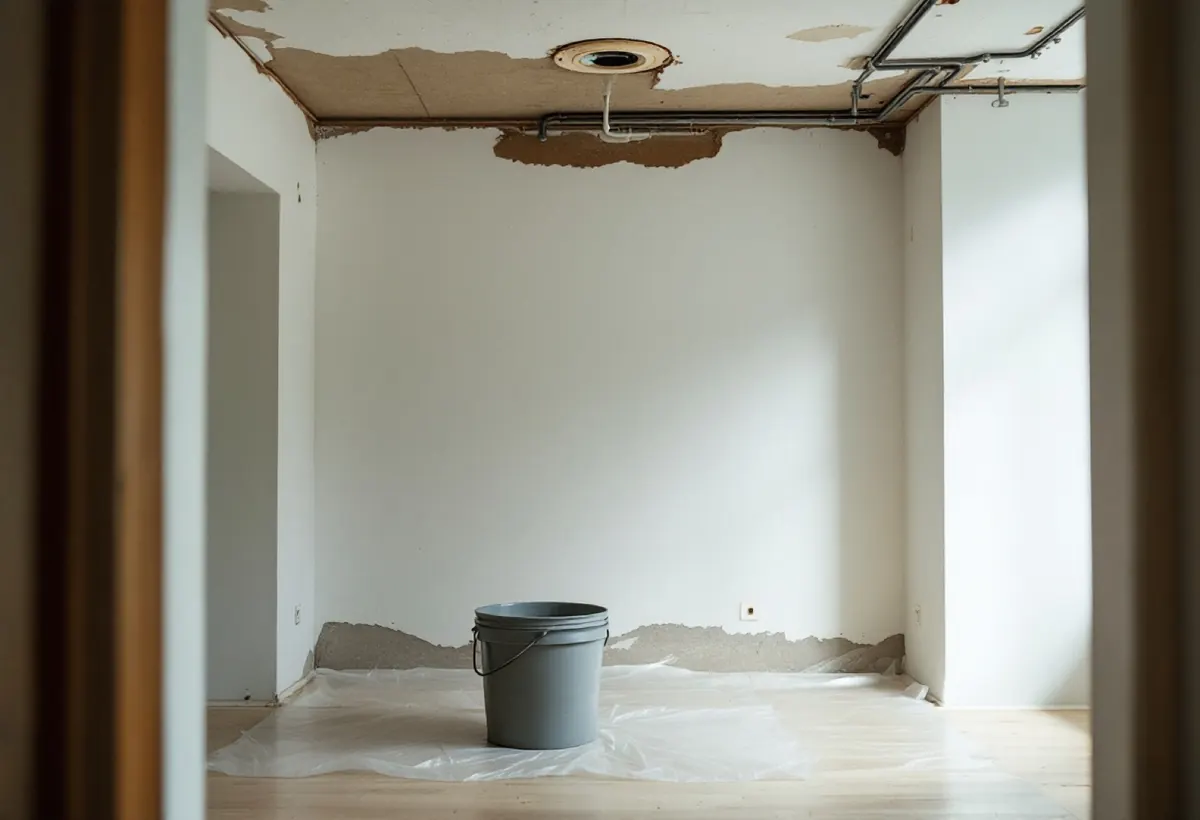
Upstairs toilet overflowed through the ceiling: what comes down?
Water that drips through a floor carries the category of its source. The Northern Arizona University Water Damage Restoration Guideline notes that clean water deteriorates as it mixes with soils and contaminants, and the cavity between a bathroom floor and the ceiling below holds dust, joists, insulation and, near the toilet, the wax ring and flange. A Category 2 or 3 overflow reaching the room below is still Category 2 or 3 when it lands.
Three rules then sort the ceiling. Any insulation in the joist bay that got wet comes out, because the NAU guideline says thermal insulation in walls or ceilings cannot be adequately dried and reused, and EPA Table 1 water damage guidance lists wet fiberglass and cellulose as discard and replace. Suspended ceiling tiles are discard and replace in the same EPA table. Gypsum ceiling board is kept only if it shows no swelling, the seams are intact, and drying started within 48 hours.
Opening the ceiling is usually how the insulation question gets answered, because a wet batt sitting on dry looking board is invisible from below. Cut lines, drying and repair for the room below are on our page about water damage on a ceiling. If you rent the lower unit, report it to the landlord in writing the same day with photos timed by the 48 hour drying window.
How much water does one overflowing flush put on the floor?
Roughly one tank. According to the EPA WaterSense residential toilet page, WaterSense labelled toilets use 1.28 gallons per flush or less, the current federal standard is 1.6 gallons, and older toilets use as much as 6 gallons, about 4.7 times a WaterSense model. When a clogged bowl is flushed, most of that refill has nowhere to go but over the rim.
The worst losses are not one flush. A fill valve that sticks open, or a supply line that splits, keeps feeding water until the stop valve behind the toilet is closed, which is why a slow Category 1 leak found after a day can wet more subfloor than a dramatic Category 3 overflow caught in a minute. Turning that stop valve clockwise is the first move in every branch of the decision path. Why a toilet keeps overflowing, or overflows with no clog, is a fill valve, vent or drain line question for our sister site theplumbingbrief.com.
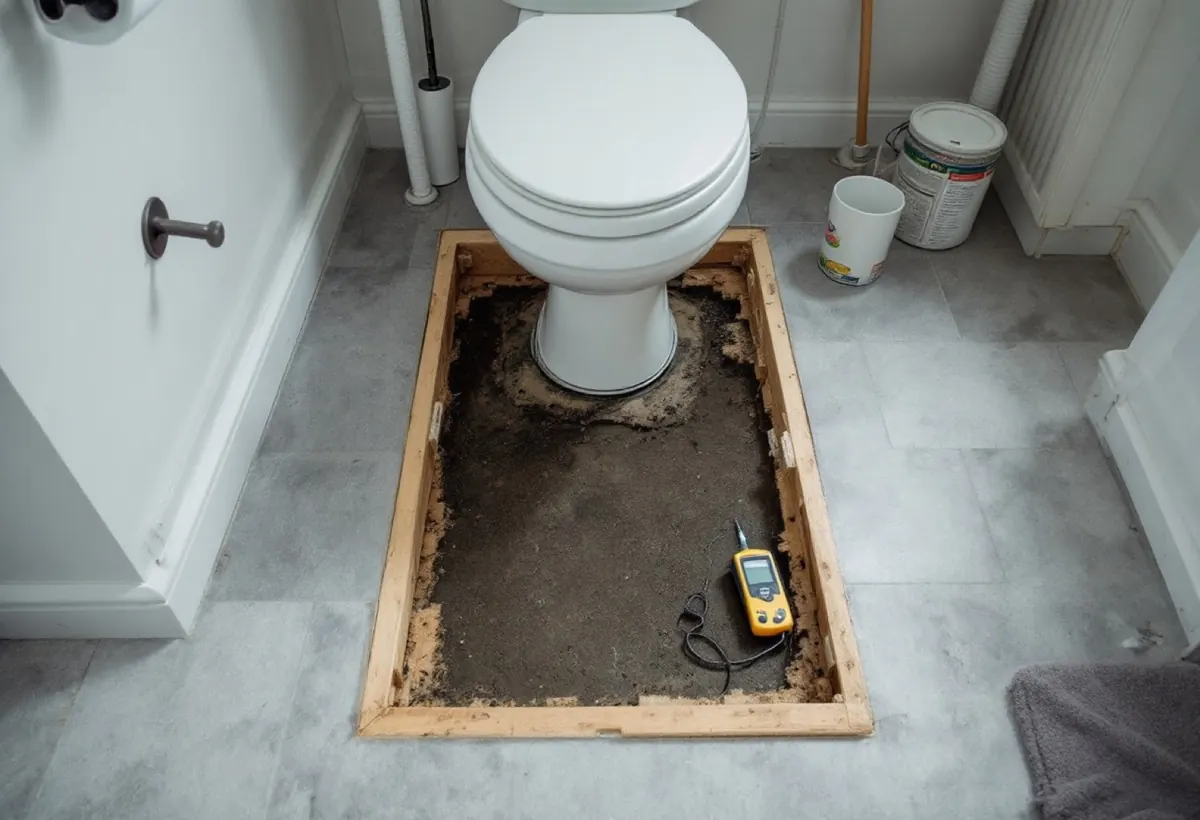
Can you clean a Category 3 toilet backflow yourself?
EPA’s answer is about equipment and training, not courage. EPA Table 1 water damage guidance says that if you know or suspect the water source is contaminated with sewage, personal protective equipment and containment are required by OSHA, that fans should not be used before determining that the water is clean or sanitary, and that an experienced professional should be consulted if you do not have expertise remediating contaminated water.
The Northern Arizona University Water Damage Restoration Guideline lists the minimum kit for anyone working in Category 3 water during initial decontamination: rubber gloves, eye protection, a protective suit and rubber boots, with an evaluation of whether respiratory protection is needed. It also requires that technicians on Category 2 and 3 jobs be trained in exposure risks and safe cleanup, and that tools leaving the area be decontaminated with an approved disinfectant or discarded.
If you hire out, ask three things before work starts: what category they have recorded for the loss and why, whether carpet and pad will be removed or cleaned under that category, and what moisture reading they will use as the dry standard. A written category matters later, because the insurer’s adjuster reads the same S500 terms. The full black water process is on our page about sewage damage cleanup.
Sudden overflow, slow seep or drain backup: which clause will the adjuster read?
The answer sits in the policy form and its endorsements, not in the category. The three source branches in the decision path above map onto three different kinds of wording, so put three questions to the insurer or a licensed agent in writing, with the date and time you found the water and the photos taken before cleanup: is a one time overflow from the tank or bowl a covered sudden and accidental discharge under my form; does any continuous or repeated seepage or leakage exclusion apply, and over what number of days, if the water had been running under the floor; and if the water rose up from the drain line (Category 3 backflow under the NAU guideline), do I carry a water backup endorsement and what is its limit.
This page does not quote a specific insurer’s form, because a filed form could not be opened for this build on 16 November 2026, and wording varies by company and state. If the answer you get conflicts with the form text, your state insurance department’s consumer line can explain how it handles the dispute. How backup endorsements work for tenants is set out on water backup coverage on renters insurance.
More water damage pages sit in the water damage hub, sorted by source and material.
Questions people actually ask
Can a toilet overflow cause damage to the floor and ceiling below?
Yes. One overflowing flush releases roughly a tank of water, 1.6 gallons on a toilet built to the federal standard per EPA WaterSense, and a stuck fill valve keeps going. Water runs under vinyl and baseboards into the subfloor and through to the ceiling, where wet insulation must come out under the NAU guideline.
What do I do first if my toilet is overflowing right now?
Close the stop valve on the wall behind the toilet by turning it clockwise, then stop flushing. Note the time and photograph the water before mopping, since the category depends on what was in the bowl and the EPA drying window is 24 to 48 hours from that moment. If water is rising with no flush, do not run other drains: that is backflow from beyond the trap.
What is the likelihood of mold after a toilet overflow?
Low if everything wet is dried within 24 to 48 hours: EPA says in most cases mold will not grow when that window is met. The risk sits in what stays wet unseen, such as plywood under vinyl plank and insulation above the ceiling below, which the NAU guideline says cannot be dried and reused.
Is toilet water that overflowed without a clog still Category 2?
It depends on where it came from, not on the clog. Clean water from a cracked tank or failed fill valve that never entered the bowl is Category 1 under the NAU guideline. Water that left the bowl with urine is Category 2, and water that rose up from the drain line is Category 3 regardless of colour, even if the bowl looked clean.
Can I keep carpet that was soaked by a toilet overflow?
Only for Category 1 or 2 water, and only if it was not wet for more than 48 hours, under the NAU guideline written to IICRC S500. Carpet touched by Category 3 water for any length of time is removed and replaced. Kept carpet must be steam cleaned, sanitized and fully dried before the room is used again.
Sources
- Northern Arizona University Water Damage Restoration Guideline, Northern Arizona University, Water Damage Restoration Guideline (PDF created 2009), written to the IICRC S500 Standard and Reference Guide for Professional Water Damage Restoration: category definitions and toilet examples, the 48 hour rule, drying standards for carpet, drywall, hardwood and insulation, PPE. Retrieved 16 November 2026.
- EPA Table 1 water damage guidance, U.S. Environmental Protection Agency, Mold Remediation in Schools and Commercial Buildings, Chapter 4, Table 1: Water Damage, Cleanup and Mold Prevention. Retrieved 16 November 2026.
- EPA brief guide to mold and moisture, U.S. Environmental Protection Agency, A Brief Guide to Mold, Moisture and Your Home. Retrieved 16 November 2026.
- EPA WaterSense residential toilet page, U.S. Environmental Protection Agency WaterSense, Residential Toilets: gallons per flush. Retrieved 16 November 2026.
- The decision path and the material by category table combine the rules above; cells marked as our reading are inferences, not quoted lines. Our methodology sets out the standing rules. All sources opened 16 November 2026.
This page describes published guidance and policy language; it does not say what any reader’s own policy pays or replace an on site assessment. Health questions about sewage exposure belong with a doctor or your local health department.