The short answer
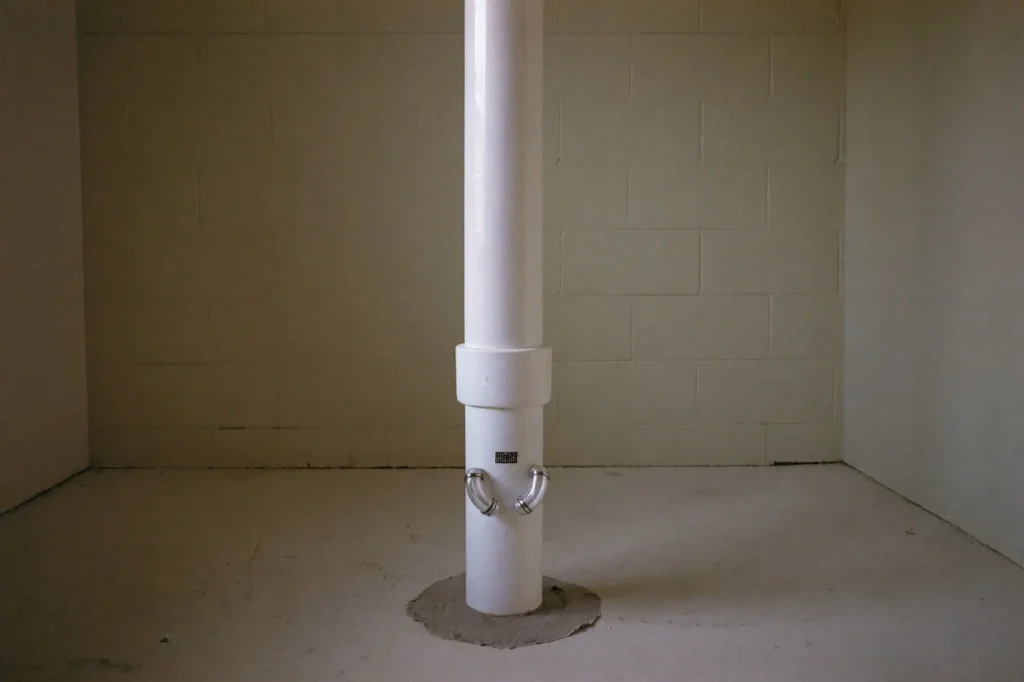
Sub-slab depressurization is a fan and pipe system that pulls soil gas from beneath a concrete floor so the air under the slab sits at lower pressure than the room above, reversing the flow that carries radon or chemical vapor indoors. It is checked with a micromanometer at test holes and a radon test 24 hours to 30 days after the fan starts.
Key takeaways
- EPA’s Consumer’s Guide calls active subslab suction the most common and usually the most reliable radon reduction method.
- The current consensus standard for houses is ANSI/AARST SGM-SF-2023; RMS-LB was folded into SGM-MFLB-2023.
- Minnesota’s default pass mark is 3 Pa in winter and 5 Pa in summer at every test hole, measured with exhaust appliances running.
- The U-tube on the pipe reads suction in the pipe, not under the far corner of the slab.
- EPA: test 24 hours to 30 days after start-up, for 2 to 7 days, then every 2 years.
What does the fan actually do to the air under the slab?
A house pulls on the soil. Warm air rising and exhaust appliances leave the lowest floor slightly below the pressure of the soil gas beneath it, and the EPA's 2015 vapor intrusion technical guide (OSWER 9200.2-154, June 2015) names that under-pressurization as the driving force for vapor entry. An SSD fan reverses the gradient: it extracts soil gas from below the slab and vents it outdoors so the sub-slab side is the lower pressure.
The hardware is small. The ITRC sub-slab depressurization technology sheet (Interstate Technology and Regulatory Council, January 2026) describes a vertical pipe of 3 to 6 inch nominal diameter through a cored hole, over a suction pit made by removing about 1 to 3 cubic feet of fill, and notes that the pit performs best left open rather than backfilled with stone. EPA’s 2015 guide gives the pit a 6 to 18 inch radius.
How far the suction reaches depends on what lies under the concrete. EPA’s EPA Consumer's Guide to Radon Reduction (EPA 402/K-10/005) says the number and location of suction pipes depends on how easily air moves in the crushed rock or soil under the slab, and that often only a single suction point is needed. EPA/625/R-93/011 shows the range: where an aggregate layer exists, one or two suction pipes commonly suffice, while one 2,260 sq ft basement with no measurable field extension was fitted with 20 pipes, about one per 100 sq ft.
Which standard governs an SSD system in 2026: SGM-SF, SGM-MFLB or the old RMS-LB?
The AARST standards index lists ANSI/AARST SGM-SF-2023, Soil Gas Mitigation Standards for Existing Homes, with compliance effective 1 December 2023; it replaced SGM-SF-2017-1220. For apartment blocks, schools and commercial buildings the current document is SGM-MFLB-2023, which consolidates RMS-MF and RMS-LB (both revision 12/20). A page that still cites RMS-LB as current for a large building is quoting a superseded standard.
Both cover radon and chemical vapors; ITRC notes they are free to view and generally updated every three years. EPA’s Consumer’s Guide still names ASTM E2121, the ASTM practice for installing radon mitigation systems in existing low-rise homes, as the standard to verify. States can write their own: Pennsylvania’s 25 Pa. Code 240.308 sets discharge, fan location, sealing and labelling rules in regulation.
How many pascals under the slab count as working?
EPA’s 1993 technical guidance, EPA/625/R-93/011, published its design targets in inches of water gauge. Measured in mild weather with exhaust appliances off, it calls for at least 0.015 in. WG everywhere under the slab (3.7 Pa), and ideally 0.025 to 0.035 in. WG (6.2 to 8.7 Pa) so cold weather and appliances never overwhelm the system. Measured in cold weather with appliances on, any measurable depressurization, 0.001 to 0.002 in. WG, should be sufficient.
EPA calls its own upper target ‘a very conservative design goal’ and says systems commonly work well below it. State programs set firmer numbers: the Minnesota Pollution Control Agency post-mitigation checklist asks whether every test point reached the agency default of 3 Pa in winter or 5 Pa in summer, about 0.012 and 0.020 in. WG. The MPCA calls these defaults, and its form records the actual reading at every test point rather than a single pass or fail.
How is pressure field extension tested, hole by hole?
Before installation, the quick version is qualitative. EPA’s Consumer’s Guide describes a soil communication test: a vacuum cleaner hose in one small hole and chemical smoke at a second hole shows whether suction pulls air across. EPA/625/R-93/011 warns that vacuum cleaner testing, used quantitatively, generally over-predicts how many SSD pipes are needed.
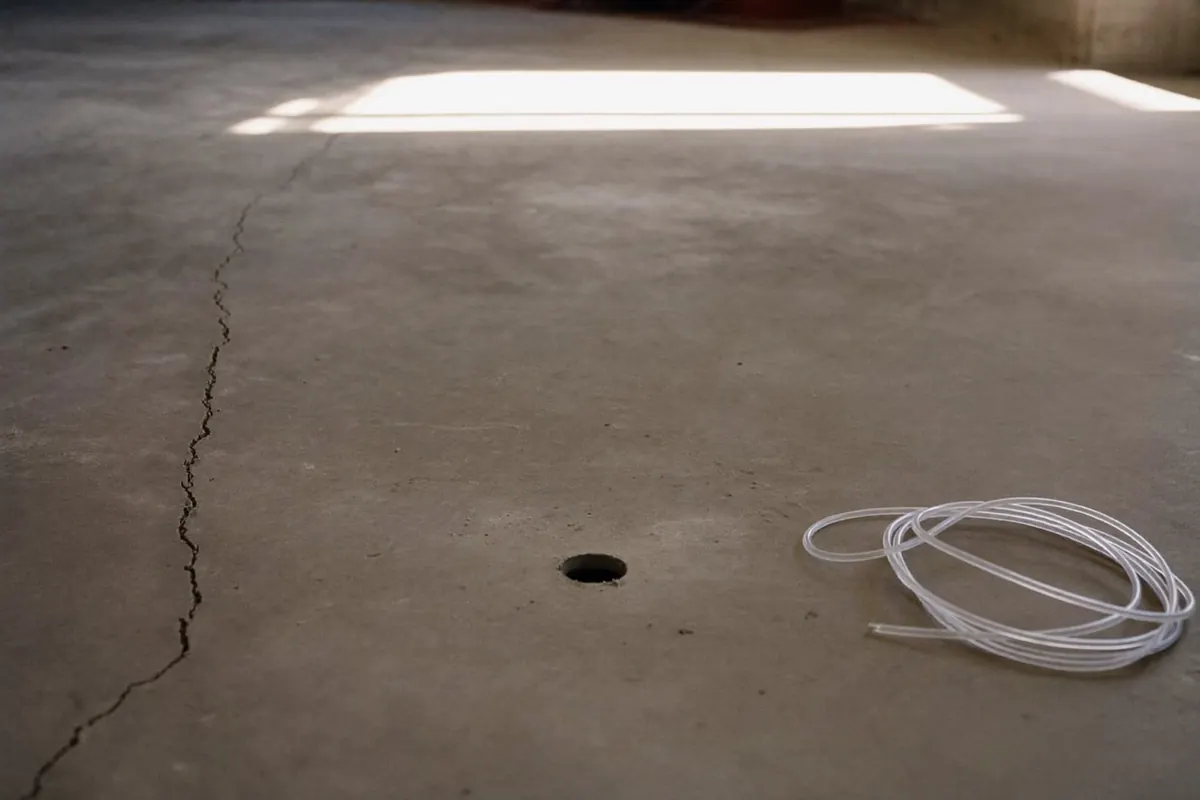
After installation, the test is numeric. With the fan running, the tester reads a micromanometer, which EPA’s 1993 glossary defines as able to detect 0.001 in. WG, between each test hole and the room above. The MPCA form records each test point to 0.1 Pa and 0.0001 in. of water column, with date, time, location on a floor plan and the make and model of the manometer.
Conditions matter as much as the gauge. MPCA checklist item 2.3 asks whether the test ran with all combustion appliances and exhaust fan appliances operating and all exterior windows and doors closed for worst case conditions, and requires backdraft testing of natural draft appliances; if the system causes backdrafting, the owner is told immediately and the system is turned off until it is corrected.
A low reading does not always mean failure. ITRC’s 2026 sheet warns that very permeable fill can carry high airflow with little measurable pressure away from the pipe, so the system acts as sub-slab ventilation; it suggests airflow, sub-slab concentration or tracer tests in that case.
Which fan: an RP145 at 2.1 in. WC or a GP501 at 4.2?
Fan choice follows the soil. EPA/625/R-93/011 notes that centrifugal in-line fans top out at 1 to 2 in. WG of suction, while high suction fans and blowers generate from about 4 to more than 40 in. WG at low flow. It cites one firm that used high suction blowers at about 20 cfm in 42 New England basements with packed sand or clay under the slab, usually with two suction pipes.
| Fan (maker table) | Watts | Max in. WC | CFM at 1.0 in. | CFM at 1.5 in. | CFM at 2.0 in. |
|---|---|---|---|---|---|
| RP145 (4″ duct) | 41 to 72 | 2.1 | 82 | 41 | 3 |
| RP265 (6″ duct) | 91 to 129 | 2.3 | 176 | 116 | 52 |
| RP380 (8″ duct) | 95 to 152 | 2.3 | 220 | 130 | 38 |
| GP301 (3″ duct) | 55 to 90 | 2.6 | 92 | 77 | 45 |
| GP501 (3″ duct) | 70 to 140 | 4.2 | 95 | 87 | 80 |
Read the table against the soil. On packed clay, where the pipe may need 2.0 in. WC to move any gas, the RadonAway RP Series table shows an RP145 delivering 3 cfm while the RadonAway GP Series table shows a GP501 at 80 cfm. On clean gravel the RP265 moves 176 cfm at 1.0 in. WC, more than any GP model.
What should the U-tube on the pipe read, and when should it worry you?
EPA’s Consumer’s Guide requires a warning device on every active system: a liquid gauge, a sound alarm, a light indicator, or a dial gauge, placed where it is easily seen or heard. The usual one is a U-tube manometer on the riser, which ITRC lists as standard SSD equipment. It shows the static suction inside the pipe at the fan’s operating point.
Read it against the fan table. If an RP145 riser gauge sits near 1.0 in. WC, RadonAway’s table puts flow near 82 cfm; if it sits near 2.0 in., flow is about 3 cfm, which points to very tight fill or a blocked pipe. A reading that drops to zero means the fan stopped or the pipe disconnected. EPA/625/R-93/011 records one house where cutting fan power dropped pipe suction from 1.7 to 0.8 in. WG and flow from 36 to 23 cfm, and indoor radon rose.
EPA’s 2015 vapor intrusion guide recommends checking the gauge quarterly, with less frequent checks possible after one year of successful operation; a reading that drifts from the one seen at start-up is the thing to report to the installer. EPA’s Consumer’s Guide adds that the fan must never be turned off and that fans may last five years or more.
Where may the pipe discharge and the fan sit?
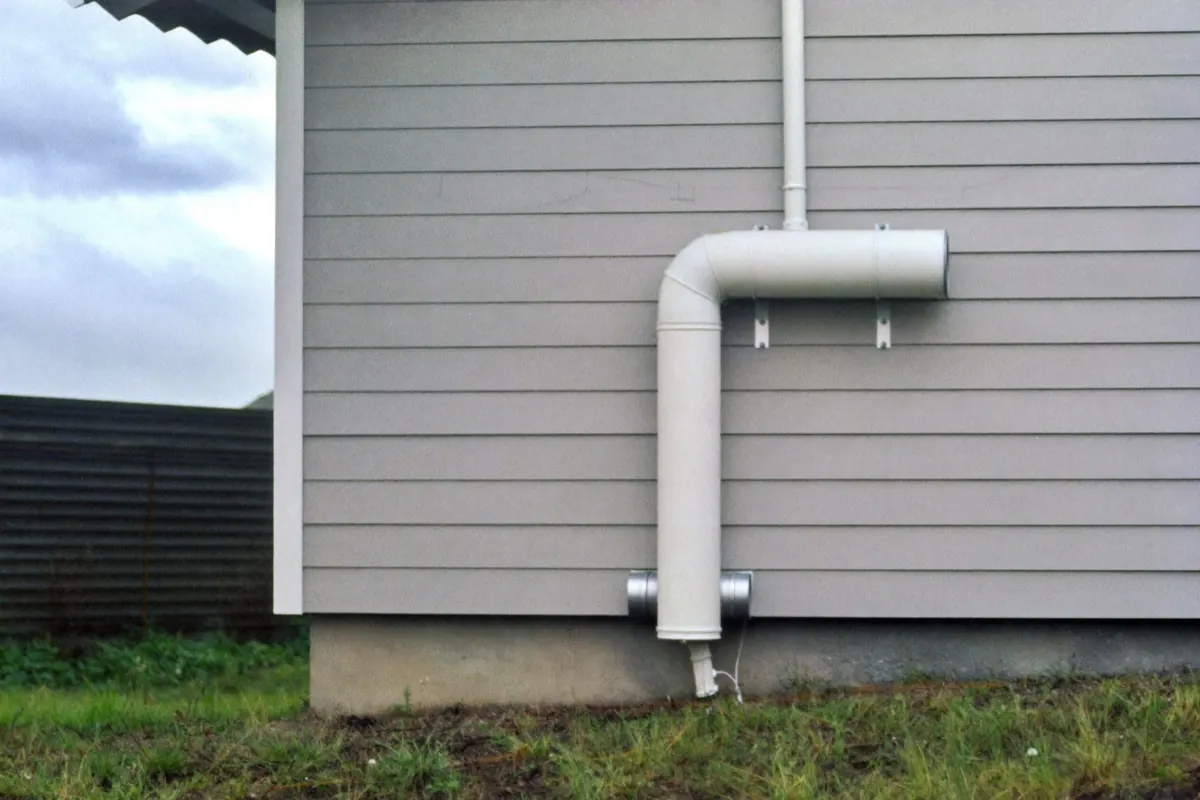
EPA’s Consumer’s Guide requires the exhaust to vent above the roof surface, 10 feet or more above the ground, and at least 10 feet from windows, doors or other openings unless it is at least 2 feet above them. The fan must not sit in or below a livable area. Pennsylvania’s 240.308(b) adds detail in regulation: vertical and upward discharge with a 45 degree elbow allowed, no rain caps, 12 inches above the roof surface for roof penetrations, and 5 feet horizontally from a vertical wall that rises above the roof.
Section 240.308(c) bars the fan from below grade locations, window wells, conditioned space and basements or crawl spaces under heated or cooled rooms, which is why attic and exterior mounts dominate. The installation rules a homeowner can see from the floor, with the system diagram, are on our radon mitigation page.
Requirement, clause and what to check on your own system
No ranking page lays the rules side by side with what an owner can verify. The clauses below come from documents readable free online: EPA’s Consumer’s Guide, Pennsylvania’s regulation, the ITRC sheet and Minnesota’s checklist. SGM-SF-2023 sets the consensus rules on the same points; its clause numbers are not quoted here because its online viewer could not be read as text for this page.
| Requirement | Clause | What to check on your own system |
|---|---|---|
| Fan location | PA 240.308(c)(1) and (2); EPA Consumer’s Guide | Fan is in an attic, garage or outdoors, never in a basement, crawl space or window well under living space |
| Discharge height | PA 240.308(b)(3); EPA Consumer’s Guide | Pipe ends 10 ft or more above the nearest ground |
| Distance from openings | PA 240.308(b)(4); EPA Consumer’s Guide | 10 ft from any operable window or door, or 2 ft above its top |
| Roof clearance | PA 240.308(b)(6)(i) | At least 12 in above the roof where the pipe penetrates it |
| Discharge shape | PA 240.308(b)(2) | Open upward; no rain cap; 45 degree elbow only |
| Sealing | PA 240.308(d)(1) and (2) | Floor wall joint, control joints, utility holes and sump lid sealed; backer rod in gaps over 1/2 in |
| Warning device | EPA Consumer’s Guide; ITRC 2026 | A gauge or alarm you can see or hear, and it has a reading |
| Labels | PA 240.308(e) | Label legible from 3 ft with installer, certification number, date and ‘test at least every two years’ |
| Pipe slope | ITRC 2026 | Horizontal runs slope at least 1 percent back to the suction point, supported every 4 ft |
| PFE results | MPCA checklist items 2.3 and 2.4 | A floor plan of test points with readings, taken with exhaust appliances on |
| Backdraft check | MPCA checklist section 3 | Natural draft appliances tested after start-up |
| Post-mitigation test | EPA Consumer’s Guide | Started 24 h to 30 days after start-up, 2 to 7 days long |
When is the follow-up radon test valid after the fan starts?
EPA’s Consumer’s Guide sets the window: within 30 days of installation but no sooner than 24 hours after the system is running with the fan on, using a 2 to 7 day measurement, with windows and doors closed 12 hours before and during the test except for normal entry and exit. EPA recommends an independent test alongside the contractor’s, to remove any conflict of interest, and a retest at least every 2 years.
The guide’s reduction table puts subslab suction at 50 to 99 percent and passive subslab suction at 30 to 70 percent. If the post-test is still at or above EPA’s 4 pCi/L action level, ask the installer for the pressure field readings at each test hole before agreeing to a second suction point. Fees for testing and for adding a suction point are on the radon mitigation cost page. For what radon exposure means for health, EPA’s radon pages are the reference; this page covers the system only.
How does an SSD system change when the target is solvent vapor, not radon?
The fan and pipe are the same; the proof is heavier. EPA’s 2015 guide notes SSD was first developed for radon, then adds that venting systems may need permits, that sub-slab probes should monitor differential pressure, and that tracer and smoke tests can find leaks. It cites a Denver program of 337 homes treated for 1,1-dichloroethylene, where about a quarter of systems needed adjustment or upgrading after installation.
ITRC’s 2026 sheet lists what radon jobs rarely include: condensate knockout tanks, activated carbon on the exhaust, balancing valves to rebalance the field as concentrations fall, and, in new buildings, a membrane of about 10 mil for low vapor levels or at least 20 mil where sub-slab vapor is three orders of magnitude above the screening level. It also warns that SSD will not run continuously when groundwater is in contact with the slab.
For crawl spaces the equivalent is sub-membrane depressurization: the New Jersey DEP fact sheet (June 2008) describes an impermeable membrane over the earthen floor with the pipe through it. Membrane work for moisture rather than soil gas is priced on our crawl space encapsulation cost page, and how remediation projects are scoped in general is on what remediation means. Related standards are indexed in the standards hub.
Questions people actually ask
Is a sub-slab depressurization system the same as a radon mitigation system?
It is the most common type. EPA’s Consumer’s Guide lists four soil suction methods for basement and slab homes: subslab, drain tile, sump hole and block wall suction, plus submembrane suction for crawl spaces. SSD is subslab suction with a fan. EPA’s 2015 vapor intrusion guide uses the same design to keep chemical vapors out.
Can a passive sub-slab system work without a fan?
Sometimes, at lower efficiency. EPA’s Consumer’s Guide rates passive subslab suction at 30 to 70 percent reduction against 50 to 99 percent for the active version, and says it is usually built into new homes as radon-resistant features. Adding a fan to the existing passive pipe is the upgrade EPA names when a test reads 4 pCi/L or more.
Does a sub-slab depressurization system dry out a basement?
ITRC’s 2026 technology sheet lists reduced moisture in damp basements among SSD advantages, because the fan draws soil air away from the slab. It is not a drainage system: ITRC also says SSD will not work continuously when groundwater touches the slab, and Pennsylvania’s 240.308(d)(2) requires channel filler to leave room for water to drain into the sub-slab material.
How loud is a radon fan, and can it go in the basement?
Location rules settle the second half: EPA’s Consumer’s Guide and Pennsylvania’s 240.308(c) bar the fan from living space and from basements or crawl spaces under heated rooms, so it sits in an attic, a garage or outdoors. ITRC notes large blowers may need silencers, and attic mounts last longer than exterior ones because they are out of the weather.
How much electricity does an SSD fan use?
RadonAway’s published tables list 41 to 72 watts for the RP145, 91 to 129 watts for the larger RP265 and 70 to 140 watts for the high suction GP501. EPA’s Consumer’s Guide says the fan must run continuously, so multiply the listed watts by 8,760 hours a year and your utility rate for an annual figure.
Sources
- EPA Consumer's Guide to Radon Reduction, U.S. Environmental Protection Agency, EPA 402/K-10/005, 2025 printing. Retrieved 8 November 2026.
- EPA/625/R-93/011, Radon Reduction Techniques for Existing Detached Houses, Technical Guidance (Third Edition) for Active Soil Depressurization Systems, EPA, October 1993, hosted by WBDG. Retrieved 8 November 2026.
- EPA's 2015 vapor intrusion technical guide, Assessing and Mitigating the Vapor Intrusion Pathway from Subsurface Vapor Sources to Indoor Air, OSWER Publication 9200.2-154, June 2015, section 8. Retrieved 8 November 2026.
- ITRC sub-slab depressurization technology sheet, Interstate Technology and Regulatory Council Vapor Intrusion Toolkit, January 2026. Retrieved 8 November 2026.
- Minnesota Pollution Control Agency post-mitigation checklist, form c-rem3-06c, Attachment C, Minnesota Pollution Control Agency. Retrieved 8 November 2026.
- 25 Pa. Code 240.308, Radon mitigation standards for residential buildings, Pennsylvania Code, amended effective 24 January 2019. Retrieved 8 November 2026.
- AARST standards index, American Association of Radon Scientists and Technologists: current and superseded ANSI/AARST standards. Retrieved 8 November 2026.
- RadonAway RP Series table (dated 8/15) and RadonAway GP Series table, RadonAway, hosted by HVACQuick. Retrieved 8 November 2026.
- New Jersey DEP fact sheet, New Jersey Department of Environmental Protection, June 2008, hosted by EPA CLU-IN. Retrieved 8 November 2026.
- Pascal values are conversions at the 249 Pa per inch of water gauge factor printed in EPA/625/R-93/011, computed when this page was built. Our methodology sets out the standing rules.
Pressure targets differ by program and by site, as the EPA and MPCA values above show. For a vapor intrusion site, the regulator’s approved work plan sets the pass mark; for radon, check your state radon office for rules that apply to your installer.