The short answer
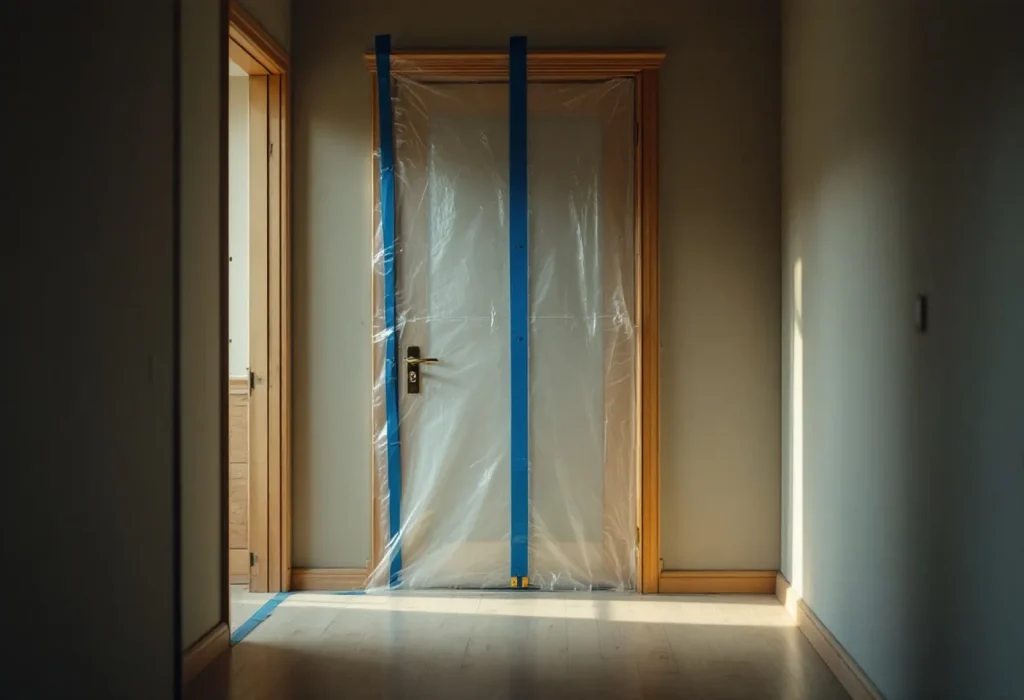
How long does asbestos removal take? The hands-on removal runs 1 to 5 working days for most house jobs, but the whole project usually takes 2 to 4 weeks, because fixed clocks surround it: a 10 working day federal notice for regulated buildings, state notice periods, mandated waits between cleanings in New York, and lab turnaround on clearance air samples.
On this page
Which clocks run before anyone touches the asbestos?
The first fixed wait is paperwork. Under the federal asbestos NESHAP, 40 CFR 61.145(b)(3)(i), the owner or operator must postmark or deliver notice at least 10 working days before stripping, removal or any site preparation that would disturb the material, when the job reaches 260 linear feet on pipes, 160 square feet on other components or 35 cubic feet. Counting Monday to Friday only, 10 working days filed on a Monday puts the earliest start on the Monday two weeks later, 14 calendar days out, before any public holiday.
The federal rule does not reach most houses. The definition of facility in 40 CFR 61.141 excludes residential buildings with four or fewer dwelling units, so a single family home or a duplex is outside the federal notice. An apartment building with five or more units, a school, an office or a store is inside it.
States add their own clocks, and they do not count the same way. New York’s 12 NYCRR 56-3.4 requires notice to the Asbestos Control Bureau to be received at least 10 calendar days before Phase II A of a large asbestos project, and a large project under 12 NYCRR 56-2.1 is 160 square feet or 260 linear feet or more. Texas rule 25 TAC 296.251 requires 10 working days for abatement in a public building, which matches the federal count.
| Rule | Waiting period | What triggers it | Per the rule text |
|---|---|---|---|
| Federal asbestos NESHAP, regulated facilities | 10 working days | At least 260 linear ft on pipes, 160 sq ft on other components or 35 cu ft of regulated material | 40 CFR 61.145 |
| Federal NESHAP, emergency renovation | No later than the following working day | A sudden, unexpected event | 40 CFR 61.145 |
| New York State, large asbestos project | 10 calendar days | 160 sq ft or more, or 260 linear ft or more | 12 NYCRR 56-3.4, 12 NYCRR 56-2.1 |
| Texas DSHS, public buildings and NESHAP facilities | 10 working days | Any abatement in a public building | 25 TAC 296.251 |
| Texas DSHS, emergency renovation | No later than the first working day after the incident | Sudden, unexpected event | 25 TAC 296.251 |
| Puget Sound, homeowner doing own friable removal | Notice before work, $25 fee | From 10 linear ft of pipe or 48 sq ft a year | Puget Sound Clean Air Agency |
These clocks are why a job quoted at two days still takes three weeks on the calendar. The full federal and state rule map sits on our asbestos regulations page.
How many days does the removal itself take for a floor, a ceiling or pipe lagging?
No federal or state agency publishes a production rate in square feet per day, and a search of EPA, OSHA and state program pages for this page found none. What exists are ranges published by firms in the trade. Environmental Education Associates, a New York asbestos training school, published the removal ranges below in May 2026, and the USW asbestos FAQ gives two ranges of its own.
| Job | EEA removal phase (May 2026) | USW FAQ (undated) |
|---|---|---|
| Small residential: one room, pipe insulation or small ceiling | 1 to 2 days | Floor tile in a single room: 1 to 3 days |
| Mid-size residential: several rooms, popcorn ceiling, floor tile | 2 to 3 days | Not given |
| Attic | 2 to 4 days | Not given |
| Whole home | 5 to 10 days | Not given |
| Commercial or industrial floors | 5 to 10 days per floor | Extensive pipe insulation or fireproofing: several weeks |
| Full commercial building or pre-demolition | 2 to 6 weeks or more | Several weeks |
The same EEA page puts containment set up at 4 to 8 hours for a single room and 1 to 2 days for multi-room work, and teardown at 4 hours to 1 day. Friable material, restricted access and evening or weekend work push a job to the top of each range, per the EEA table notes. Under OSHA’s 29 CFR 1926.1101, removal of thermal system insulation and surfacing material such as popcorn texture is Class I work, the class that carries the heaviest enclosure requirements.
What does a 1,000 sq ft popcorn ceiling job look like on a New York calendar?
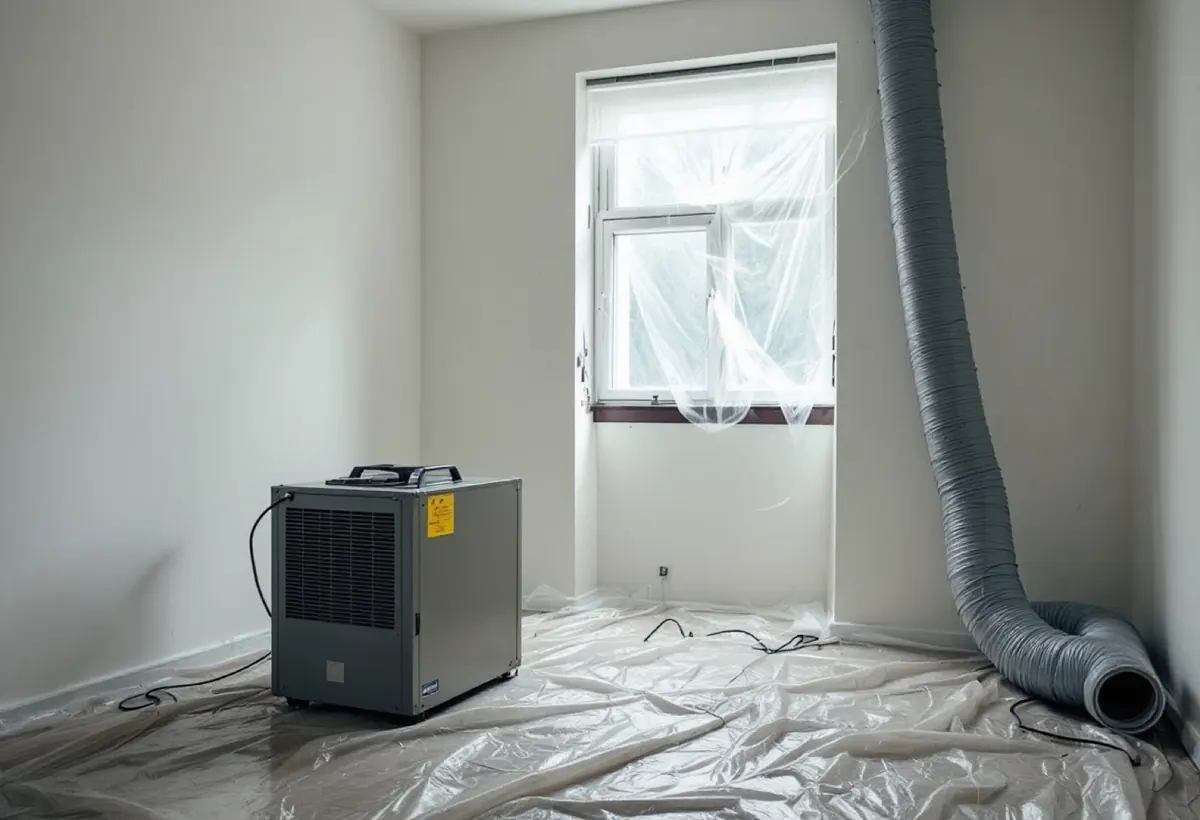
The chart below, per the rule texts cited in it, lays one job end to end: a sprayed ceiling texture of 1,000 square feet in a single family house in New York State, removed by an asbestos abatement contractor. The size makes it a large asbestos project under 12 NYCRR 56-2.1, so the 10 calendar day notice applies; the house is outside the federal NESHAP notice because it has fewer than five units.
Two bars cannot be shortened with money: the notice and the mandated waits. The rest can move. Paying EMSL’s 3 hour PLM tier ($147 a sample against $60 at 24 hours, per the EMSL Analytical 2026 price list) saves most of a day at the front, and a crew that sets up in 4 hours rather than a day saves another. The notice still decides the earliest removal date, which is why the cheapest time saving is to get the bulk samples analysed before the contract is signed.
Why does New York make the crew wait 12 hours between cleanings?
New York is the clearest example of a settling clock written into law. 12 NYCRR 56-9.1(f)(1) sets a waiting, settling or drying time that must pass after each stage of cleaning, by material. A fully plasticized work area is cleaned three times: a first wet cleaning followed by lockdown encapsulant, a second cleaning after the top layer of sheeting comes down, and a final cleaning after the bottom layer comes down.
| Material abated | Wait after each cleaning | Waits across 3 cleanings |
|---|---|---|
| Fireproofing, plaster, TSI and other friable material | 12 hours | 36 hours |
| Floor tile or mastic removed with machinery | 12 hours | 36 hours |
| Floor tile or mastic removed by hand | 4 hours | 12 hours |
| Other interior non-friable material, by hand | 4 hours | 12 hours |
| Incidental disturbance project | 4 hours | 12 hours |
| TSI removed by glovebag inside a tent | 2 hours | 6 hours |
| Intact transite panels removed indoors | 2 hours | 6 hours |
| Exterior non-friable work without a negative pressure enclosure | None | None |
For friable material that is 36 hours of waiting the crew cannot compress, against 12 hours for hand-removed floor tile. Clearance air sampling may not start until the last wait has passed and no visible debris, pools of liquid or condensation remain, per 12 NYCRR 56-9.1(d) and 12 NYCRR 56-9.2. Federal rules carry no equivalent settling clock; outside New York, a waiting period appears only if the project design writes one in. How long fibres themselves stay airborne is a separate physics question, covered on our page on how long asbestos stays in the air.
How many hours does clearance air sampling add, and how fast can the lab answer?
The federal clearance protocol written for schools, 40 CFR 763.90(i) with Appendix A to 40 CFR 763 Subpart E, is the benchmark most project designs borrow. Per the appendix, it calls for a visual inspection first, then aggressive sampling: surfaces swept with the exhaust of a leaf blower of at least 1 horsepower, one stationary fan per 10,000 cubic feet of work site, and a minimum of 13 samples per site: five inside, five outside, two field blanks and one sealed blank.
Sample volume sets the clock. Per the text of 40 CFR 763.90(i)(4), a 25 mm filter must draw at least 1,199 litres for the five-inside-samples route, and Appendix A allows 25 mm cassettes at 1 to under 10 litres per minute. Our arithmetic: at just under 10 litres per minute that is at least 120 minutes of pumping, and at 1 litre per minute about 20 hours. The pumps run side by side, so a well set up clearance takes a few hours on site.
Then the lab. A job passes AHERA clearance by TEM when the inside samples average no more than the 70 structures per square millimetre filter background with the volume met, or when inside and outside averages pass the Z-test in Appendix A. For jobs over the small-scale, short-duration size and up to 160 square feet or 260 linear feet, 40 CFR 763.90(i)(5) allows PCM instead, with each of five samples at or below 0.01 fibres per cubic centimetre.
Per the EMSL Analytical 2026 price list, five inside TEM samples cost $2,150 at the 2.5 to 3 hour tier, $805 at 24 hours and $540 at two weeks. A PCM count under NIOSH 7400 lists at $102 a sample at 3 hours and $41.50 at 24 hours, per the same list. Ask the contractor which tier the bid assumes, because a two week tier leaves the containment, and you, waiting. Who should collect these samples and the full threshold table are on our asbestos air monitoring page.
Which clocks apply to a bathroom floor, a ceiling and a boiler room?
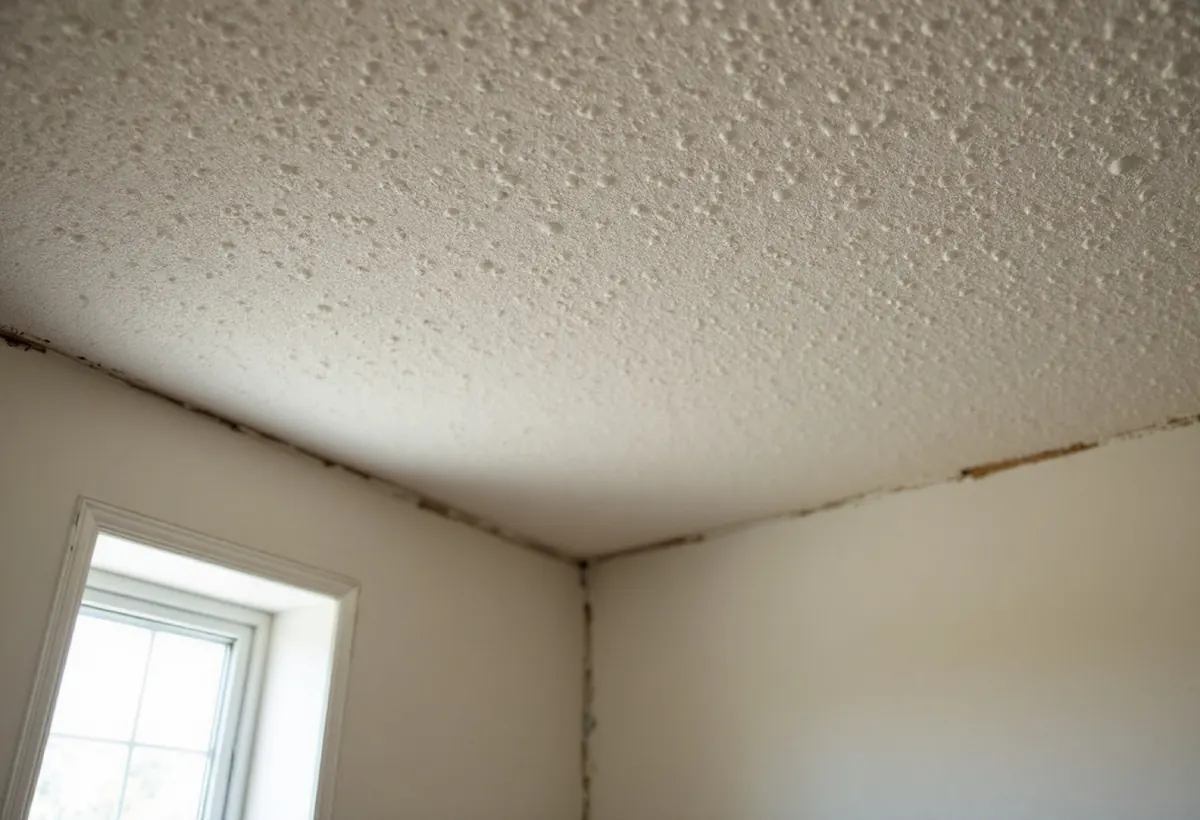
The same contractor can face three different calendars. The table applies the rules above to three common jobs. Thresholds are from 40 CFR 61.145, 40 CFR 61.141, 12 NYCRR 56-2.1, 12 NYCRR 56-9.1 and 40 CFR 763.90(i); removal days are the published ranges, not our estimate.
| Job (per the rule texts) | Federal notice | State clock (NY, TX examples) | Clearance method | Published removal days |
|---|---|---|---|---|
| Bathroom floor tile, 60 sq ft, single family house | No: under 4 units is not a facility (61.141) | NY small project; 4 hour wait per cleaning | PCM allowed if a school (up to 160 sq ft) | EEA 1 to 2 days; USW 1 to 3 days |
| Popcorn ceiling, 1,000 sq ft, single family house | No: not a facility (61.141) | NY large project: 10 calendar days; 12 hour waits | TEM benchmark (over 160 sq ft) | EEA 2 to 3 days (mid-size) |
| Same ceiling across a 24 unit apartment building | Yes: 10 working days (over 160 sq ft) | NY 10 calendar days; TX 10 working days | TEM benchmark | EEA whole home 5 to 10 days as a proxy |
| Boiler room pipe lagging, 300 linear ft, commercial | Yes: 10 working days (over 260 linear ft) | NY large project; 12 hour waits (2 if glovebag tent) | TEM (over 260 linear ft) | EEA commercial 5 to 10 days per floor; USW several weeks |
The bathroom floor is the job most often finished inside a week, because no federal notice applies and New York’s wait for hand-removed tile is 4 hours a cleaning. Price ranges for each of these jobs are on our asbestos removal cost page, and ceiling specifics are on the popcorn ceiling asbestos page.
Can you stay in your house during asbestos removal?
Federal text does not order a household out of the whole house; it orders them out of the work area. The EPA homeowner guidance says a contractor should not allow household members and pets into the area until work is completed, should seal the work area from the rest of the house with plastic sheeting and duct tape, and should turn off the heating and air conditioning system. OSHA’s 29 CFR 1926.1101(e)(3) limits access to a regulated area to authorized persons.
The practical limit is what the enclosure takes away. A negative pressure enclosure under 29 CFR 1926.1101 must keep at least 4 air changes per hour and a pressure difference of at least 0.02 inches of water below the surrounding space, so the exhaust unit runs around the clock until clearance. If the only bathroom, the kitchen or the main return duct sits inside the containment, living there is hard for the 2 to 4 weeks EEA gives for a typical residential project.
Four questions settle it with the contractor: which rooms and doors will be sealed and for how many days; how many days the HVAC system will be off, given EPA’s shutdown advice; where the decontamination unit and the waste bags will sit; and whether the project design adds a settling period before clearance, which in New York is 12 hours per cleaning for friable material under 12 NYCRR 56-9.1.
What pushes the finish date back after the job starts?
A failed clearance is the largest single slip. Under 12 NYCRR 56-9.2, when inside samples fail, the work area is cleaned again, the waiting time runs again, and a full new set of inside and outside samples is collected in the same positions. EEA puts each failed cycle at 2 to 5 extra days.
Start date changes also cost time. Under 40 CFR 61.145(b)(3)(iv), a job that will start later than notified needs a telephone call and a written notice no later than the original date, but a job that wants to start earlier needs a new written notice at least 10 working days before the new date. The notice must also be updated when the amount of asbestos changes by at least 20 percent, per 40 CFR 61.145(b)(2), which matters when demolition uncovers more material behind a wall.
Hidden material is the third cause. NESHAP notices must describe the procedure for unexpected regulated material, per 40 CFR 61.145(b)(4)(xvi), and in New York a project that grows past 160 square feet becomes a large project with the 10 calendar day notice. For homeowners doing their own friable removal in the Puget Sound Clean Air Agency area, debris must be disposed of within 10 days of removal. The steps of a full project are laid out on our asbestos abatement page.
Out of scope: this page covers schedules and rules only. Questions about what an exposure means for your health belong with a physician and the health effects section of the EPA Learn About Asbestos page.
Questions people actually ask
What is the 3-5-7 rule for asbestos testing?
It is the minimum bulk sample count for friable surfacing material per the EPA AHERA rule for schools, 40 CFR 763.86: at least 3 samples from a homogeneous area of 1,000 square feet or less, 5 from over 1,000 up to 5,000, and 7 from over 5,000. It decides how many samples the lab has to read, not how long removal takes.
How long does an asbestos test take to come back?
Turnaround is a tier you buy. According to the EMSL Analytical 2026 price list, EMSL offers PLM bulk analysis from 3 hours to 2 weeks, at $147 a sample for 3 hours, $60 for 24 hours and $36.50 for two weeks. TEM air samples run from 2.5 to 3 hours to two weeks on the same list.
How soon can I move back in after asbestos removal?
Once the visual inspection and clearance air samples pass. Under 40 CFR 763.90(i), the benchmark most designs borrow, that means TEM results at or below 70 structures per square millimetre or a passed Z-test. EEA puts teardown and reoccupancy at 4 hours to 1 day after clearance.
Do I need to notify anyone if I remove asbestos from my own house?
The federal NESHAP notice does not cover houses of four or fewer units under 40 CFR 61.141, but local rules can. According to its homeowner page, Puget Sound Clean Air Agency requires a Single Family Residence Notification and a $25 fee before friable removal of 10 linear feet of pipe or 48 square feet a year or more.
Can an emergency asbestos job skip the 10 day notice?
It skips the wait, not the filing. 40 CFR 61.145(b)(3)(iii) requires notice for an emergency renovation as early as possible and no later than the following working day, with the date and hour of the emergency. Texas 25 TAC 296.251 sets the first working day after the incident.
Sources
- 40 CFR 61.145, asbestos NESHAP standard for demolition and renovation: applicability thresholds, notice timing, start date changes. eCFR, US Environmental Protection Agency. Retrieved 9 November 2026.
- 40 CFR 61.141, NESHAP definitions, facility exclusion for residential buildings of four or fewer units. eCFR. Retrieved 9 November 2026.
- 40 CFR 763.90(i) and 40 CFR 763.86, AHERA response actions, clearance criteria and bulk sampling counts. eCFR. Retrieved 9 November 2026.
- Appendix A to 40 CFR 763 Subpart E, AHERA TEM method: aggressive sampling, 13 sample set, flow rates, 70 s/mm2 filter background. eCFR. Retrieved 9 November 2026.
- 29 CFR 1926.1101, OSHA construction asbestos standard: Class I definition, regulated area access, negative pressure enclosure specifications. Legal Information Institute. Retrieved 9 November 2026.
- 12 NYCRR 56-2.1, 12 NYCRR 56-3.4, 12 NYCRR 56-9.1 and 12 NYCRR 56-9.2, New York Industrial Code Rule 56: project sizes, notification, cleaning stages and waiting times, clearance. Legal Information Institute. Retrieved 9 November 2026.
- 25 TAC 296.251, Texas Department of State Health Services asbestos notification rule. Legal Information Institute. Retrieved 9 November 2026.
- Puget Sound Clean Air Agency, Homeowner Renovation page. Retrieved 9 November 2026.
- EPA homeowner guidance, Protect Your Family from Exposures to Asbestos, US EPA, last updated 25 June 2026. Retrieved 9 November 2026.
- EPA Learn About Asbestos page, US EPA. Retrieved 9 November 2026.
- EMSL Analytical 2026 price list, EMSL Analytical, Inc., 2026 commercial price list, revision 1.6 dated 9 January 2026. Retrieved 9 November 2026.
- Environmental Education Associates, How Long Does Asbestos Abatement Take, Environmental Education Associates, published 12 May 2026. Retrieved 9 November 2026.
- USW asbestos FAQ, uswonline.com asbestos FAQ, undated. Retrieved 9 November 2026.
- Calendar counts, sample pumping times and lab totals are our arithmetic on the figures above. Our methodology sets out the standing rules; more rules pages sit in the standards hub.
Rules change and local agencies add their own. Confirm the notice period with the agency for the job address and the lab tier with the contractor before you plan a move out.