
The short answer
A flash flood is flooding that begins within 6 hours, and often within 3 hours, of heavy rainfall or another cause such as a dam or levee failure, according to the National Weather Service. Speed is what makes flash flooding deadly: in NOAA Storm Events records, Flash Flood events carry 23.7 deaths per 1,000 records against 10.8 for slower floods, and most victims are in vehicles.
Key takeaways
- The NWS clock is 6 hours from the causative event, often 3.
- “Flash flood emergency” is not a separate NWS product. NWS Instruction 10-922 says it is wording added to a Flash Flood Warning in exceedingly rare situations.
- Most flash flood threats from rain now go out as a Flood Watch; NWS reserves the Flash Flood Watch code for dam failures, ice jams and burn scars.
- NWS: a mere 6 inches of fast-moving flood water can knock over an adult, and 12 inches of rushing water can carry away most cars.
- Texas recorded 338 of 1,089 US Flash Flood deaths from 2015 to 2025, according to NOAA records analysed in our report.
- IICRC S500 lists rising water from rivers or streams among its Category 3 examples; the restorer confirms category on inspection.
On this page
What is a flash flood
What is a flash flood? The answer turns on how fast the water arrives, not how deep it gets. Federal agencies phrase it differently but agree on the clock, and the NWS glossary counts dam failure and ice jams as causative events.
| Source | Definition, as published | Note |
|---|---|---|
| NWS glossary | A rapid and extreme flow of high water into a normally dry area, or a rapid rise in a stream above a predetermined flood level, beginning within six hours of the causative event | Threshold varies by region |
| NWS Philadelphia office | Flooding that begins within 6 hours, and often within 3 hours, of the heavy rainfall (or other cause) | Adds the 3 hour norm |
| USGS | Runoff from excessive rainfall causes a rapid rise in the water height (stage) of a stream or normally dry channel | Rain-driven framing |
| NOAA NSSL | Heavy or excessive rainfall in a short period of time, generally less than six hours | Can occur with no rain |
The NWS Philadelphia flash flooding definition page adds why flash flooding catches people: water at home or work may rise quickly and trap them, or damage the property before anyone can protect it.
Flash flood vs flood: which is worse
The USGS flood types FAQ puts it in one sentence: flash floods generally cause greater loss of life and river floods greater loss of property. Our NOAA-based report puts a number on that: 2.2 times as many deaths per 1,000 event records.
| Flash flood | River flood | |
|---|---|---|
| Onset | Minutes to about 6 hours | Slower rise, can last days or weeks |
| Usual driver | Intense rain on a small area, dam or levee failure | Longer rain, snowmelt, ice jams on larger rivers |
| Where most common | Dry climates, rocky terrain, cities, canyons | Larger rivers in wetter climates |
| What it costs most | Lives | Property |
Flash flood watch vs warning vs emergency
The NWS watch and warning page gives the public meanings; NWS Instruction 10-922, the directive forecast offices follow, gives the rules. Together they settle three points most explainers get wrong.
| Alert | NWS meaning | NWS motto |
|---|---|---|
| Flood Advisory | Flooding not bad enough for a warning, but it may cause significant inconvenience | Be aware |
| Flood Watch / Flash Flood Watch | Conditions are favorable for flooding; it does not mean flooding will occur, but it is possible | Be prepared |
| Flash Flood Warning | A flash flood is imminent or occurring | Take action: move to high ground |
| Flash Flood Emergency (wording inside a warning) | Severe threat to human life and catastrophic damage imminent or ongoing | Act on the call to action now |
A flash flood emergency is a warning, not a separate product
Under NWS Instruction 10-922, in exceedingly rare situations, when a severe threat to human life and catastrophic damage from a flash flood is imminent or ongoing, the phrase “This is a FLASH FLOOD EMERGENCY for [geographic area]” may be included in a Flash Flood Warning. Its examples include multiple swift water rescue teams deployed and total failure of a major high hazard dam.
Damage threat tags decide whether phones buzz
| Damage threat tag | NWS definition | Wireless Emergency Alert? |
|---|---|---|
| Base (no tag) | Most flash floods, with the potential for impacts and damage | No |
| CONSIDERABLE | Unusual severity of impact where urgent action is needed to protect lives and property | Yes |
| CATASTROPHIC | Exceedingly rare, violent flash floods; appears only with flash flood emergency language | Yes |
Most flash flood watches are now called Flood Watches
The same directive says the Flood Watch code is used when the cause is excessive rainfall, “which is the most common situation”, and reserves the Flash Flood Watch code for rare non-rain causes such as dam or levee failure or ice jams, or for rain on burn scars. Watches typically cover 6 to 48 hours before the event, so a Flood Watch can be a flash flood threat.
What causes flash floods
Flash flooding is most often due to extremely heavy rainfall from thunderstorms, according to the NWS Philadelphia flash flooding definition page, which lists rainfall intensity, location, land use, topography, vegetation, soil type and soil water content as the factors that decide how quickly it happens.
| Cause | Mechanism | What it means on the ground |
|---|---|---|
| Rainfall rate | Rain falls faster than the ground can absorb it | NWS warnings can carry an expected rainfall rate tag |
| Burn scars | Charred ground sheds water almost instantly | Debris flows; NWS warning criteria name burn areas |
| Dam or levee failure | Sudden release, rain or no rain | Automatic warning criterion |
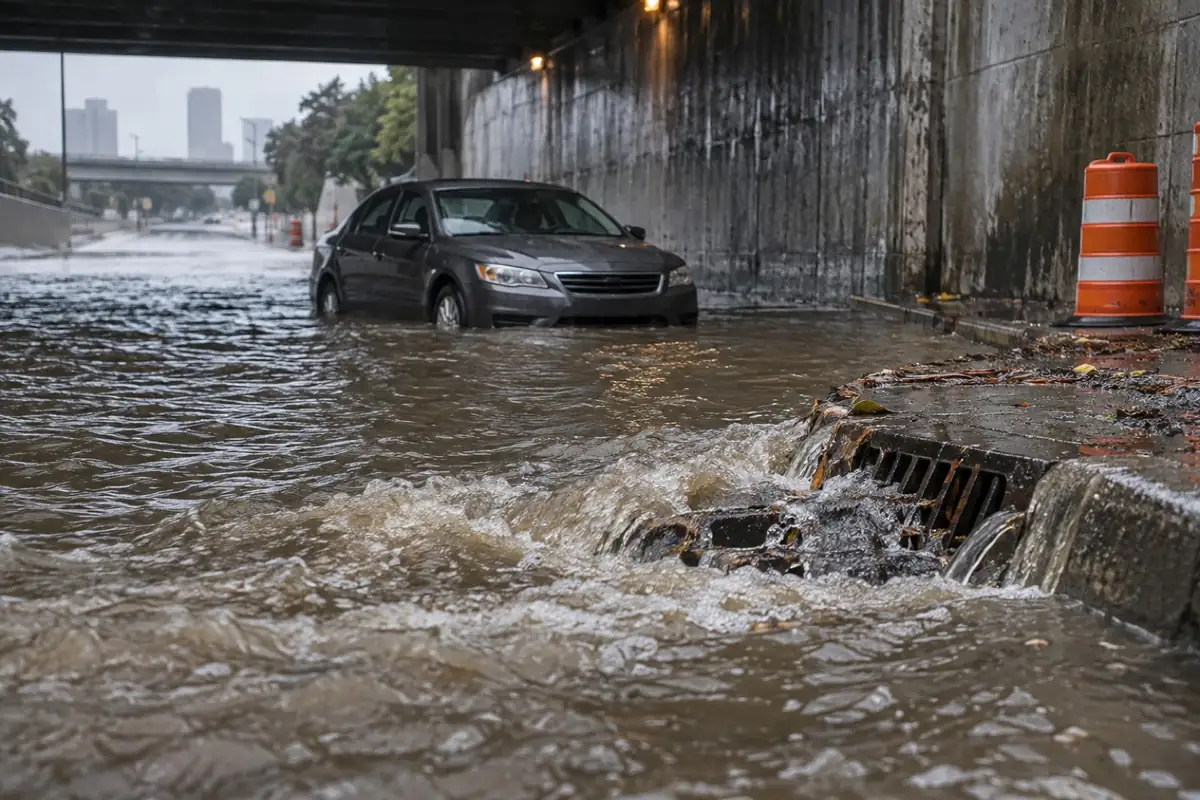
| Urban runoff | Pavement and roofs block infiltration | Underpasses, garages, basements flood first |
| Ice or debris jams | Water backs up, then releases | Rapid rise behind the jam, surge below it |
| Steep terrain | Rapid runoff, shallow clay soils | A creek can rise from inches to feet within an hour |
Burn scars deserve their own line. NOAA’s NOAA NSSL flood types page says rain can run off wildfire-damaged land almost instantly and mobilize sediment into a far more destructive debris flow. NSSL adds that a creek only 6 inches deep in mountainous areas can swell to a 10-foot deep raging river in less than an hour.
Where flash flooding kills
Flash flooding is possible everywhere, according to the NWS Philadelphia office, including city streets and highway underpasses. The deaths are not spread evenly. Our flash flood deaths by state report, built on NOAA NCEI Storm Events records for 2015 to 2025, attributes 338 of 1,089 Flash Flood deaths to Texas, 31% of the national count and more than the next 5 states combined.
Per head the order changes. According to the same NOAA-based report, West Virginia leads at 18.6 deaths per million residents, ahead of Kentucky (14.2) and New Mexico (13.1), with Texas fourth at 10.8. The report also finds 14 states and DC with Flash Flood events but no deaths, including Georgia with 1,154 events.
| Episode | Deaths | Note |
|---|---|---|
| Kerr County, Texas, July 2025 | 117 deaths | Deadliest county in the 2015 to 2025 records |
| Texas, August 2017 | Not ranked here | 47% of all reported Flash Flood property damage |
| Kentucky, July 2022 | 40 deaths | $35,000 reported damage |
| New Jersey, September 2021 | 13 deaths | $0 reported damage |
Deaths and damage do not line up. Per the report, the top 10 episodes hold 86% of $80.8 billion in reported damage, and only 33% of NOAA Flash Flood records carry any damage estimate.
How little moving water it takes
The NWS Turn Around Don't Drown page states it exactly: “A mere 6 inches of fast-moving flood water can knock over an adult. It takes just 12 inches of rushing water to carry away most cars and just 2 feet of rushing water can carry away SUVs and trucks.” The same page cites the CDC: over half of all flood-related drownings occur when a vehicle is driven into hazardous flood water.
| Source | People | Vehicles |
|---|---|---|
| NWS Turn Around Don’t Drown | A mere 6 inches of fast-moving flood water can knock over an adult | 12 inches of rushing water carries away most cars; 2 feet carries away SUVs and trucks |
| NWS during a flood | 6 inches of moving water to knock you off your feet | 12 inches can float a car or small SUV; 18 inches can carry away large vehicles |
| Ready.gov (FEMA) | Six inches of moving water can knock you down | One foot of moving water can sweep your vehicle away |
The sources differ on vehicles, so take the strictest reading. NWS also warns the road may have collapsed under the water.
What to do in a flash flood, by situation
This matrix is the part to bookmark. Each line comes from NWS or Ready.gov guidance.
| Which situation are you in | What the guidance says | Source |
|---|---|---|
| A Flood Watch is posted for your area | Monitor NOAA Weather Radio or local alerts; review your evacuation route and higher-ground plan | NWS, Ready.gov |
| A Flash Flood Warning is issued | If you are in a flood prone area move immediately to high ground | NWS |
| You are driving and the road is flooded | Turn around; never drive around barricades | NWS, Ready.gov |
| Your car is trapped in rapidly moving water | Stay inside; get on the roof if water is rising inside the car | Ready.gov |
| You are trapped in a building | Go to the highest level; do not climb into a closed attic | Ready.gov |
| You are camping by a stream | Get to higher ground immediately | NWS |
| Water covers outlets in a room | Do not enter; get out if you hear buzzing or see sparks | NWS |
After the water drops, the order matters too:
- Wait for the all clear. The NWS after a flood page warns floors can collapse and ceilings fall.
- Make sure the electrical system is off.
- Keep generators outside. NWS names carbon monoxide poisoning as one of the leading causes of death after storms with power outages.
- Photograph before you clean, as FloodSmart asks.
Flood insurance has a lead time as well: Ready.gov says a policy typically takes up to 30 days to go into effect, so it is not a decision for the day of a watch.
Flash flood damage to property, and the restoration that follows
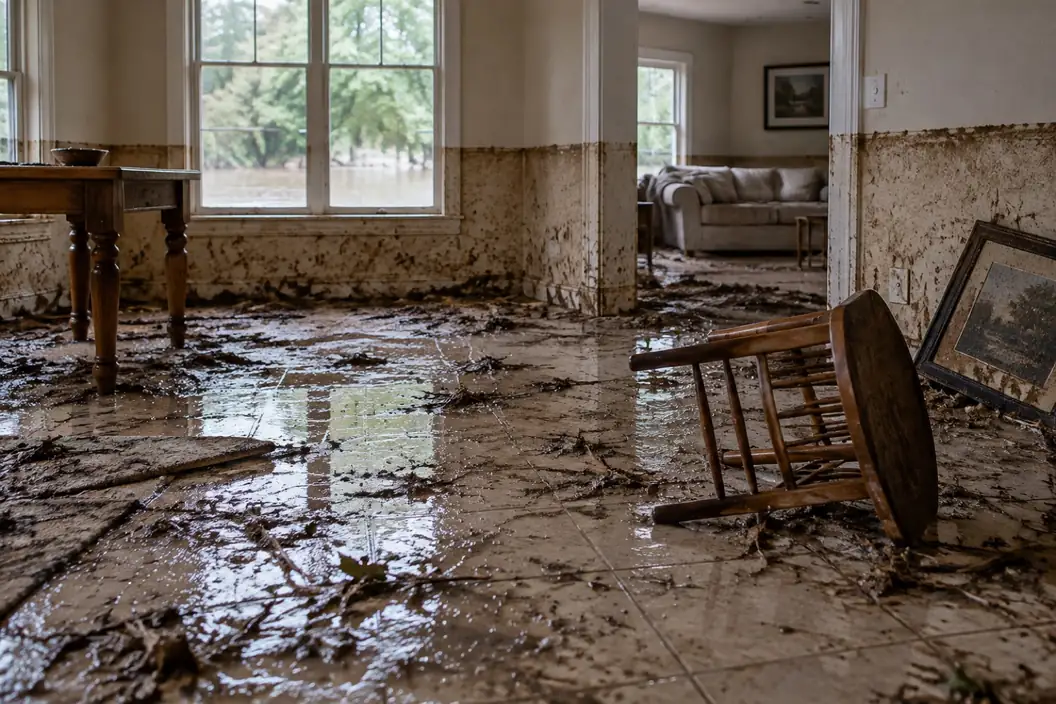
Flash flood damage differs from a slow river flood in three ways. It arrives with debris and sediment, which NOAA’s NSSL warns about. It is usually contaminated: the NWS after a flood page says floodwaters often carry sewage or chemicals. And it leaves no time to move contents.
The restoration sequence for a flooded building, flood cut heights and the NFIP claim timeline are set out in our flood damage restoration guide. Where the water ran below grade, our basement flood cleanup guide covers pumping pace, because a basement emptied too fast against saturated soil is a structural risk. Our water damage desk collects the rest.
Insurance is described here, not decided. The FloodSmart What is a Flood page lists mudflows caused by flooding in the NFIP flood definition and names burned ground after a wildfire among the causes flood insurance covers. FloodSmart also states that mold damage is not covered under standard NFIP policies, with narrow exceptions. What one policy pays depends on its wording and the carrier.
For contractors: scoping a flash flood loss
The IICRC S500 position statement (10 February 2026) quotes the S500 definition: Category 3 examples include “rising water from rivers or streams”, and the same statement stresses that the restorer makes the category determination after inspection rather than by assumption. Our IICRC water categories guide explains the framework. The drying clock is short: the EPA mold and moisture guide says wet materials dried within 24 to 48 hours will in most cases not grow mold, and our guide to how long mold takes to grow covers the timing.
| Scope item | What the source says | File it as |
|---|---|---|
| Water category | S500 lists rising water from rivers or streams as a Category 3 example; weather water is not automatically Cat 3 | Inspect, then record the determination and its basis |
| Event record | Warnings carry a polygon, valid time and threat tag | Save the NWS warning |
| Sediment and debris | Debris flows on burn scars, silt in cavities | Separate mud removal from extraction |
| Drying clock | EPA: dry within 24 to 48 hours to prevent mold in most cases | Time-stamped mobilisation and moisture logs |
| Claim evidence | FloodSmart: photos before cleaning, keep material samples | Photo log; bag and label samples |
The archived warning shows when the water came, a photographed water line how high, and the category record what it carried. For statistics to quote in a proposal, see our flood facts page.
Questions people actually ask
What exactly is a flash flood?
The National Weather Service defines it as flooding that begins within 6 hours, and often within 3 hours, of heavy rainfall or another cause such as a dam or levee failure or an ice jam. Its glossary describes a rapid and extreme flow of high water into a normally dry area, and notes the threshold can vary by region.
What causes flash floods?
Most often extremely heavy rain from thunderstorms falling faster than the ground can absorb it, according to the NWS. Other causes are dam or levee failures, ice or debris jams, rain on wildfire burn scars, and urban pavement that sends runoff to low spots.
Is a flood or flash flood worse?
For people, a flash flood. The USGS says flash floods generally cause greater loss of life and river floods greater loss of property. In NOAA Storm Events records for 2015 to 2025, Flash Flood events carry 23.7 deaths per 1,000 records against 10.8 for other floods, per our analysis.
What was the biggest flash flood in history?
There is no single official ranking. NOAA’s NSSL cites the 1889 Johnstown, Pennsylvania dam break, which released a 30 to 40 foot wall of water and killed 2,200 people. In NOAA records for 2015 to 2025, the deadliest county was Kerr County, Texas, with 117 deaths in July 2025, per our analysis.
Is a flash flood emergency worse than a flash flood warning?
Yes. It is the highest level of a Flash Flood Warning rather than a separate product. Under NWS Instruction 10-922, the emergency wording is added only in exceedingly rare situations with a severe threat to human life and catastrophic damage imminent or ongoing, and it carries the CATASTROPHIC damage threat tag.
Can a flash flood happen without rain where you are?
Yes. The NWS says it is possible to experience a flash flood in areas not immediately receiving rain, because the storm can sit upstream. NOAA’s NSSL adds that flash floods can follow a dam or levee failure or the sudden release of a debris or ice jam with no rain at all.
Sources
- NWS Instruction 10-922, NWS, 3 August 2021, admin update signed 17 June 2025. Retrieved 18 October 2026.
- NWS glossary, entries for flash flood, flash flood watch and flash flood warning. Retrieved 18 October 2026.
- NWS Philadelphia flash flooding definition, NWS Weather Forecast Office Philadelphia/Mt Holly. Retrieved 18 October 2026.
- NWS watch and warning page, NWS Turn Around Don't Drown page, NWS during a flood page and NWS after a flood page, NOAA National Weather Service. Retrieved 18 October 2026.
- NOAA NSSL flood basics and NOAA NSSL flood types, NOAA National Severe Storms Laboratory. Retrieved 18 October 2026.
- USGS flood types FAQ, U.S. Geological Survey. Retrieved 18 October 2026.
- Ready.gov floods page, FEMA. Retrieved 18 October 2026.
- FloodSmart What is a Flood and FloodSmart documentation page, FEMA FloodSmart. Retrieved 18 October 2026.
- IICRC S500 position statement, ANSI/IICRC S500 Consensus Body, 10 February 2026, citing S500 5th edition (2021). Retrieved 18 October 2026.
- EPA mold and moisture guide, US EPA. Retrieved 18 October 2026.
- Our flash flood deaths by state report, NOAA NCEI Storm Events 2015 to 2025, quoted as stated on the live page and not recomputed. Read 18 October 2026.
- No figure on this page was estimated. Our methodology sets out the standing rules.
Alerts are issued by your local NWS forecast office. In an emergency, follow local officials and call 911.