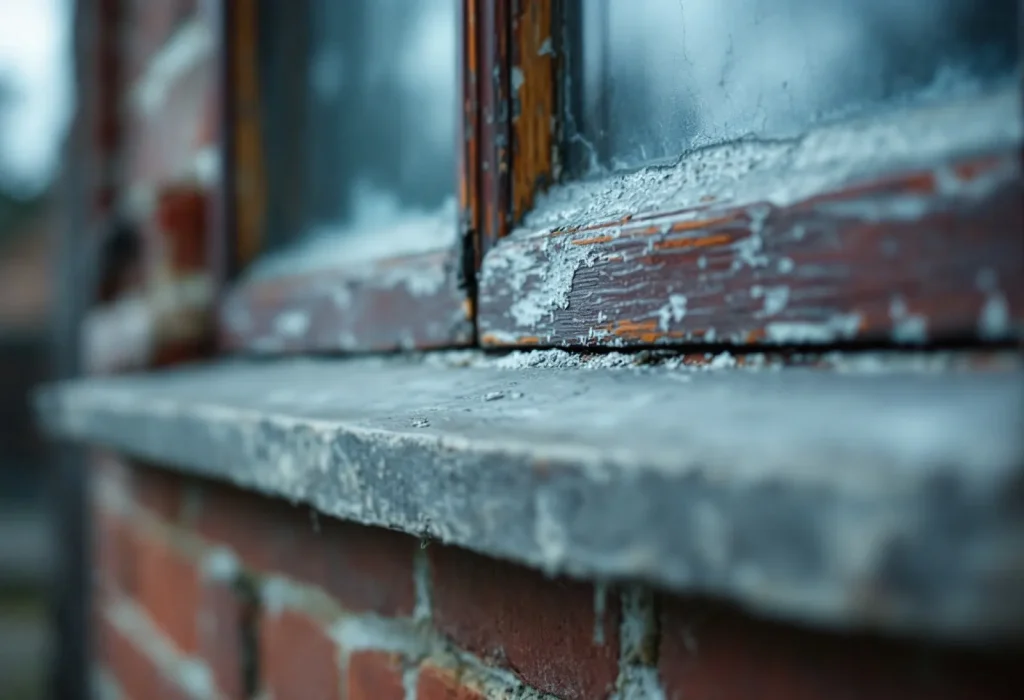
The short answer
Asbestos caulk is window putty, glazing compound or joint sealant containing more than 1% asbestos by polarized light microscopy, the threshold in 40 CFR 61.141. You cannot identify it by eye; a lab must test a sample. EPA letters from 1991 and 1993 treat pliable, intact putty much like Category I material, but sanding, grinding, cutting or crumbling makes it regulated RACM.
Is asbestos window caulk Category I or Category II under the NESHAP?
Read literally, 40 CFR 61.141 puts caulk in Category II. The rule lists only four Category I materials: asbestos-containing packings, gaskets, resilient floor covering and asphalt roofing products. Every other nonfriable material over 1 percent asbestos is Category II nonfriable ACM, and caulk, glazing compound and sealant are not on the Category I list.
EPA softened that in two letters, which are the whole content of EPA's window caulk and glazing page and are linked there without a summary. EPA's 6 February 1991 letter to G. Hitchings says floor tile mastic, electrical wiring “and caulking compounds might be treated like Category I materials; however, this determination must be made on a case-by-case basis.” EPA's 14 January 1993 letter to J. Dufour goes further for windows: to the extent asbestos window putty “is a pliable asbestos-containing sealant or mastic that is in good condition,” EPA called it Category I ACM that is not required to be removed before demolition.
The same 1993 letter sets the limit: window putties “will become regulated ACM if they have become friable or are subjected to sanding, grinding, cutting or abrading.” That tracks the RACM definition in 40 CFR 61.141, and 40 CFR 61.145(c)(1)(i) lets Category I material stay in place for demolition only when it is not in poor condition and not friable. Brittle, cracked putty that powders when pressed is no longer pliable, so the favourable reading in the letters stops applying. Our page on friable asbestos sets out the hand pressure test word for word.
When the RACM does have to come out of a covered facility, the quantity tests in 40 CFR 61.145(a)(1) still apply: at least 260 linear feet on pipes, 160 square feet on other components or 35 cubic feet off components triggers the full notice and work practice rules, with written notice 10 working days before work begins.
Glazing compound, perimeter caulk or interior sealant: which bead are you looking at?
“Window caulk” usually means two or three different products. National Park Service Preservation Brief 9 describes reglazing a wood sash as laying a bed of putty around the rabbet, pressing in the pane, inserting glazing points and finishing with “a final seal of putty” bevelled around the glass. That putty is the glazing compound. The joints where the frame meets the wall are caulked separately, and the brief tells owners to check both.
The distinction matters for the lab and the rules. EPA's 14 January 1993 letter to J. Dufour addressed window putty specifically, while EPA's PCBs in Building Materials Questions and Answers (28 July 2015) (question 7) places PCB caulk mainly “in or around windows, door frames, stairways, building joints, masonry columns” and lists window glazing separately as a material where PCBs have been found. The EMSL price guide counts every layer as a separate fee, so a putty sample and a perimeter caulk sample are two results, not one.
What each kind of caulk triggers when windows come out or a building comes down
No ranking page puts the asbestos rule and the PCB rule for each bead side by side. The table below is built from 40 CFR 61.141, 40 CFR 61.145, the 1991 and 1993 EPA letters, 40 CFR 761.3 and EPA's PCBs in Building Materials Questions and Answers (28 July 2015). It describes the federal floor; state and local air agencies can be stricter.
| Caulk, glazing or sealant | Where it sits | Asbestos NESHAP status | PCB status (TSCA, 40 CFR 761) | What window replacement or demolition triggers |
|---|---|---|---|---|
| Pliable glazing putty, intact | Wood or steel sash, around each pane | Category II by the 61.141 list; EPA 1993 letter treats it as Category I that may stay for demolition | Window glazing listed by EPA as a PCB source in some 1950 to 1979 buildings | Demolition: may stay if intact. Cutting or scraping it out: RACM and OSHA Class II work |
| Hard, cracked or powdery glazing putty | Same location, weathered | RACM once friable (61.141 item a) and must come out before demolition in a covered facility | Same as above; test if built or renovated 1950 to 1979 | Removal first, wet methods, NESHAP waste rules |
| Exterior perimeter caulk | Frame to masonry, door frames | Category II; EPA 1991: may be treated like Category I case by case | EPA’s main PCB caulk use, 1950 to 1979; 50 ppm or more is an unauthorized use under TSCA | Window replacement removes it: test for both before work |
| Masonry and expansion joint sealant | Building joints, columns, stairways | Category II; condition and demolition method decide RACM | Named in EPA Q&A 7; reported from below 50 to above 440,000 ppm | PCB bulk product waste if 50 ppm or more (761.3) |
| Interior caulk at trim or casing | Casing to plaster or drywall | Category II; nonfriable while flexible | EPA: PCB use in housing materials “not well documented” | OSHA applies to contractors even in a house |
Why is the same window caulk also tested for PCBs at 50 ppm?
Because the PCB rule is about use, not just waste. EPA's PCBs in Building Materials Questions and Answers (28 July 2015) (question 33) states that TSCA regulations “prohibit the use of PCBs in caulk and other building materials manufactured with PCBs at levels greater than or equal to 50 ppm, including the continued use of such materials that are already in place.” EPA adds that buildings following its recommended practices will in most cases be a low enforcement priority.
EPA’s guidance on EPA's PCBs in building materials page centres on schools and other buildings built or renovated between about 1950 and 1979, and question 7 reports caulk concentrations from below 50 ppm to more than 440,000 ppm. For houses the same document is cautious: EPA found PCBs in some large apartment complexes, but residential use “is not well documented.”
Once removed, caulk at 50 ppm or more is PCB bulk product waste under 40 CFR 761.3, which names caulking in the definition. 40 CFR 761.62(b)(1)(i) allows caulking to go to a state-permitted non-hazardous landfill, but (b)(4)(i) requires written notice to the landfill at least 15 days before the first shipment, and (b)(5) requires sampling records and notifications to be kept for 3 years. EPA’s Q&A (question 18) also allows a shortcut: skip the PCB test and assume regulated levels, then dispose under subpart D.
If the bead is also over 1 percent asbestos, both rule sets apply to the same waste. That is why our sibling page on how to dispose of asbestos treats the landfill call as the first step.
How to identify asbestos caulking: what the lab does with one bead
EPA's homeowner asbestos page is plain that you generally cannot tell whether a material contains asbestos by looking at it unless it is labelled, and that taking samples yourself is not recommended. Colour, hardness and age are not tests. A sample has to go to a lab, and caulk needs a different preparation from wallboard or ceiling texture.
Labs class caulk as NOB, non-friable organically bound material. Per the EMSL Analytical laboratory price guide, typical NOBs include “floor tiles, mastics, roofing, caulking, tars, covebase, glazing” (end note 7); the guide recommends gravimetric reduction preparation for them and additional TEM analysis when a PLM NOB result is none detected or under 1% (end note 9).
Per the EMSL Analytical laboratory price guide, testing one bead for both hazards costs $211 at two week turnaround and $567 at the fastest listed rates (our arithmetic: PLM NOB plus PCB bulk). Adding the TEM follow-up per the same list takes that to $286 to $742. These are commercial list prices; a consultant’s visit is extra. Our guide to choosing an asbestos testing lab lists the NVLAP accreditation to ask for.
Sample each bead type separately: face putty, perimeter caulk and any interior sealant are separate homogeneous materials. On a building with many window types, an asbestos survey groups them so the sample count stays defensible.

How often did old caulk carry asbestos, PCBs or both in one lab’s 31 samples?
No federal survey reports how often caulk contains asbestos. The nearest published data is an informal study by an EMSL analyst in Healthy Indoors, 10 March 2020: 31 caulk samples already tested for PCBs were pulled from the lab’s repository and re-analysed for asbestos by TEM after gravimetric reduction. 11 contained asbestos, 6 of them above 1 percent, and 15 held PCBs above 50 ppm.
The article labels the “neither” group 19 percent; 9 of 31 is 29 percent, which is the share the chart shows. The sample was not random across building types, so treat the split as evidence that both hazards turn up in the same bead, not as a prevalence rate for your building.
Does replacing windows in a house trigger the NESHAP or OSHA rules?
The NESHAP usually does not. 40 CFR 61.141 defines a facility to exclude residential buildings having 4 or fewer dwelling units, so owner work on a single family house is outside the federal notice and removal duties, though state and local rules may still apply. Our asbestos regulations page maps which agency covers what.
OSHA does apply to any contractor’s crew. 29 CFR 1926.1101 defines Class II work as removing ACM that is not thermal system insulation or surfacing material, “including construction mastics.” OSHA's 3 August 2005 interpretation treated cutting out asbestos mastic as Class II and said barriers can be dropped only when it comes out substantially intact and a negative exposure assessment exists. OSHA's 7 May 2026 interpretation confirmed that restoration work in single family homes next to asbestos materials is covered by the standard.
The exposure limits are 0.1 fibre per cubic centimetre over 8 hours and 1.0 f/cc over 30 minutes, per 29 CFR 1926.1101(c). For removal method, EPA's summary of caulk removal tools rates a utility knife as producing no dust on elastic caulk, while hammers and power tools need containment and dust capture. Method detail for asbestos sits on our how to remove asbestos page.
Out of scope: health effects. This page reads regulations, EPA letters and lab documents only; for health information see EPA's homeowner asbestos page and the CDC’s Agency for Toxic Substances and Disease Registry.
Questions people actually ask
Will Kilz seal asbestos?
EPA does not endorse any paint or primer for this. Its homeowner page calls sealing, or encapsulation, a repair that should be done “only by a professional trained to handle asbestos safely,” and the asbestos stays in place. Painting cracked putty also hides the condition a 40 CFR 61.141 judgement depends on. Our asbestos encapsulation page covers when sealing is appropriate.
How do you tell if an adhesive or caulk contains asbestos?
Only a lab can tell. Caulk, mastic and glazing are NOB materials, so ask for PLM NOB with gravimetric reduction, and for TEM if the result is none detected or under 1%, per the EMSL price guide end notes. EPA’s homeowner page warns that you generally cannot identify asbestos by looking unless the material is labelled.
Can I encapsulate asbestos caulk myself?
EPA’s homeowner page says repair, including sealing, should be done only by a trained professional. In a house of 4 or fewer units the federal NESHAP does not apply, but state rules may, and OSHA’s 29 CFR 1926.1101 applies to any hired crew. Ask your state asbestos programme whether owner work is allowed and what waste rules follow.
Will 30 minutes of asbestos exposure hurt you?
Health effects are outside the scope of this page; EPA’s asbestos pages and the CDC are the sources for that question. The only 30 minute figure in federal rules is OSHA’s excursion limit: no worker may be exposed above 1.0 fibre per cubic centimetre averaged over 30 minutes, under 29 CFR 1926.1101(c)(2).
Sources
- EPA's window caulk and glazing page, United States Environmental Protection Agency, last updated 4 November 2026. Retrieved 9 November 2026.
- EPA's 6 February 1991 letter to G. Hitchings, applicability determination C88, Emission Standards Division. Retrieved 9 November 2026.
- EPA's 14 January 1993 letter to J. Dufour, Office of Air and Radiation, responses 5 and 6 on window putty. Retrieved 9 November 2026.
- 40 CFR 61.141 and 40 CFR 61.145, asbestos NESHAP definitions, thresholds and removal rules, Legal Information Institute. Retrieved 9 November 2026.
- 40 CFR 761.3 and 40 CFR 761.62, PCB bulk product waste definition and disposal, Legal Information Institute. Retrieved 9 November 2026.
- EPA's PCBs in building materials page, and EPA's PCBs in Building Materials Questions and Answers (28 July 2015), questions 7, 10, 12, 18 and 33. Retrieved 9 November 2026.
- EPA's summary of caulk removal tools, United States Environmental Protection Agency. Retrieved 9 November 2026.
- 29 CFR 1926.1101, OSHA construction asbestos standard, paragraphs (b) and (c), Legal Information Institute. Retrieved 9 November 2026.
- OSHA's 3 August 2005 interpretation on construction mastic as Class II work, and OSHA's 7 May 2026 interpretation on restoration work in single family homes, Occupational Safety and Health Administration. Retrieved 9 November 2026.
- EPA's homeowner asbestos page, last updated 25 June 2026. Retrieved 9 November 2026.
- EMSL Analytical laboratory price guide, EMSL Analytical, Inc.: PLM NOB, TEM NOB and PCB bulk caulking prices and end notes 7 to 9. Retrieved 9 November 2026.
- National Park Service Preservation Brief 9, The Repair of Historic Wooden Windows, John H. Myers, figure 4d. Retrieved 9 November 2026.
- Healthy Indoors, 10 March 2020, Robert J. DeMalo, EMSL Analytical, informal 31 sample study. Retrieved 9 November 2026.
- Two-test totals and the corrected share are arithmetic on the figures above. Our methodology sets out the standing rules.
This page describes federal rules and published guidance. State and local asbestos and PCB programmes can be stricter; confirm with your state agency before work.
More rules pages sit on our standards hub.