The short answer
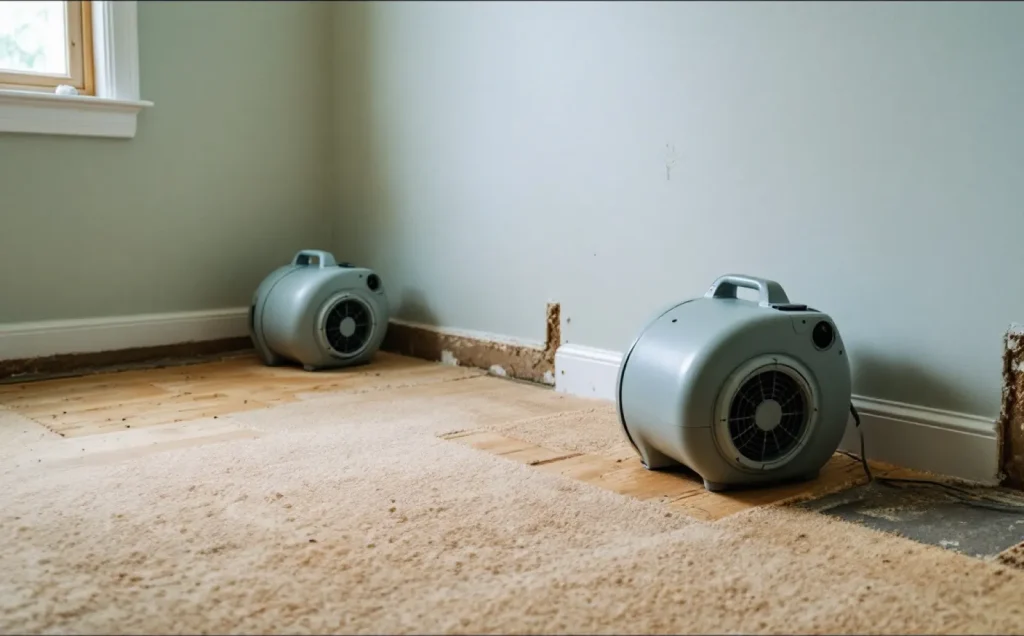
An air mover for water damage is a high-velocity drying fan aimed across wet floors and lower walls. The IICRC worksheet sizes it at one per affected room, plus one per 50 to 70 sq ft of wet floor, one per 100 to 150 sq ft of wet wall or ceiling above 2 ft, and one per wall offset over 18 inches, rounded up.
How many air movers does a 12 x 12, a 14 x 20 and a kitchen need?
The IICRC Airmover and Gallons Calculation Worksheet, revision 7.1.22, is a four-step count. Step 1 puts one unit in each affected room. Step 2 adds one per 50 to 70 sq ft of wet floor, and that floor figure already covers the lower walls up to 2 ft (24 in). Step 3 adds one per 100 to 150 sq ft of wet wall and ceiling above 2 ft. Step 4 adds one for each inset or offset over 18 in. Every fraction rounds up.
Two exceptions sit in the same worksheet. A room under about 25 sq ft, such as a closet, may need only one unit. Where water reached the lower walls but moved less than 2 ft into the room, the count switches to one unit per 14 linear ft of wet wall, and that method is not mixed with the square foot method in the same room. The worksheet comes from the IICRC; the ANSI/IICRC S500 standard it serves is sold, not published free.
| Room | Worksheet arithmetic | Air movers |
|---|---|---|
| Bedroom 12 x 12 ft, wet carpet wall to wall, water below 2 ft on walls | 1 + 144/70 to 144/50 floor + 0/150 to 0/100 wall + 0 offset | 4 |
| Living room 14 x 20 ft, wet floor, two 20 ft walls wicked to 4 ft, one fireplace bump out over 18 in | 1 + 280/70 to 280/50 floor + 80/150 to 80/100 wall + 1 offset | 7 to 9 |
| Kitchen, water ran under 30 linear ft of cabinets but less than 2 ft into the room | 30 / 14 = 2.14, round up | 3 |
The living room is the useful case: per the worksheet, 7 to 9 units for one 280 sq ft room, because the wicked walls and the fireplace each add a unit. A homeowner with one box fan is short by a factor of about 7 before any question of fan type. Measure the wet area with a meter rather than by eye; our moisture meters for water damage page covers which meter reads which material.
Which way should each unit point, and how far from the wall?
The R&R magazine KnowHow guide of 29 April 2024 gives three numbers: set each unit at 5 to 45 degrees to the wall, put the snout about 1 inch off the wall so it does not choke the outlet, and point every unit the same way so streams do not cancel. The R&R KnowHow guide of 12 June 2025 calls for a circular pattern, or vortex, with units at 45 degrees. Both sources are trade guidance, not the S500 text.
AlorAir, a maker of restoration equipment, makes the same point in plainer terms: airflow parallel to a wet surface covers more material than airflow aimed at one spot, so units sit along the wet perimeter rather than in the middle of the room. Extract standing water first, because AlorAir and the IICRC gallons worksheet both treat extraction as the faster step: 1 cubic foot of standing water is 7.48 gallons. Our water extraction page covers that stage.
How many air movers can share one 15 A or 20 A circuit?
Drying equipment runs for days without a break, so it is a continuous load. According to Mike Holt's EC&M Code Q&A (22 September 2016), NEC 210.20(A) requires the branch circuit breaker to be rated at not less than 125% of continuous load plus 100% of noncontinuous load, with 210.19(A)(1) applying the same basis to the wire. Turned around, a 15 A breaker carries 12 A of continuous load and a 20 A breaker 16 A, before anything else on that circuit.
| Model (data from maker pages) | Type (maker’s word) | CFM | Amps | Weight | Cord | Maker daisy chain on 15 A | Units per 15 A at 80% | Units per 20 A at 80% |
|---|---|---|---|---|---|---|---|---|
| Dri-Eaz Velo Pro | Low profile | 500 to 885 | 1.2 to 1.9 | 18.6 lb | 18 ft | 10 | 6 | 8 |
| Dri-Eaz Sahara Pro X4 | Not stated by maker | 867 | 1.9 to 2.5 | 21.7 lb | 16 ft | 6 | 4 | 6 |
| Dri-Eaz Stealth AV3000 | Axial | 2,600 | 2.7 | 27.5 lb | 15 ft | 4 | 4 | 5 |
| Phoenix Focus II | Dual axial | 1,015 | 1.1 | 15.5 lb (spec sheet), 16 lb (manual) | 17 ft 5 in | 10 | 10 | 14 |
| Dri-Eaz Vortex | Axial | 2,041 | 7.4 | 35 lb | 20 ft | Not stated | 1 | 2 |
Per the maker pages, daisy chain numbers and the 80% figures agree once speed is accounted for. The Dri-Eaz Velo Pro page lists 10 units on one 15 A circuit; at its 1.2 A low setting that is 12 A, exactly the continuous limit, while at its 1.9 A high setting only 6 fit. The Dri-Eaz Sahara Pro X4 page says its outlets connect up to 6 units: 11.4 A at the 1.9 A low draw, inside the limit, but 15 A at the 2.5 A high draw, which is over it. The Phoenix Focus II at 1.1 A reaches 10 units at 11 A, and its manual says chained units must comply with the National Electrical Code. The Dri-Eaz Vortex at 7.4 A allows 1 per 15 A circuit.
Worked example: the 14 x 20 living room
At the high range of 9 units, Velo Pro units on high draw 17.1 A, which needs 2 separate 15 A circuits. The same count of Phoenix Focus II units draws 9.9 A and fits on 1 15 A circuit with 2.1 A spare. A dehumidifier on the same circuit takes from that margin; sizing it is covered on our water damage dehumidifier page.
Low profile, centrifugal or axial: which shape suits which wet area?
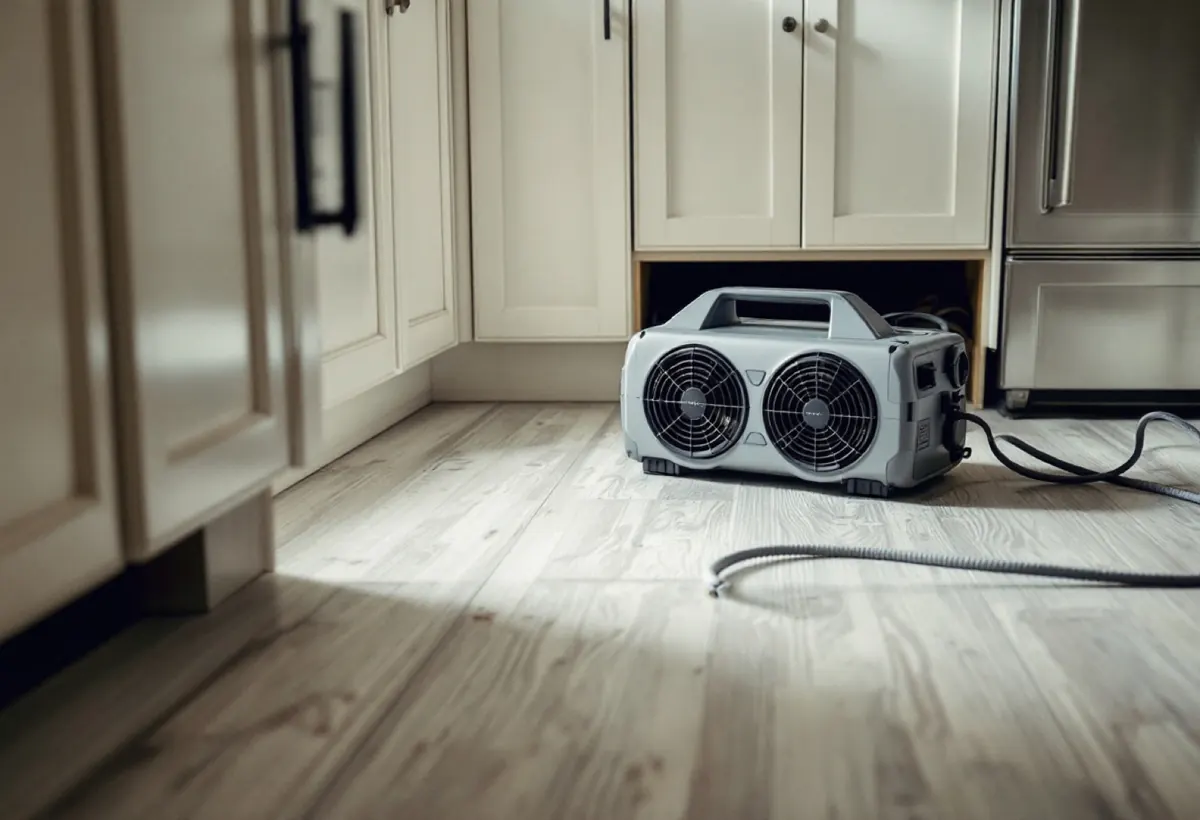
Makers sort units by shape. AlorAir describes centrifugal units as strong, focused airflow for walls, carpet and stairs, axial units as broad, high-volume airflow for open rooms and hallways, and low profile units as compact bodies for floors and under cabinets. The spec table shows the trade. Per the maker pages, the axial Dri-Eaz Stealth AV3000 moves 2,600 CFM at 0.40 in of static pressure on 2.7 A, while the low profile Dri-Eaz Velo Pro moves 500 to 885 CFM from a body 8.8 in tall.
Static pressure is the number that separates a drying fan from a room fan, and few makers print it. Dri-Eaz lists 0.40 in for the Stealth AV3000 and 3.0 in for the Dri-Eaz Vortex, a 1.0 HP unit that draws 7.4 A. Higher static pressure pushes air through ducting, into wall cavities or under cabinets; the Phoenix manual notes that ducting reduces its amp draw. Comparing CFM alone hides that.
Do household fans help with water damage, or spread the problem?
They move air, but they are not built or rated for the job. The EPA Mold Remediation in Schools and Commercial Buildings guide, Chapter 3 sets the clock: its Table 1 strategies respond to water damage within 24 to 48 hours, to act before mold growth starts. A restoration unit publishes its amp draw, a daisy chain limit and, for Phoenix, an Xactimate code (WTRDRY); a household fan usually publishes none of that, so the circuit math above cannot be done.
Insurers and contractors bill restoration air movers by the day. The Phoenix Focus II spec sheet reports an Xactimate rate of $25.39 a day, labelled as the Madison, Wisconsin rate as of 1 September 2019, which gives a sense of scale: the 7 unit living room for 3 days is 21 unit days. Current rates differ by region and date. Total drying time is covered on our how long water damage drying takes page.
When must air movers stay off: standing water, mold or broken asbestos material?
- Standing water and wet hands. The Phoenix Focus II owner's manual says not to expose the unit to standing water or rain. 29 CFR 1910.334(a)(5)(i) bars workers from plugging or unplugging energized cords with wet hands, and (a)(4) requires equipment used in locations inundated with water to be approved for them. Power off the affected circuit at the panel before stepping into water.
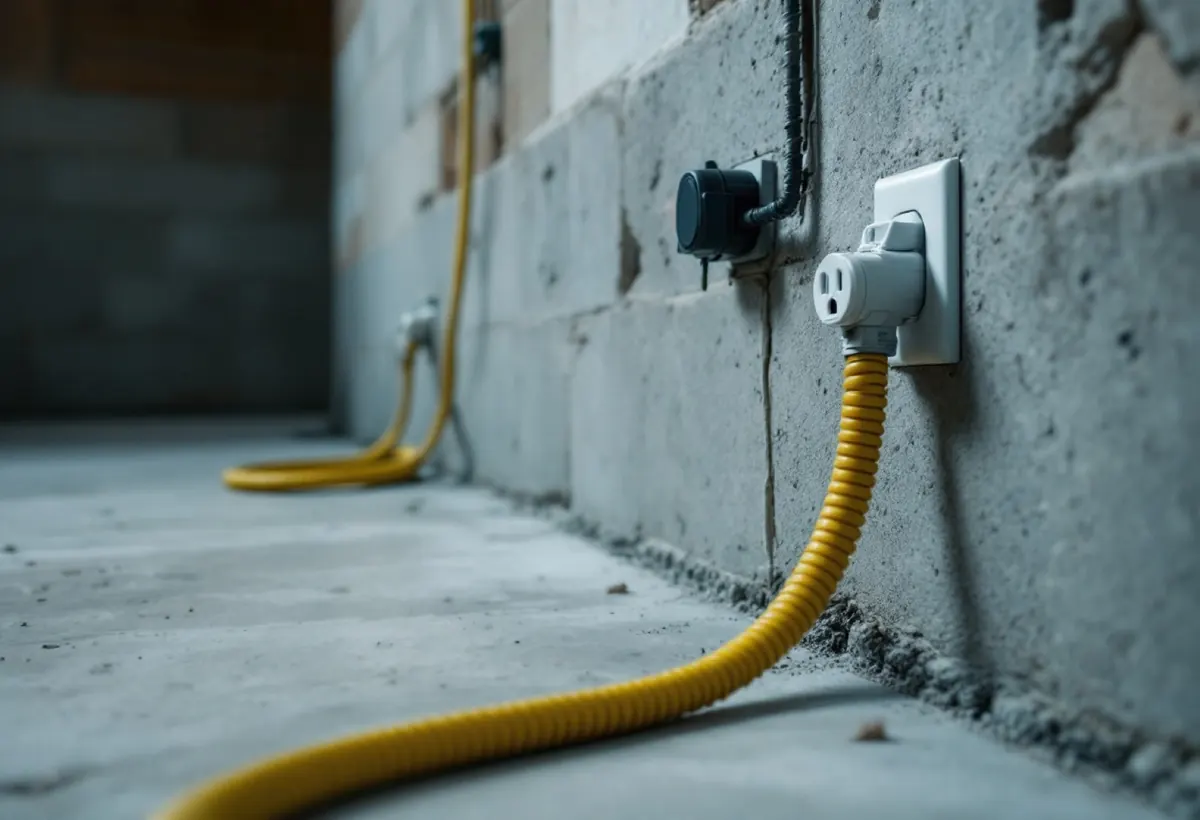
- Temporary outlets. 29 CFR 1926.404(b)(1)(ii) requires approved ground fault circuit interrupters on all 120 volt, single phase, 15 and 20 A receptacles on construction sites that are not part of the permanent wiring. The Dri-Eaz Sahara Pro X4 page lists GFCI outlets on the unit itself.
- Visible mold. The EPA lists “using fans to dry items” among the actions likely to stir up mold, and says fans must not carry spores into unaffected areas. Mold needs containment first; our mold mitigation page covers it.
- Suspect asbestos material broken by the water, such as popcorn ceiling texture or pipe wrap in a pre 1980s house. Who may disturb it, and how, is set out on our asbestos abatement page.
Air movers are one half of the drying system. They raise evaporation, and the moisture they release has to leave through dehumidification or ventilation, which is the subject of our structural drying page. More water topics sit in the water damage hub.
Questions people actually ask
What kind of fan is used to dry water damage?
A restoration air mover: a low profile, centrifugal or axial unit built for continuous running. Examples, per the maker pages: the Dri-Eaz Velo Pro at 500 to 885 CFM on 1.2 to 1.9 A and the Phoenix Focus II, a dual axial unit at 1,015 CFM on 1.1 A, each with an outlet for daisy chaining more units.
How do you dry out a room after flooding?
Stop the water, shut off power to wet circuits, extract standing water, then place air movers using the IICRC worksheet count and run dehumidification at the same time. EPA guidance frames the response window as 24 to 48 hours. Check the wet area with a moisture meter and remove units as zones read dry.
Does Home Depot sell air movers?
Yes. Search results captured on 9 November 2026 included a B-Air VP-25 listing on homedepot.com, a 1/4 HP unit sold as a carpet and floor dryer. Before buying, read the amp draw on the label, because it sets how many units one 15 A circuit can run at the 12 A continuous limit.
Can I use one air mover for a whole house?
Not by the IICRC count. The worksheet starts at one unit per affected room before adding floor and wall units, so three wet rooms need at least 3. Only a space under about 25 sq ft, such as a closet, may be served by a single unit.
How long should air movers run after water damage?
Until moisture readings reach the dry standard for each material, not a set number of days. The R&R KnowHow guide of 29 April 2024 says to move units off areas as they dry and concentrate them on the remaining wet zones, and to document each change.
Sources
- IICRC Airmover and Gallons Calculation Worksheet, Institute of Inspection, Cleaning and Restoration Certification, US Imperial edition, revision 7.1.22. Retrieved 9 November 2026.
- R&R magazine KnowHow guide of 29 April 2024, “How To Install Air Movers”, Restoration and Remediation magazine. Retrieved 9 November 2026.
- R&R KnowHow guide of 12 June 2025, “How to Optimize Air Mover Placement in Water Damage Restoration”. Retrieved 9 November 2026.
- Mike Holt's EC&M Code Q&A, “Branch Circuit Overcurrent Protection”, EC&M, 22 September 2016, summarising NEC 210.20(A) and 210.19(A)(1). Retrieved 9 November 2026.
- 29 CFR 1926.404(b)(1)(ii) and 29 CFR 1910.334(a), via eCFR. Retrieved 9 November 2026.
- EPA Mold Remediation in Schools and Commercial Buildings guide, Chapter 3, EPA 402-K-01-001, page last updated 8 September 2026. Retrieved 9 November 2026.
- Dri-Eaz Velo Pro, Dri-Eaz Sahara Pro X4, Dri-Eaz Stealth AV3000 and Dri-Eaz Vortex product pages, Legend Brands. Retrieved 9 November 2026.
- Phoenix Focus II spec sheet and Phoenix Focus II owner's manual, Therma-Stor Phoenix, hosted by Sylvane. Retrieved 9 November 2026.
- AlorAir, “Air Movers for Water Damage Explained”, maker blog. Retrieved 9 November 2026.
- Room counts, amps per circuit and unit days are arithmetic on the figures above, computed when this page was built. No spec or price on this page was estimated or invented. Our methodology sets out the standing rules.
The NEC 210.20(A) limits here are a planning check, not an electrician’s load calculation. Read the amp rating on each unit’s label and confirm what else shares the circuit.