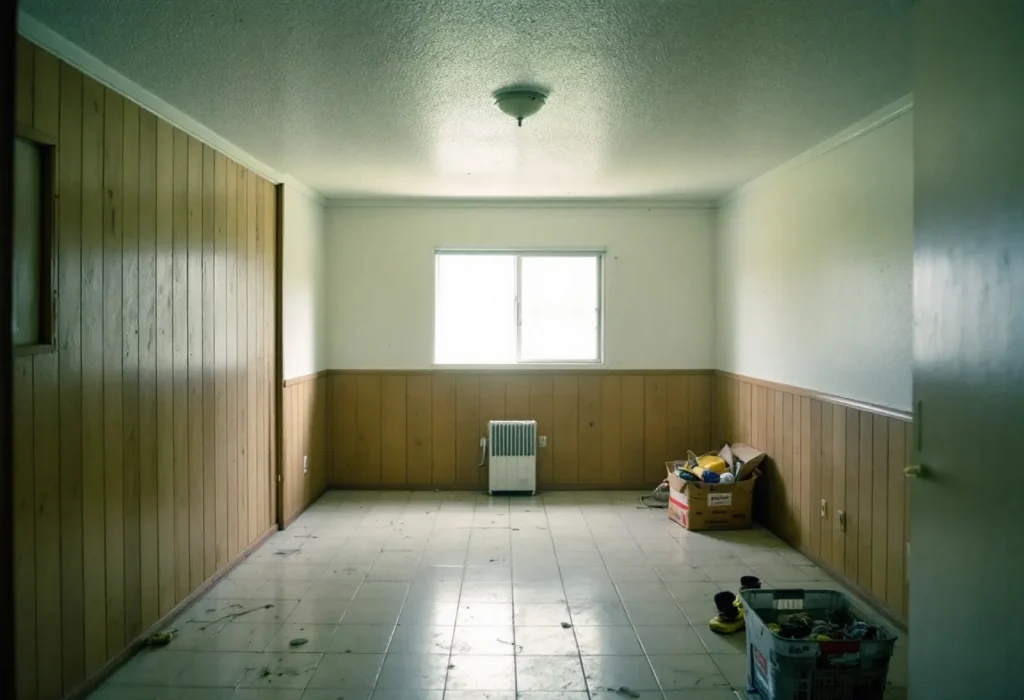
The short answer
Asbestos in mobile homes is likely in units built before about 1980 and cannot be ruled out by date alone in later ones. The 1976 HUD Code never mentions asbestos, and federal bans on most building products did not survive a 1991 court ruling. Census data show about 1.6 million occupied mobile homes built before 1980. Only a lab test settles it.
How many pre-1980 mobile homes are still lived in? About 1.59 million
The Census Bureau ACS 2024 table B25127 counts 6,836,130 occupied units in its category for mobile homes, boats, RVs and vans, 5.2% of all 132,737,146 occupied US homes. Of those, 1,589,896 (23.3%) were built before 1980, per the Census estimate, with an approximate margin of error of ±22,934.
The 1960 to 1979 bin alone holds 1,418,520 units, 89% of the pre-1980 Census total. That is the generation built when the products on the CPSC list below were still sold without federal limits.
Two limits matter when reading this. The Census category also counts boats, RVs and vans, per the B25127 variable list, so the figure is an upper bound for mobile homes. And the 1980 to 1999 bin (3,039,117 units, Census) cannot be split at 1989, the year EPA’s partial ban was issued, so some of those homes also predate every federal product rule discussed below.
Where the older units are
| State | Occupied mobile homes | Built before 1980 | Share pre-1980 | Approx. MOE, pre-1980 |
|---|---|---|---|---|
| California | 468,750 | 231,249 | 49.3% | ±7,994 |
| Florida | 655,355 | 190,472 | 29.1% | ±8,615 |
| Texas | 691,902 | 85,634 | 12.4% | ±5,844 |
| Arizona | 252,437 | 72,615 | 28.8% | ±5,779 |
| North Carolina | 454,283 | 63,671 | 14.0% | ±5,091 |
| Washington | 175,664 | 55,405 | 31.5% | ±3,865 |
| Pennsylvania | 172,734 | 55,320 | 32.0% | ±3,751 |
| New York | 155,926 | 46,493 | 29.8% | ±3,593 |
| Michigan | 194,066 | 46,252 | 23.8% | ±3,123 |
| Oregon | 122,051 | 42,458 | 34.8% | ±3,715 |
California stands out: 49% of its occupied mobile homes predate 1980 in the Census data, against 29% in Florida and 12% in Texas. Per the Census table, the 10 states shown hold 889,569 of the 1,589,896 pre-1980 units nationally. For the same question asked about site-built houses, see our page on houses with asbestos.
Does the June 15, 1976 HUD Code say anything about asbestos? No
Under 24 CFR 3282.8, the federal manufactured home rules apply to every home that entered the first stage of production on or after June 15, 1976. That date is why homes built after it are called manufactured homes and older ones are usually called mobile homes. 24 CFR 3280.2 defines a manufactured home as a structure at least 8 body feet wide or 40 body feet long in travel mode, or 320 square feet erected, built on a permanent chassis.
The construction standard itself, 24 CFR Part 3280, does not contain the word asbestos. An eCFR full text search of Title 24 on 16 November 2026 returned 8 hits for asbestos across Title 24, in Parts 200, 570, 581, 905 and 970, none in Part 3280. HUD did regulate one indoor pollutant: 24 CFR 3280.308 caps formaldehyde from composite wood, for example 0.09 ppm for particleboard and 0.05 ppm for hardwood plywood.
So a HUD label proves the home met a federal construction code, not that its materials were asbestos free. Guides online that credit the 1976 code with moving builders off asbestos give no rule text for it, and Part 3280 has none.
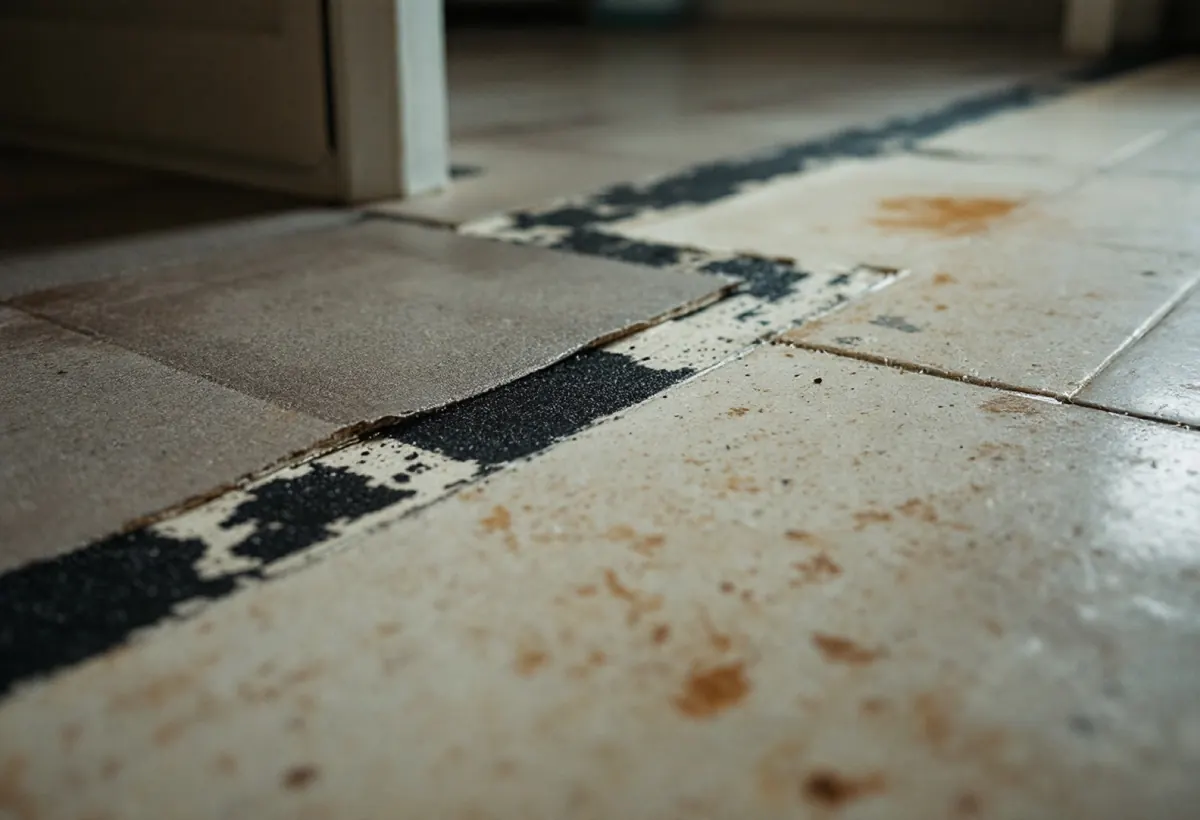
Which parts of a 1960s, 1970s or 1980s mobile home could contain asbestos?
The CPSC guide Asbestos In The Home names the household products to suspect, and three federal actions moved the lines: 16 CFR 1304.4 for patching compounds in 1978, the 1990 spray-on limit, and the 1989 ban that a federal appeals court overturned for most products in 1991, as EPA's asbestos actions page records. The matrix lays those dates over the build eras a mobile home owner sees on a data plate or title.
| Component (CPSC or EPA product name) | Built before mid 1978 | Built mid 1978 to 1989 | Built after 1989 |
|---|---|---|---|
| Ceiling texture, textured paint, joint and patching compound | Possible: on the CPSC list | Consumer patching compounds with added asbestos banned after June 11, 1978 (16 CFR 1304.4); CPSC dates the textured paint ban to 1977 | Same bans stand |
| Sprayed soundproofing or decorative wall and ceiling finish | Possible: on the CPSC list | Possible: no federal spray limit cited by EPA until 1990 | Spray application above 1% asbestos prohibited from 1990 under the NESHAP, per EPA |
| Vinyl floor tile, sheet vinyl backing, floor adhesive | Possible: on the CPSC list | Possible: not banned by any rule in force | Not banned after the 1991 ruling; vinyl asbestos floor tile is on EPA’s 2019 list of uses that need EPA review to return |
| Asbestos cement siding, roofing and shingles | Possible: on the CPSC list | Possible | Cement products on EPA’s 2019 list |
| Roof coatings, sealants and adhesives | Possible: named by EPA | Possible | Roof and non-roof coatings, adhesives and sealants on EPA’s 2019 list |
| Cement sheet, millboard or paper around furnaces and stoves; furnace door gaskets | Possible: on the CPSC list | Possible | Millboard and beater-add gaskets on EPA’s 2019 list |
| Pipe and duct wrap, blanket or tape | Possible: CPSC names pipe blanket and tape | Possible | Pipeline wrap and tape products on EPA’s 2019 list |
Read the right-hand column carefully. EPA says most of the 1989 ban was overturned in 1991, leaving only new uses and 5 product types banned, and the products on the 2019 list were still legal to make until that rule took effect on June 24, 2019. So a 1990s data plate narrows the odds but never closes them, and EPA’s March 2024 chrysotile rule, per the EPA's asbestos actions page, is the first to prohibit the ongoing uses.
Two of the matrix rows have their own pages. Sprayed ceiling texture, the most common suspect in pre-1978 single-wides, is covered in popcorn ceiling asbestos. Vinyl tile and sheet backing are covered in how to tell if floor tiles contain asbestos.
Can a 1985 or 1995 build date prove a mobile home is asbestos free?
No. A common rule of thumb online says mobile homes built after 1978 are unlikely to contain asbestos because EPA banned it in building materials. The EPA's asbestos actions page says otherwise: the 1989 partial ban on manufacture, import, processing and distribution was mostly overturned in 1991 by the Fifth Circuit, so the product categories in the matrix stayed legal well past 1980.
EPA's homeowner asbestos page states that you cannot tell whether a material contains asbestos by looking at it unless it is labeled, and that if in doubt you should treat it as asbestos and leave it alone. EPA also says a home whose materials are not damaged and will not be disturbed does not need testing. Testing becomes the question when you plan to cut, sand, drill, pull up flooring or demolish.
Before that kind of work, an accredited inspector takes the samples, which EPA recommends over self-sampling because sampling done wrong can release more fibres than leaving the material alone. What a pre-work survey covers, and what to ask for in the report, is on our asbestos survey page.
Does the federal asbestos NESHAP apply when one trailer is scrapped?
Usually not. 40 CFR 61.141 defines a regulated facility as any institutional, commercial, public, industrial or residential structure, but excluding residential buildings having four or fewer dwelling units. EPA’s clarification at 60 FR 38725 (July 28, 1995) says the demolition or renovation of an isolated small residential building by any entity, municipalities included, is not covered.
For trailers specifically, EPA determination A050001 (June 23, 2005), answering the Delaware Department of Natural Resources, says single family homes, including trailer homes, are generally not subject to the asbestos NESHAP, and that a single residential trailer home and its recycling process stay exempt if it is a single dwelling unit at the time of demolition. EPA still suggested Delaware encourage inspection and removal of asbestos material at the compaction site.
The exemption ends when units are grouped. Under 40 CFR 61.141 an installation is any group of buildings at one demolition or renovation site under the same owner or operator, and EPA’s 2005 letter says two or more residential trailer homes on the same site under one owner become a regulated installation. The Florida DEP asbestos FAQ applies this to parks: mobile home parks are subject to NESHAP when the same owner or operator works on multiple units concurrently, or as part of a larger project such as clearing blighted lots for newer units, and mobile structures used for non-residential purposes are always covered.
The full federal and state rule set is summarised in our asbestos regulations reference.
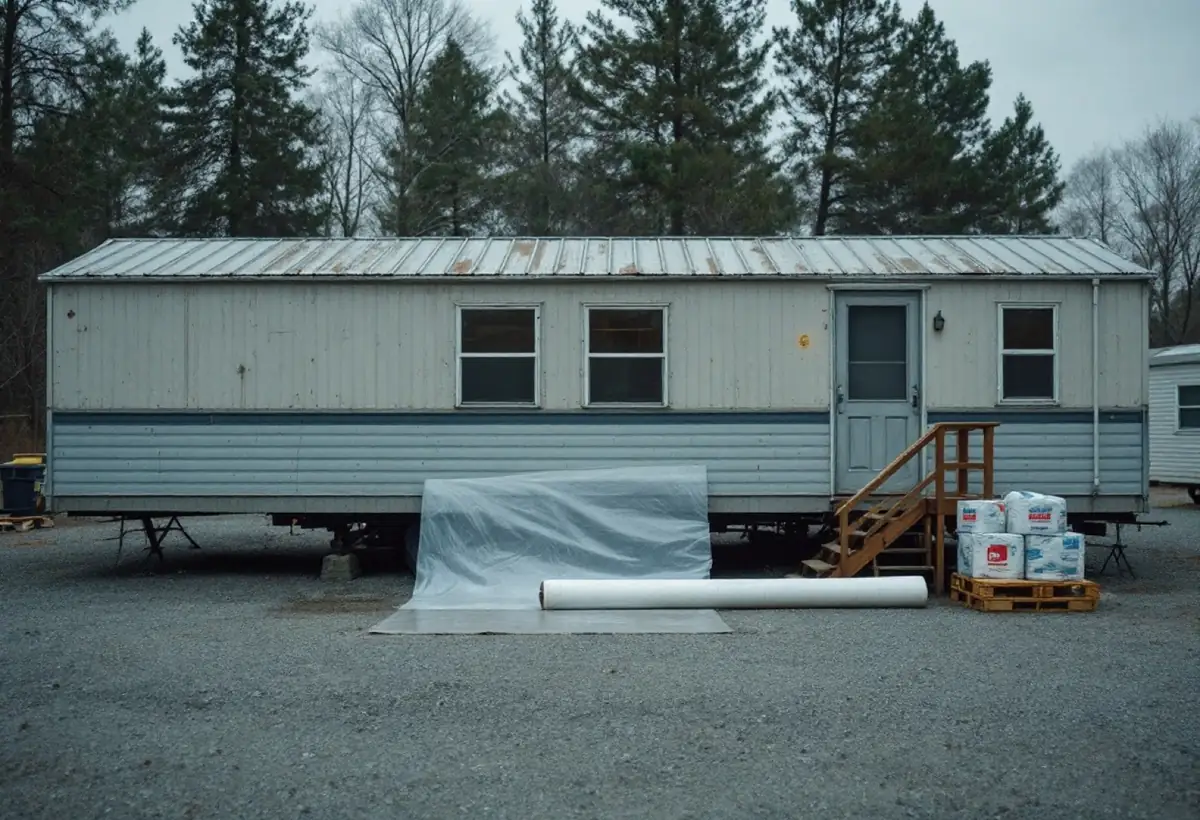
Which states and air agencies make you survey a mobile home before it comes down?
Local rules can be stricter than the federal exemption. The Puget Sound Clean Air Agency in Washington requires an asbestos survey by an AHERA certified building inspector before any demolition and says its notification and fee apply to all structures, including mobile homes with greater than 120 square feet of roof area, with a 10 day wait after filing.
The Missouri DNR fact sheet PUB2157 states plainly that projects involving demolition of two or more mobile homes are not exempt, and demolition notifications go to the department at least 10 working days ahead. Maine DEP exempts single family residences from its 5 working day demolition notice but notes that OSHA rules apply whenever an employer and employee relationship exists.
| Jurisdiction | One owner-occupied mobile home | When the rules bite | Source |
|---|---|---|---|
| Federal NESHAP (40 CFR 61.141) | One mobile home used as a single family dwelling: exempt | Two or more on one site under the same owner or operator | EPA 1995 notice; EPA determination A050001 |
| Puget Sound Clean Air Agency, Washington | Survey by an AHERA certified building inspector before demolition | Notification and fee for all structures, including mobile homes with more than 120 sq ft of roof area; wait 10 days | PSCAA Homeowner Demolition page |
| Missouri DNR | Single residential structure with four or fewer units: exempt | Two or more mobile homes not exempt; demolition notice 10 working days ahead | Missouri DNR PUB2157 (dated 05/07/2024) |
| Florida DEP | Single family mobile home: not subject unless part of a larger installation | Parks with concurrent work on multiple units, or blight clearing; any non-residential mobile structure | Florida DEP asbestos FAQ |
| Maine DEP | Single family residences left out of the 5 working day demolition notice | Inspection by a DEP licensed consultant for buildings other than residential buildings under 5 units | Maine DEP inspection requirements page |
If you are clearing several units in a park, or a dealer or recycler is taking title to more than one, ask the state air agency in writing whether the job counts as an installation under 40 CFR 61.141 before the first unit is cut. Disposal routes once material is identified are on our asbestos disposal page.
What should happen before you cut, sand or haul a pre-1980 single-wide?
Five steps, in order, drawn from the EPA homeowner page and the agency rules above:
- Find the build date on the HUD label or data plate. A date before June 15, 1976 means no HUD label at all under 24 CFR 3282.8; before 1980 puts the home in the 1.59 million unit group counted by the Census ACS.
- List what the work will disturb: ceiling texture, floor layers, furnace closet panels, roof coating, siding. Each matrix row is a separate sample.
- Have an accredited inspector sample those materials, as EPA recommends, and get layer by layer results for flooring.
- Check your state or air agency: Washington’s Puget Sound agency requires a survey and a 10 day notice even for one home.
- Keep the lab report with the title. A buyer, a park, a recycler or a landfill may ask for it.
Re-coating or replacing the roof of a mobile home is roofing work, which our sister site The Roofing Brief covers. More asbestos standards and reference pages sit in the standards hub.
For contractors and park operators
Two counts change your duties. Two or more units on one site under one owner or operator make an installation under 40 CFR 61.141, per EPA’s 2005 determination and the Florida DEP FAQ, and Maine DEP reminds owners that OSHA rules apply wherever an employer and employee relationship exists, whatever NESHAP says about the building.
Questions people actually ask
Are mobile homes likely to contain asbestos?
Older ones are. Census ACS 2024 data count 1,589,896 occupied mobile homes built before 1980, the era when every product type on the CPSC household list was legal. Later homes are less likely to, but EPA records that most of the 1989 ban was overturned in 1991, so no build year alone proves a home clean.
Was asbestos used in mobile homes in the 1970s?
The products were legal and on the market. The CPSC lists ceiling texture and patching compound, vinyl floor tile and sheet backing, cement siding and roofing, and furnace millboard and gaskets. Consumer patching compounds with added asbestos were banned only after June 11, 1978 under 16 CFR 1304.4. A lab test shows whether a specific home used them.
What year was asbestos banned in mobile homes?
There is no mobile home specific year. The HUD Code of June 15, 1976 does not mention asbestos. Product rules apply to all homes: patching compounds in 1978, spray application in 1990, new uses after August 25, 1989, a 2019 review rule, and EPA’s March 2024 chrysotile rule. For the full sequence see when asbestos was banned.
Is it safe to live in a mobile home built with asbestos?
EPA’s guidance is that material in good condition that will not be disturbed should be left alone, and such a home does not need testing. The concern starts when material is damaged, crumbling or water stained, or when remodeling will cut, sand or drill it. Check older ceilings and floors for tears, abrasions and water damage, and avoid touching suspect spots.
Can I use a home test kit on my mobile home ceiling?
EPA says taking samples yourself is not recommended, because sampling done incorrectly can be more hazardous than leaving the material alone, and it recommends a trained, accredited professional. Sprayed ceiling texture is one of the materials most easily disturbed, so a 1960s or 1970s ceiling is a poor first DIY sample.
Can a scrap yard take one old trailer without an asbestos survey?
Under federal rules, often yes: EPA’s 2005 determination says a single residential trailer home and its recycling process are exempt from the NESHAP. State and local rules can still require one. Washington’s Puget Sound agency requires a survey and a 10 day notification before demolishing any mobile home over 120 square feet of roof area.
Out of scope: this page covers materials, dates and rules, not health effects. For health information, see EPA's asbestos actions page and the linked EPA asbestos health pages.
Sources
- Census Bureau ACS 2024 table B25127, Census Bureau, American Community Survey 2024 1-year, table-based summary file, with the B25127 variable list. Retrieved 16 November 2026.
- 24 CFR 3282.8 and 24 CFR 3280.2, HUD manufactured home procedural and construction rules, via Legal Information Institute. Retrieved 16 November 2026.
- 24 CFR 3280.308, HUD formaldehyde emission controls, via Legal Information Institute. Retrieved 16 November 2026.
- eCFR full text search of Title 24, Office of the Federal Register, query asbestos. Retrieved 16 November 2026.
- CPSC guide Asbestos In The Home, US Consumer Product Safety Commission. Retrieved 16 November 2026.
- 16 CFR 1304.4, CPSC ban of consumer patching compounds containing respirable free-form asbestos, via Legal Information Institute. Retrieved 16 November 2026.
- EPA's asbestos actions page, US Environmental Protection Agency, EPA Actions to Protect the Public from Exposure to Asbestos. Retrieved 16 November 2026.
- EPA's homeowner asbestos page, US Environmental Protection Agency, Protect Your Family from Exposures to Asbestos, last updated June 25, 2026. Retrieved 16 November 2026.
- 40 CFR 61.141, asbestos NESHAP definitions, via Legal Information Institute. Retrieved 16 November 2026.
- 60 FR 38725 (July 28, 1995), EPA, Asbestos NESHAP Clarification of Intent, Federal Register Vol. 60 No. 145. Retrieved 16 November 2026.
- EPA determination A050001 (June 23, 2005), EPA Applicability Determination Index, Demolition of Residential Trailer Homes. Retrieved 16 November 2026.
- Florida DEP asbestos FAQ, Florida Department of Environmental Protection. Retrieved 16 November 2026.
- Puget Sound Clean Air Agency, Homeowner Demolition, Puget Sound Clean Air Agency, Washington. Retrieved 16 November 2026.
- Missouri DNR fact sheet PUB2157, Missouri Department of Natural Resources, Air Pollution Control Program, dated 05/07/2024. Retrieved 16 November 2026.
- Maine DEP, Asbestos Inspections Required Prior to Demolitions and Renovations, Maine Department of Environmental Protection. Retrieved 16 November 2026.
- Pre-1980 totals, shares, state rankings and the combined margin of error are arithmetic on the Census estimates above, computed when this page was built. Our methodology sets out the standing rules.
Rules differ by state, county and air district and change over time. Before demolition or renovation, confirm survey and notification duties with your state air or environmental agency and local building department.