The short answer
Air duct cleaning cost runs about $450 to $1,500 for a typical residential system, with larger or multi-system homes at $1,000 to $3,000. Before you book it, read the EPA position: duct cleaning has not been shown to prevent health problems and is not proven to improve air quality in routine circumstances. The EPA recommends cleaning where there is visible mould growth inside the ducts, a vermin infestation, or ducts so clogged with debris that particles are actually entering the room. After a fire, a flood or construction work, cleaning is clearly indicated for a different reason.
Key takeaways
- The EPA does not recommend routine duct cleaning. Its published position is that duct cleaning has not been shown to prevent health problems and that particle levels in homes have not been demonstrated to increase because of dirty ducts.
- The EPA does recommend cleaning in three specific situations: visible mould growth inside the ducts or on other system components, vermin infestation, and ducts clogged with debris that is actually entering the room through the registers.
- Restoration is a separate case. After a fire, a flood affecting the ductwork, or construction, the system has become a distribution network for soot, spores or dust, and cleaning is part of the remediation scope rather than a maintenance option.
- Typical cost is $450 to $1,500 for a residential system; $1,000 to $3,000 for larger or multi-system homes. Mould remediation inside ductwork or duct replacement sits well above that. Indicative ranges compiled from published contractor and aggregator price guides current in 2026.
- Per-vent pricing runs roughly $25 to $50 per vent plus a system charge, and per-vent quotes are where the advertised number most often excludes the air handler.
- The air handler, coil and blower are where contamination actually concentrates, and they are the first thing a cheap quote leaves out.
- The $49 or $99 whole-house advert is a recognised bait pattern. The advertised figure does not cover a real cleaning and the visit is structured around what gets added on site.
On this page
- Start with what the EPA actually says
- The three conditions EPA does name
- Restoration is a different question
- What air duct cleaning costs
- Per-vent pricing and what it hides
- What a legitimate service includes
- The air handler is the part that matters
- The $49 whole-house advert
- The industry reference standard
- When ducts have mould in them
- What moves the price legitimately
- Questions that separate a real quote from a lead
- Questions people actually ask
Air duct cleaning cost is an unusual thing to write about honestly, because the single most useful piece of information for most readers is that they may not need the service at all. That is not a popular position in a category with a large advertising spend behind it, and it is the position of the federal agency that studied it. We will cover the pricing in full, and we are going to put the EPA position first, because the cost of a service you did not need is the whole amount.
Start with what the EPA actually says
The United States Environmental Protection Agency publishes a consumer guidance document on this exact question: EPA, Should You Have the Air Ducts in Your Home Cleaned?. Its position has not changed in substance for many years and it is worth quoting the sense of it plainly.
- Duct cleaning has never been shown to actually prevent health problems. That is the EPA’s language, and it is the sentence the industry’s advertising works hardest around.
- Particle levels in homes have not been shown to increase because of dirty air ducts. Much of the dust in a duct adheres to the duct surface and does not enter the living space.
- The EPA does not recommend that air ducts be cleaned routinely, only as needed, and it names the conditions under which cleaning is warranted.
- The EPA does recommend that if you have a fuel-burning furnace, stove or fireplace, those are inspected for proper functioning and serviced before each heating season, which is a different service from duct cleaning.
This page exists to price a service honestly, which means saying clearly when it is not indicated. If a company tells you that routine duct cleaning will improve your health, reduce your energy bills by a specific percentage, or resolve allergies, ask them for the evidence and compare it against the EPA guidance linked above. We are not giving health advice here and we are not qualified to. We are pointing at the federal guidance and suggesting you read it before you buy.
Why the advertising says otherwise
Duct cleaning is sold on an image: a photograph of a duct interior with a heavy layer of dust, and the implication that you have been breathing it. Ducts do accumulate dust, that part is true. The step that does not follow is that the accumulated dust is entering the room in quantities that matter, and the EPA guidance addresses exactly that step. A duct with dust adhering to its walls is a duct with dust adhering to its walls.
The three conditions EPA does name
The EPA guidance is not a blanket discouragement. It names specific circumstances in which cleaning is appropriate, and those are worth knowing precisely, because they are checkable.
| Condition | How you would know | What to do first |
|---|---|---|
| Visible mould growth inside hard-surface ducts or on other components of the heating and cooling system | Visible growth on duct interiors, on the coil, or inside the air handler. Requires a look, which a camera inspection provides | Ask for the mould to be shown to you, and consider having it identified as mould rather than accepting the label. Insulated duct that is mouldy is generally replaced, not cleaned. |
| Ducts infested with vermin, such as rodents or insects | Droppings, nesting material, odour, audible activity. This is usually obvious once you look | Deal with the infestation and the entry route first. Cleaning while the access point is open produces a repeat. |
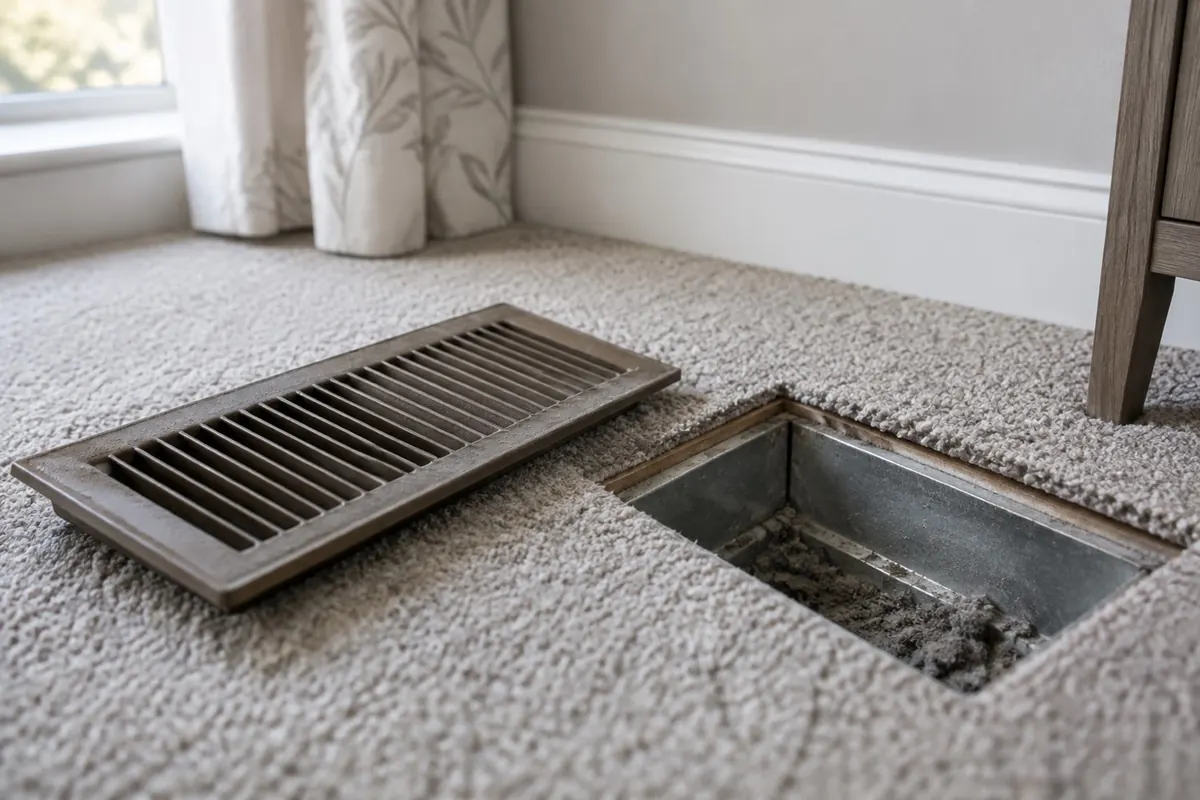
| Ducts clogged with excessive amounts of dust and debris, with particles actually being released into the home from the supply registers | Visible particles coming out of the registers when the system runs, not merely dust on the register face | Confirm it is coming from the supply and not simply settling. Establish why the debris is there, because it usually has a cause. |
Notice what is not on that list
Allergy symptoms are not on it. Energy efficiency is not on it. General household dust is not on it. A house that has not had its ducts cleaned in fifteen years is not on it. Those are the four reasons most commonly given in sales conversations, and none of them appears in the federal guidance as a basis for cleaning. If your reason for considering the service is one of those four, the honest advice is to read the EPA document first.
Restoration is a different question
Everything above concerns routine maintenance. Restoration work is a separate case with a separate logic, and conflating the two is how this subject gets confused. In a restoration context the HVAC system is not a dusty appliance. It is a distribution network that moved contamination through a building, and the cleaning is remediation rather than housekeeping.
| Situation | Why the system is in scope | What cleaning addresses |
|---|---|---|
| After a fire, if the system ran during or after it | The return pulled smoke in and the supply distributed residue to every room the system serves, including rooms that never saw flame | Soot inside the duct network, the air handler, the coil and the blower, which recontaminates cleaned rooms on the next cycle. |
| After a furnace puff-back in an oil-fired system | The distribution network is the origin. Oily soot was pushed back through the appliance and out through every register in seconds | Oily residue through the whole network, which resists water-based cleaning and needs degreasing. |
| After a flood that reached the ductwork | Water in ducts or in the air handler creates conditions for microbial growth in a network that then blows into every room | Wet and contaminated duct interiors. Insulated flexible duct that got wet is normally replaced rather than cleaned. |
| After construction or renovation | Construction dust, drywall dust and sawdust load the system in quantity, and drywall dust in particular is fine and pervasive | Bulk debris in the network, which is close to the EPA’s third named condition. |
| After vermin infestation is resolved | Nesting material and droppings are in the network and the system distributes the associated odour | Physical contamination and the odour it produces, once the entry route is closed. |
This is why duct cleaning appears on our site under restoration rather than home maintenance. Our smoke damage repair guide covers why the HVAC question is asked on day one of a fire loss, and our guide to getting smoke smell out of house interiors covers why a contaminated duct network is the most common reason a visually clean building keeps smelling. For water losses, our water damage restoration cost guide covers the wider scope.
What air duct cleaning costs
With the question of whether you need it settled, here is the pricing. These are indicative ranges compiled from published contractor and aggregator price guides current in 2026. They are not the output of a contractor pricing survey and they are not a quote.
The headline band most readers need is the second row: $600 to $1,500 for a typical residential system, with the wider $450 to $1,500 range covering smaller properties at the bottom. Anything materially below that for a whole system is worth examining closely, and the section on the bait pattern below covers why.
Why the mould and replacement rows are so much higher
Because they are not cleaning. Mould growing inside a duct system is a remediation job with containment, and insulated flexible duct with growth in the insulation is generally replaced rather than cleaned, because there is no way to verify cleaning inside the insulation. That is the same verification logic that governs insulation elsewhere in a building. Our mould remediation cost guide covers the containment and verification structure that applies.
Per-vent pricing and what it hides
Many quotes are structured per vent rather than per system: roughly $25 to $50 per vent, plus a system or trip charge. On its face that is a reasonable structure, because vent count really does track the size of the job. It also happens to be the structure that makes an incomplete scope look like a complete price.
| What the quote says | What it may exclude | Question to ask |
|---|---|---|
| $30 per vent, 12 vents | The air handler, the coil, the blower and the main trunk lines | Is the air handler included, and the coil and blower with it? Get the answer in writing. |
| $25 per vent, unlimited vents | The return runs, which are often fewer, larger and dirtier than the supplies | Are returns counted and cleaned, and at what price? |
| Whole-house flat rate below the typical band | Almost everything except a vacuum held at the register face | What equipment is used, and is it source removal under negative pressure? |
| Per-system price with no vent count | Nothing necessarily, and it is the clearer structure | How many systems does this cover, and what happens if there are two? |
| Price quoted before anyone has seen the system | Any variable the quote could not have known about | Is this a fixed price or an estimate, and what changes it? |
What a legitimate service includes
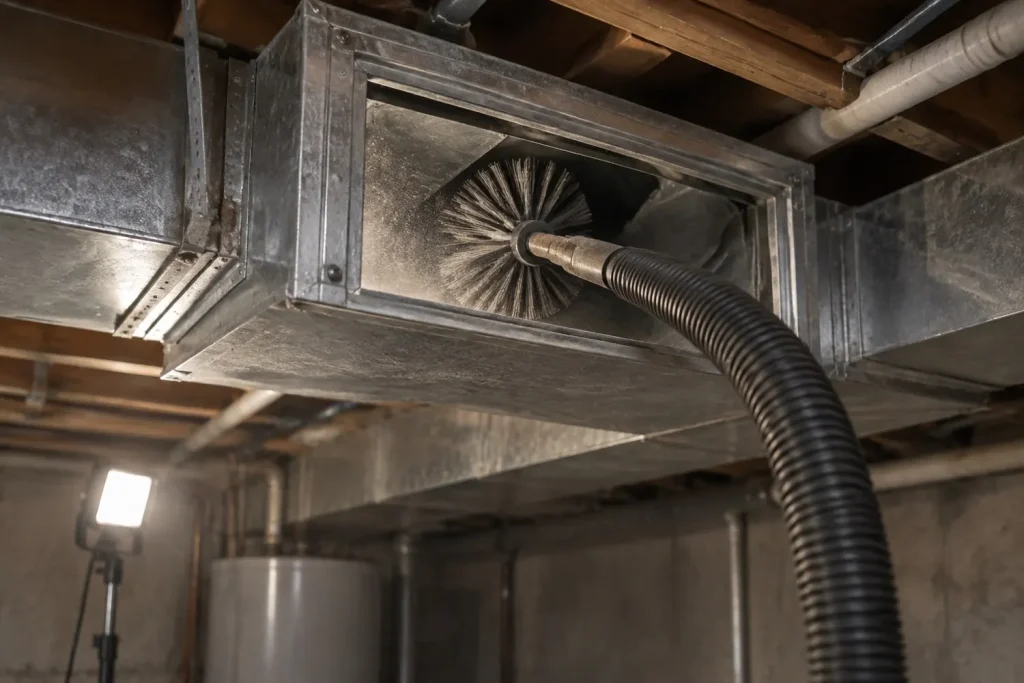
A real duct cleaning is a source removal process. The principle is that the system is put under negative pressure by a collection unit, the interior surfaces are agitated so that adhering debris is dislodged, and everything dislodged travels into the collection unit rather than into the house.
| Element | What it is | Why it matters |
|---|---|---|
| Negative-air source removal | A truck-mounted or large portable collection unit connected to the system, putting the ductwork under negative pressure for the whole job | Without it, agitation simply redistributes debris. This is the difference between cleaning and stirring. |
| Access openings | Cut and properly resealed openings where the collection unit and tools connect to trunk lines | You cannot clean a trunk line through a register. Openings are normal and their resealing is part of the work. |
| Agitation | Rotary brushes, air whips or compressed-air skipper balls run through the runs | Adhering debris does not come off with suction alone, which is why a vacuum at the register face is not a cleaning. |
| Air handler, coil and blower cleaning | Opening the unit and cleaning the blower wheel, the evaporator coil and the cabinet interior | This is where contamination concentrates. It is also the element most often omitted. |
| Register and grille cleaning | Removal and cleaning of supply and return covers | Visible, cheap, and the part a poor job does thoroughly so that the result looks right. |
| Filter replacement | A new filter of the correct size and rating at the end | Putting the loaded original back defeats the exercise. |
| Before and after documentation | Camera images of duct interiors before and after | The only way you can confirm work you cannot see. Ask for it up front, not afterwards. |
The air handler is the part that matters
If you take one practical thing from this page other than the EPA position, take this: the contamination is concentrated at the equipment, not spread evenly along the ducts.
Air passes through the blower wheel and across the evaporator coil on every cycle. The coil is wet during cooling, which makes it the surface in the whole system most likely to hold biological growth. The blower wheel accumulates a felted layer on its blades that measurably reduces airflow. The cabinet collects whatever gets past the filter. All of that sits upstream of every supply duct in the building.
Cleaning the ducts and not the air handler is therefore backwards. It cleans the distribution and leaves the source. It is also, not coincidentally, the cheaper half of the job to perform and the harder half for a homeowner to inspect, which is why it is the element that goes missing from low quotes. Ask about it specifically and ask for photographs of the blower wheel and coil before and after.
The $49 whole-house advert
There is a recognised advertising pattern in this category: a whole-house duct cleaning offered at $49, $79 or $99, often with unlimited vents. We are naming the pattern rather than any company, because the pattern is what is useful to recognise.
Work backwards from the cost structure. A full source-removal cleaning is several hours of technician time plus a truck-mounted or large portable collection unit plus travel. The labour alone at any sustainable rate exceeds the advertised figure before the equipment is switched on. The advertised price is therefore not a price for the service described. It is the cost of getting a technician into the building.
| Stage | What typically happens | What it costs you |
|---|---|---|
| The advert | A whole-house price well below the cost of performing the work, often with unlimited vents | Nothing yet, which is the point. |
| The booking | Scheduled quickly with minimal questions about the system | Nothing. A real quote usually involves questions about system count, vent count and access. |
| The on-site assessment | A finding that the system needs additional services not covered by the advertised price | The real number, presented under time pressure with a technician already in the house. |
| The add-ons | Sanitiser or antimicrobial treatment, mould treatment, coil cleaning, per-vent surcharges beyond the advertised inclusion | Frequently several multiples of the advertised figure. |
| The work performed if you decline | A vacuum held at each register face, which is not source removal | The advertised price, for something that does not meet the description of a duct cleaning. |
The antimicrobial add-on specifically
Chemical sanitisers and antimicrobial treatments applied inside ductwork are a common add-on, and the EPA guidance discusses biocides in ducts with notable caution. Any product applied inside a duct system is a product you will be breathing the residue of, and the EPA notes that few products are registered specifically for use in internally insulated ducts. If a treatment is proposed, ask what the product is, whether it is registered for use in air ducts, and what the label directions say. A technician who cannot answer that has not read the label.
The industry reference standard
The trade body for this work is NADCA, the National Air Duct Cleaners Association, which publishes the ACR standard for assessment, cleaning and restoration of HVAC systems. It is the industry reference framework for what a cleaning consists of and how a system is assessed before and verified after. We describe its role rather than reproduce its text, which is sold by the association.
What the existence of that standard gives you as a buyer is a question: is this cleaning being performed to the ACR standard, and will the verification be documented? A company working to a published standard will answer immediately. It is worth being clear about what membership of a trade body does and does not tell you. It tells you the firm has chosen to join a body with a published standard. It is not a government licence and it is not an inspection of the job you are buying.
When ducts have mould in them
This is the first of the EPA’s three named conditions and it deserves its own treatment, because the answer is frequently not cleaning.
| Duct type | If there is growth | Why |
|---|---|---|
| Bare sheet metal duct | Can usually be cleaned, because the surface is non-porous and the result can be inspected | Non-porous surfaces hold growth on the face where it can be removed and verified. |
| Internally insulated duct, fibreglass lining | Generally replaced rather than cleaned | Growth in the insulation cannot be cleaned through or verified, which is the same rule that applies to insulation anywhere. |
| Flexible duct with insulated wrap | Generally replaced if the interior is contaminated | The interior liner is difficult to clean mechanically without damaging it, and damaged flex duct leaks. |
| The evaporator coil and drain pan | Cleaned, and the underlying moisture problem corrected | A blocked condensate drain or a coil that stays wet is the cause. Cleaning without fixing that produces a repeat. |
The other half of this is diagnosis. Visible growth inside a duct system means the system has a moisture problem, and removing the growth without finding the moisture produces a recurrence at your expense. Our mould remediation cost guide covers the containment and verification structure, and our state mould licensing review covers which states require a licence for this work at all, which varies enormously.
What moves the price legitimately
| Driver | Effect on price | Why |
|---|---|---|
| Number of systems | Close to linear. Two systems is close to two jobs | Each system needs its own collection unit connection, its own access, its own air handler cleaning. |
| Vent count | Meaningful and roughly proportional | Each run is agitated and cleaned individually, so runs are time. |
| Duct material and construction | Flexible and internally insulated duct costs more to handle and sometimes cannot be cleaned at all | Mechanical agitation damages some liners, so the method changes or replacement is proposed. |
| Access | Substantial. Crawlspace, attic and tight ceiling voids add hours | Time on site is the dominant cost and access is what consumes it. |
| Condition | Substantial on heavily loaded or contaminated systems | A post-fire or post-construction system carries a load a maintenance clean does not. |
| Verification and documentation | Modest, and worth paying for | Camera inspection before and after is the only evidence you will ever have of work inside a duct. |
Questions that separate a real quote from a lead
- Why do you think my system needs cleaning? The answer should reference one of the EPA’s three conditions, or a restoration event. If the answer is that it has been a while, that is not a reason.
- Is this source removal under negative pressure? Anything else is a vacuum at the register and not a duct cleaning.
- Does the price include the air handler, coil and blower? Get this in writing. It is the most commonly excluded and most important element.
- Will you cut and reseal access openings? Trunk lines cannot be reached without them, and a job with no openings did not reach the trunks.
- Will I get before and after camera images? The work is invisible, so documentation is the whole of your evidence.
- Are you proposing any chemical treatment, and what is the product? If yes, ask whether it is registered for use in air ducts and what the label says.
- Is the price fixed, and what would change it? This is the question that defuses the on-site upsell before it happens.
Our methodology sets out the standing rules for how we price and source pages like this one, including our commitment to labelling compiled ranges as compiled rather than presenting them as survey data.
Questions people actually ask
How much does air duct cleaning cost?
About $450 to $1,500 for a typical residential system, and $1,000 to $3,000 for larger or multi-system homes. Mould remediation inside ductwork runs higher, and duct replacement higher again. Those are indicative ranges compiled from published contractor and aggregator price guides current in 2026, not survey results.
Does air duct cleaning actually do anything?
The EPA’s published position is that duct cleaning has never been shown to actually prevent health problems, and that particle levels in homes have not been shown to increase because of dirty ducts. It does not recommend routine cleaning. It does recommend cleaning where there is visible mould growth in the system, vermin infestation, or ducts clogged with debris actually entering the room. After a fire, flood or construction the case is different and clear.
Why is the quote I received only $79?
Because that figure does not cover the work. A full source-removal cleaning is several hours of technician time plus a collection unit plus travel, which exceeds that before the equipment runs. The low advertised price is a recognised pattern for getting a technician into the building, where the real number is presented as add-ons.
How often should air ducts be cleaned?
The EPA does not recommend a routine interval and instead says to clean as needed, naming visible mould growth in the system, vermin infestation and ducts clogged with debris entering the room. If none of those applies and there has been no fire, flood or construction, there is no published basis for a schedule.
Is duct cleaning worth it after a fire?
Yes, if the heating or air conditioning system ran during or after the fire, because it then pulled smoke into the return and distributed residue to every room it supplies. In that case it is part of the remediation scope rather than an optional extra, and leaving it out is the most common reason a cleaned building starts smelling again.
What should be included in a duct cleaning?
Negative-air source removal with a truck-mounted or large portable collection unit, properly cut and resealed access openings, mechanical agitation of the runs, cleaning of the air handler, coil and blower, register and grille cleaning, a new filter, and before and after camera documentation. The air handler is the element most often left out of a cheap quote.
Should I let them apply a sanitiser or antimicrobial in the ducts?
Ask what the product is, whether it is registered for use in air ducts, and what the label directions say, before agreeing. The EPA guidance treats biocide use in ducts with caution and notes that few products are registered for use in internally insulated ducts. Anything applied inside the system is something the system will circulate.
Sources
- EPA, Should You Have the Air Ducts in Your Home Cleaned?. United States Environmental Protection Agency consumer guidance. Source of the statements that duct cleaning has never been shown to actually prevent health problems, that particle levels in homes have not been shown to increase because of dirty air ducts, that the EPA does not recommend routine cleaning, and of the three conditions under which cleaning may be appropriate: visible mould growth inside the system, vermin infestation, and ducts clogged with debris actually entering the home. Also the source of the caution regarding biocide application inside ducts. Paraphrased here; read the original. Retrieved 23 September 2026.
- NADCA, National Air Duct Cleaners Association, which publishes the ACR standard for assessment, cleaning and restoration of HVAC systems. Referenced as the industry framework; the standard text is sold by the association and is described rather than reproduced. Retrieved 23 September 2026.
- Cost bands are compiled from published contractor and aggregator price guides current in 2026. They are indicative rather than survey results. We have not conducted a contractor pricing survey; when we do, its sample and method will be published with it.
- The price-composition chart is ILLUSTRATIVE and schematic. It is not survey data, not accounting data from any firm, and not a quote.
- The description of the low-price advertising pattern is a description of a generic pattern in the category. No company is named and no allegation is made about any specific business.