The short answer
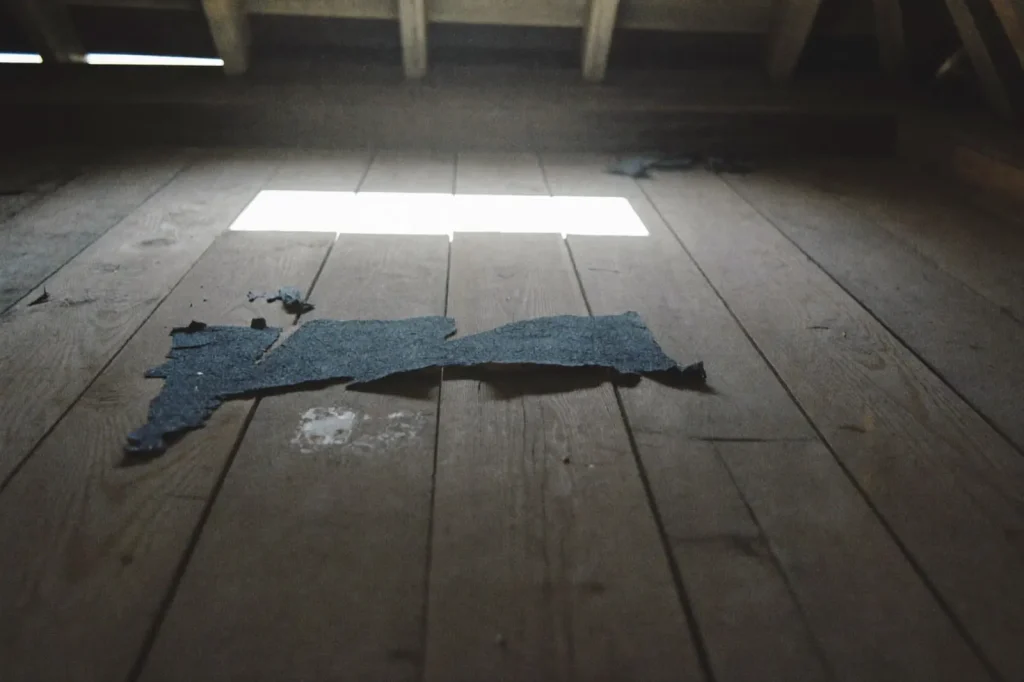
Asbestos felt paper is asbestos-bearing paper or felt used in houses as asphalt roofing felt, as the felt backing bonded under sheet vinyl, and as stove and pipe papers. Under 40 CFR 763.165, flooring felt, rollboard and commercial, corrugated and specialty paper are banned; roofing felt is not on that list. Only a lab result confirms asbestos in any of them.
Key takeaways
- The asbestos in old sheet vinyl sits in the felt backing; OSHA presumes vinyl flooring installed by 1980 contains asbestos, backing included, until tested.
- Flooring felt manufacture was banned after 27 August 1990; the papers and rollboard followed after 26 August 1996, per 40 CFR 763.165.
- Asphalt roofing felt is Category I nonfriable ACM under 40 CFR 61.141, and EPA Region 4 says asbestos felt was reportedly used on homes only from 1971 to 1974.
- Old black felt and modern #15 felt look alike: color, smell and texture do not identify asbestos.
Where is asbestos felt or paper in a house? Six places from roof to basement
Federal rules name the products, and 40 CFR 763.163 defines them by use. Flooring felt is paper felt “intended for use as an underlayer for floor coverings, or to be bonded to the underside of vinyl sheet flooring.” Rollboard is two sheets of asbestos paper laminated together, used for office partitions, garage paneling and linings for stoves and electric switch boxes. Corrugated paper served as pipe covering and block insulation. The table maps each to the place you would find it.
| Where you find it | Product | What the source says | Status under the 1989 rule as amended | NESHAP or OSHA category |
|---|---|---|---|---|
| Roof: felt between deck and shingles, or plies in a flat built-up roof | Roofing felt | Region 4: widely used in built-up roofs; on homes reportedly 1971 to 1974 | Not on the surviving ban list | Category I (asphalt roofing product) |
| Kitchen or bath floor: the felt layer bonded under sheet vinyl | Flooring felt | EPA lists the backing on vinyl sheet flooring | Manufacture and import banned after 27 August 1990; distribution after 25 August 1992 | Category I (resilient floor covering) while intact |
| Floor: loose felt underlayer beneath a floor covering | Flooring felt | 763.163 names felt “intended for use as an underlayer for floor coverings” | Same as above | Category I if part of the floor covering; test for friability |
| Wall or floor behind a wood stove; inside switch boxes; garage panels | Asbestos paper, rollboard | EPA lists asbestos paper around wood stoves; 763.163 lists rollboard stove and switch box linings | Rollboard manufacture banned after 26 August 1996 | Category II, or friable if it crumbles by hand |
| Basement pipes and ducts: corrugated paper wrap | Corrugated paper | 763.163 lists pipe coverings; Green Book lists corrugated paper pipe wrap | Manufacture banned after 26 August 1996 | OSHA thermal system insulation; friable if it crumbles |
| Behind siding or under old hardwood: building paper | Building paper | Not named in the EPA, OSHA or CFR lists read for this page | No federal listing found | Unknown until sampled |
Corrugated pipe and duct wrap has its own identification and removal page at our air cell asbestos guide. The building paper row is the honest gap: none of the federal product lists checked for this page names it, and EPA’s 1990 Green Book, Appendix G, warns that its own list does not include every product that may contain asbestos, so a sample decides.
What does asbestos tar paper look like next to modern #15 felt?
Like ordinary black roofing felt. EPA Region 4 describes asbestos roofing felt as “asbestos paper saturated and coated with asphalt,” and a current maker sheet, Atlas Roofing's #15 felt data sheet, describes #15 felt as an asphalt-saturated organic mat, sold in 36 inch by 144 foot rolls covering 432 square feet. Both are black, asphalt-smelling sheets of the same thickness class, which is why EPA's homeowner asbestos page says you generally cannot tell asbestos by looking unless the material is labeled.
Region 4’s inspector guidance gives one physical cue for choosing where to sample on a roof: “sample areas where fibers can be seen protruding from the matrix of the asphalt.” That tells an inspector where to cut, not whether the fibers are asbestos, since only polarized light microscopy at a lab identifies them. Under sheet flooring, the suspect layer is the felt bonded to the underside of the vinyl, and EPA lists that backing specifically on EPA's Learn About Asbestos page.
The age of the house is the better first filter. EPA Region 4 reports asbestos roofing felt on homes for only a short window, 1971 to 1974, while built-up flat roofs used it more widely. Asbestos flooring felt could be made in or imported into the US until 27 August 1990 under 40 CFR 763.165(a), and OSHA presumes vinyl flooring installed no later than 1980 contains asbestos. Published lab fees per sample and per layer are on our asbestos testing cost page.
Is the asbestos in old sheet vinyl in the felt backing or the vinyl face?
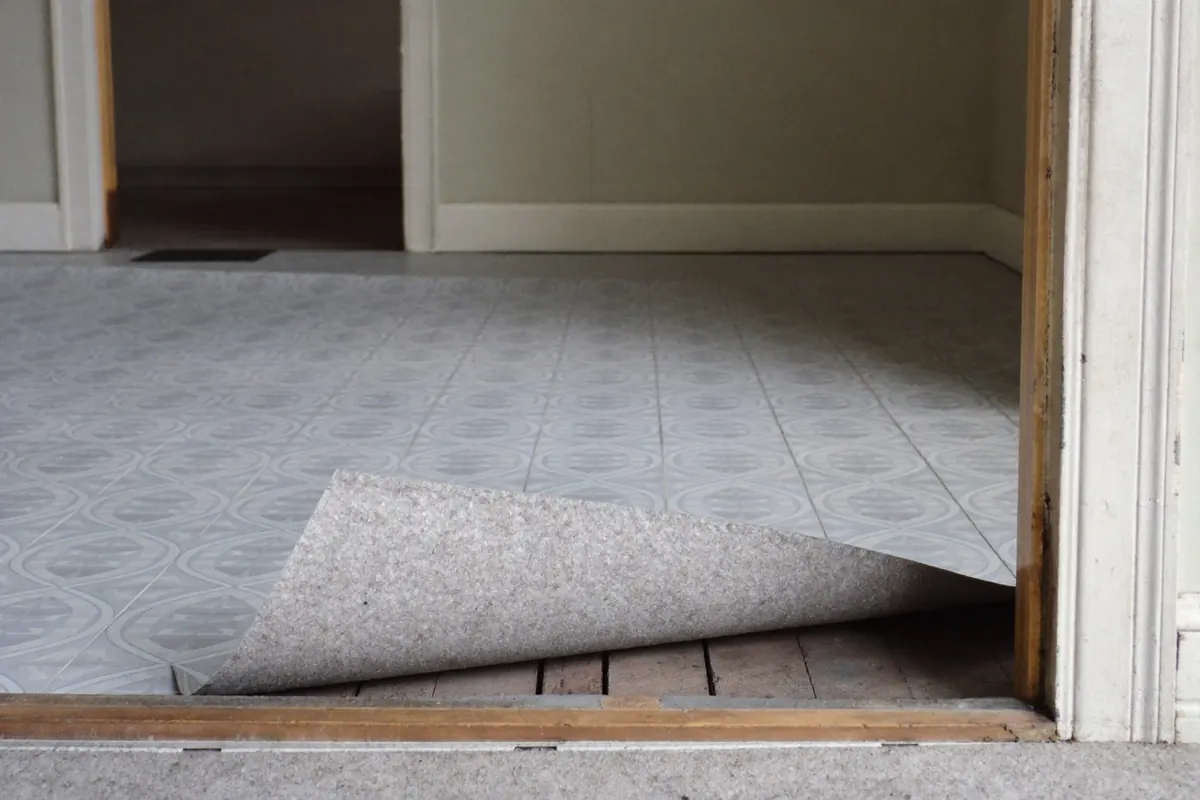
The federal definitions point at the backing. 40 CFR 763.163 defines flooring felt as felt “bonded to the underside of vinyl sheet flooring,” and EPA's Learn About Asbestos page lists “the backing on vinyl sheet flooring and adhesives” among household products that may contain asbestos. The printed vinyl face is a separate layer, and the adhesive below is a third.
That layering is why EPA's 1995 multi-layer clarification matters at the lab. EPA’s long-standing policy, restated in 1995, is that “each layer in a multi-layered system was to be analyzed as a separate material,” with no averaging of an asbestos layer into non-asbestos layers. Ask for the vinyl face, felt backing and adhesive to be reported on separate lines; the only exception the 1995 notice names is wallboard with joint compound at the joints and nail holes.
OSHA treats the backing as part of the floor. 29 CFR 1926.1101(g)(8)(i) says “flooring or its backing shall not be sanded,” requires resilient sheeting to be removed by cutting with wetting of the snip point, prohibits rip-up, and requires wet methods for scraping residual adhesive and backing. Step-by-step floor removal sits on our removing asbestos floor tiles page.
Is asbestos roofing felt still legal? What survived the 1989 ban and the 1991 court ruling
EPA issued its ban rule on 12 July 1989, and in 1991 the Fifth Circuit Court of Appeals overturned most of it. Per EPA's ban and phase-out page, the rule now bans only new uses of asbestos begun after 1989 and five products: “flooring felt, rollboard, and corrugated, commercial, or specialty paper.” Roofing felt is not among them, and the current text of 40 CFR 763.165, rewritten by the 28 June 1994 technical amendment, lists the same products.
So the felt under a sheet vinyl floor is a banned product type today while the felt on a roof is not, though neither ban touches material already installed. The ban dates in 40 CFR 763.169 also explain why sellers could still legally ship flooring felt until 25 August 1992, two years after the manufacturing cutoff, and why remaining stock had to be disposed of within 6 months of each distribution ban.
Does old tar paper have asbestos? What the 1971 to 1974 residential window means
Sometimes. EPA Region 4 NESHAP guidance says asphalt-asbestos roofing products made from felt “were reportedly used on residential structures for only a short time (1971 to 1974),” while asbestos felts “have been widely used in built-up roofs” on flat surfaces. The word “reportedly” is EPA’s, and the guidance gives no count, so the window narrows suspicion without clearing a 1960s or 1980s roof.
EPA's 1990 Green Book lists roofing felt, flooring backing and thermal paper products in Appendix G, and says asbestos content across building products ranged from about 1 percent to nearly 100 percent. A flat commercial roof with many plies, or a house that has been reroofed over old layers, gives more chances of an asbestos ply than a single layer of felt under shingles. Asbestos cement and asphalt shingles are covered separately on our asbestos shingles page.
Is asbestos felt Category I nonfriable under 40 CFR 61.141, and when does it become RACM?
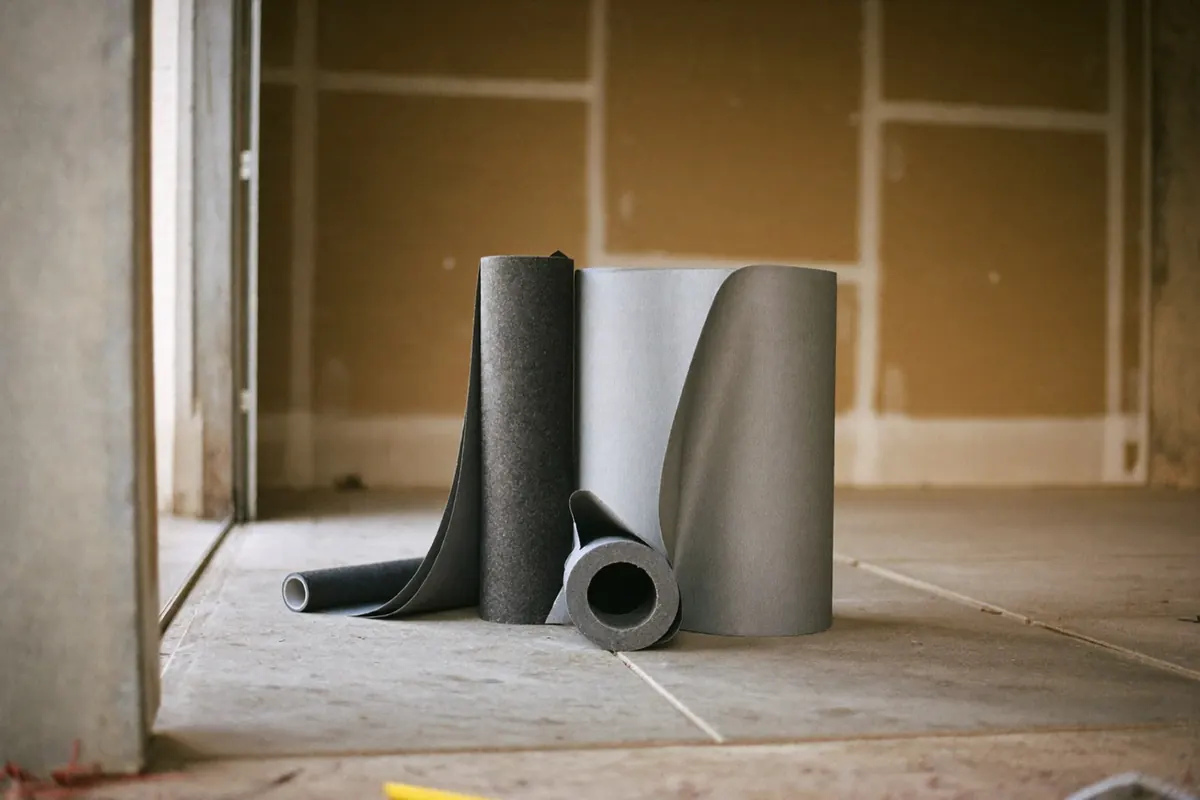
Roofing felt and sheet vinyl backing both start in Category I. 40 CFR 61.141 defines Category I nonfriable ACM as “asbestos-containing packings, gaskets, resilient floor covering, and asphalt roofing products containing more than 1 percent asbestos.” Category I material becomes regulated asbestos-containing material if it turns friable or will be sanded, ground, cut or abraded. Stove paper and rollboard, which are neither roofing nor flooring, fall in Category II unless they crumble by hand when dry, which makes them friable.
EPA Region 4 NESHAP guidance adds the demolition rule: packings, gaskets, resilient floor coverings and asphalt roofing materials must be removed before demolition “only if they are in poor condition and are friable,” and its field test is to seal a sample in a transparent bag and apply hand pressure. OSHA’s non-mandatory Appendix H to 29 CFR 1926.1101 agrees that roofing felt is “considered non-friable if intact.” The full category logic is on our friable asbestos page.
The same 61.141 definition of a facility excludes “residential buildings having four or fewer dwelling units,” so federal NESHAP notice rules generally skip a single house reroof done on its own. EPA's homeowner asbestos page notes that federal law does not require accreditation for people who inspect or remove asbestos in detached single-family homes, though some states do.
Why don’t roofers use tar paper anymore?
Many still do, but synthetic sheets now share the code tables. Intertek report CCRR-0648, filed with the Florida Building Commission, evaluates polypropylene synthetic underlayments: under the 2024 IBC and IRC they may be used where ASTM D8257 compliant underlayment is required, and under the 2021 and 2018 codes as an alternative to ASTM D226 Type I and Type II felt. One of the products weighs a nominal 2.0 lb per 100 square feet.
Felt is still specified by name: the New Orleans reroofing permit specification requires underlayment meeting ASTM D226 Type II or ASTM D4869 Type III, and Atlas Roofing's #15 felt data sheet rates its #15 felt to D226 Type I and D4869 Type II. Choosing between felt and synthetic for a new roof is a roofing question our sister site theroofingbrief.com covers.
For contractors: which OSHA rules apply when you remove asbestos felt from a roof or floor?
Removing roofing felt or sheet vinyl that contains more than 1 percent asbestos is Class II work under 29 CFR 1926.1101(b), which names “floor tile and sheeting, roofing and siding shingles.” For roofing, paragraph (g)(8)(ii) requires removal in an intact state where feasible, wet methods for material that is or will become non-intact, continuous misting of cutting machines, and HEPA collection or HEPA vacuuming along power-cut lines on built-up roofs with asbestos felts.
Removed roofing must not be dropped or thrown to the ground; it is carried, passed by hand, or lowered by a covered dust-tight chute, crane or hoist by the end of the shift. Paragraph (g)(8)(ii)(H) exempts removal or repair of intact roofing under 25 square feet, counted across all work on the same roof that day, from wet methods and HEPA vacuuming when manual methods keep it intact and create no visible dust.
The exposure limits behind those rules are 0.1 fiber per cubic centimeter as an 8 hour average and 1.0 f/cc over 30 minutes, per paragraph (c) of 29 CFR 1926.1101. Paragraph (g)(8)(i)(I) lets an industrial hygienist rebut the flooring presumption, mastic and backing included, using recognized analytical techniques.
Out of scope: health effects. This page reads regulations, EPA guidance and maker documents only; for health information see EPA's Learn About Asbestos page and CDC’s Agency for Toxic Substances and Disease Registry.
Questions people actually ask
What does asbestos paper look like around a wood stove?
There is no reliable look; the federal sources describe it by location and construction. EPA lists “walls and floors around wood-burning stoves protected with asbestos paper, millboard, or cement sheets,” and 40 CFR 763.163 describes rollboard as two sheets of asbestos paper laminated together and used to line stoves. Appearance does not confirm asbestos; a lab sample does.
Will 30 minutes of asbestos exposure hurt you?
Health outcomes are outside this page; EPA and CDC’s ATSDR cover them. What the rules set: OSHA’s excursion limit in 29 CFR 1926.1101(c)(2) is 1.0 fiber per cubic centimeter averaged over 30 minutes, alongside the 0.1 f/cc 8 hour limit. OSHA’s Appendix H says intact roofing felt generally does not emit airborne fibers unless sanded, sawed or aggressively worked.
Is it safe to leave old sheet vinyl with felt backing in place?
EPA’s homeowner guidance says material in good condition that will not be disturbed “should be left alone.” For workers, OSHA bars sanding the flooring or its backing and bans dry rip-up of resilient sheeting for workers in 29 CFR 1926.1101(g)(8)(i). Test before any project that will cut or lift it.
Can a homeowner tear off asbestos roofing felt themselves?
Federal NESHAP rules in 40 CFR 61.141 exclude residential buildings with four or fewer units, and EPA says federal law does not require accreditation for work in detached single-family homes. States and localities can be stricter, and OSHA’s 29 CFR 1926.1101 still binds any hired crew. Ask your state asbestos program whether a homeowner exemption exists and how the waste must be wrapped.
How should a felt sample be sent to a lab?
Ask for polarized light microscopy with each layer reported separately, as EPA’s 19 December 1995 clarification requires for multi-layered systems. For sheet vinyl that means three results: wear layer, felt backing and adhesive. EPA advises homeowners not to collect samples themselves, because poor sampling can release more fibers than leaving the material alone.
Sources
- 40 CFR 763.163, 40 CFR 763.165 and 40 CFR 763.169, TSCA asbestos product definitions and prohibitions, via Cornell LII. Retrieved 9 November 2026.
- EPA's ban and phase-out page, Asbestos Ban and Phase-Out Federal Register Notices, U.S. EPA, citing 54 FR 29460 and 59 FR 33208. Retrieved 9 November 2026.
- EPA's asbestos actions timeline, EPA Actions to Protect the Public from Exposure to Asbestos, U.S. EPA. Retrieved 9 November 2026.
- 40 CFR 61.141, Asbestos NESHAP definitions, via Cornell LII. Retrieved 9 November 2026.
- 29 CFR 1926.1101, OSHA Asbestos standard for construction, paragraphs (b), (c), (g)(8), (k) and Appendix H, via Cornell LII. Retrieved 9 November 2026.
- EPA Region 4 NESHAP guidance, U.S. EPA Region 4, Asbestos/NESHAP Regulated Asbestos Containing Materials Guidance, Internet Archive copy captured 24 September 2009. Retrieved 9 November 2026.
- EPA's Learn About Asbestos page, Learn About Asbestos, U.S. EPA. Retrieved 9 November 2026.
- EPA's homeowner asbestos page, Protect Your Family from Exposures to Asbestos, U.S. EPA. Retrieved 9 November 2026.
- EPA's 1990 Green Book, Managing Asbestos in Place, EPA 20T-2003, July 1990, Appendix G, via the Whole Building Design Guide. Retrieved 9 November 2026.
- EPA's 1995 multi-layer clarification, 60 FR 65243, 19 December 1995, via govinfo.gov. Retrieved 9 November 2026.
- Atlas Roofing's #15 felt data sheet, Atlas Roofing Corporation, #15 Specification Felt product data, via BuildSite. Retrieved 9 November 2026.
- Intertek report CCRR-0648, Intertek Code Compliance Research Report CCRR-0648, ApexOne synthetic roofing underlayments, issued 3 March 2026, via the Florida Building Commission. Retrieved 9 November 2026.
- New Orleans reroofing permit specification, City of New Orleans, Reroofing Permits Technical Specifications. Retrieved 9 November 2026.
- The location table and diagrams are drawn from the sources above. Our methodology sets out the standing rules.
This page reads regulations, EPA guidance and maker documents; it reports no sampling or testing of its own and is not legal advice. Ask your state asbestos program whether a state rule is stricter than the federal rules described here, and ask your inspector to report each felt and paper layer separately.
More rules pages sit on our standards hub.