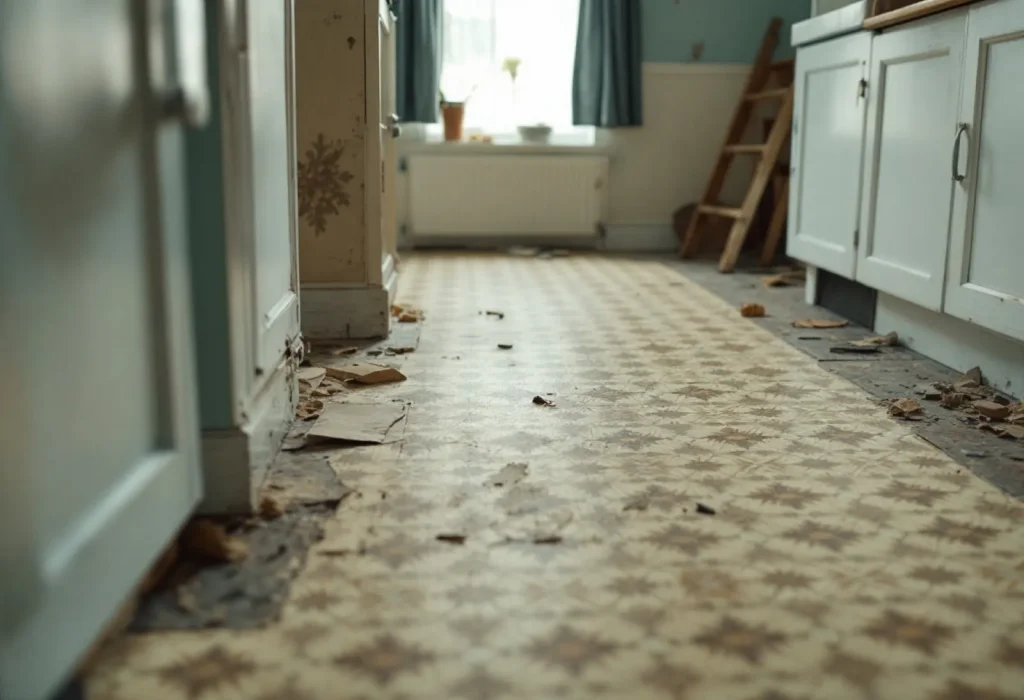
The short answer
Asbestos linoleum is usually not linoleum at all. True linoleum is oxidized linseed oil with cork or wood flour on a jute backing, with no asbestos in the recipe. The asbestos sat in the felt backing of sheet vinyl that people call linoleum, made from the 1940s into the early 1980s, and in some adhesives. Only a lab reading each layer can confirm it.
Is old linoleum the same floor as asbestos backed sheet vinyl?
No, though the two get the same name. A University of Colorado Denver linoleum thesis abstract describes linoleum as a nineteenth century plant based composite: an oxidized linseed oil binder compounded with cork or wood flour and mineral pigments, pressed onto a jute backing, and dates the mid century shift to plastics, when vinyl copied linoleum’s look while promising faster production and no wax care.
The asbestos story belongs to that vinyl. R&R magazine's history of asbestos flooring (John Kozak, 28 February 2025) says asbestos moved from asphalt tile into vinyl composition tile and felt backed sheet and tile products from the 1940s, mainly after World War II, and that most major US makers had stopped asbestos flooring by the early 1980s, some as late as 1985. The Resilient Floor Covering Institute’s RFCI Recommended Work Practices (January 2018) names the products: vinyl asbestos tile, asphalt tile, some asphaltic cutback adhesives, and the backings of many sheet vinyl floorings and lining felts.
The federal rule draws the same line. 40 CFR 61.141 defines resilient floor covering as asbestos containing asphalt and vinyl floor tile and sheet vinyl floor covering with more than 1 percent asbestos. Linoleum is not named. A common rule of thumb online says asbestos was often added to linoleum itself; none of the primary sources read for this page say so.
Which layer of a 1940s to early 1980s sheet floor held the asbestos?
The backing, not the patterned face. RFCI Recommended Work Practices (January 2018) puts the asbestos in the backings of many sheet vinyl floorings and adds that its presence is not readily identifiable. Underneath there may be an adhesive and a separate lining felt, both listed by RFCI, and then plywood or particleboard underlayment, which the Southwest Clean Air Agency sheet vinyl guide (December 2007) treats as part of the removal unit.
Kitchens often hold more than one floor. SWCAA warns that you may find more than one layer of flooring under the top one, and that a lower layer laid with little adhesive may peel more cleanly than the top. Each buried floor is a separate material for sampling purposes. The felt layer itself, and the felt papers used under other finishes, have their own page on asbestos felt paper.
How do you tell linoleum from asbestos backed vinyl at a cut edge?
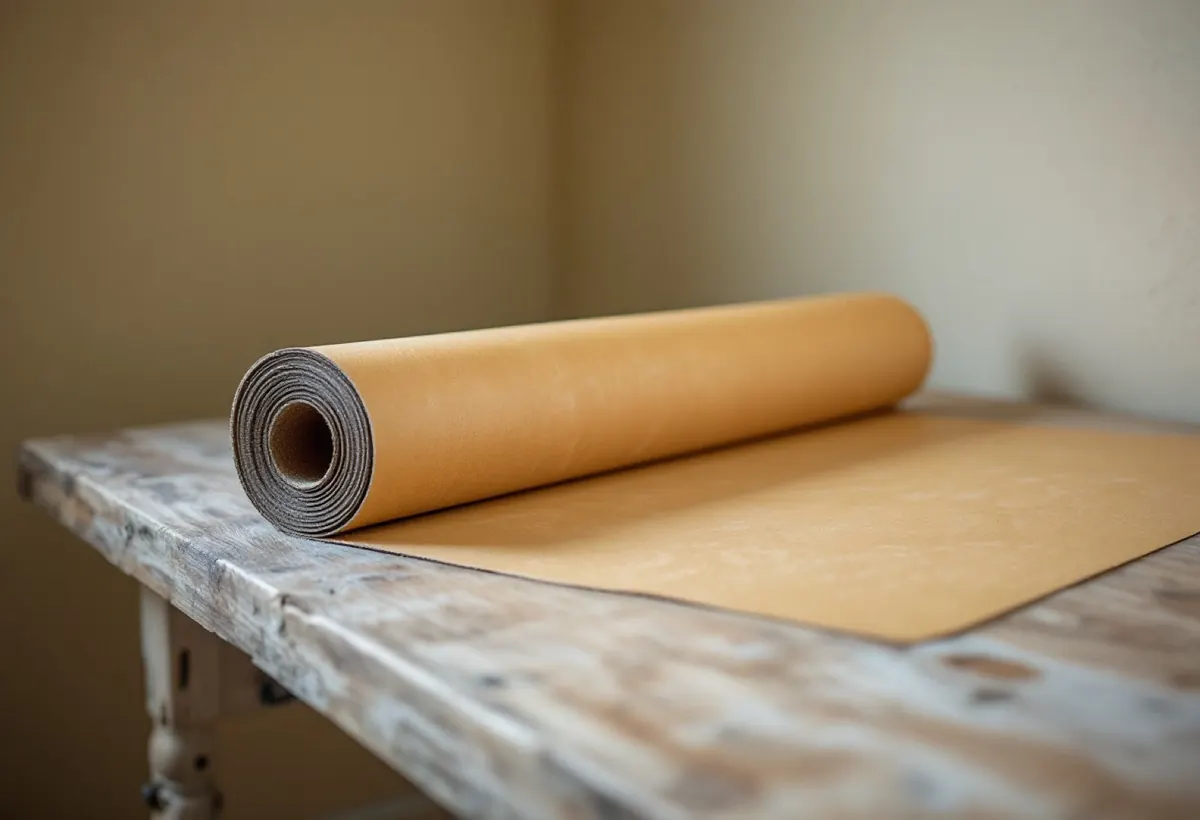
Read the back. The University of Colorado Denver linoleum thesis abstract gives a rapid identification protocol that starts with the backing and then the wear logic, whether the pattern is colour through inlaid or surface printed. A woven jute back points to linoleum. A felt back points to sheet vinyl, the product family RFCI ties to asbestos backings.
That narrows it; it does not clear it. EPA's homeowner asbestos page says you generally cannot tell whether a material contains asbestos by looking at it unless it is labelled, and RFCI says the asbestos in these backings is not readily identifiable. Install date helps: OSHA’s flooring rule in 29 CFR 1926.1101 paragraph (g)(8)(i) presumes vinyl and asphalt flooring in buildings built no later than 1980 is asbestos containing until tested.
On who should cut the sample, the agencies differ. EPA's homeowner asbestos page says a trained and accredited professional should take it and that sampling yourself is not recommended. The SWCAA guide, written for owner occupied single family homes in southwest Washington, describes a 1 inch by 1/8 inch sliver cut at a removed register or moulding, through every layer down to the hard underlayment, with a second person misting water on the cut. Either way, the sample must include all layers. Lab choice and accreditation are on our asbestos testing lab page.
What does the lab report for each layer, and where is the 1% line?
EPA/600/R-93/116, EPA’s July 1993 bulk method, tells labs to treat each distinct layer as a discrete sample, separate the layers, analyze them individually and report a result for each, even when a single combined value is also requested. A sheet floor chip with a wear layer, felt and adhesive can therefore come back as three lines.
The line that matters is in 40 CFR 61.141: a layer is asbestos containing material when PLM finds more than 1 percent asbestos. The same section’s friable definition adds that a result under 10 percent by a method other than point counting should be checked by PLM point counting. EPA’s method also warns that floor tiles may hold fibres thinner than 0.25 micrometres, too small for PLM to resolve, so a PLM negative on tile is not always the last word.
| Era and product | Construction | Layer that held asbestos | What to sample | How the lab reports it |
|---|---|---|---|---|
| Linoleum, 19th century onward (UCD) | Linseed oil and cork or wood flour on jute | Not named in the 61.141 resilient floor covering definition | The adhesive and any felt beneath it | Each layer a discrete sample (EPA/600/R-93/116, 2.2.1) |
| Felt backed sheet vinyl, 1940s to early 1980s (R&R) | Vinyl wear layer on a felt backing | Backing felt (RFCI) | Full thickness to the underlayment (SWCAA) | Wear layer and felt reported separately; over 1% is Category I ACM |
| Lining felt under sheet or tile (RFCI) | Separate felt laid under the floor | Some lining felts (RFCI) | Include it in the cut | Reported as its own layer |
| Asphaltic cutback adhesive, spec MMM-A-110 to mid 1970s (R&R) | Black asphalt adhesive | Some cutback adhesives (RFCI) | The adhesive smear on the back of the cut | Reported as its own layer; see the black mastic page for TEM |
| Vinyl asbestos and asphalt tile (RFCI) | Asphalt tiles 9 by 9 inch from the 1920s (R&R) | Tile body (RFCI) | Tile plus mastic, as two layers | PLM may miss fibres under 0.25 µm in tile (EPA method 2.2.2) |
| Flooring felt made after 1989 (EPA) | Felt products | Banned under TSCA since the 1989 rule | Older floors still in place are not affected | Test still settles any pre 1989 floor |
Two sibling pages pick up from here. Tile identification is on how to tell if floor tiles have asbestos, and the black adhesive’s PLM blind spot and New York’s TEM rule are on black mastic asbestos.
Why does scraping the backing turn Category I flooring into regulated asbestos?
Intact, the floor is nonfriable. 40 CFR 61.141 lists resilient floor covering over 1 percent asbestos as Category I nonfriable ACM. It becomes regulated asbestos containing material (RACM) when it has become friable, item (b), or when it is sanded, ground, cut or abraded, item (c). RFCI notes that the asbestos in old resilient floors was encapsulated in the product matrix, and states that EPA recognizes those products as nonfriable unless practices its booklet prohibits occur.
The felt backing is the weak point. SWCAA’s guide says that when a glued sheet floor is peeled, the backing usually tears away and stays stuck to the underlayment. That torn, damp or dry felt is the layer scraped by hand, and OSHA’s 29 CFR 1926.1101 requires every scrape of residual adhesive or backing to use wet methods, bans sanding the flooring or its backing, and prohibits rip up of resilient sheet flooring. RFCI adds that slicing sheet vinyl with a sharp blade during its wet work practices still counts as intact removal under OSHA’s 1994 definition. More on the friable test is on friable asbestos.
Can you leave asbestos sheet flooring in place or lay a new floor over it?
Yes, and every agency read for this page prefers it. EPA's homeowner asbestos page says to leave undamaged asbestos material alone, not to sand or try to level asbestos flooring or its backing, and to install new floor covering over it when it needs replacing. RFCI Recommended Work Practices (January 2018) calls removal the last alternative and lists three options: lay new flooring directly over a single layer of existing resilient flooring, fill the embossing with embossing leveler first (residential use only), or cover it with a recommended wood underlayment on a suspended wood subfloor.
SWCAA’s guide suggests 1/4 inch underlayment over the old floor as one route. Leaving it also keeps 40 CFR 61.145 simple: Category I flooring that is not in poor condition and not friable need not be removed before demolition under paragraph (c)(1)(i). Federal notification at least 10 working days ahead applies to facilities from 160 square feet of RACM on components; 40 CFR 61.145 sets both figures.
If removal is chosen anyway, the waste is the first surprise. SWCAA tells homeowners to expect a dozen 33 by 50 inch, 6 mil asbestos bags for each 100 square feet of floor removed. The arithmetic below applies that rule to three common rooms.
| Room | Floor area, sq ft | SWCAA rate, bags | Bags, rounded up | At or over 160 sq ft NESHAP trigger |
|---|---|---|---|---|
| Half bath, 5 by 8 ft | 40 | 4.8 | 5 | No |
| Kitchen, 10 by 12 ft | 120 | 14.4 | 15 | No |
| Kitchen and dinette, 10 by 20 ft | 200 | 24 | 24 | Yes, if the building is a NESHAP facility |
Prices for abatement crews are on asbestos removal cost; tile work methods are on removing asbestos floor tiles.
What if you already ripped up old linoleum before testing?
Stop work and keep what is left wet. The SWCAA guide calls wetting critical and says debris should be kept wet until it is packaged and sealed; it mixes water with dish detergent at one teaspoon per spray bottle or 1/4 to 1/2 cup per tank sprayer. RFCI Recommended Work Practices (January 2018) specifies 16 oz of detergent per 1 gallon for its own sheet removal method.
- Do not sweep or vacuum with a household vacuum. SWCAA says never to vacuum or sweep asbestos debris; OSHA bans dry sweeping and requires a HEPA vacuum with a metal floor tool and no brush.
- Send a piece that still shows every layer, including the torn felt left on the floor, so the lab can report backing and adhesive (EPA/600/R-93/116, section 2.2.1).
- Bag debris double in 6 mil polyethylene and seal with duct tape (SWCAA). In SWCAA’s area the debris must be disposed of within 10 calendar days, with a waste manifest, at a site permitted for asbestos.
- Turn off heating and cooling and tape plastic over floor registers, as SWCAA’s prep steps 2 and 9 describe.
If the result comes back under 1 percent in every layer, 40 CFR 61.141 does not treat the floor as asbestos containing material. If any layer is over, the remaining floor and the debris follow the rules in the two sections above, and local air agencies such as SWCAA may add their own.
For contractors: what does OSHA 1926.1101 require on old sheet flooring?
29 CFR 1926.1101 classes this as Class II work and sets the flooring practices in paragraph (g)(8)(i): flooring or its backing shall not be sanded; resilient sheeting is removed by cutting with wetting of the snip point and wetting during delamination; all scraping of residual adhesive or backing is wet; mechanical chipping needs a negative pressure enclosure. Item (I) presumes resilient flooring, its mastic and its backing are asbestos containing unless an industrial hygienist finds otherwise by recognized analytical techniques.
Training for Class II flooring work runs at least 8 hours with hands on practice under paragraph (k)(9)(iv)(A). For floors left in service, paragraph (l)(3) bans sanding and limits finish stripping to low abrasion pads below 300 rpm with wet methods. RFCI’s sheet method slices the floor in strips 4 to 8 inches apart, through the top layer and about halfway into the backing, then peels the wear layer while a second worker mists the delamination point. The house rules for this site’s flooring pages are on the standards hub.
Questions people actually ask
Does 50 year old linoleum have asbestos?
A floor laid around 1976 falls inside the window when felt backed sheet vinyl and some adhesives still held asbestos; R&R magazine says most major US makers stopped by the early 1980s. If it is true linoleum on jute, the body is linseed oil and cork, but the adhesive beneath can still be sampled. OSHA presumes flooring in buildings built by 1980 is asbestos containing until tested.
What does an asbestos vinyl floor look like?
Nothing on the face gives it away. EPA says you generally cannot tell by looking unless the material is labelled, and RFCI says asbestos in sheet vinyl backings is not readily identifiable. The useful clue is at a cut edge: a felt backing marks sheet vinyl, the family RFCI links to asbestos backings, while woven jute marks linoleum. Only a lab result, per the 1% line in 40 CFR 61.141, answers it.
Is old sheet flooring a hazard if it is left alone?
EPA’s homeowner page says asbestos materials that are not damaged or disturbed are not likely to pose a health risk, and that the best course is usually to leave them alone in good condition. The triggers to avoid are sanding, dry scraping, power stripping with abrasive pads and levelling the backing, all named on that EPA page and in OSHA’s 29 CFR 1926.1101.
Is asbestos linoleum in a bathroom handled any differently?
The material is the same; the room adds fixtures. SWCAA’s sheet vinyl guide says toilets and claw foot tubs must come out before removal, while modern tubs set flush to the floor with flooring laid against them need not be removed. Plumbing questions belong to our sister site theplumbingbrief.com. Covering the old floor with 1/4 inch underlayment avoids lifting fixtures twice.
Does the federal NESHAP rule apply to a single family house?
Usually not. 40 CFR 61.141 defines a facility to exclude residential buildings with 4 or fewer dwelling units, so the federal 10 working day notice in 61.145 does not reach most homes. State and local air agencies can go further: SWCAA, for example, limits its homeowner procedures to owner occupied single family homes and says only an asbestos abatement contractor may be paid for removal.
When did flooring stop containing asbestos?
There is no single date. R&R magazine reports most major US makers had stopped asbestos flooring by the early 1980s, some as late as 1985, with some asphalt adhesives made with asbestos as late as 1989. EPA’s 1989 rule (54 FR 29460) still bans flooring felt, and RFCI says resilient flooring made today contains no asbestos.
Out of scope: this page covers identification, sampling, lab reporting and regulatory status only. For health questions, start with EPA's homeowner asbestos page and the agencies it links.
Sources
- 40 CFR 61.141, asbestos NESHAP definitions (Category I nonfriable ACM, resilient floor covering, friable, RACM, facility), via Legal Information Institute, Cornell. Retrieved 12 November 2026.
- 40 CFR 61.145, demolition and renovation applicability, notice and the (c)(1)(i) exception, via Cornell LII. Retrieved 12 November 2026.
- 29 CFR 1926.1101, OSHA construction asbestos standard, paragraphs (g)(8)(i), (k)(9) and (l)(3), via Cornell LII. Retrieved 12 November 2026.
- EPA's homeowner asbestos page, United States Environmental Protection Agency, last updated 25 June 2026. Retrieved 12 November 2026.
- EPA's list of banned asbestos uses, EPA, 1989 rule 54 FR 29460 banned uses including flooring felt, last updated 21 January 2026. Retrieved 12 November 2026.
- EPA/600/R-93/116, EPA Office of Research and Development, Test Method for the Determination of Asbestos in Bulk Building Materials, July 1993, sections 2.2.1 and 2.2.2. Retrieved 12 November 2026.
- Southwest Clean Air Agency sheet vinyl guide, Southwest Clean Air Agency, Vancouver, Washington, “How to Properly Remove Sheet Vinyl Flooring with Asbestos”, December 2007. Retrieved 12 November 2026.
- RFCI Recommended Work Practices (January 2018), Resilient Floor Covering Institute. Retrieved 12 November 2026.
- R&R magazine's history of asbestos flooring, R&R magazine, 28 February 2025. Retrieved 12 November 2026.
- University of Colorado Denver linoleum thesis abstract, College of Architecture and Planning, University of Colorado Denver, December 2024 to December 2025. Retrieved 12 November 2026.
- Bag counts are arithmetic on SWCAA’s published rate, computed when this page was built. Our methodology sets out the standing rules.
State and local asbestos rules differ from the federal floor described here. Before disturbing an old floor, ask your state or local air agency whether a single family home is covered, whether owner removal is allowed, and where the waste may go.