The short answer
Black mastic asbestos is common but not universal: black asphalt “cutback” floor adhesive was made with asbestos under a federal specification until at least the mid 1970s, and some was still made that way in 1989. Only a lab can tell. Ask for PLM with gravimetric reduction, then TEM if the PLM reads 1% or less, because EPA’s own method says standard PLM can miss fibres in mastic.
Which black mastics were made with asbestos, and until when?
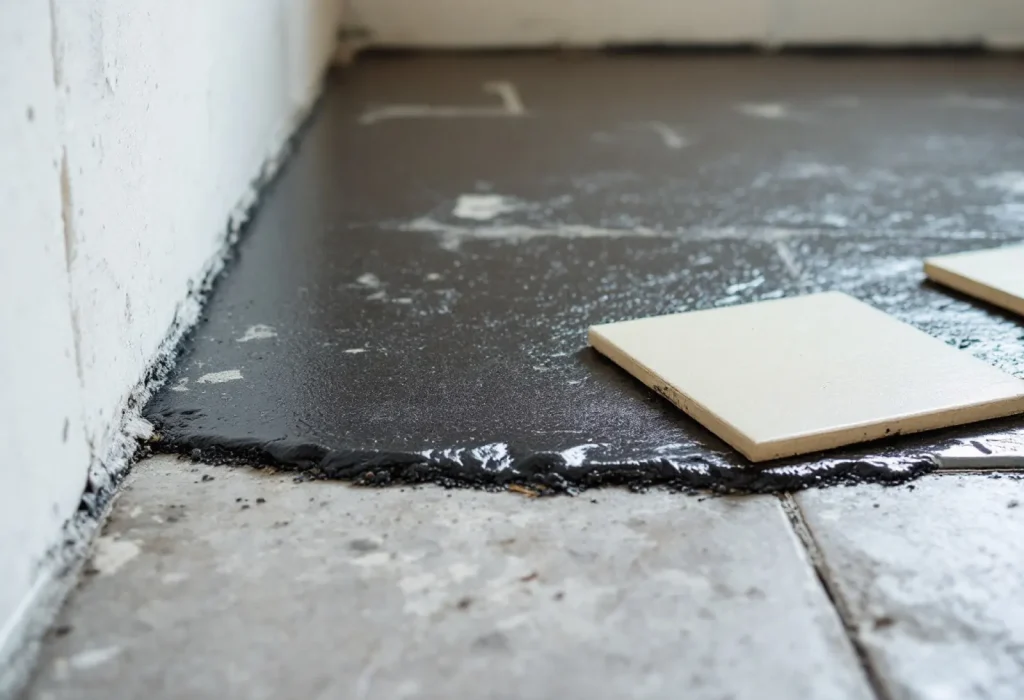
Black mastic is asphalt based adhesive, which is why it is black; the flooring industry calls it asphaltic “cutback” adhesive. The RFCI Recommended Work Practices (January 2018) states that vinyl asbestos tile and asphalt tile contain asbestos fibres, “as did some asphaltic cutback adhesives”, and that the presence of the asbestos “is not readily identifiable”. Note the word some: the industry’s own booklet does not say all.
The dates come from R&R magazine's history of asbestos flooring, written by John Kozak and dated 28 February 2025. It reports that asbestos in cutback was mandated under Federal Specification MMM-A-110 until at least the mid 1970s, that by 1979 other mineral fibres or fillers were allowed, that most major US makers had stopped asbestos flooring by the early 1980s with some continuing to 1985, and that some asphalt based adhesives contained asbestos as late as 1989. A cutoff year therefore narrows the odds but never clears a floor.
OSHA draws its own line. Under 29 CFR 1926.1101, paragraph (k)(1)(i), asphalt and vinyl flooring installed no later than 1980 must be treated as asbestos containing unless the employer shows otherwise, and paragraph (g)(8)(i) assumes the associated mastic is asbestos containing too. The 1989 federal ban that people often cite did not settle the question: EPA's asbestos actions page says most of the 1989 rule (54 FR 29460) was overturned by the Fifth Circuit in 1991. The full ban history sits on our page on when asbestos was banned.
Can you tell asbestos black mastic from asbestos free black mastic by colour or texture?
No. EPA's homeowner asbestos page (updated 25 June 2026) says that generally you cannot tell whether a material contains asbestos simply by looking at it, unless it is labelled, and cured cutback carries no label. The RFCI booklet makes the same point for flooring: the asbestos “is not readily identifiable”. A black, tar like layer with trowel ridges tells you the adhesive is asphaltic; it says nothing about the 1% threshold EPA sets in 40 CFR 61.141.
Dating clues help you decide how careful to be before the result is back. A 9 inch square tile above the mastic points to the asphalt tile era that R&R dates from the 1920s, and a floor laid in 1980 or earlier sits inside OSHA’s presumption. Our guide to telling whether floor tiles contain asbestos covers those visual clues in detail, including tile sizes and backings.

Why can a standard PLM test report “none detected” on asbestos mastic?
The answer is printed in EPA’s own bulk method, EPA/600/R-93/116 (July 1993). Section 2.2.1 says PLM “can show significant bias leading to false negatives” for certain materials because fibres may be too thin or too coated to see. Section 2.2.2 says floor tiles may contain fibres under 0.25 micrometres in diameter that PLM cannot resolve. Section 2.2.3 names mastic directly: many organic mastics dissolve in the refractive index liquids the analyst uses, which distorts the optical reading unless the binder is removed first.
The fix in the same method is to strip the binder before looking. Section 2.3 sets out gravimetric reduction: the sample is ashed in a furnace, and for floor tile an acid dissolution step follows, with the weight tracked at each step so the asbestos share is calculated against the original mass. Section 2.5 then names analytical electron microscopy (TEM) as the method for materials whose fibres are “not resolved by PLM techniques”, and says “many floor tiles” fall in that group.
EPA has repeated the point for schools. EPA's AHERA floor tile answer (updated 2 April 2026) says EPA “recommends use of the updated method of TEM analysis to determine whether or not floor tiles are ACM” because TEM “helps to rule out false negatives”, and that if either TEM or PLM finds more than 1% asbestos, the material must be considered ACM. A PLM positive stands; a PLM negative on a resilient floor layer is the result to question.
Which lab method should you order for a black mastic sample, and what does each cost per layer?
The table below sets the six methods a lab price list offers for a mastic layer side by side, with what each can miss and who requires or recommends it. Prices are from the {‘plm_std’: {’24 hr’: 60.0, ‘2 wk’: 36.5}, ‘plm_400′: {’24 hr’: 115.0, ‘2 wk’: 68.0}, ‘plm_nob’: {’24 hr’: 79.0, ‘2 wk’: 55.0}, ‘tem_nob’: {’24 hr’: 175.0, ‘2 wk’: 75.0}, ‘tem_nob_unprepped’: {’24 hr’: 187.9, ‘2 wk’: 87.9}, ‘ny_1986′: {’24 hr’: 72.0, ‘2 wk’: 49.75}, ‘ny_1984′: {’24 hr’: 169.0, ‘2 wk’: 73.0}}, per layer, at the 2 week and 24 hour turnaround columns. EMSL’s end notes say fees are charged “per layer”, with tile and mastic charged separately, so the black mastic under a tile is always its own result.
| Method | What it reports | What it can miss | Who requires or recommends it | EMSL 2026 price per layer |
|---|---|---|---|---|
| PLM, calibrated visual estimate (EPA/600/R-93/116) | Asbestos type and estimated %, reporting limit under 1% | Thin fibres under 0.25 micrometres; mastic binder dissolving in index liquids (sections 2.2.2, 2.2.3) | Named in the 40 CFR 61.141 definitions; fine for a quick positive | $36.50 to $60 |
| PLM, 400 point count | Asbestos % to a reporting limit under 0.25% | Same fibre visibility limit as visual PLM | 40 CFR 61.141 requires point counting when a friable result under 10% came from another PLM method | $68 to $115 |
| PLM NOB with gravimetric reduction (EPA) | Asbestos % on the ashed and acid washed residue, target limit 0.5% | Still optical: fibres below PLM resolution | EMSL note 9 recommends TEM if this reads none detected or under 1% | $55 to $79 |
| NY ELAP 198.6 (PLM with gravimetric prep) | ACM if over 1%; otherwise “Inconclusive” | Cannot declare a non friable organically bound layer non ACM | New York ELAP labs for NOB materials | $49.75 to $72 |
| TEM NOB (EPA/600/R-93/116 section 2.5.5.1) | Asbestos type and % from grids of the reduced residue | Section 2.5 lists TEM as the answer to fibres PLM cannot resolve | EPA recommends TEM for floor tile under AHERA | $75 to $175 if prepped by PLM NOB; $87.90 to $187.90 if not |
| NY ELAP 198.4 (TEM) | ACM if over 1%; Non ACM if 1% or less after a PLM recheck | Flowchart orders more sampling if TEM is low but fibres were seen | New York: “the only reliable method to declare an NOB as Non ACM” | $73 to $169 |
Labelled calculation, according to the EMSL prices above at the 2 week rate: a standard PLM result on the mastic layer costs $36.50. The EPA NOB path, gravimetric PLM followed by TEM, costs $130, about 3.6 times as much, and the New York pair of 198.6 then 198.4 costs $122.75. At the 24 hour column, according to the same list, the two paths rise to $254 and $241. For a tile and its mastic sampled together, standard PLM on both layers is $73; standard PLM on the tile plus the NOB path on the mastic is $166.50, per the same price list.
TEM only adds cost when it can change the answer. If gravimetric PLM already reads more than 1%, EPA’s AHERA answer says the material must be treated as ACM and a TEM run would not reverse that; EMSL even prices a positive stop prep fee of $12.90 for samples prepped but not analysed. TEM earns its fee on the negative. Lab accreditation and how to choose one are covered on our asbestos testing lab page.
How does New York turn a PLM negative on mastic into “Inconclusive”?
New York is the clearest worked example of the false negative rule written into lab procedure. The Wadsworth Center NOB flowchart, published by the state’s Environmental Laboratory Approval Program (ELAP) and revised 25 July 2011, covers non friable organically bound (NOB) materials, the class that black mastic belongs to. A PLM result of 1% or less under Item 198.6 must be reported as “Inconclusive”, with a required disclaimer, and the chart states that “TEM is the only reliable method to declare an NOB as Non ACM”, according to the flowchart.
The practical reading for anyone holding a New York report: a 198.6 result that says Inconclusive is not a clean result, and nothing should be sanded or ground on the strength of it. Outside New York the words on the report differ, but the physics in EPA/600/R-93/116 section 2.2.2 is the same, so ask the lab whether the PLM was run after gravimetric reduction and whether TEM is available on the same prepared residue.
Is black mastic friable, and when does 40 CFR 61.141 make it RACM?
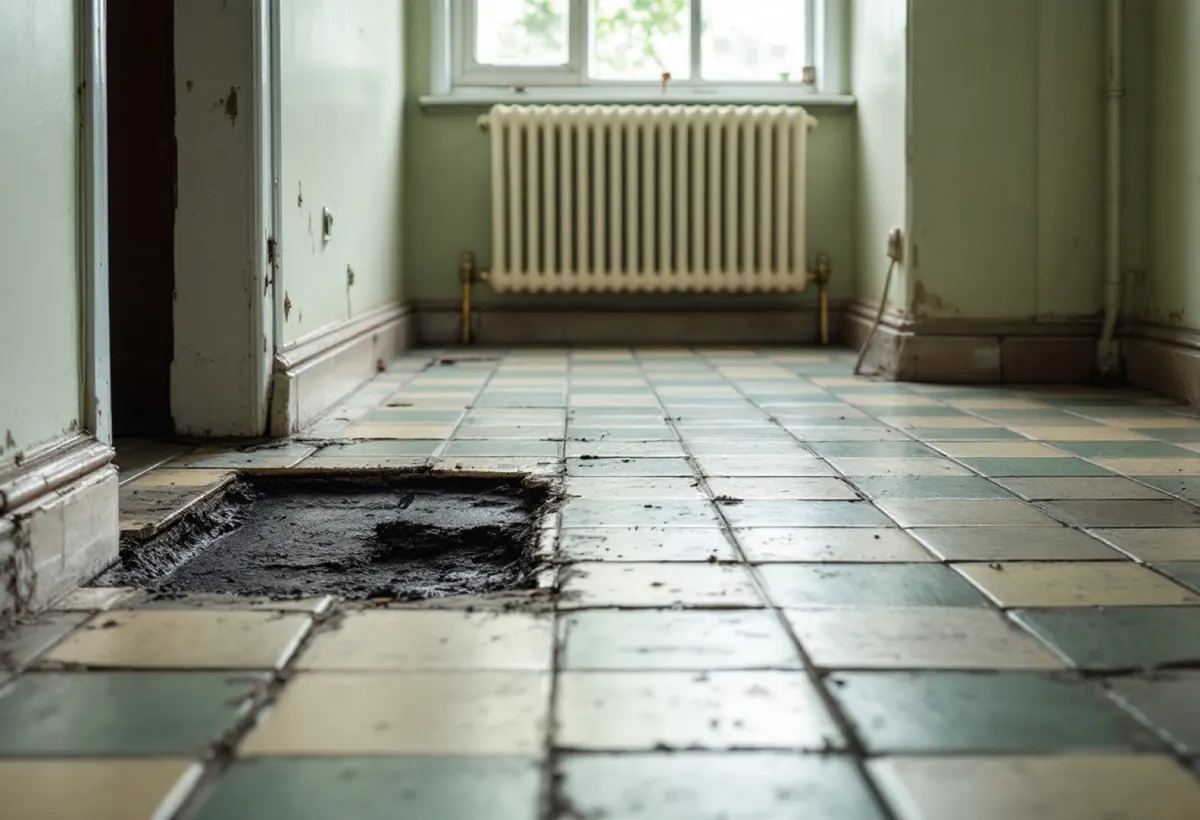
Intact cured black mastic is classed as nonfriable. EPA’s rule at 40 CFR 61.141 defines Category I nonfriable ACM as packings, gaskets, resilient floor covering and asphalt roofing products containing more than 1% asbestos by PLM. The definition does not name mastic, but EPA’s own interpretive text does: section 1.2 of Appendix A to Subpart M of 40 CFR Part 61, the roof removal rule, lists “resilient floor covering mastic” among Category I materials. The general friable versus nonfriable test is explained on our friable asbestos page.
The category changes with what is done to the layer. The same section 61.141 defines regulated asbestos containing material (RACM) to include Category I nonfriable ACM “that will be or has been subjected to sanding, grinding, cutting, or abrading”, and defines grinding to include mechanical chipping or drilling. EPA’s 3 June 1988 letter to T. Joel Loving framed the test plainly: if the mastic is strong enough to prevent fibre release during the work, the work practice and visible emission portions do not apply; if not, the material becomes regulated from the time it is created.
| What happens to the mastic | NESHAP status | Rule or EPA position |
|---|---|---|
| Intact, left in place | Category I nonfriable ACM if over 1% | Not RACM. Under 40 CFR 61.145(c)(1)(i) Category I ACM not in poor condition and not friable need not be removed before demolition |
| Softened with solvent and wet scraped | Not listed as RACM in 61.141 unless it becomes friable | OSHA requires wet methods for scraping residual adhesive; RFCI lists solvent removers with a flashpoint over 140 F |
| Sanded, ground, cut or abraded | RACM under 40 CFR 61.141 (c) | OSHA (g)(8)(i): flooring or its backing shall not be sanded |
| Shot blasted or bead blasted | Subject to NESHAP work practices | EPA Region IV, 1990: must be adequately wet before and during |
| Mechanically chipped | “Grinding” includes mechanical chipping (61.141) | OSHA: prohibited unless in a negative pressure enclosure |
| Crumbled or broken extensively | RACM if it has become friable | EPA, 1994: case by case, by condition and forces applied |
Two limits on the table. The NESHAP covers a facility, and 40 CFR 61.141 excludes residential buildings having four or fewer dwelling units, so a single family home renovation is usually outside it, though not outside state or local rules. And the 1994 letter to Dale L. Keyes declined to set a bright line on breakage: a case by case determination must be made considering the condition of the material and the forces acting on it.
Does OSHA let a contractor skip the test and presume the black mastic is asbestos?
Yes, and for flooring it presumes by default. 29 CFR 1926.1101 paragraph (g)(8)(i) says resilient flooring material “including associated mastic and backing shall be assumed to be asbestos containing” unless an industrial hygienist determines it is asbestos free using recognised analytical techniques. Removing construction mastics is named in the standard’s definition of Class II asbestos work. Paragraph (k)(5) adds that rebuttal testing of flooring rests on recognised techniques showing the material is not ACM.
The presumption carries work rules. Paragraph (g)(8)(i) bars sanding flooring or its backing, requires wet methods for all scraping of residual adhesive, prohibits dry sweeping, and prohibits mechanical chipping unless it is done in a negative pressure enclosure. Paragraph (c) sets the exposure limits at 0.1 fibres per cubic centimetre as an 8 hour time weighted average and 1.0 f/cc over 30 minutes. A contractor who presumes rather than tests accepts these controls on every square foot.
For contractors: when does a black mastic floor trigger NESHAP inspection and notice?
For buildings the NESHAP covers, 40 CFR 61.145 paragraph (a) requires the owner or operator to “thoroughly inspect the affected facility” for asbestos before demolition or renovation begins. The RACM thresholds in the same section are 80 linear metres (260 linear feet) on pipes, 15 square metres (160 square feet) on other facility components, or 1 cubic metre (35 cubic feet) off facility components. A mastic floor that will be ground or shot blasted counts toward the 160 square foot figure, because grinding makes it RACM.
Sample the mastic as its own layer, separate from the tile, and say so on the chain of custody, since EMSL bills and reports per layer. Ask the lab three things before the bag ships: whether its PLM for NOB uses gravimetric reduction, whether a none detected result is automatically forwarded to TEM, and whether it holds New York ELAP approval if the job is in New York. The removal side, from wet scraping to the EPA letters on shot blasting, is on our asbestos floor tile removal page, and every asbestos standard we cover is indexed on the standards hub.
Questions people actually ask
Is it safe to walk on black mastic?
EPA's homeowner asbestos page says the best course is usually to leave asbestos material alone if it is in good condition, and its warnings target sawing, sanding, scraping and drilling, not foot traffic. Under 40 CFR 61.145, intact Category I material not in poor condition need not even be removed before demolition. If you plan to cover it, the RFCI January 2018 booklet sets out which residual cutback treatments suit which new floors.
Can I put new flooring over old black cutback adhesive?
Often yes, with conditions. The RFCI January 2018 work practices say residual cutback can be left with no ridges or puddles under some new floors, that asphaltic cutback adhesive has proved suitable over existing cutback when the new floor’s maker recommends it, and that asbestos encapsulants or bridging coats over asphaltic adhesive are not recommended because they can affect bonding.
How do you remove black mastic that contains asbestos?
Not by sanding or grinding. OSHA’s 29 CFR 1926.1101(g)(8)(i) bans sanding flooring or its backing and requires wet methods for scraping residual adhesive, and EPA’s 1990 Region IV letter puts shot blasted mastic under NESHAP work practices. Our floor tile removal page walks through the full method and the EPA letters.
How long does a TEM test on mastic take?
It depends on the turnaround you buy. According to the EMSL Analytical 2026 price list, TEM NOB is offered at 24 hours to 2 weeks, with the 24 hour rate at $175 and the 2 week rate at $75 per layer when the sample was already prepared by PLM NOB. New York 198.4 at EMSL starts at the 24 hour column; faster turnaround is quoted on request.
Does the one percent rule apply to black mastic?
Yes. EPA’s rule at 40 CFR 61.141 defines Category I nonfriable ACM as material with more than 1 percent asbestos, and EPA’s AHERA floor tile answer says that if either PLM or TEM finds more than 1%, the material must be considered ACM. A layer at 1% or less by TEM is not ACM under those two EPA definitions.
Out of scope: this page covers identification, lab methods and regulatory status only. For health questions, start with EPA's homeowner asbestos page and the agencies it links.
Sources
- 40 CFR 61.141, asbestos NESHAP definitions (Category I and II nonfriable ACM, friable, RACM, facility, grinding, adequately wet), via Legal Information Institute, Cornell. Retrieved 11 November 2026.
- 40 CFR 61.145, inspection duty, RACM thresholds and paragraph (c)(1)(i), via Cornell LII. Retrieved 11 November 2026.
- Appendix A to Subpart M of 40 CFR Part 61, Interpretive Rule Governing Roof Removal Operations, section 1.2, 1 July 2012 edition, U.S. Government Publishing Office. Retrieved 11 November 2026.
- 29 CFR 1926.1101, OSHA asbestos standard for construction, paragraphs (b), (c), (g)(8)(i), (k)(1)(i) and (k)(5), via Cornell LII. Retrieved 11 November 2026.
- EPA/600/R-93/116, Test Method for the Determination of Asbestos in Bulk Building Materials, U.S. EPA Office of Research and Development, July 1993, sections 2.2, 2.3 and 2.5. Retrieved 11 November 2026.
- EPA's AHERA floor tile answer, U.S. EPA, last updated 2 April 2026. Retrieved 11 November 2026.
- EPA's homeowner asbestos page, U.S. EPA, last updated 25 June 2026. Retrieved 11 November 2026.
- EPA's asbestos actions page, U.S. EPA, last updated 21 January 2026. Retrieved 11 November 2026.
- EPA's floor tile and mastic determinations, U.S. EPA index, including the 3 June 1988 letter to T. Joel Loving, the 13 July 1990 Region IV letter to C. H. Fancy and the 1994 letter to Dale L. Keyes. Retrieved 11 November 2026.
- Wadsworth Center NOB flowchart, Non Friable Organically Bound Bulk Material, Items 198.6 and 198.4, New York State Department of Health Environmental Laboratory Approval Program, revised 25 July 2011. Retrieved 11 November 2026.
- {‘plm_std’: {’24 hr’: 60.0, ‘2 wk’: 36.5}, ‘plm_400′: {’24 hr’: 115.0, ‘2 wk’: 68.0}, ‘plm_nob’: {’24 hr’: 79.0, ‘2 wk’: 55.0}, ‘tem_nob’: {’24 hr’: 175.0, ‘2 wk’: 75.0}, ‘tem_nob_unprepped’: {’24 hr’: 187.9, ‘2 wk’: 87.9}, ‘ny_1986′: {’24 hr’: 72.0, ‘2 wk’: 49.75}, ‘ny_1984′: {’24 hr’: 169.0, ‘2 wk’: 73.0}}, EMSL Analytical, Inc., PLM, PLM NOB, TEM NOB and NYS ELAP bulk rates and end notes 8 to 11. Retrieved 11 November 2026.
- RFCI Recommended Work Practices (January 2018), Resilient Floor Covering Institute. Retrieved 11 November 2026.
- R&R magazine's history of asbestos flooring, John Kozak, R&R magazine, 28 February 2025. Retrieved 11 November 2026.
- Per layer path costs and the cost ratio are arithmetic on the EMSL prices above, computed when this page was built. Our methodology sets out the standing rules.
Lab prices, turnaround and state rules change. Confirm the method, billing unit and reporting language with the lab, and check your state or local air agency, before relying on a result for work that disturbs the floor.