The short answer
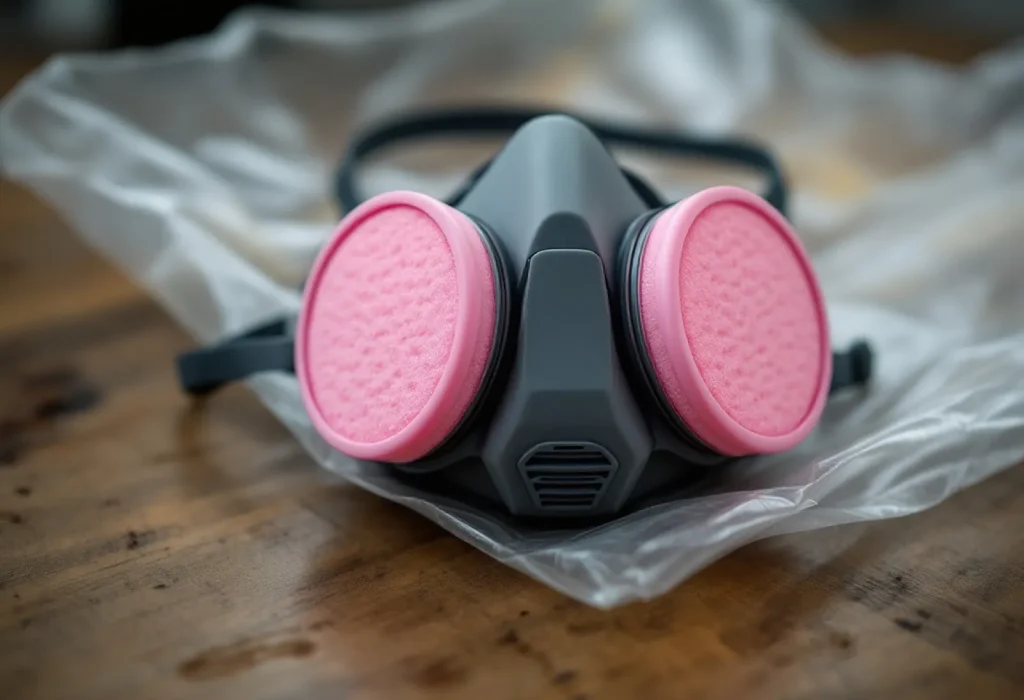
A respirator for asbestos removal under OSHA’s construction rule must be at least a reusable half mask with HEPA filters, and 29 CFR 1926.1101(h)(3) bans filtering facepieces, including N95 and disposable P100 masks. Class I work without a negative exposure assessment needs a tight-fitting PAPR or supplied air, and above 1 f/cc supplied air with auxiliary SCBA.
This page reads the respirator rules that bind employers. Health questions are out of scope here; EPA's homeowner asbestos page is the place to start.
Does an N95 or a disposable P100 meet OSHA’s asbestos rule?
No. 29 CFR 1926.1101(h)(3)(i)(A) says employers “must not select or use filtering facepiece respirators for use against asbestos fibers”, and 29 CFR 1910.1001(g)(3)(i) repeats the ban for general industry. 29 CFR 1910.134(b) defines a filtering facepiece as a respirator with the filter built into the facepiece or the entire facepiece made of filter medium. That covers every disposable, whatever its rating.
The ban targets the form, not the filter grade. The 3M 8293 specification lists a NIOSH approved P100 mask, approval TC-84A-2561, with 99.97 percent filtration and an APF of 10, and then prints “DO NOT use for gases and vapors, asbestos, or abrasive blasting”. The 3M 8233 and 8293 sheet says the same of the N100 model, approval TC-84A-1298. Appendix H of the OSHA rule, which is non-mandatory, agrees: “Disposable respirators or dust masks are not permitted to be used for asbestos work.”
The filter test catches a second mistake. Paragraph (h)(3)(i)(B) requires HEPA filters on powered and non-powered air-purifying respirators, and a reusable half mask may accept N95 filters too: the MSA Advantage 200 LS page lists N95, R95 and P100 options for the same facepiece. Check the filter fitted, not only the mask.
Mold is a different question, because EPA does name an N95 as its minimum there. Our N95 mask for mold page has that job-size matrix.
What is the minimum respirator for Class I, II, III and IV work?
29 CFR 1926.1101(b) sorts work by what is disturbed. Class I removes thermal system insulation (TSI) and surfacing material, such as asbestos pipe insulation. Class II removes other material, including wallboard, floor tile, roofing and siding, as in removing asbestos floor tiles. Class III is repair and maintenance likely to disturb asbestos. Class IV is custodial contact and debris cleanup.
| Work | Paragraph | Minimum respirator |
|---|---|---|
| Class I, no negative exposure assessment (NEA), assessed at or below 1 f/cc | (h)(1)(i), (h)(3)(iv)(A) | Tight-fitting PAPR, or full facepiece supplied air in pressure-demand mode with HEPA egress cartridges or auxiliary SCBA |
| Class I, no NEA, assessed above 1 f/cc | (h)(1)(i), (h)(3)(iv)(B) | Full facepiece supplied air in pressure-demand mode with auxiliary positive-pressure SCBA |
| Class I with an NEA | (h)(1)(i), (h)(3)(i) | Still required. Select from 1910.134 Table 1; no filtering facepiece; HEPA filters |
| Class II or III, no NEA | (h)(1)(iv), (h)(3)(iii)(A) | Air-purifying half mask, not a filtering facepiece, with HEPA filters |
| Class III disturbing TSI or surfacing material | (h)(1)(v), (h)(3)(iii)(B) | Air-purifying half mask, not a filtering facepiece, with HEPA filters |
| Class II, material not coming off substantially intact | (h)(1)(ii), (h)(3)(i) | Required. Table 1 selection, no filtering facepiece, HEPA filters |
| Class II or III without wet methods | (h)(1)(iii), (h)(3)(i) | Required, except sloped roof removal with an NEA and material kept intact |
| Class II or III with an NEA, wet methods, intact, no TSI or surfacing disturbed | No (h)(1) class trigger | None named, unless a limit is exceeded under (h)(1)(vii) |
| Class IV in a regulated area where others must wear respirators | (h)(1)(vi), (h)(3)(i) | Required. Table 1 selection, no filtering facepiece, HEPA filters |
| Any class above 0.1 f/cc TWA or 1 f/cc excursion; emergencies | (h)(1)(vii), (h)(1)(viii) | Required. Select to keep exposure within the calculated use ceiling |
| General industry, such as custodial work or brake repair | 1910.1001(g)(1), (g)(3) | When controls fall short, during repairs and emergencies: Table 1 selection, no filtering facepiece, HEPA filters |
Most of that table turns on the negative exposure assessment. Under paragraph (f)(2)(iii), an employer shows exposures will stay below both limits using objective data, monitoring of closely similar jobs within the past 12 months, or breathing-zone samples from the current job. For Class I, (f)(2)(ii) presumes exposure above the limits until that is done. Our asbestos air monitoring page covers how those samples work.
At least one buyer guide ranking for this search gets the Class I line wrong, listing a “full-face PAPR (APF 25 or 50)” as the requirement. The rule says “tight-fitting”, which OSHA's 18 July 2017 letter reads as half mask or full mask facepiece, and Table 1 gives a full facepiece PAPR an APF of 1,000, not 25 or 50. That letter, on a Class III glove bag job, also says tight-fitting facepieces are required, so a hooded PAPR does not satisfy the employee-choice provision.
Does the rule reach public employees and state-plan states?
Yes, through other doors. 40 CFR 763.122 makes state and local government employers without an approved state plan follow the same OSHA standards, and Cal/OSHA 8 CCR 1529(h) repeats the filtering facepiece ban for California employers. Other state plans can differ, so check the agency on our state asbestos accreditation map before relying on the federal text.
What do assigned protection factors allow at 0.1 f/cc?
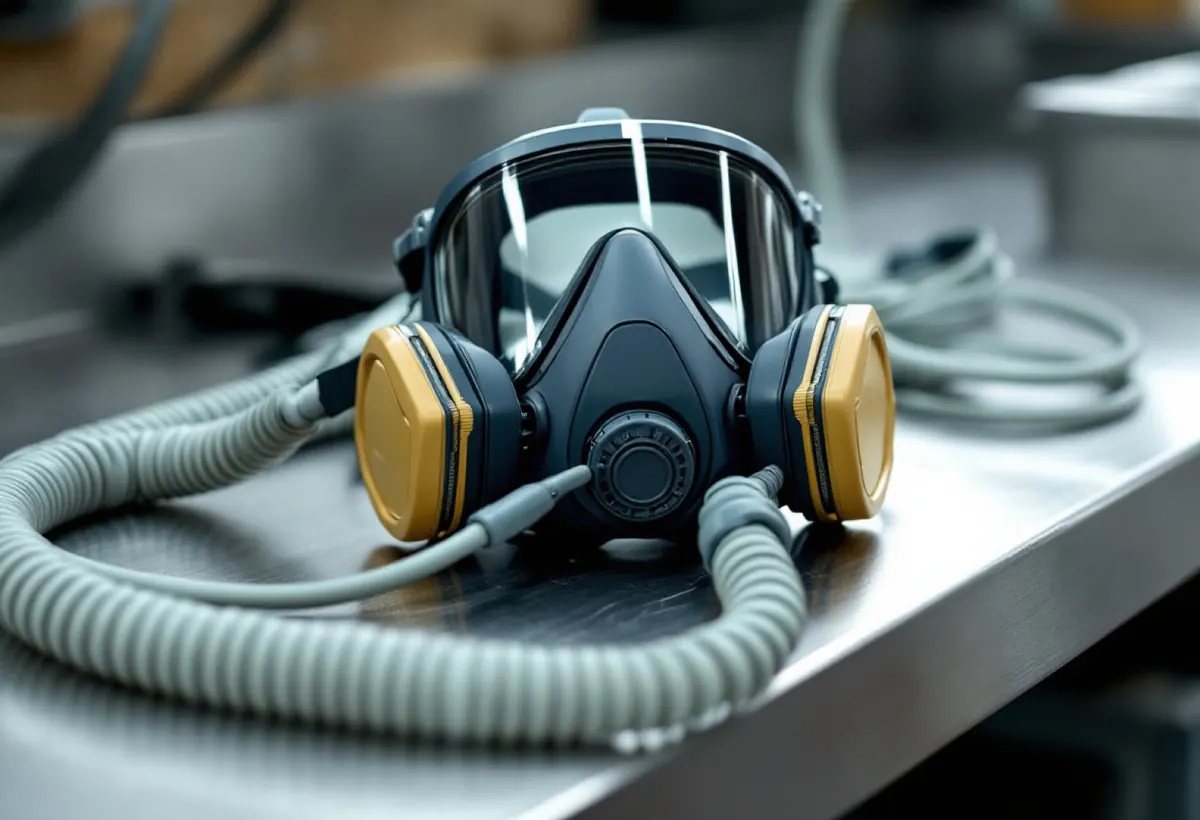
29 CFR 1910.134(b) calculates the maximum use concentration as the assigned protection factor times the exposure limit. Asbestos has two limits under 29 CFR 1926.1101(c): 0.1 f/cc as an 8-hour average and 1.0 f/cc over 30 minutes. The columns below are our arithmetic, and the lower result is what binds a full shift.
| Respirator (1910.134 Table 1) | APF | APF x 0.1 f/cc | APF x 1.0 f/cc, 30 min | Status in the asbestos rule |
|---|---|---|---|---|
| Half mask, air purifying | 10 | 1 f/cc | 10 f/cc | Named minimum for Class II and III without a negative exposure assessment |
| Full facepiece, air purifying | 50 | 5 f/cc | 50 f/cc | Selectable from Table 1; not named for Class I without an assessment |
| Half mask PAPR | 50 | 5 f/cc | 50 f/cc | Allowed for Class I at or below 1 f/cc if tight fitting |
| Full facepiece PAPR | 1,000 | 100 f/cc | 1,000 f/cc | Allowed for Class I at or below 1 f/cc; above that, OSHA says no |
| Full facepiece supplied air, pressure demand | 1,000 | 100 f/cc | 1,000 f/cc | Required above 1 f/cc in Class I, with auxiliary SCBA |
| Full facepiece SCBA, pressure demand | 10,000 | 1,000 f/cc | 10,000 f/cc | Named only as the auxiliary unit for supplied air |
The rule can be stricter than the arithmetic. In OSHA's 4 January 2024 letter, a contractor measuring about 2 f/cc on Class I work asked to move from supplied air to a PAPR or full facepiece once monitoring confirmed the level. A half mask PAPR calculates to 5 f/cc, yet OSHA said no: above 1 f/cc the employer keeps supplied air with auxiliary SCBA, because the asbestos standard takes precedence over Table 1.
Is a P100 filter the same as the HEPA filter OSHA asks for?
For this rule, yes. 29 CFR 1926.1101(b) defines HEPA as retaining at least 99.97 percent of 0.3 micrometer particles, and 29 CFR 1910.134(b) states the equivalent NIOSH filters “are the N100, R100, and P100 filters”. 42 CFR 84.170 requires a minimum of 99.97 percent for all three classes. The asbestos paragraphs themselves never print the words P100 or N100, which is why a search for them finds nothing in the section.
The letter matters less than the number. Under 42 CFR 84.170, N-series filters are limited to workplaces free of oil aerosols, while R and P cover any particulate including oil-based ones, so a job with no oil aerosol can use either on the OSHA text. A P100 filter also does not raise a half mask above APF 10. The 3M instructions add a working limit: if filters become damaged, soiled or hard to breathe through, leave the area and replace them.
How often does OSHA require a fit test: every year or every 6 months?
Every year, on the mandatory text. 29 CFR 1926.1101(h)(2)(i) pulls in paragraph (f) of 29 CFR 1910.134, and (f)(2) requires a fit test before first use, whenever a different facepiece is used, and “at least annually thereafter”. The confusion is OSHA’s own: non-mandatory Appendix H of the asbestos rule still tells workers their employer must fit test “every 6 months”. Appendix H is information, the regulatory text controls, and a contract or state plan may still set 6 months.
- Pass marks. Under (f)(7), a quantitative fit factor of at least 100 for a half mask and 500 for a full facepiece.
- Qualitative limit. Under (f)(6), qualitative tests only cover negative-pressure respirators needing a fit factor of 100 or less.
- Powered and supplied units. Under (f)(8), tight-fitting ones are tested in negative-pressure mode, whatever mode they run in on the job.
- Every donning. Paragraph (g)(1)(iii) requires a user seal check each time, and Appendix B-1 says it is no substitute for a fit test.
- Beards. Paragraph (g)(1)(i)(A) bars facial hair between the seal and the face on any tight-fitting facepiece.
When must the medical evaluation happen, and who pays?
The asbestos rule has its own route. OSHA's 10 May 2007 letter points out that paragraph (h)(2)(i) adopts 1910.134 paragraphs (b) to (d) and (f) to (m) but leaves out paragraph (e), the general medical evaluation, because asbestos medical surveillance already covers it. So the duties below come from 1926.1101(m) and (h)(2)(ii), as procedure only; what the exam contains is out of scope here.
- Before assignment. Paragraph (m)(2)(i)(A) sets an exam before assignment to an area where negative-pressure respirators are worn, and (m)(1)(i)(B) requires a physician-supervised determination that the worker can do the work and use the equipment.
- At 30 days. Under (m)(1)(i)(A), surveillance covers anyone on Class I, II or III work for 30 or more combined days a year or at or above a limit. Under (m)(2)(i)(B), the exam falls within 10 working days after the thirtieth day. A day of Class II or III work on intact material for one hour or less, following the rule’s work practices, does not count.
- Yearly. Paragraph (m)(2)(i)(C) repeats it at least annually.
- Cost. Paragraph (m)(1)(ii)(A) puts exams at no cost to the employee, at a reasonable time and place.
- If the physician says no. Paragraph (h)(2)(ii) bars the assignment and requires a move to another job, or the chance to transfer if one is available, at the same pay, seniority and status.
What do 3M, Honeywell and MSA data sheets say about asbestos?
The sheets show why the form and the filter have to be read separately. Rows follow the two tests in (h)(3)(i) and are not a ranking; we compared published specifications and did not test any product.
| Model | Published specification | Asbestos wording | Against (h)(3)(i) |
|---|---|---|---|
| 3M 8293 disposable | Filtering facepiece, P100, 99.97%, TC-84A-2561 | “DO NOT use for gases and vapors, asbestos, or abrasive blasting” | Prohibited form |
| 3M 8233 disposable | Filtering facepiece, N100, 99.97%, TC-84A-1298 | “Do not use for asbestos exposures” | Prohibited form |
| 3M 7500 half mask with 2091 filter | Silicone face seal, three sizes, 135 g; approved with 2000 series filters; P100, 99.97% | Filter instructions list asbestos under use for | Meets both tests |
| Honeywell North 7700 half mask | Silicone, three sizes; certified with North N Series filters and cartridges, Compact Air PAPR and CF2000 supplied air | Sheet lists airborne particulates; does not name asbestos | Depends on filter fitted |
| MSA Advantage 200 LS half mask | Rubber and plastic blend, three sizes; takes N95, R95 or P100 | Page lists asbestos and asbestos removal as an application | Depends on filter fitted |
Confirm any model by its TC number on the NIOSH Certified Equipment List before buying, because 3M and Honeywell both word approval as a facepiece used with named filters. Maker sheets show approval, and they do not stand in for the fit test, medical and written program steps above. More rule pages sit on our standards hub.
What does this mean if you own the house?
Those duties bind employers, so they do not automatically reach an owner working alone. EPA's homeowner asbestos page still says removal “must be done only by a trained and accredited asbestos professional”, while noting federal law does not require that training for work in detached single-family homes, though some states do. The 3M filter instructions also state 3M PSD products are for occupational use only. Our how to remove asbestos page covers what an owner can legally do.
If you are hiring, three questions test whether a contractor knows this rule, because each has a checkable answer in 29 CFR 1926.1101. Which class is this job, and is a negative exposure assessment on file? Which respirator and filter will the crew wear, by model and TC number? When was each worker last fit tested, given (f)(2) needs one at least annually? An answer that mentions an N95 ends the conversation.
Questions people actually ask
Is a half face respirator enough for asbestos?
It depends on the class. OSHA names an air-purifying half mask with HEPA filters as the minimum for Class II and III work without a negative exposure assessment under 29 CFR 1926.1101(h)(3)(iii). It is not enough for Class I work without an assessment, which needs a tight-fitting PAPR or supplied air under (h)(3)(iv).
Is a P3 filter the same as a P100 for asbestos?
Not on US paperwork. P3 is not a class in 42 CFR 84.170, which lists only N, R and P series at 95, 99 and 100. OSHA’s 29 CFR 1910.134(b) names N100, R100 and P100 as HEPA equivalents, and NIOSH does not approve devices solely certified to international standards. Check for a NIOSH TC number.
Can visitors enter a regulated area without a respirator?
No, where respirators are required. Paragraph 1926.1101(e)(4) says all persons entering a regulated area where employees must wear respirators under (h)(1) shall be supplied with one selected under (h)(3). That takes in inspectors and supervisors, and the same filtering facepiece ban applies to what they are handed.
Do cleanup crews need respirators after asbestos removal?
They can. OSHA treats cleaning up debris from Class I, II and III work as Class IV under 29 CFR 1926.1101(b). Paragraph (h)(1)(vi) requires respirators for Class IV work in a regulated area where others performing work must wear them, and paragraph (g)(10) covers employees cleaning up debris in those areas too.
How long do P100 filters last on asbestos work?
OSHA’s asbestos paragraphs set no filter life in hours. The 3M 2000 and 2200 series instructions say to leave the contaminated area and replace filters if they become damaged or soiled, or if breathing becomes difficult. Under 29 CFR 1910.134(h), the employer keeps respirators maintained, so the replacement schedule belongs in the written program.
Sources
- 29 CFR 1926.1101, Asbestos, including paragraphs (b), (c), (e), (f), (h) and (m) and Appendix H, via Cornell LII. Retrieved 2 November 2026.
- 29 CFR 1910.1001, Asbestos (general industry), including paragraphs (a), (c) and (g), via Cornell LII. Retrieved 2 November 2026.
- 29 CFR 1910.134, Respiratory Protection, Table 1 and Appendix B-1, via Cornell LII. Retrieved 2 November 2026.
- 42 CFR 84.170, Air-purifying particulate respirators; description, via Cornell LII. Retrieved 2 November 2026.
- OSHA's 4 January 2024 letter, Respirators for asbestos Class I work, Occupational Safety and Health Administration. Retrieved 2 November 2026.
- OSHA's 18 July 2017 letter, Hooded versus tight-fitting respirators when complying with the Asbestos Standard, OSHA. Retrieved 2 November 2026.
- OSHA's 10 May 2007 letter, Asbestos standards and the respiratory protection standard as applied to medical surveillance, OSHA. Retrieved 2 November 2026.
- 40 CFR 763.122, Asbestos Worker Protection, United States Environmental Protection Agency rule, via Cornell LII. Retrieved 2 November 2026.
- Cal/OSHA 8 CCR 1529(h), California Department of Industrial Relations. Retrieved 2 November 2026.
- EPA's homeowner asbestos page, EPA, page updated 25 June 2026. Retrieved 2 November 2026.
- NIOSH misrepresented products page, reviewed 4 February 2025; NIOSH Certified Equipment List. Retrieved 2 November 2026.
- 3M 8293 specification, 3M, copyright 2018; 3M 8233 and 8293 sheet, 3M; 3M 2000 and 2200 series filter instructions, 3M, copyright 2025; 3M 7500 series specifications, 3M, copyright 2015. 3M’s server refused automated requests, so these were read from Internet Archive copies of those URLs. Retrieved 2 November 2026.
- Honeywell 7700 series product sheet, Honeywell, a copy hosted on a retailer’s file server, and MSA Advantage 200 LS page, MSA Safety. Retrieved 2 November 2026.
- Use-ceiling figures are arithmetic on the values above. Our methodology sets out the standing rules.
This page reads regulations, agency letters and maker documents; it reports no testing of its own and is not legal advice. For your job, ask your state asbestos program or OSHA area office which class applies and whether a state rule is stricter.