The short answer
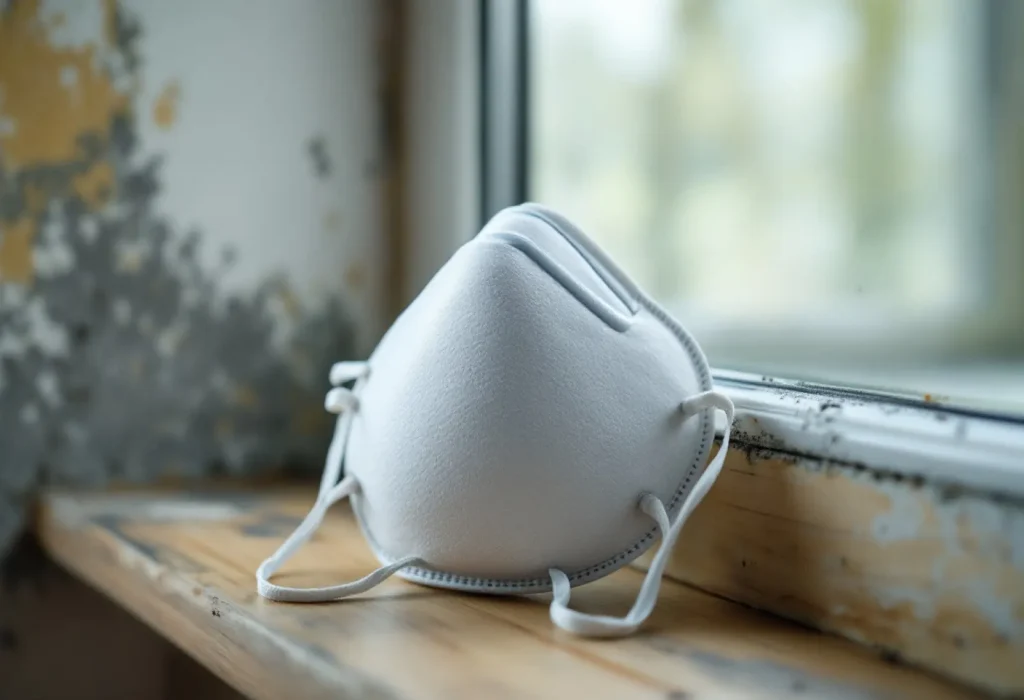
An N95 mask for mold is EPA’s stated minimum for cleanups under 10 square feet, if it is NIOSH approved and sealed to a clean-shaven face. From 10 to 100 square feet, EPA moves to a half-face or full-face respirator with HEPA cartridges by professional judgment, and above 100 square feet to a full-face PAPR. Surgical masks and KN95s are not substitutes.
Which respirator does EPA name at under 10, 10 to 100 and over 100 square feet?
EPA Table 2 sorts mold work by total affected surface area, and EPA Chapter 3 defines its three protection labels: Minimum, Limited and Full. The matrix joins those labels to the filter class in 42 CFR 84.170 and the assigned protection factor (APF) in 29 CFR 1910.134 Table 1, then sets OSHA bulletin SHIB 03-10-10 beside them, because EPA and OSHA do not match between 10 and 100 square feet.
| Affected area | EPA level | Respirator EPA describes | Filter class and minimum efficiency | OSHA APF | OSHA bulletin at the same size |
|---|---|---|---|---|---|
| Under 10 sq ft, about a 3 ft by 3 ft patch | Minimum | N-95, plus gloves and goggles | N95: at least 95% | 10 | Level I (10 sq ft or less): N-95 disposable, given as an example |
| 10 to 30 sq ft | Limited or Full, by professional judgment | Limited: half-face or full-face air-purifying respirator with HEPA cartridge. Full: full-face PAPR. | HEPA equivalent (N100, R100, P100): at least 99.97% | Half-face 10, full-face 50, full-face PAPR 1,000 | Level II: N-95 disposable, given as an example |
| 30 to 100 sq ft | Limited or Full, by professional judgment | Limited: half-face or full-face air-purifying respirator with HEPA cartridge. Full: full-face PAPR. | HEPA equivalent (N100, R100, P100): at least 99.97% | Half-face 10, full-face 50, full-face PAPR 1,000 | Level III: N-95 disposable, given as an example |
| Over 100 sq ft, or significant exposure potential at any size | Full | Full-face PAPR; the blower feeds a mask or a hood | HE or PAPR100 class: at least 99.97% | Mask 1,000; hood 25 unless the maker shows 1,000 | Level IV (over 100 contiguous sq ft): full face piece with HEPA cartridges, APF 50 |
| Sewage, chemical or biological water, any size | Outside Table 2 | EPA: “OSHA requires PPE and containment” | Set by the contaminant | Depends on the respirator | Not covered by the levels |
At 10 to 100 square feet the agencies differ. OSHA’s bulletin offers an N-95 disposable as its example respirator up to 100 square feet, while EPA moves to HEPA cartridges at 10. Neither line is law: the OSHA bulletin says it “is not a standard or regulation”, and EPA says its bands exist to make technique selection easier, not because of “health effects or research” showing a method suits a given area. EPA adds, “When in doubt, caution is advised.” That is the reason to treat the 10 to 100 band as a half-face respirator with P100 filters at least.
EPA's home mold guide sets the do-it-yourself line at about 10 square feet and sends bigger or heavily water-damaged jobs to the commercial guide. How the cleanup itself runs at that size belongs to our DIY mold remediation guide, and the containment that goes with larger bands is set out in the mold remediation process.
Does an N95 stop mold spores, or does the leak at the edge matter more?
An N95 filter must show at least 95 percent efficiency under 42 CFR 84.170, and the N series is limited to workplaces free of oil aerosols. Per 42 CFR 84.174, NIOSH loads 20 filters with a salt aerosol of 0.075 µm count median diameter at 85 liters per minute, after 25 hours at 85 percent humidity. That aerosol is far finer than the 0.7 to 4 µm range University of Cincinnati researchers used to represent bacteria and fungal spores.
At that size the filter was not the weak point. In Cho and colleagues (2010), penetration through the N95 filter ran 0.04 to 0.19 percent, while leakage at the face seal ran 0.11 to 1.07 percent, on a manikin set up to match field fit. Their finding: even on a well-fitting mask, most particles that got in came through the seal. A mask that gaps at the nose loses the protection the filter rating implies.
Field data point the same way. The NIOSH Grant 2 R01 OH 04085 final report measured 25 subjects on 8 farms and found protection fell as particles shrank, in both masks. Combined across both, the geometric mean protection factor for fungal spore counts was 29, against an OSHA APF of 10. The report found no significant gap between mask types when scored on fungi specifically, and it attributes differences between contaminants to analytical sensitivity.
Read those numbers with their limits. Every subject was fit tested first, and 2 of the 25 failed on the disposable, so a mask bought at a hardware store and never tested has no such figure behind it. The same report cites a pilot study in New Orleans after Hurricane Katrina suggesting elastomeric half masks may protect better against fungal spores than disposables, although both carry an APF of 10.
What should make you step up to a half-face P100 or a PAPR?
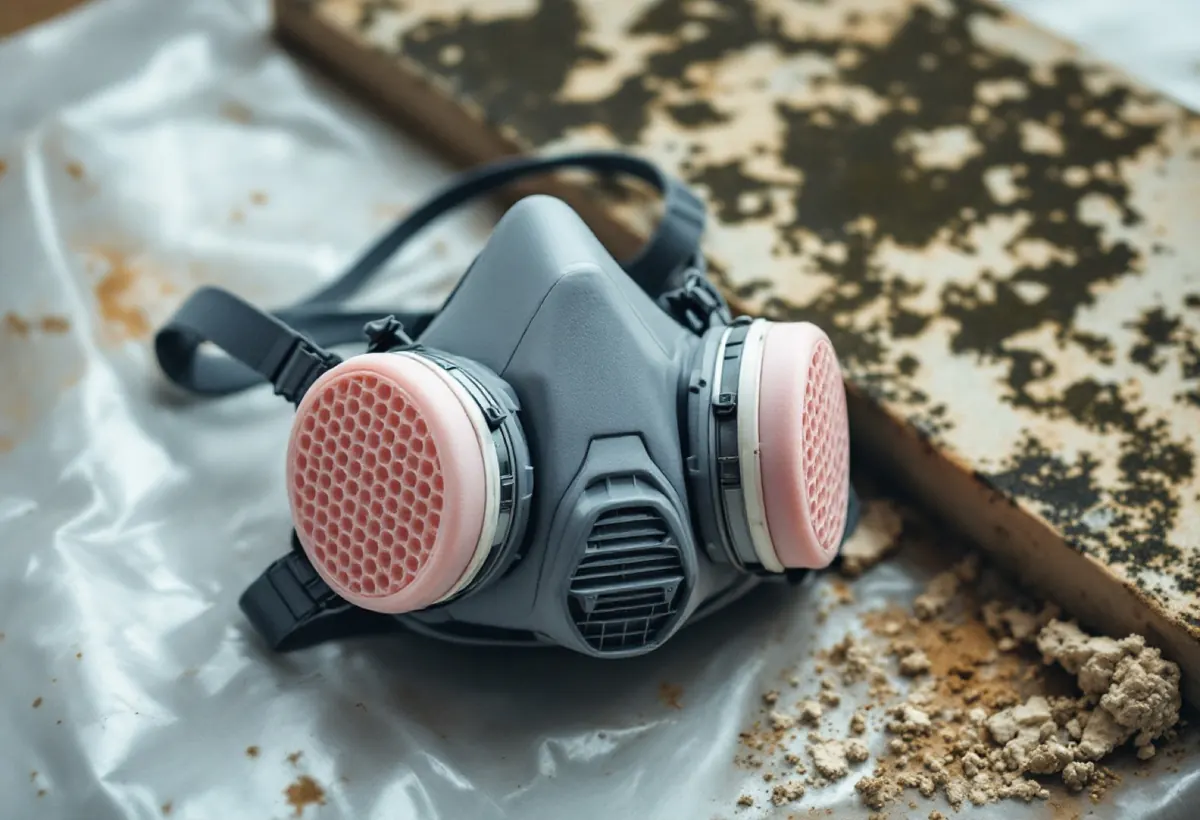
Five triggers appear in the agency text, and any one of them moves the choice past a disposable N95.
- Area over 10 square feet. That is the top of EPA’s Minimum band in Table 2.
- More than 4 hours, or demolition. CDC disaster cleanup guidance says to think about a reusable half-face or full-face respirator for more than 4 hours of removing moldy items or for work like ripping out moldy drywall.
- EPA’s four cautious cases. A particularly toxic species identified or suspected, extensive hidden mold expected such as behind vinyl wallpaper or in the HVAC system, a high chance of mold going airborne, or people EPA calls sensitive individuals present.
- A beard. The FDA comparison page states a proper N95 fit cannot be achieved with facial hair. In the workplace, 29 CFR 1910.134(g)(1)(i) bars facial hair at the seal of any tight-fitting facepiece, which leaves a loose-fitting PAPR at APF 25.
- Eyes in the dust. EPA notes half-face units give no eye protection and wants goggles without open vent holes. A full-face respirator removes the need for goggles.
What a half-face P100 changes, and what it does not
A half-face P100 does not earn a higher OSHA number than an N95. 29 CFR 1910.134 Table 1 puts filtering facepieces and elastomeric half masks in the same APF 10 row, so the real step in assigned protection comes at a full facepiece (50) or a powered unit. What the half-face adds is 99.97 percent filter efficiency, a replaceable filter, and in the NIOSH grant data a higher measured factor in every particle size band, though that study used an N95 filter on the reusable mask, not a P100.
Neither stops fumes. EPA Chapter 3 says HEPA filters “do not remove vapors or gases”, and Appendix D to 29 CFR 1910.134 says a dust-filtering respirator will not protect against gases or vapors. So a particulate filter of any rating does nothing about chlorine smell, one reason to read the bleach to water ratio for mold before mixing anything.
EPA’s Full level also adds mold-impervious head and foot coverings and a breathable body suit, naming Tyvek. Our Tyvek suit page covers that layer.
Why don’t a surgical mask, cloth mask or KN95 count?
Mask names describe different products under different regulators. The differences come straight from the FDA comparison page and the NIOSH misrepresented products page.
| Product | Who sets the rating | Seals to the face? | What the agency says about filtering |
|---|---|---|---|
| N95 respirator | NIOSH approval under 42 CFR 84 | Yes, edges designed to form a seal | Filter tested to at least 95%, per 42 CFR 84.170 |
| Surgical mask | FDA, 21 CFR 878.4040 | No, loose fitting | FDA: “does not filter or block very small particles in the air” |
| Face mask or barrier face covering, cloth included | FDA guidance; barrier coverings under ASTM F3502-21 | Not as a respirator | FDA: not a substitute for N95s or other filtering facepiece respirators |
| KN95 | Sold against foreign standards such as China’s GB 2626; NIOSH does not approve KN95 masks | NIOSH flags ear loops with no fastener; an approved N95 has two head bands or fastened loops | NIOSH “does not recognize or validate claims” of meeting an international standard |
One naming trap remains. 29 CFR 1910.134(b) defines a filtering facepiece as a “dust mask”, and EPA’s home guide says some N-95 respirators resemble a paper dust mask, yet a hardware store dust mask without a NIOSH label and TC number is not an N95. Check the printing, not the shape.
How do you confirm an N95 is genuine and sealed before you start?
Per NIOSH approval guidance, every approved N95 made after September 2008 must carry the approval holder’s name or logo, the word NIOSH, a TC-84A-XXXX approval number and the N95 rating on the product. Search that number on the NIOSH Certified Equipment List. The NIOSH counterfeit list shows why: counterfeits have used a real number, TC-84A-8125, without permission, and sellers have kept using a rescinded one, TC-84A-4276.
Then fit it the way the NIOSH N95 instructions describe. Top strap at the crown, bottom strap at the back of the neck below the ears, never crossed. Press the nose piece with both hands. Cover the mask with your hands and breathe out: air at the edges, or fogged glasses, means it is not snug. NIOSH says to try a different size or style if it will not seal, and to check for gaps every time.
Replace it when the straps stretch or it becomes wet, dirty or damaged, and do not wash it, per NIOSH. A user check is not a fit test: Appendix B-1 of 29 CFR 1910.134 says seal checks “are not substitutes” for qualitative or quantitative fit tests.
Do fit testing and OSHA 1910.134 apply to you?
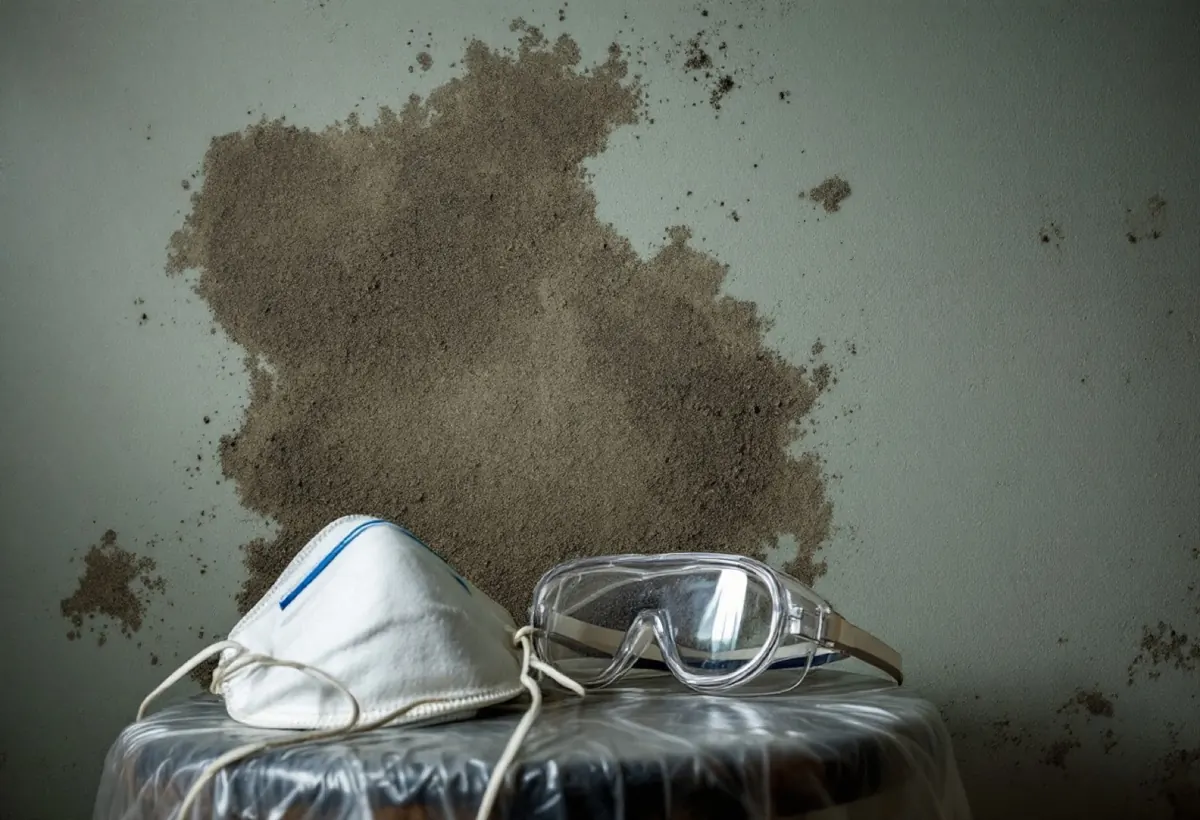
29 CFR 1910.134 binds employers. EPA's home mold guide says OSHA requires fit testing “in an occupational setting”, and the CDC disaster cleanup guidance tells someone at home to make sure the respirator fits properly, “even if not fit-tested”, by following the package instructions. The split between required and voluntary use decides almost everything else.
| Who is wearing it | Governing text | Fit test | Medical evaluation | Written program |
|---|---|---|---|---|
| Homeowner cleaning their own house | Not an employer duty. EPA and CDC advise following the package instructions. | Not required | Not required | Not required |
| Employee choosing an N95 voluntarily | 1910.134(c)(2)(i) and the exception in (c)(2)(ii) | Not required | Not required | Exempt; the employer hands over Appendix D |
| Employee choosing a half-face voluntarily | 1910.134(c)(2)(ii) | Not required | Required: employer ensures the user is medically able | Required for medical, cleaning and storage elements |
| Employee required to wear any respirator | 1910.134(a)(2), (c)(1), (e)(1), (f)(2) | Before first use, on any facepiece change, and at least annually | Before fit test or use | Required, with annual training |
For contractors
OSHA bulletin SHIB 03-10-10 says workers using respirators under 29 CFR 1910.134 must be trained, medically cleared and fit tested, with a written program, and 1910.134(c)(4) puts respirators, training and medical evaluations at no cost to the employee. Quantitative fit testing must reach a fit factor of 100 on a half facepiece and 500 on a full facepiece under (f)(7), and qualitative testing is limited to a fit factor of 100 or less under (f)(6), so a full-face program relying on APF 50 needs quantitative testing.
No exposure limit exists to calculate against. The OSHA bulletin says “there are no federal standards or recommendations” for airborne mold, so the maximum use concentration in 1910.134(b) falls back on “informed professional judgment”. Write that reasoning into the program, and check state licensing rules on our state mold licensing page.
Check the building material too. If the moldy surface might contain asbestos, 29 CFR 1926.1101(h)(3) bans filtering facepieces outright on an employer’s job, and our respirator for asbestos removal page has the class-by-class rule. Related size and method questions are indexed on the mold hub.
Questions people actually ask
Is an N95 enough for black mold?
EPA’s Table 2 goes by area, not color, so a patch under 10 square feet still reads as N-95 Minimum. EPA does call for a more cautious approach when a particularly toxic species is identified or suspected, which pushes the choice up a level. Color alone does not identify species, as our black mold comparison explains.
Can you reuse an N95 after a mold cleanup?
NIOSH says to replace an N95 when the straps stretch out, it no longer fits snugly, or it becomes wet, dirty or damaged, and not to wash it or heat it. EPA’s PPE guidance names no reuse count for mold work. A mask carrying mold dust after demolition is dirty on that NIOSH test, so throw it in the trash.
Can a child wear an N95 during mold cleanup?
No. CDC’s disaster cleanup page states NIOSH-approved respirators are not designed for children, and FDA says a proper fit cannot be achieved on children. NIOSH also lists a product marketed as an approved respirator for kids as misrepresented, since it does not approve filtering facepieces for children. Keep children out of the work area instead.
Do you need an N95 just to inspect mold?
EPA’s guidance says you may wish to use PPE while investigating as well as during cleanup, and lists the minimum as an N-95 respirator, gloves and eye protection. Chapter 3 ties that to disturbing mold: “Consider using PPE when disturbing mold.” EPA also warns removal of wallpaper “can lead to a massive release of spores” from mold on its underside, so wear it before pulling anything back.
Can you wear glasses with an N95 for mold work?
Yes, but watch for the warning sign. NIOSH says glasses that fog when you breathe out mean the mask is not snug, and it lists glasses among the items that can cause gaps. In workplaces, 29 CFR 1910.134(g)(1)(ii) requires glasses or goggles to be worn without interfering with the seal of the facepiece.
Sources
- EPA Table 2, Mold Remediation Guidelines, from Mold Remediation in Schools and Commercial Buildings (EPA 402-K-01-001), United States Environmental Protection Agency, page updated 14 April 2026. Retrieved 2 November 2026.
- EPA Chapter 3, Investigating, Evaluating and Remediating Moisture and Mold Problems, EPA, page updated 29 April 2026. Retrieved 2 November 2026.
- EPA's home mold guide, A Brief Guide to Mold, Moisture and Your Home, EPA, page updated 18 February 2026. Retrieved 2 November 2026.
- OSHA bulletin SHIB 03-10-10, A Brief Guide to Mold in the Workplace, Occupational Safety and Health Administration, updated 8 November 2013. Retrieved 2 November 2026.
- 29 CFR 1910.134, Respiratory Protection, including Table 1 and Appendices B-1 and D, via Cornell LII. Retrieved 2 November 2026.
- 42 CFR 84.170 and 42 CFR 84.174, Approval of Respiratory Protective Devices, via Cornell LII. Retrieved 2 November 2026.
- CDC disaster cleanup guidance, CDC, reviewed 26 August 2026. Retrieved 2 November 2026.
- NIOSH N95 instructions, How to Use Your N95 Respirator, reviewed 12 March 2025. Retrieved 2 November 2026.
- NIOSH approval guidance, reviewed 21 January 2025; NIOSH Certified Equipment List. Retrieved 2 November 2026.
- NIOSH counterfeit list and NIOSH misrepresented products page, reviewed February 2025. Retrieved 2 November 2026.
- FDA comparison page, N95 Respirators, Surgical Masks, Face Masks, and Barrier Face Coverings, Food and Drug Administration. Retrieved 2 November 2026.
- Cho and colleagues (2010), Large Particle Penetration through N95 Respirator Filters and Facepiece Leaks with Cyclic Flow, Annals of Occupational Hygiene 54(1), pages 68 to 77. Retrieved 2 November 2026.
- NIOSH Grant 2 R01 OH 04085 final report, Respiratory Protection Against Bioaerosols in Agriculture, University of Cincinnati, grant period 2008 to 2011. Retrieved 2 November 2026.
- The matrix is our compilation of the sources above. Our methodology sets out the standing rules.
This page reads published guidance and regulations; it reports no testing of its own. Health questions are out of scope here: EPA’s mold pages and CDC are the places to start.