The short answer
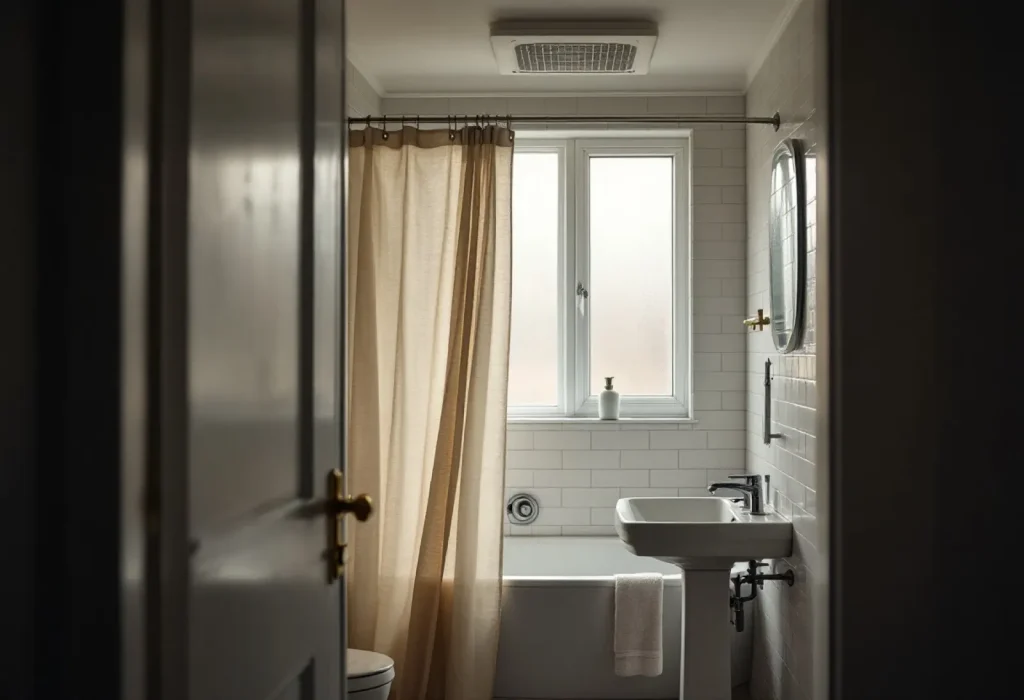
Mold in bathroom spaces is a moisture problem first and a cleaning problem second. Find the surface growing it, then the water feeding it: shower steam, splash or a leak. The model code floor, per the DOE Building America Solution Center, is a 50 cfm intermittent or 20 cfm continuous fan vented outdoors. Clean surface growth; open the wall when it returns within weeks or the floor goes soft.
Key takeaways
- Timing separates the sources: growth wet only after showers is condensation; growth damp through a dry spell is a leak.
- Home Ventilating Institute sizing is 1 cfm per square foot up to 100 sq ft, then 50 cfm per toilet, shower or tub and 100 cfm per jetted tub.
- Run time advice splits: HVI says 20 minutes, DOE says one hour. On our model a 10 by 12 ft bath on a 50 cfm fan still holds about 40% of the moisture excess at 20 minutes, per the HVI run time.
- Washington’s adopted IRC caps a 50 cfm fan on 4 inch flex duct at 25 feet and does not permit 4 inch flex on an 80 cfm fan.
- EPA's Brief Guide to Mold, Moisture and Your Home sets indoor humidity below 60%, ideally 30 to 50%.
- Homeowners forms such as the NJM HO-3 exclude repeated seepage and condensation over weeks, months or years unless hidden and unknown.
What this page does not cover. Health effects of mold are outside our scope; see CDC's mold page and the EPA mold pages, or ask a clinician. Fan wiring and plumbing repairs are other trades.
On this page
A bathroom is six or seven surfaces sharing one air volume and one fan, and the surface that grows mold first tells you what is wrong with the room. This page reads the room; the surface pages on our mold hub do the scrubbing.
Which surface is it on? The room map
| Where it is | Usual source | First check | Go to |
|---|---|---|---|
| Grout and caulk in the shower | Daily water and soap film | Wipes off tile, stays in the joint? | mold in shower |
| Ceiling, densest over the tub | Condensation or attic venting | Even, striped or ringed pattern? | mold on a bathroom ceiling |
| Vanity floor and back panel | Supply, trap or faucet drip | Damp with the taps off? | mold under the sink |
| Curtain or liner hem | Water held in folds | Bottom few inches worst? | shower curtain mold |
| Tank, rim or toilet base | Standing water, sweat or seal | Floor soft at the base? | black mold in the toilet |
| Wall beside the shower | Steam, or water behind tile | Damp on a day nobody showered? | water behind tile |
| Fan grille and housing | Duct condensation draining back | Holds a tissue? | mold on a bathroom ceiling |
What you are looking at in a bathroom
Two of the commonest bathroom stains are not fungi. A damp white cloth, a flashlight held flat to the surface and a dry day sort most of them.
| What you see | Most likely | Quick check |
|---|---|---|
| Pink or orange slime on tub, shower floor or toilet rim | Serratia marcescens, a bacterium, per NDSU Extension | Smears off; returns in wet corners |
| Black or green specks on paint, caulk or grout | Surface mold | Raised, fuzzy, smears on a damp cloth |
| White gritty crust | Mineral or soap scum | Will not smear; dissolves in an acid cleaner |
| Straight grey lines at joist spacing | Ghosting at framing | Flat and dry; see the ceiling page |
| Brown ring with a hard edge | Water from above or behind | Damp after a dry spell |
NDSU Extension says the pink film feeds on soap residue in tubs, showers and toilets and comes off with a chlorine bleach cleanser. Black is only a colour; either way, fix the water, then clean or remove the material.
Which water is feeding it
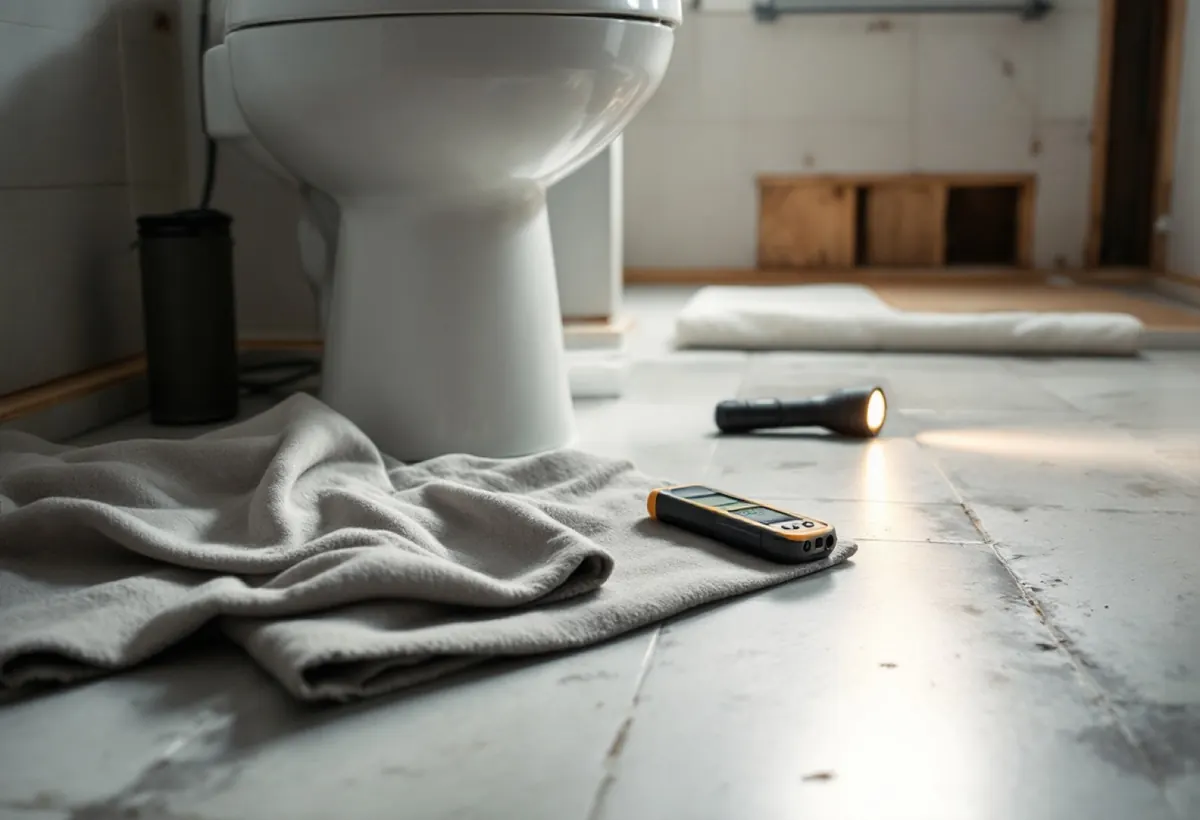
Steam and splash are tied to showers; a leak is not. Leave the room unused for a day or two with the door open, then look again.
| Source | Pattern | Timing | Fix |
|---|---|---|---|
| Shower steam | Even speckle on the coldest surfaces | Wet after showers, dries in hours | Fan airflow and run time |
| Splash | Tub edge, threshold, curtain hem, toilet base | Wet during use | Squeegee, door or curtain fit, caulk |
| Supply or drain leak | Hard-edged ring, swelling, wall-bottom peel | Damp through a dry spell | Plumbing first |
| Water behind tile | Hollow tile, cracked tub-to-floor joint | Never fully dries | Open and dry; see water behind tile |
| Toilet seal or tank sweat | Dark or soft floor at the base | Constant or seasonal | Seal or tank work |
EPA's Brief Guide to Mold, Moisture and Your Home says recurring bathroom mold is usually prevented by running a fan or opening a window and cleaning more often. That holds for the first row only; ventilation will not touch a leak.
The exhaust code floor for a bathroom
The DOE Building America Solution Center fan guide gives the IRC 2021 and ASHRAE 62.2 requirement as 50 cfm intermittent or 20 cfm continuous, discharged outdoors at least 10 feet from a mechanical air inlet or 3 feet from a gravity inlet. ICC’s own reader refused our fetch, so the table quotes Washington’s adopted code as one primary example.
| Requirement | What it says | Where written |
|---|---|---|
| Rate | 50 cfm intermittent or 20 cfm continuous | Table M1505.4.4.1, WAC 51-51-1505 |
| Delivered airflow | Rates mean airflow as installed; tested unless the duct meets the prescriptive table | M1505.4.4.2, WAC 51-51-1505 |
| Controls | Manual on and off, or occupancy, humidity, timer or pollutant sensor | M1505.4.4.1, WAC 51-51-1505 |
| Extra elbows | Minus 10 ft of allowed length per elbow beyond three | Table M1505.4.4.2, WAC 51-51-1505 |
| Sound | ENERGY STAR: 1 sone continuous, 3 sones intermittent | DOE Building America Solution Center fan guide |
| Duct route | First 3 ft straight; an elbow at the outlet can significantly cut airflow | DOE Building America Solution Center fan guide |
The duct table explains why a correctly rated fan can still fail. Per Washington’s table, a 50 cfm fan on 4 inch flex is good for 25 feet, against 70 feet of smooth duct, and an 80 cfm fan on 4 inch smooth only 20 feet.
Apartments, hotels and commercial restrooms
| Space | Intermittent | Continuous | Per |
|---|---|---|---|
| Public toilet room | 70 cfm | 50 cfm | water closet or urinal |
| Hotel or dormitory private bath | 50 cfm | 25 cfm | room |
| Shower room | 50 cfm | 20 cfm | showerhead |
| Dwelling unit bathroom | 50 cfm | 20 cfm | bathroom |
Sizing the fan: three methods, three answers
Code sets a floor, not a fit. The Home Ventilating Institute recommends 1 cfm per square foot up to 100 sq ft, about eight air changes an hour, and above that 50 cfm per toilet, shower and tub plus 100 cfm per jetted tub. Broan-NuTone's sizing help page uses volume: length times width times height times 0.13, rounded up to the next ten.
Both land near the eight air changes per hour that Shair and colleagues, ASHRAE Journal, 1979 suggested for bathroom moisture control: 0.13 cfm per cubic foot is 7.8 an hour, HVI’s rate in an 8 foot room 7.5. They part on ceiling height, which only Broan’s method counts.
| Bathroom | Code floor | HVI | Broan |
|---|---|---|---|
| 5 by 8 ft, 8 ft ceiling | 50 cfm | 40 cfm (floor governs) | 50 cfm |
| 10 by 8 ft, 9 ft ceiling | 50 cfm | 80 cfm | 100 cfm |
| Over 100 sq ft: toilet, shower, tub | 50 cfm | 150 cfm | Not used |
| Same, jetted tub | 50 cfm | 200 cfm | Not used |
HVI also says to undercut the door so make-up air can enter; a fan behind a tight door is starved.
How fast the steam actually leaves
Home Ventilating Institute says run the fan 20 minutes after use; the DOE Building America Solution Center fan guide says one hour. The chart runs the standard well-mixed dilution equation on the worked rooms: arithmetic, not a measurement.
| Room and delivered airflow | Air changes per hour | Left at 20 min | Left at 60 min |
|---|---|---|---|
| 5 by 8 ft hall bath, 50 cfm | 9.4 | 4% | 0% |
| Same room, only 25 cfm delivered | 4.7 | 21% | 1% |
| 10 by 12 ft primary bath, 50 cfm | 2.8 | 40% | 6% |
| Same primary bath, 150 cfm | 8.3 | 6% | 0% |
Per the model, a 5 by 8 ft bath with a working 50 cfm fan is nearly clear at HVI’s 20 minutes, about 4% left. A 10 by 12 ft bath on the same fan holds about 40% at 20 minutes and 6% at an hour, per the same arithmetic: big bathrooms with one small fan grow mold farthest from the grille.
Measured data agrees. In a 2022 SINTEF and NMBU master's thesis, the field bathroom at 36 cubic metres an hour, about 21 cfm, logged 15 minutes of mould-favourable conditions in a week; the one at 54, about 32 cfm, logged none.
Bathroom mold prevention: humidity targets and the meter test
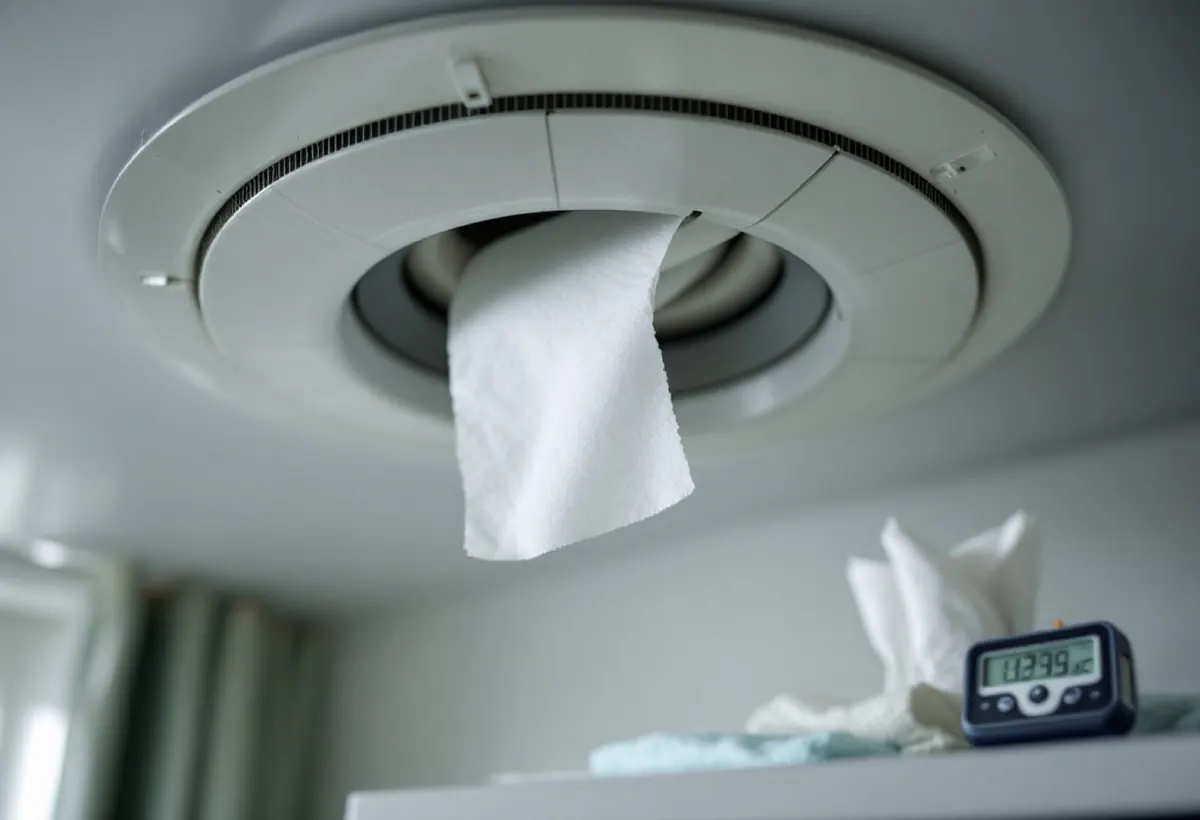
EPA prices a humidity meter at about $10 to $50. Every bathroom spikes during a shower; what counts is the fall. Note the reading before the shower, run the fan, read again at 20 and 60 minutes. Still well above EPA’s 60% at the hour with the fan on and the door undercut? The fan, duct or termination is the problem. Hold a tissue to the grille first, as the DOE Building America Solution Center fan guide suggests.
How to get rid of mold in a bathroom, in room order
For area limits and protective gear, see DIY mold remediation. This is the sequence specific to this room.
- Fix the air first. Why this differs: a bathroom refills with moisture daily, so cleaning first just resets the clock.
- Rule out a leak. Why this differs: condensation and leaks sit side by side here, and cleaning over a leak hides the evidence a plumber or adjuster needs.
- Clean top down. Ceiling, walls, fixtures, floor. Why this differs: the ceiling is often the largest patch; see mold on a bathroom ceiling.
- Treat joints and soft goods separately. Why this differs: caulk, grout and curtains are often cheaper to replace than clean; see mold in shower and shower curtain mold.
- Mind the chemistry. CDC's mold page says no more than 1 cup of household laundry bleach in 1 gallon of water for hard surfaces, never mixed with ammonia or other cleaners. Why this differs: a small closed room concentrates fumes.
- Do not paint or caulk over it. EPA’s Brief Guide says paint over mold is likely to peel. Why this differs: mold-resistant bathroom paint is the usual shortcut.
Black mold in bathroom walls, and other signs it is bigger
Black mold low on a bathroom wall, beside the tub or behind the toilet, is usually the visible end of a wet assembly. These triggers mean open it up rather than clean again.
| Trigger | Usually means | Next step |
|---|---|---|
| Back within weeks after the fan is proven | Water the fan cannot reach | Moisture readings, plumbing check |
| Hollow or cracked tile, cracked tub-to-floor joint | Water behind the tile | water behind tile |
| Soft floor at toilet or tub | Wet or decayed subfloor | Pull toilet or baseboard, probe |
| Peeling paint on the far side of a shower wall | Wet wall cavity | Open from the dry side |
| Stain on the ceiling below | Drain, supply or pan leak | Open the ceiling below first |
| Musty smell, every surface dry | Hidden growth | Inspection |
| Over about 10 square feet | EPA’s professional-help threshold | DIY mold remediation |
CDC's mold page advises against carpet in bathrooms at all.
The bathroom decision path
- Find the surface in the room map; take a dated photo.
- Leave the room unused a day or two. Still damp: leak. Plumbing first, then step 7.
- Dry between showers: hold a tissue to the grille. No pull means fan, duct or termination.
- Pulls but recovers slowly: compare the fan to HVI sizing.
- Sized and pulling: read the meter at 20 and 60 minutes; check duct length and the door gap.
- Air fixed: clean each surface by its own page, top down.
- Any escalation trigger: open the assembly or call a remediation contractor.
For contractors: scope, documentation and policy wording
ANSI/IICRC S520, Fourth Edition, 2024, sets mold remediation procedures. A bathroom job is small in area and heavy in documentation, because the cause decides who pays.
| Record | What | Why the adjuster asks |
|---|---|---|
| Source | Readings against a dry reference; dry-spell result | Sudden leak and long-term seepage differ |
| Exhaust | Rating, duct size, length, elbows, termination | A failed fan is maintenance; an upgrade may be code work |
| Duration | Dated photos, stain layers, owner’s timeline | Wording turns on weeks, months or years |
| Concealment | Inside wall, under floor or above ceiling | Hidden and unknown damage is carved back in |
The NJM New Jersey HO-3 (03/18) form, one published example, excludes constant or repeated seepage or leakage, or condensation of humidity, moisture or vapor, over weeks, months or years, unless unknown to all insureds and hidden within walls, ceilings or floors. The same form adds fungi, wet or dry rot, or bacteria coverage of up to $25,000, per the form’s wording including tear-out to reach growth. Forms differ; send owners to their policy, their state insurance department and a licensed professional.
Questions people actually ask
Is mold in the bathroom normal?
Small spots on grout, caulk or a ceiling corner are common because a bathroom gets wet daily. Per EPA’s Brief Guide, recurring bathroom mold usually means the room needs more ventilation and more frequent cleaning. Growth that returns after the fan is fixed, or sits low on a wall, points to a leak instead.
How do I get rid of mold in my bathroom permanently?
Remove the water, not just the stain. Prove the fan pulls with a tissue, size it to HVI’s 1 cfm per square foot, run it 20 to 60 minutes after showers, and rule out leaks with a dry-spell test. Then clean each surface by its own method, top down, and never paint over growth.
What size exhaust fan does a bathroom need?
The IRC floor, as summarised by DOE, is 50 cfm intermittent or 20 cfm continuous. HVI recommends 1 cfm per square foot up to 100 sq ft, and above that 50 cfm per toilet, shower or tub plus 100 cfm per jetted tub. Broan-NuTone multiplies room volume by 0.13.
How long should a bathroom fan run after a shower?
HVI recommends 20 minutes; DOE’s Building America Solution Center says one hour on a timer. On this page’s well-mixed model, 20 minutes clears a small bath with a working 50 cfm fan, but a large bath on the same fan still holds a big share of its moisture. Let a humidity meter decide.
Can a bathroom exhaust fan cause mold?
A fan venting into the attic or soffit, or a cold uninsulated duct, moves the moisture instead of removing it, and condensation can drain back to the grille. DOE’s guide and Washington’s adopted IRC require discharge outdoors. Mold on the grille usually means the duct needs checking from the attic.
What should I do about black mold in a bathroom wall?
If it sits on the paint and wipes off, clean it and fix the ventilation. If it is low beside the tub or toilet, returns within weeks, or comes with loose tile, peeling paint or a soft floor, treat it as a wet wall: find the water, check the cavity and remove wet drywall rather than cleaning it.
Sources
- DOE Building America Solution Center fan guide, U.S. Department of Energy: IRC 2021 and ASHRAE 62.2 rates, outlets, run time, sone limits, ducts. Retrieved 31 October 2026.
- WAC 51-51-1505, Washington State Legislature, adopted IRC Section M1505. Retrieved 31 October 2026.
- WAC 51-52-0403, Washington State Legislature, adopted IMC Section 403. Retrieved 31 October 2026.
- Home Ventilating Institute, Bathroom Ventilation, undated. Retrieved 31 October 2026.
- Broan-NuTone's sizing help page, Broan-NuTone. Retrieved 31 October 2026.
- Shair and colleagues, ASHRAE Journal, 1979: Shair, Wolbrink, Bowen, Neelley and Sampsel, ASHRAE Journal 21(7), abstract via AIVC. Retrieved 31 October 2026.
- a 2022 SINTEF and NMBU master's thesis: Johnstad, Aurlien and Holøs, NMBU, abstract in Norwegian. Retrieved 31 October 2026.
- EPA's Brief Guide to Mold, Moisture and Your Home, U.S. EPA, updated 18 February 2026. Retrieved 31 October 2026.
- CDC's mold page, CDC, dated 26 September 2024. Retrieved 31 October 2026.
- NDSU Extension, NDSU Extension release, 9 August 2010. Retrieved 31 October 2026.
- NJM New Jersey HO-3 (03/18) form, New Jersey Manufacturers Insurance Company. Retrieved 31 October 2026.
- ANSI/IICRC S520, IICRC standard page. Retrieved 31 October 2026.
- Decay figures are our arithmetic, not bathroom measurements. Our methodology sets out the standing rules.
Codes are adopted and amended locally. Confirm the edition with your building department before specifying a fan.