The short answer
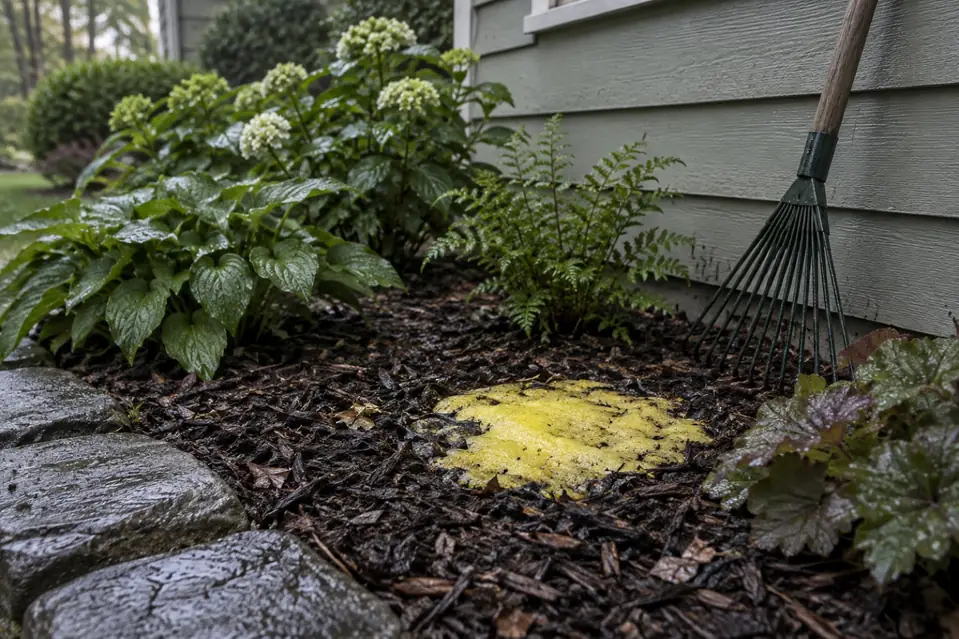
Yellow mold is not one organism. On mulch or soil it is usually a slime mold, which is harmless to the building. On damp timber or brick it can be Serpula lacrymans, the dry rot fungus, which destroys wood. Indoors it may be yellow-green Aspergillus. Probe the wood and read its moisture content before you clean anything.
Key takeaways
- What the yellow sits on decides most cases: mulch and soil point to slime mold, timber against damp masonry to dry rot.
- Historic Scotland’s TAN 24 records that Serpula lacrymans turns lemon yellow when stressed, then brown and grey as it dies.
- According to the FPL Wood Handbook, wood at or below 20% moisture content is safe from fungal damage; serious decay needs wood above about 30%.
- Sound wood lifts as a splinter; decayed wood breaks off abruptly, per the Federal Highway Administration probing guidance.
- Slime mold is scooped, surface mold is cleaned, and dry rot is a moisture repair plus new timber. None of them is a spray job.
- The ISO HO 00 03 sample form hosted by the Insurance Information Institute lists dry rot among its Coverage A exclusions and treats mold, fungus or wet rot separately.
On this page
Search results file a garden curiosity, a decay fungus and a household mold under one colour. Confusing them costs money both ways: remediating a slime mold that would have dried up, or bleaching a sill plate being digested from inside.
What you are looking at: five yellows
The USDA Forest Products Laboratory Wood Handbook, chapter 14 says mold on wood shows as fuzzy or powdery growth in which green and yellowish hues are common, that fresh decay fungus growth is usually white or brown but may be strikingly yellow or orange, and that sapwood stains sometimes run to yellow. Colour cannot separate cosmetic from structural. Texture, substrate and behaviour can.

| What you see | Texture and behaviour | Most likely |
|---|---|---|
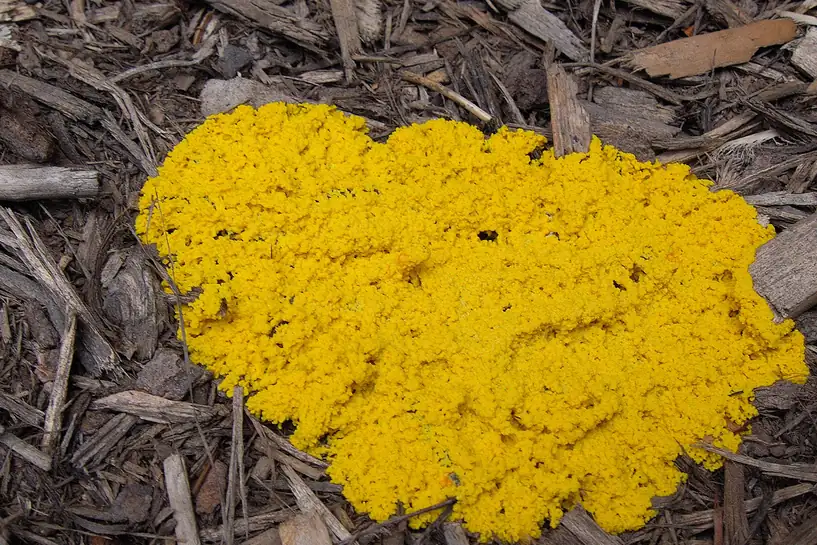
| Bright yellow foam on mulch, appeared overnight | Wet and spongy; dries to a crust, then dark dust | Fuligo septica slime mold |
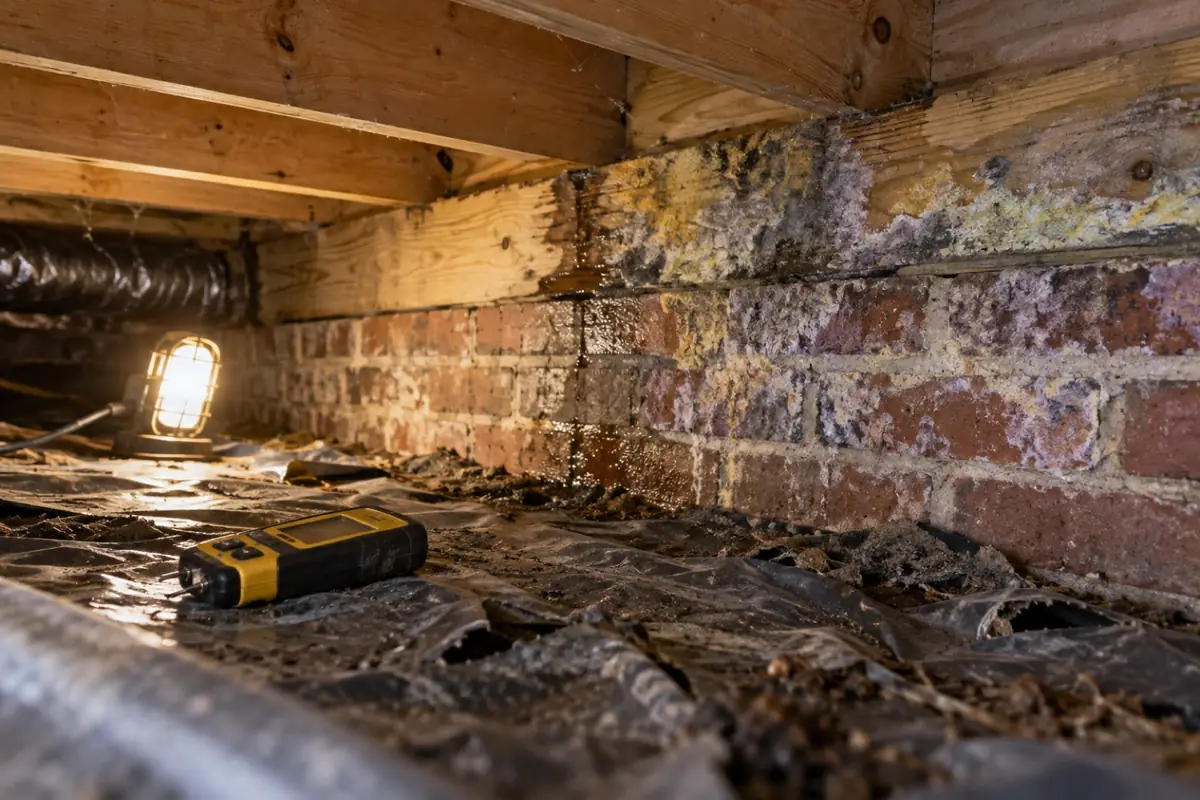
| Grey felt with lemon yellow and lilac patches on timber | Flat sheets; strands cross brick and plaster | Serpula lacrymans dry rot |
| Yellow or orange fan of threads on a joist | Fan or root-like strands pressed to the wood | Fresh decay fungus growth |
| Yellow-green to olive powder | Dry and dusty; colour comes from spores | Aspergillus or similar surface mold |
| Even yellow tint inside sapwood | No raised growth; will not brush off | Fungal or chemical stain |
Also check for foam: BASF’s ENERTITE G data sheet says cured open-cell spray foam is yellow or off white (see mold in insulation).
The yellow growth matrix
One question sets the budget: is it eating the structure?
| Yellow growth | Organism | Structural? | Action |
|---|---|---|---|
| Foam on mulch or soil | Fuligo septica slime mold | No | Scoop, bag, dry the bed |
| Foam on a deck board or post | Slime mold using wood as a perch | Not itself; the wet wood needs checking | Scoop, then probe and meter |
| Grey skin, lemon yellow patches, timber or brick | Serpula lacrymans dry rot | Yes, brown rot | Stop the water, open up, cut out decayed timber |
| Lemon yellow turning brown and grey | Serpula under stress or dying | Damage done; activity may be ending | Confirm the source is dry, assess what remains |
| Yellow or orange fan on a joist | Decay fungus | Yes, if wood is above fibre saturation | Probe, meter, fix leak, replace weak wood |
| Yellow-green powder on drywall or framing | Aspergillus or similar | No; the wet material may be | Clean or remove; fix moisture |
| Yellow tint inside sapwood | Stain | Only slightly, per the FPL | Leave or plane it |
Only the two decay rows are a structural yes, which is why the probe and the meter below beat any photo comparison. For the neighbouring colours see green mold and orange mold.
Yellow slime mold on mulch and wood
Ohio State University Extension calls Fuligo septica one of the largest slime molds, conspicuous for its intense yellow, and most often found on bark mulch. It is not a true fungus: Ohio State classes slime molds as amoeba-like protists whose feeding stage oozes over surfaces eating bacteria, fungal spores and organic particles, then hardens into a spore crust that releases dark dust.
Ohio State says it is not toxic or dangerous to humans, animals or plants, and Iowa State University Extension says it typically dries into a white powdery mass within a few days. Washington State University Extension advises scooping it into a bag, because hosing it spreads the spores, and then drying the bed.
Yellow slime mold on wood
On a fence post or deck board, slime mold is using the wood as a surface, not food. The board has still been wet long enough to host it, so scrape it off and run the probe test below. Decking has its own page: mold on deck.
Serpula lacrymans: the yellow that eats buildings
The Historic Scotland Technical Advice Note 24, The Environmental Control of Dry Rot (2002), names Serpula lacrymans as by far the most important dry rot fungus in buildings and urges the Latin name because ‘dry rot’ is used loosely. It lists a rusty red fruit body, strands brittle when dry, and white or grey mycelium with pink or lemon tinges.
The yellow carries information. TAN 24 says the fluffy white growth seen in laboratories is soon tinged salmon pink, lilac or lemon yellow in buildings, that yellowing is a stress defence showing conditions are no longer optimal, and that colour moves from lemon yellow to brown and grey as stress rises. It warns colour alone is not a dependable field test.

Why masonry matters
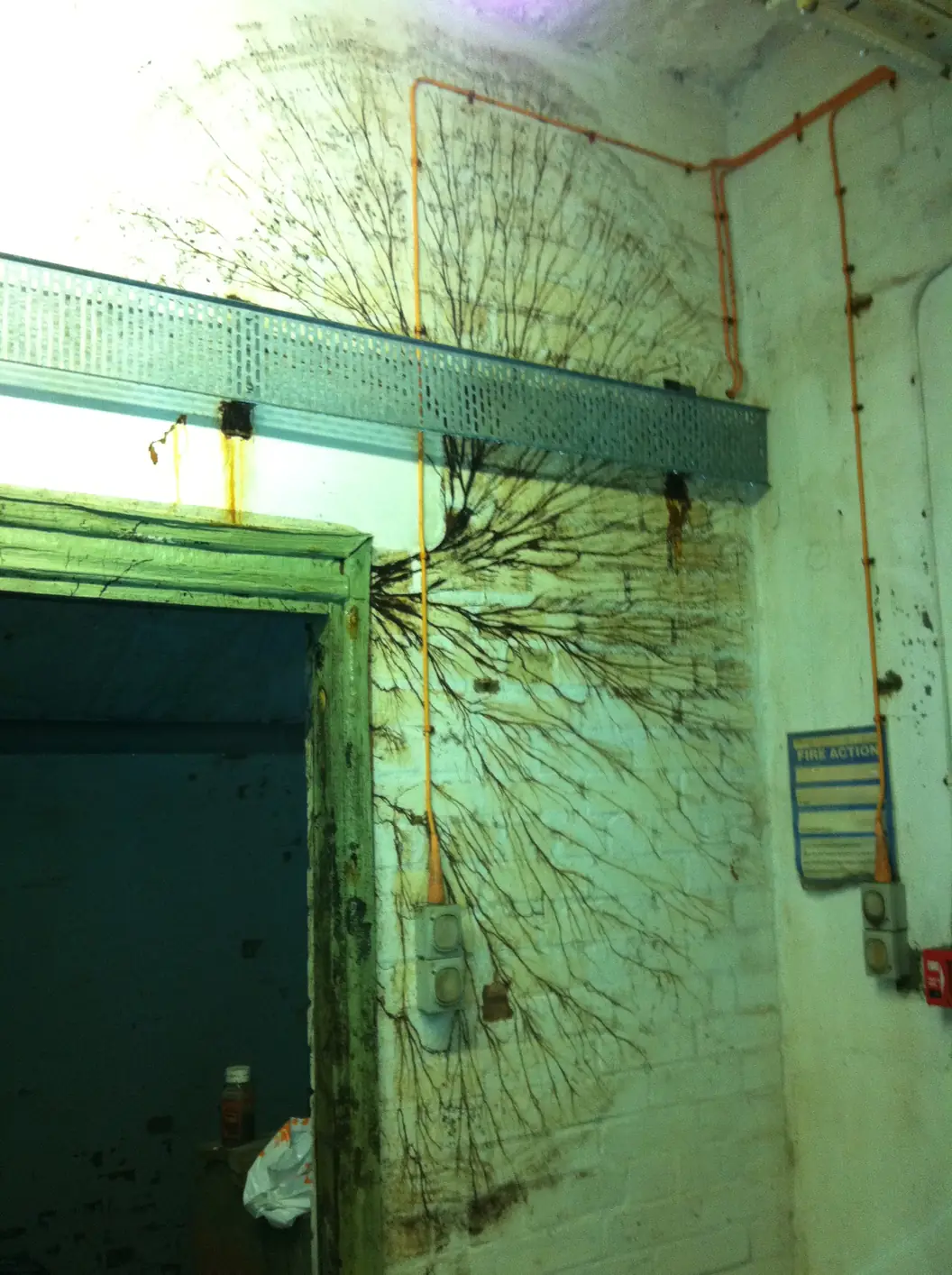
The USDA Forest Products Laboratory Wood Handbook, chapter 14 explains that some brown rot fungi form water-conducting strands that carry water, usually from soil, into wood that would otherwise be dry, which is why it calls the name dry rot incorrect. TAN 24 adds that Serpula needs metal ions from masonry as well as wood, so it grows luxuriantly where timber meets brick, stone or plaster.
| On the outbreak you see | TAN 24 Table 3 reading |
|---|---|
| Fluffy, like cotton wool | Certainly alive |
| Flat and grey, like thin sheets | Probably not actively growing |
| Dark yellow or brown | Dying or dead |
| Smells of mushrooms | At least part may be alive |
| No damp and no stagnant air nearby | Almost certainly not active |
For a scope, the key line is the British Wood Preserving and Damp-Proofing Association position TAN 24 quotes: finding and fixing the dampness, and drying it out, is the fundamental part of a successful treatment. TAN 24 also records that some firms cut back sound timber up to 1 metre beyond decay. The general mold, stain and decay tests for timber are on mold on wood.
Yellow-green Aspergillus and other surface molds
The Crop Protection Network and Purdue Extension bulletin BP-83-W describe Aspergillus flavus as an olive-green, powdery mold whose spores disperse like dust. The Wisconsin State Laboratory of Hygiene fungal glossary says it prefers water activity of 0.75 to 0.8 and has been recovered indoors from carpet and building materials: a mold of damp materials, not proof the wood beneath is decaying. Colour does not change the cleanup method, which lives on DIY mold remediation; naming the species rarely changes scope (see mold testing).
Yellow mold in a crawl space
The USDA Forest Products Laboratory Wood Handbook, chapter 14 says condensation can seriously decay crawl space framing, that its primary source is soil moisture, that a polyethylene barrier on the soil isolates it, and that joists need at least 18 inches of clearance for inspection. Three yellow patterns follow: foam on bare soil is slime mold; yellow-green powder across many joists is surface mold from humid air; a yellow fan or felt on one sill plate or rim joist bearing on damp masonry is the one to probe now. Method: crawl space mold remediation.
Surface mold or decay: the probe and the meter
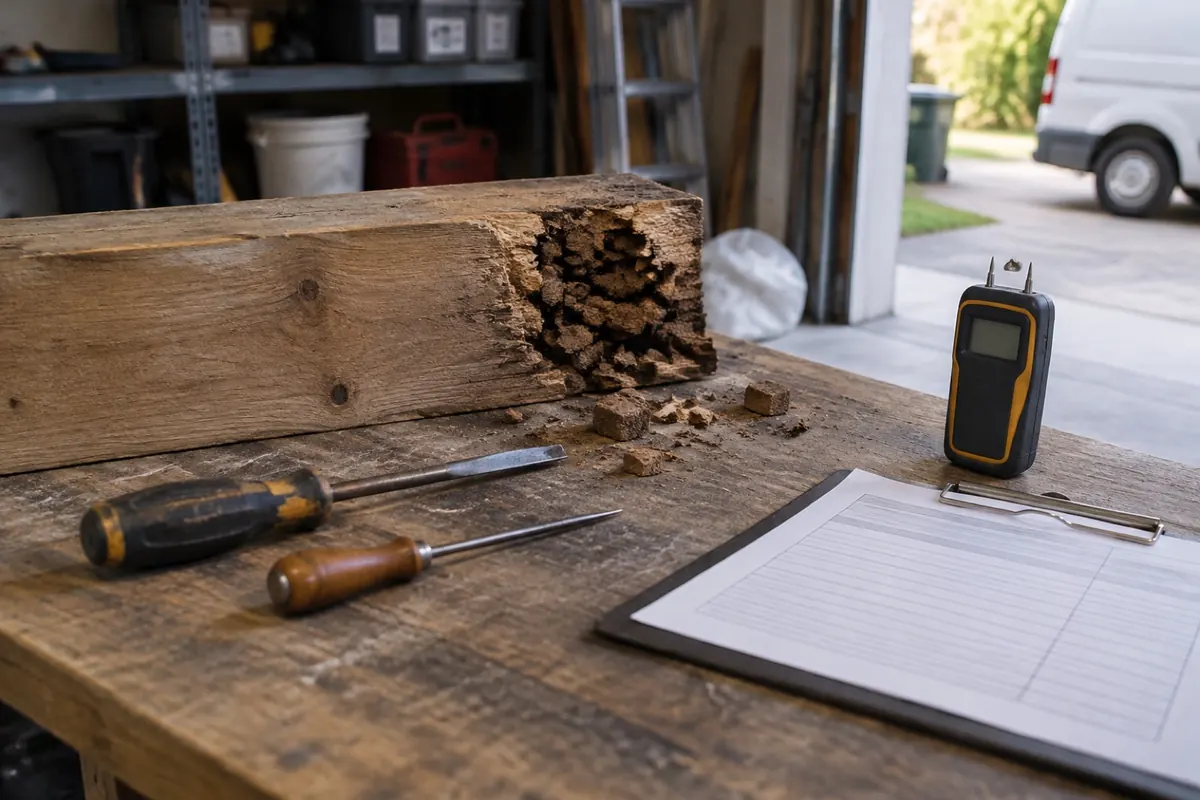
The Federal Highway Administration probing guidance describes probing with an awl, pocketknife or pick hammer: decayed wood is soft, resists less, and a lifted sliver breaks abruptly where sound wood splinters. A screwdriver gives the same signal. The limits: it finds near-surface decay, struggles on soft species like western red cedar, and water-softened wood can mimic decay.
Then meter it. A firm face proves little: according to the FPL Wood Handbook, lab toughness losses ran from 6% to more than 50% once decay had removed just 1% of the wood’s weight, a stage visible only under a microscope.
| Wood moisture content | Meaning | Per the source |
|---|---|---|
| At or below 20% | Safe margin; existing decay will not progress | FPL Wood Handbook |
| Above 20% | Timbers at risk from dry rot | TAN 24 Table 2 |
| Above about 30% | Serious decay possible | FPL Wood Handbook |
| Above 60% | Likely safe from dry rot, not other organisms | TAN 24 Table 2 |
| Humid air only | Not wet enough for decay; permits some mold | FPL Wood Handbook |
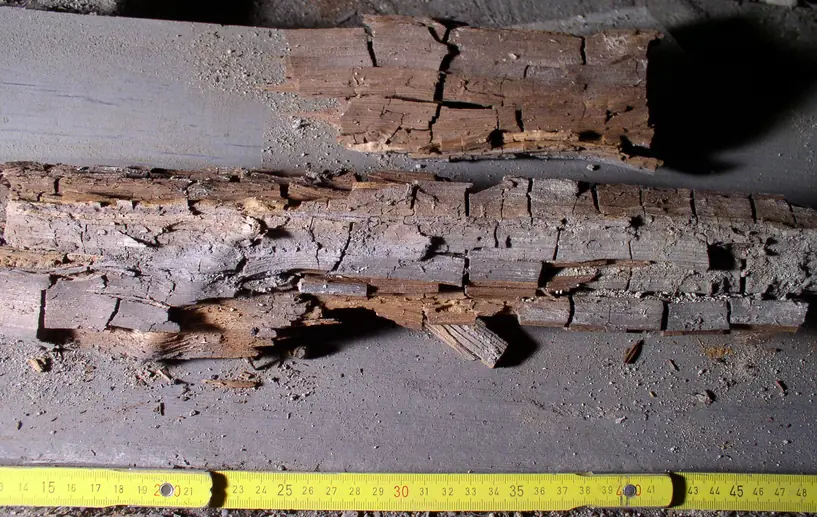

Inside, the FPL Wood Handbook says brown rot leaves wood browner and cracked across the grain into cubes, while white rot bleaches it and feels spongy. TAN 24 says all dry rot fungi cause brown rot.
The decision path, in six questions
Answer in order; cleaning first destroys the evidence.
- What is it on? Mulch, soil or lawn: slime mold. Scoop, dry, done, unless it is on wood.
- Foamy or powdery? Overnight foam is slime mold; dry powder that wipes off is surface mold; felt, skin or strands go to step 3.
- Does it cross masonry? Strands from timber onto brick or plaster are the Serpula pattern. Stop cleaning; get a structural assessment.
- Probe the wood. Splinter means sound. Abrupt break or soft point means decay.
- Meter it. Per the FPL, at or below 20% decay will not progress; above about 30% it can be serious. Find the water before pricing timber.
- Size it. EPA 402-K-01-001 treats surface mold under 10 square feet as a small job with minimum protective equipment and no containment. Decay in a bearing member is a structural repair at any size.
Removal, case by case
The reason column is the point: generic spray and scrub advice fails on two of these cases. Kill versus remove is covered on how to kill black mold; the chemistry does not change with colour.
| Case | What to do | Why this differs from generic advice |
|---|---|---|
| Slime mold on mulch | Scoop, bag, rake the bed dry | Hosing spreads spores, per WSU; it is not a fungus |
| Slime mold on wood | Scrape off, probe and meter | The board’s moisture is the real finding |
| Surface mold, small area | Fix moisture; scrub hard surfaces with detergent and water; dry | EPA says moldy porous materials may have to go |
| Surface mold on wood that probes sound | HEPA vacuum once dry, clean, hold below 20% | FPL: softwood surface growth often brushes off |
| Decay fan, wood soft | Stop leak, cut to sound wood, sister or replace | FPL: visible decay means greatly reduced strength |
| Serpula lacrymans | Remove water, ventilate, replace decayed timber, isolate new timber from damp masonry | TAN 24: ventilation quickly inactivates it once timber is off damp masonry |
Yellow mold on food
Food follows the USDA Food Safety and Inspection Service, by food type rather than colour: cut at least 1 inch around and below the spot on hard cheese and firm vegetables; discard soft cheese, bread, jams, nuts and peanut butter. Fridges are covered on mold in refrigerator.
When it is bigger than the visible spot
- Strands or sheets crossing brick, block, stone or plaster.
- A probe that sinks, or a sliver that snaps short, in a sill, rim joist, joist end or post base.
- Framing above about 30% moisture, or still above 20% after the source is fixed, per the FPL.
- A rusty red fruit body, a TAN 24 Serpula feature.
- A mushroom smell in a closed space (TAN 24 Table 3).
- Springy floors, cubical cracking, or regrowth after cleaning.
For contractors: scope, documentation, policy wording
Slime mold is a short service ticket; surface mold follows the EPA area guidance; decay is carpentry plus moisture correction, and documentation decides whether that invoice survives.
| Record | Capture | Why the adjuster asks |
|---|---|---|
| Identification | Substrate, strands, fruit body, photos | Justifies decay repair versus cleaning |
| Moisture map | Pin readings with a dry reference, RH, temperature | Shows the FPL lines and drying completion |
| Probe log | Member, tool, result | Separates cosmetic from strength loss |
| Water source | Leak, condensation, ground or masonry wicking | Policy wording turns on cause |
| Cut back extent | Measured to sound wood, photographed | Defends replaced linear feet |
The ISO HO 00 03 sample form hosted by the Insurance Information Institute lists ‘smog, rust or other corrosion, or dry rot’ among Coverage A exclusions and separately excludes ‘mold, fungus or wet rot’, except where hidden within walls, ceilings or floors and caused by an accidental discharge of water from plumbing, heating, cooling or an appliance. That is sample ISO wording; the customer’s own policy, their state insurance department and a licensed professional decide what a claim pays.
Questions people actually ask
Is yellow mold dangerous?
It depends which yellow. Ohio State University Extension says yellow slime mold on mulch is not toxic or dangerous to people, animals or plants. Serpula lacrymans dry rot is dangerous to the building because it destroys timber. Yellow-green Aspergillus is a household mold handled by normal EPA cleanup rules.
What is the yellow foam growing in my mulch?
Almost certainly Fuligo septica, the dog vomit or scrambled egg slime mold. It feeds on bacteria in the mulch, not on plants or the house. Iowa State Extension says it usually dries to a white powdery mass within days. Scoop it into a bag; Washington State Extension says hosing spreads the spores.
What does yellow mold on wood mean?
It is surface mold, slime mold resting on the board, or a decay fungus; the Forest Products Laboratory notes fresh decay growth can be strikingly yellow. Probe it: a splinter means sound wood, an abrupt break means decay. Above about 30% moisture, according to the FPL, serious decay is possible.
Is yellow mold the same as dry rot?
Sometimes. Serpula lacrymans shows lemon yellow tinges when stressed, according to Historic Scotland’s Technical Advice Note 24, alongside grey skin, lilac patches and strands crossing masonry. Yellow growth without strands, on wood that probes sound, is more likely surface mold.
Why is there yellow mold in my crawl space?
The Forest Products Laboratory says soil moisture is the primary source of crawl space condensation. Foam on soil is slime mold, yellow-green powder on many joists is surface mold, and a yellow fan on one sill or rim joist near masonry should be probed for decay first.
How do I get rid of yellow mold for good?
Remove the water. Dry the bed for slime mold, keep indoor humidity below the EPA’s 60 percent ceiling for surface mold, and for decay fix the leak, cut back to sound wood and keep framing at or below the 20% moisture content the Forest Products Laboratory treats as a safe margin.
What this page does not cover. Buildings and identification only, no health advice: see the health information linked from EPA's mold cleanup page and ask a doctor. Termite and other pest damage to wood belongs to our sister site thepestcontrolbrief.com.
Sources
- USDA Forest Products Laboratory Wood Handbook, chapter 14: Arango, Lebow and Glaeser, Biodeterioration of Wood, FPL-GTR-282, USDA Forest Service, 2021. Retrieved 30 October 2026.
- Historic Scotland Technical Advice Note 24: Palfreyman, Low and Urquhart, The Environmental Control of Dry Rot, Historic Scotland, 2002. Retrieved 30 October 2026.
- Ohio State University Extension: Erik Draper, Buckeye Yard and Garden onLine, 13 July 2023. Retrieved 30 October 2026.
- Washington State University Extension: Stevens County, Dog vomit slime mold, undated. Retrieved 30 October 2026.
- Iowa State University Extension: Yard and Garden FAQ, updated 3 December 2024. Retrieved 30 October 2026.
- Crop Protection Network: Aspergillus Ear Rot of Corn, undated. Retrieved 30 October 2026.
- Purdue Extension bulletin BP-83-W: Aspergillus Ear Rot, Purdue Extension. Retrieved 30 October 2026.
- Wisconsin State Laboratory of Hygiene fungal glossary, University of Wisconsin, undated. Retrieved 30 October 2026.
- Federal Highway Administration probing guidance: Bridge: Probing, FHWA InfoTechnology, undated. Retrieved 30 October 2026.
- EPA 402-K-01-001: Mold Remediation in Schools and Commercial Buildings, September 2008. Retrieved 30 October 2026.
- EPA's mold cleanup page, updated 4 June 2026, and EPA's brief guide to mold and moisture, updated 18 February 2026, US EPA. Retrieved 30 October 2026.
- USDA Food Safety and Inspection Service: Molds on Food: Are They Dangerous? Live page refused automated access; read via the Internet Archive copy of 4 October 2026, on 30 October 2026.
- ISO HO 00 03 sample form hosted by the Insurance Information Institute: HO 00 03 10 00, Section I exclusions. Retrieved 30 October 2026.
- BASF, ENERTITE G technical data sheet. Retrieved 30 October 2026.
- Photographs: Wikimedia Commons, credited in each caption, licences read on each file page. See our methodology.
Identification from appearance is provisional; a laboratory or qualified surveyor can confirm a decay fungus.
More in our mold hub.