The short answer
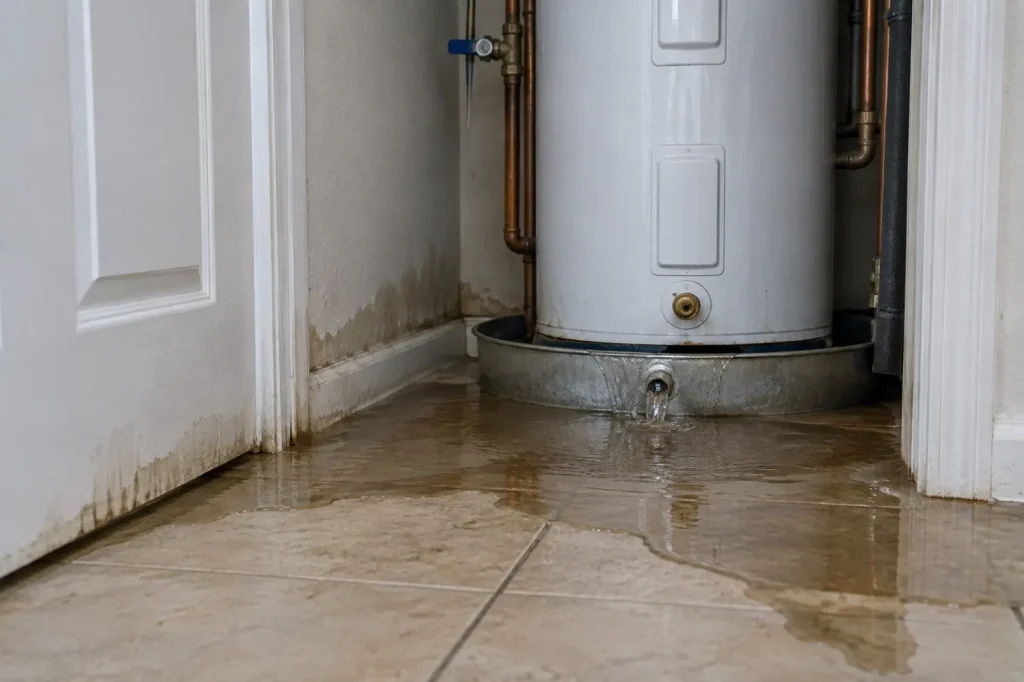
Water heater leak damage is capped by two valves. Close the cold water supply valve at the heater and turn off its gas or power, and the loss stops at the tank, about 36 to 50 gallons. Left open, a three-quarter inch supply can add roughly 660 gallons an hour. Then extract, check every wall touching the heater space, and dry to measured readings.
Key takeaways
- IRC Section P2903.9.2 requires a full-open valve on the cold supply at or near every water heater. It is the most important valve in this event.
- A nominal 40 gallon tank often holds 35 to 36 gallons, per DOE. The supply line, not the tank, makes a flood.
- The code pan is sized for dripping. A 24 inch, 1.5 inch deep pan fills in under a minute at the flows in IRC Table P2903.8.1.
- An attic heater is the worst case: the water goes down through insulation, drywall and light fixtures into finished rooms.
- HO-3 style wording separates resulting water damage from the heater itself and excludes leakage repeated over 14 days or more.
- Published lifespans cluster between 10 and 15 years; IBHS study facts say leak risk rises sharply from year 5.
On this page
The first ten minutes after a water heater leak
Repair belongs to a plumber. This order protects people, caps volume, keeps evidence.
| Step | Why |
|---|---|
| 1. Gas smell? Leave first | NFPA: if you smell gas, do not light the appliance; leave and call 9-1-1 and the gas company. |
| 2. Electric heater or wet outlets nearby: breaker off from dry ground | ESFi: never touch a breaker or fuse with wet hands or standing on a wet surface. |
| 3. Close the cold supply valve at the heater | Required at or near the heater by IRC P2903.9.2. Stops refill, so the loss is capped at the tank contents. |
| 4. Gas heater: gas control to off | The plumber relights or replaces. |
| 5. Valve seized? Use the main shutoff | The house main does the same job. |
| 6. Photograph before moving anything | The pan, the valve, the label and the wet area are claim evidence. |
What you are looking at: relief, drip, seep or rupture
Each look-alike sets a different scope. The relief valve case confuses people most: under IRC Section P2804.6.1 its discharge pipe must end no more than 6 inches above the floor or pan and at a point readily observable by occupants.
| What you see | What it usually means | Scope signal |
|---|---|---|
| Water traced to the end of the relief valve pipe | The relief valve opened. Code routes it to the floor or pan, readily observable, so it is visible by design. | Not a tank failure; plumber finds why it opened. |
| Pan wet, tank base dry, drip from a top fitting | Connection or valve leak above the tank. | Slow; ask how long it has run (the 14-day clause). |
| Water from under the jacket, rust at the base | Tank shell failure. It only gets worse. | Heater replacement; shutoff stays closed. |
| Drip at the drain valve near the bottom | The drain valve every tank must have. | Small volume. |
| Fast spreading water, hissing | Rupture or failed supply connector. | Close the valve now. |
| Damp baseboard in the next room, dry closet | Water ran under the bottom plate, or a hidden supply line leak. | Moisture-map both sides of every wall. |
How much water a leaking water heater releases
The tank is smaller than its label. The DOE 2024 water heater final rule found many nominal 40 gallon products rated at 35 to 36 gallons, because manufacturers may report a nominal volume within 10 percent of actual storage. The tank is a fixed volume; the cold supply is not.
For supply flow, the code gives two reference points. IRC Table P2903.1 requires a hose bibb outlet to deliver at least 5 gallons per minute. IRC Table P2903.8.1, the manifold sizing table, puts the maximum for a 3/4 inch line at 11 gpm in metal and 17 gpm in plastic, based on velocity limits of 8 and 12 feet per second. That is 300 to 1020 gallons an hour, before the tank’s own contents.
| Scenario | Gallons | Weight or flow |
|---|---|---|
| Tank only, nominal 40 gallon | 35 to 36 | about 300 lb |
| Tank only, nominal 50 gallon | up to 50 | about 417 lb |
| 50 gallon tank plus a supply at hose bibb flow, 1 hour | 350 | 5 gpm |
| 50 gallon tank plus a 3/4 inch metal line at its limit, 1 hour | 710 | 11 gpm |
| 50 gallon tank plus a 3/4 inch plastic line at its limit, 1 hour | 1,070 | 17 gpm |
With the valve closed it is a spill; with it open and nobody home, it is a flood.
Location decides the damage pattern
The IBHS State of the Risk: Interior Water Damage report, December 2024, names water heaters on upper floors or in attics as a driver of interior water loss and says location alone can make a failure worse.
| Heater location | Damage pattern | Priority actions |
|---|---|---|
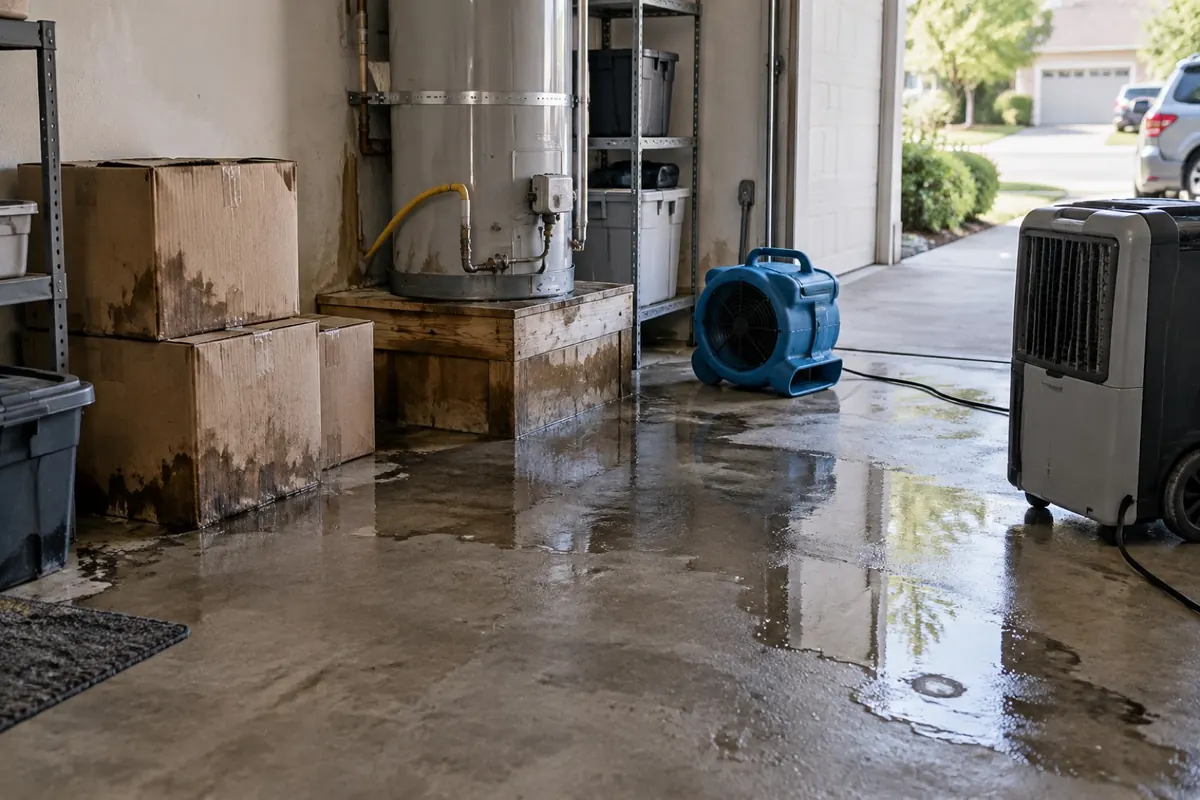
| Garage, on slab | Fans across the slab and out the door; wicks into the shared house wall and stored cardboard. | Extract, lift contents, check the shared wall’s bottom plate. |
| Interior closet or utility room on slab | Runs under bottom plates into two or three rooms; carpet pad and tack strip soak along the wall line. | Pull baseboards, read both faces of every closet wall, lift pad in adjacent rooms. |
| Closet on a wood floor, upper floor or over a crawl space | Goes through the subfloor into the ceiling or crawl space below. | Subfloor and joist readings, ceiling below, crawl space vapor barrier. |
| Basement | Pools at the lowest point and stays; finished walls, carpet and contents take it. | Extract, cut finished walls to readings, lift contents. |
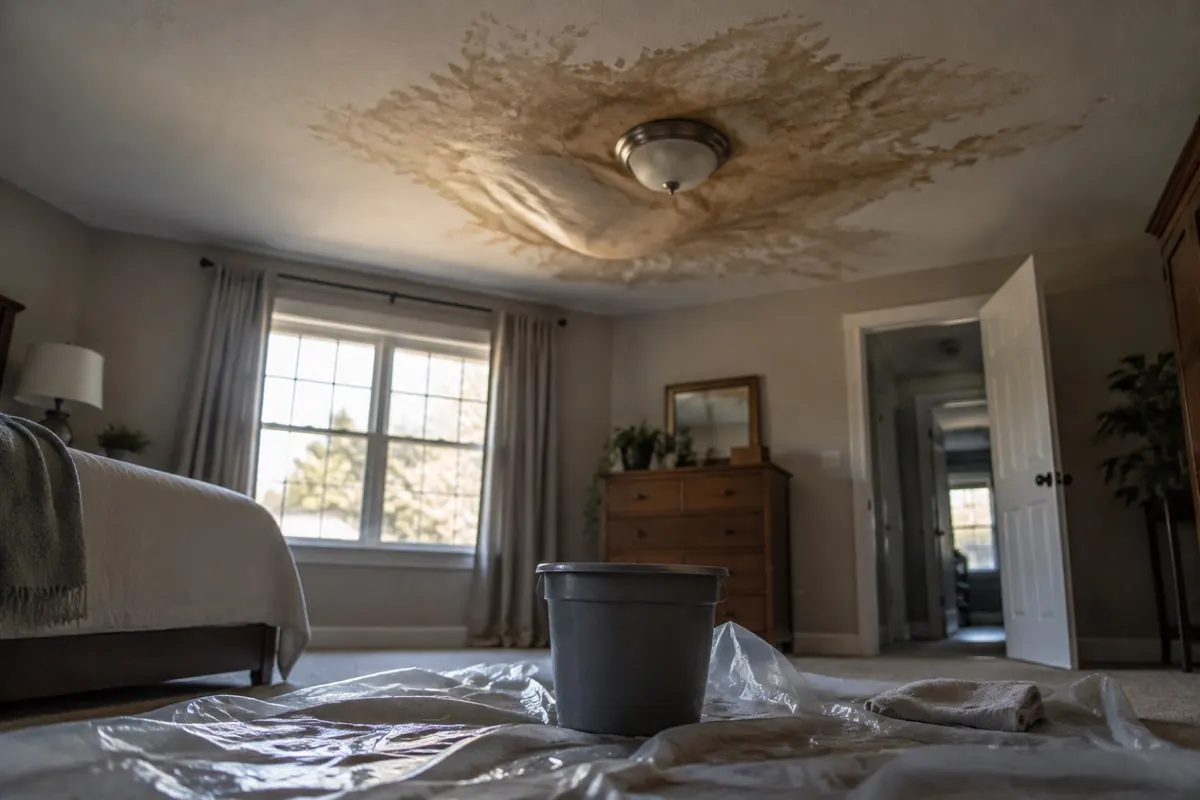
| Attic | Worst case. Water drops through insulation and drywall into finished rooms and light fixtures, with 417 lb of tank water on the framing. | Power off to ceiling circuits, remove wet insulation, open the ceiling below, check framing. |
Two notes. IRC Section P2801.7 requires a gas heater’s ignition source to sit at least 18 inches above a garage floor unless it is listed as flammable vapor ignition resistant, so garage heaters often stand on a platform that hides a wet base. Water coming through a ceiling light is an electrical problem first; see water in a light fixture. Wall and floor assemblies are covered on water damage in walls and subfloor water damage.
Drain pans, leak detection and what the code requires
IRC Section P2801.6 and IPC Section 504.7 use the same trigger: a storage tank installed where leakage will cause damage must sit in a pan. The DOE Building America water heater checklist adds that the heater sits on blocks within the pan. Note the size language: the pan must receive dripping or condensate. It is a drip catcher.
| Provision | IRC P2801.6 to P2801.6.2 | IPC 504.7 to 504.7.2 |
|---|---|---|
| When a pan is required | Where leakage from the tank will cause damage | Same trigger |
| Pan material | Galvanized steel or aluminum at least 0.0236 inch, plastic at least 0.036 inch, or approved | Same metals and plastic thickness |
| Plastic under a gas heater | Allowed if flame spread index 25 or less and smoke-developed 450 or less | Not allowed |
| Depth and drain | At least 1.5 inches deep; 3/4 inch indirect waste | Same |
| Where the drain ends | Indirect waste receptor, or outdoors 6 to 24 inches above grade | Adds floor drain as an option |
| Replacement heaters | No pan drain required where none was installed before | Same exception |
An illustrative 24 by 24 inch pan at the 1.5 inch minimum holds about 3.7 gallons. At the IRC Table P2903.8.1 figure of 11 gpm it would fill in about 20 seconds.
The replacement exception explains why many older heaters have a pan with no drain. The pan sections quoted here do not require a leak detector or automatic shutoff; those are optional, and only a closed valve stops a supply-side flood.
Tank age: when failure gets likely
The Connecticut Insurance Department pamphlet, reproducing IBHS study facts, says the chance of a leak or burst begins to increase dramatically at 5 years and that three in four water heaters fail before 12 years. The ENERGY STAR gas water heater fact sheet says to replace a heater over 10 years old before it fails. The ENERGY STAR 2009 water heater guide lists a 13 year average life for high-efficiency gas storage, and the DOE 2024 water heater final rule estimates an average lifetime of around 15 years for storage water heaters.
For the file, age frames the wear and tear question, so photograph the rating label.
Insurance: sudden failure versus gradual leak
We describe policy language, not what your policy pays. The USAA HO-3 special form on file with the Oklahoma Insurance Department is an example of HO-3 style wording; insurers’ forms differ.
| Clause in the example form | Treatment | Water heater reading |
|---|---|---|
| Constant or repeated seepage or leakage over 14 days or more, from a plumbing or heating system or household appliance | Excluded | A slow drip found late is the classic denial. |
| Wear and tear, deterioration; mechanical breakdown; rust or corrosion | Excluded as causes | Usually why the heater itself is not paid. |
| Resulting water damage from those causes, not otherwise excluded | Covered, including tear-out to repair the system | The floors, walls and ceilings the water reached. |
| The system or appliance the water escaped from | Not covered | The heater is a separate question from the damage. |
Read your own policy, then ask your state insurance department or a licensed professional. Our guide to homeowners insurance and water damage covers the general rules.
What the claims data shows, per the Triple-I
| Cause of loss, 2019 to 2023 | Claims per 100 house years | Average paid per claim |
|---|---|---|
| Water damage and freezing | 1.50 | $15,400 |
| Wind and hail | 2.80 | $14,747 |
| Fire and lightning | 0.23 | $88,170 |
| All property damage | 5.53 | $16,857 |
According to the IBHS State of the Risk: Interior Water Damage, the Insurance Information Institute estimates that one in every sixty homes with coverage filed an interior water damage claim between 2016 and 2020. Neither source breaks out water heaters; heater-specific averages that circulate online could not be traced to an original study and are left out.
Water heater flood cleanup and drying
The method for this event differs from a generic water loss in where the water sits and what holds it. The EPA moisture guide says to dry water-damaged areas within 24 to 48 hours to prevent mold growth.
| Step | Why this differs from generic advice |
|---|---|
| 1. Valve closed, fuel off | Generic advice says shut the main. The heater’s own valve caps the loss and keeps the house supplied. |
| 2. Extract the heater space first | Generic advice spreads effort. The water sits in a small closet against two or three walls. |
| 3. Read both faces of every wall touching the heater space | Generic advice checks the wet room. Water crosses under bottom plates into rooms that look dry. |
| 4. Coordinate removal with the plumber | Generic advice dries around fixtures. The floor under the tank stays wet until it is out. |
| 5. Set the category from the source and the clock | Supply water starts clean, but rust, sediment and time change what can be saved. |
| 6. Attic: insulation out, ceiling opened | Generic advice dries in place. Wet insulation holds water on the drywall. |
| 7. Dry to readings, not to touch | Close up only when materials match a dry reference. |
Category rules are on IICRC water categories, equipment and readings on structural drying, and the attic ceiling on water damage ceiling.
Escalation triggers: signs it is bigger than the closet
- Gas smell at any point: leave and call, per NFPA.
- The heater stood in water, for example in a basement flood. The CPSC flood warning says gas control valves on water heaters that have been under water cannot be salvaged and must be replaced.
- Water reached a ceiling below, a light fixture or the electrical panel.
- Flooring cups in an adjoining room, or wall readings stay high a day after extraction.
- A musty smell or staining shows the leak started long before discovery, which also raises the 14-day question.
For contractors: scope, documentation and the adjuster
The heater is the plumber’s line; the water is yours. Keep separate invoices, since the example form treats them differently. Record:
- The rating label (manufacture date, capacity) and a photo of the failure point.
- Pan present or not, drain present or not, and where it ends.
- Discovery time, how the leak was found, and when the valve was closed.
- A moisture map of the heater space and adjoining rooms, with the tear-out needed.
Out of scope. Heater repair, replacement and relighting belong to a plumber or gas technician. Nothing here states what any policy pays.
Questions people actually ask
Does homeowners insurance cover water heater leak damage?
It depends on your policy and the cause. HO-3 style wording, such as the USAA form on file in Oklahoma, covers resulting water damage from some sudden failures, including tear-out to repair the system, but not the heater, and excludes leakage repeated over 14 days or more. Your insurer and state insurance department decide your claim.
What should I do first if my water heater is leaking on the floor?
If you smell gas, leave and call. Otherwise close the cold supply valve at the heater, which the IRC requires at or near every heater, and turn off the gas control or the breaker from dry ground. Photograph the pan, valve and wet area, then extract the water and check the walls around the heater.
How much water can a leaking water heater release?
The tank holds its rated volume, often 35 to 36 gallons for a nominal 40, per DOE. With the supply open, according to IRC reference flows of 11 to 17 gallons per minute for a three-quarter inch line, add roughly 660 to 1,020 gallons an hour. Closing the cold supply valve stops that.
Is a water heater pan required?
Under IRC P2801.6 and IPC 504.7, yes, where leakage from the tank will cause damage. The pan must be at least 1.5 inches deep with a three-quarter inch drain to an indirect waste receptor or outdoors. A replacement heater does not need a pan drain where none existed before. Local codes vary.
How long do water heaters last before they leak?
Published figures range from 10 to 15 years. ENERGY STAR advises replacing a heater older than 10 years before it fails, DOE estimates an average lifetime of around 15 years, and IBHS study facts say three in four fail before 12 years, with risk rising from year 5.
Is water heater leak water clean?
It starts as clean supply water, but tank sediment, rust and time change that. Water that sits on carpet, pad or framing for days is handled at a higher category. The EPA says to dry wet materials within 24 to 48 hours to prevent mold growth.
Sources
- IRC Section P2801.6, IRC Section P2801.7, IRC Section P2804.6.1 and IRC P2801.2 (IRC Chapter 28), 2018 IRC as adopted in Pennsylvania, via UpCodes. Retrieved 30 October 2026.
- IRC Section P2903.9.2, IRC Table P2903.1 and IRC Table P2903.8.1, 2018 IRC Chapter 29, same edition. Retrieved 30 October 2026.
- IPC Section 504.7, 2018 IPC as adopted in Pennsylvania, via UpCodes. Retrieved 30 October 2026.
- DOE 2024 water heater final rule, consumer water heater standards, RIN 1904-AD91, 2024. Retrieved 30 October 2026.
- ENERGY STAR 2009 water heater guide and ENERGY STAR gas water heater fact sheet (February 2018), U.S. EPA and DOE. Retrieved 30 October 2026.
- Connecticut Insurance Department pamphlet, IBHS study facts, undated. Retrieved 30 October 2026.
- IBHS State of the Risk: Interior Water Damage, December 2024. Retrieved 30 October 2026.
- USAA HO-3 special form on file with the Oklahoma Insurance Department, HO-3R(02) (07-08), as example language. Retrieved 30 October 2026.
- Triple-I homeowners facts and statistics, ISO data 2019 to 2023. Retrieved 30 October 2026.
- USGS water density table, U.S. Geological Survey. Retrieved 30 October 2026.
- NFPA Educational Messages Desk Reference, NFPA, 2026 edition, item 10.6.3. Retrieved 30 October 2026.
- CPSC flood warning, CPSC, 6 March 1997. Retrieved 30 October 2026.
- ESFi, “Flood Electrical Safety”, via the 21 October 2026 Internet Archive snapshot. Retrieved 30 October 2026.
- DOE Building America water heater checklist, U.S. DOE and PNNL. Retrieved 30 October 2026.
- EPA moisture guide, EPA, updated 18 February 2026. Retrieved 30 October 2026.
- Volumes, weights and fill times are our arithmetic. See our methodology and the water hub.
Published codes, data and policy language only. Your local code edition and your policy wording govern.