The short answer
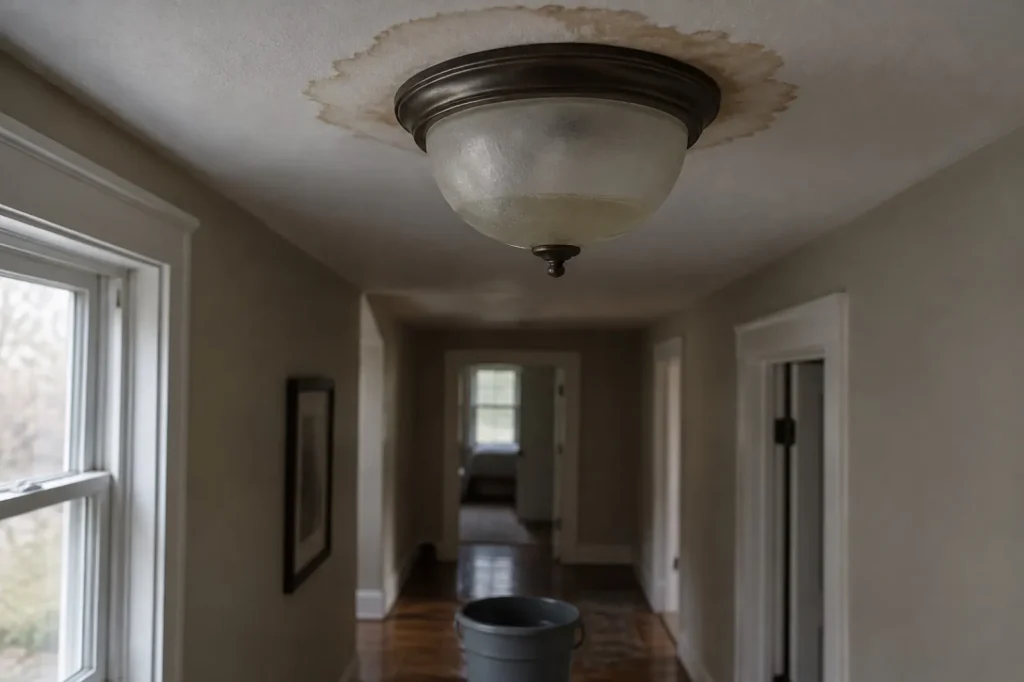
Water in light fixture housings is an electrical emergency before it is a leak. Switch the circuit off at the breaker, not the wall switch, with dry hands and dry feet. Put a bucket under the drip, do not touch the fixture, stop the source above, and keep the power off until an electrician has checked the box, cable and fixture.
Key takeaways
- The wall switch is not a shutoff. Only the breaker de-energizes the box the water is sitting in.
- The ceiling box is the first hole water finds, so the light drips while the ceiling around it can look dry.
- NEMA CS 70006-2026 lists lighting equipment, wiring devices, GFCIs, AFCIs and dry-location cable such as NM-B as items to replace after water exposure.
- NEMA says not to air dry or wash GFCIs and AFCIs.
- Timing names the source: rain, roof; showers, bathroom above; hot afternoons, AC condensate; cold mornings, attic condensation.
- A damp or wet location marking is an environment rating, not a leak rating.
On this page
The first five minutes: power, then water
Most pages start with the leak. Start with the power. FEMA's Ready.gov flood page says do not touch electrical equipment if it is wet or if you are standing in water, and turn off the electricity to prevent shock if it is safe to do so. A wall switch breaks one conductor; the cable feeding the box can stay live.
| Step | Why, per the guidance |
|---|---|
| 1. Do not touch the fixture, switch or water | ESFi: never touch equipment that has been submerged, as it may still be energized. |
| 2. Breaker off, from dry ground | ESFi: do not touch a breaker or replace a fuse with wet hands or while standing on a wet surface. |
| 3. Unsure which breaker? Use the main | ESFi’s shutdown order: each branch breaker, then the main. |
| 4. Bucket under the drip; tape the breaker | Protects the floor and stops someone switching it back on. |
| 5. Stop the water above | Shutoff valve for plumbing, AC off for a condensate overflow, roofer for rain. |
| 6. Leave the power off | ESFi: keep it off until an electrician has inspected the system. |
What you are looking at in and around the fixture
How the water presents tells you how far it travelled and how long it has been going on. For stains and sag on the open ceiling, see our guide to early signs of water damage on a ceiling.
| What you see | What it usually means |
|---|---|
| Water pooled in a closed glass bowl | Water came through the box and canopy and has passed the wiring compartment. |
| Drips from the canopy edge | Water is running down the box or ceiling hole; the wet area above is wider than the drip. |
| Brown halo around the canopy | Repeated or prolonged wetting carried staining to the edge of the wet area. |
| Rust on the canopy, screws or a recessed trim | Corrosion of metal parts, a reason NEMA gives for flooded lighting not operating safely. |
| Droplets on a bath fan light, worse after showers | Condensation returning down an exhaust duct, not a pipe leak. |
| Soft or sagging drywall around a recessed can | Saturated gypsum around a large cut hole; keep people out from under it. |
| Flicker, buzz or a tripping breaker | Water bridging live parts or a ground fault. Power off, electrician now. |
One look-alike: mist on a bathroom fixture’s glass after a shower, with nothing in the bowl, is room humidity. Water that collects or drips is a leak or a duct fault.
Why the fixture is where the water shows up
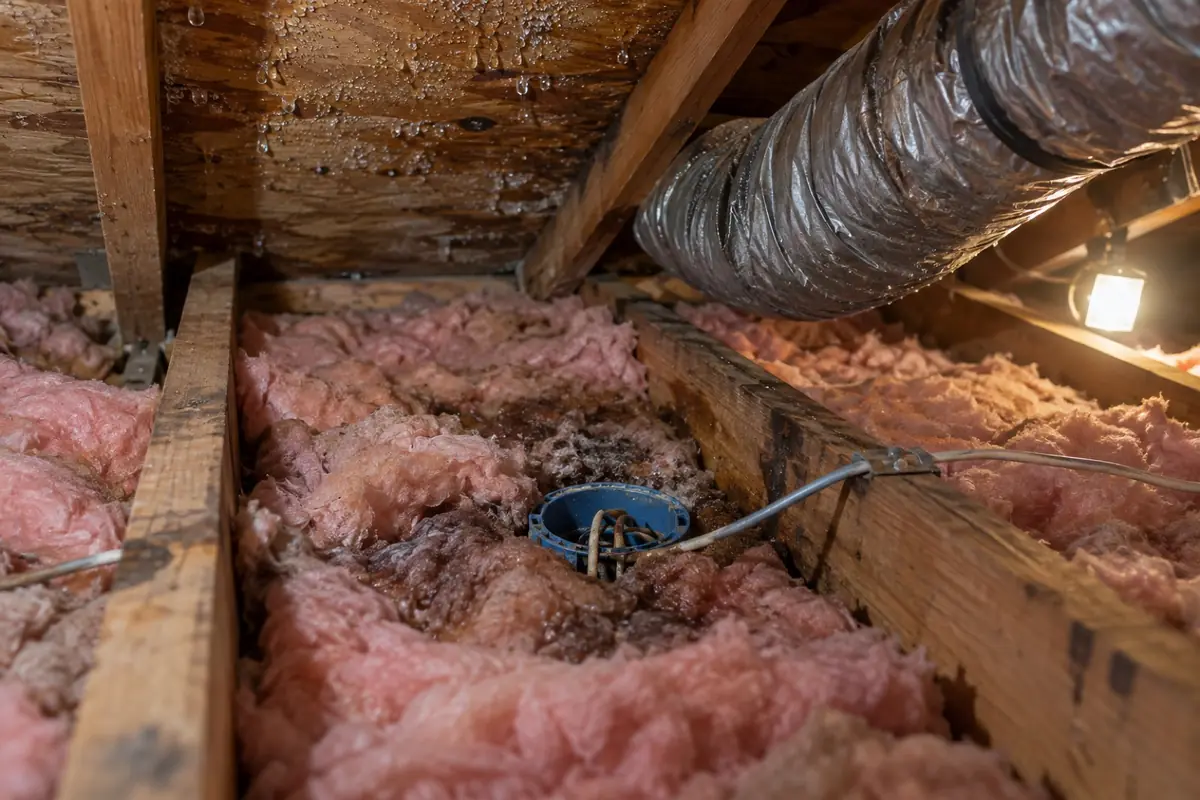
Water escaping above a ceiling lands on the back of the drywall and follows the board, a joist or a cable sheath sideways. It leaves at the first hole: the electrical box or, in a bathroom, the fan housing.
The cable acts as a wick and the box as a funnel. That is the hazard IRC Section E4003.9 is written against: fixtures in wet or damp locations must be installed so water cannot enter or accumulate in wiring compartments, lampholders or other electrical parts. Recessed cans also take water around the rim, and the board around their cut hole is the weakest part of a wet ceiling; see our water damage ceiling page.
Four routes water takes to a ceiling light
Each source has a timing signature. Write down when the drip happens before anyone cuts the ceiling; it is the cheapest clue there is, and adjusters ask for it.
| Route | When it drips | Trade that fixes it |
|---|---|---|
| Bathroom or plumbing above | Showers, flushing, a filling tub, or constant | Plumber |
| Roof or attic leak | During or hours after rain | Roofer |
| AC condensate overflow | Cooling season, long run times | HVAC technician |
| Attic condensation or bath fan duct | Cold mornings, or right after showers | HVAC or insulation contractor |
Bathroom and plumbing above
The Connecticut Insurance Department pamphlet, reproducing IBHS study facts, reports toilet water damage of $2,000 to $10,000 per incident, 78% of it from faulty supply lines, flanges, fill valves or overflows, and faulty shower pans in more than half of shower stall incidents. A drip only during showers points to the pan or drain.
Roof and attic leaks
The same Connecticut Insurance Department pamphlet says roof leaks were the most frequent source of water damage in the IBHS study, and the IBHS State of the Risk: Interior Water Damage (December 2024) describes ice dam meltwater entering attics through roof deck seams in older homes. The roof itself is a roofer’s job.
AC condensate overflow
IRC Section M1411.3.1 requires an auxiliary drain pan or secondary drain under each cooling coil where an overflow would damage the building, with the pan at least 1.5 inches deep and 3 inches larger than the unit, or a water-level device that shuts the equipment off. A clogged drain over a missing or rusted pan reaches the light below.
Attic condensation and exhaust ducts
IRC Section M1501.1 says exhaust air shall not be discharged into an attic, soffit, ridge vent or crawl space. The DOE Building America bathroom fan guide says to slope the duct down and away from the fan and to insulate it to minimize condensation. A sagging duct drains into the housing. Mould on the sheathing is covered under signs of mold in the attic.
Can the fixture and wiring be reused? What NEMA says
The reference is NEMA CS 70006-2026, Evaluating Water-Damaged Electrical Equipment, formerly NEMA GD 1. It covers equipment exposed to water through flooding, firefighting and other events involving large quantities of water, says evaluation should be done by qualified personnel, and warns that equipment can be extremely hazardous if re-energized without a proper evaluation.
| NEMA item | NEMA call | In a wet ceiling light circuit | Reason given (section) |
|---|---|---|---|
| Lighting equipment | Replace | The fixture and LED module | Corrosion and contaminated circuitry (3.8.2) |
| Ballasts and LED drivers | Replace | Inside the fixture | Most rated damp and dry only; not for submersion |
| Wiring devices | Replace | Wall switch or dimmer, if wet | Sediment stays inside after drying (3.7) |
| AFCIs, GFCIs, GFPEs | Replace | Bathroom GFCI, AFCI breaker | Do not air dry or wash (3.7) |
| Molded-case circuit breakers | Replace | Branch breakers, if the panel got wet | Corrosion, particles, lost lubrication (3.1) |
| Cable listed for dry locations, such as NM-B | Replace | The cable feeding the box | Shock hazard when re-energized (3.6) |
| Cable suitable for wet locations | May be reconditioned | Rare in a house ceiling | Only if ends stayed dry and undamaged |
| Outlet and junction boxes | Reuse possible | The ceiling box | 3.5.1 recommends replacing boxes not listed for wet locations |
| Signaling and protection systems | Replace | Hardwired smoke alarm on the wet ceiling | Life safety reliability (3.8.4) |
| Motors | May be reconditioned | Ceiling fan motor | Qualified evaluation of insulation and capacitors |
For everything a ceiling light depends on, the answer is replacement. The box is the one judgment call, and the guide leans toward replacing it.
A 1997 CPSC flood warning says submerged breakers, GFCIs and fuses must be replaced because water and silt stop them working as safety devices; the 2023 CPSC flood release repeats it for wiring. A drip is not a flood, but a wet protective device cannot be trusted on looks.
Damp and wet ratings are not leak ratings
The IRC Chapter 35 definitions call a damp location one protected from weather and not subject to saturation, and a wet location one subject to saturation or exposed to weather. IRC Section E4003.11 requires fixtures inside a tub or shower footprint, up to 8 feet above the rim, to be marked for damp locations, or wet where subject to shower spray. Neither is a rating for water arriving through the box, and NEMA’s replace call has no carve-out for wet-rated fixtures; only submersible-listed lighting is excepted.
The method for a wet ceiling fixture, step by step
Each step notes how it differs from general water damage advice, because a light is the one spot in a wet ceiling where the generic sequence can hurt someone.
| Step | Why this differs from generic advice |
|---|---|
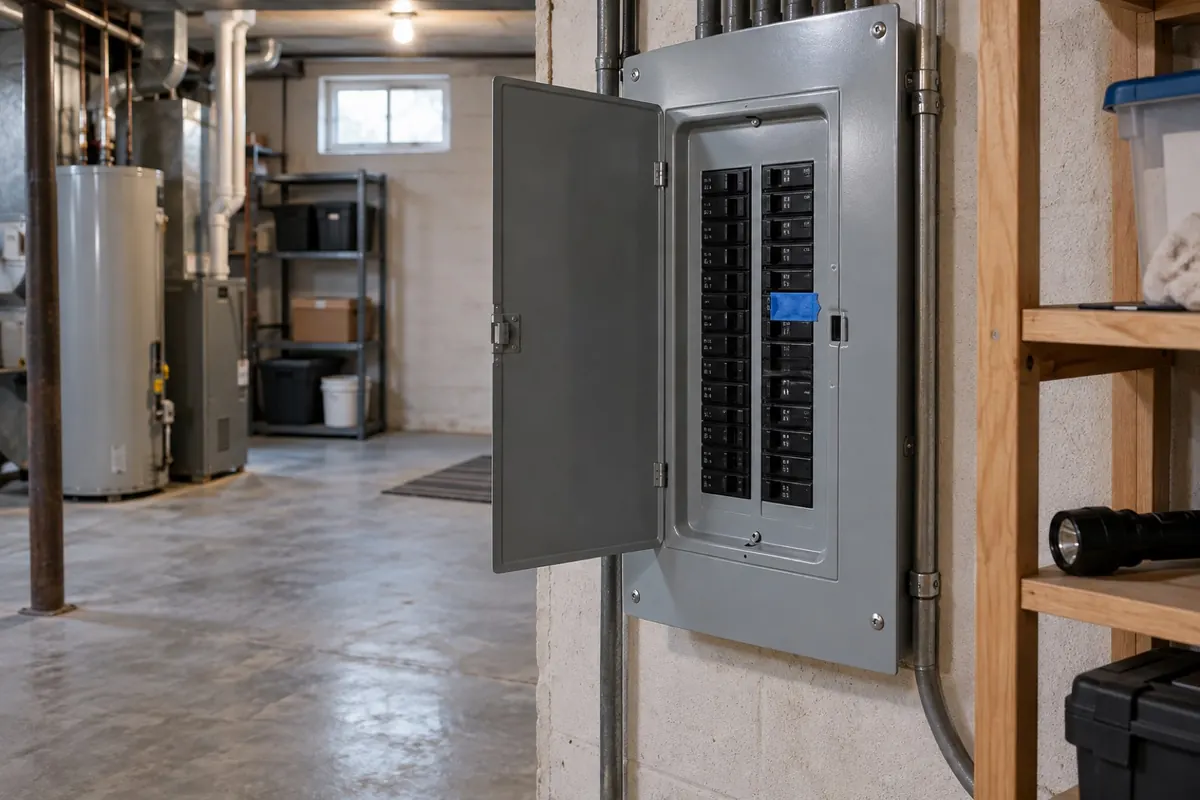
| 1. Breaker off; tape it | Generic advice says turn the light off. The switch leaves the box live. |
| 2. Leave the canopy and shade alone | Generic advice says drain the glass. That means wet metal next to the wiring compartment; the electrician tests first. |
| 3. Stop the source by timing | Generic advice says find the leak. Timing narrows it to one trade before anyone cuts drywall. |
| 4. Photograph water in the bowl | Generic advice says document damage. This photo proves water reached the wiring compartment, which drives the replace call. |
| 5. Electrician replaces per NEMA | Generic advice says let it dry and try it. NEMA lists lighting and GFCIs as replace. |
| 6. Open and dry around the box | Generic advice treats the ceiling alone. The box often comes out anyway, which opens the cavity for drying. |
| 7. Power on only after sign-off | Generic advice says flip it on when dry. ESFi says keep it off until an electrician inspects. |
The EPA moisture guide says to dry water-damaged areas within 24 to 48 hours to prevent mold growth, which for a ceiling cavity usually means opening the board around the box. Equipment and readings are covered on structural drying; existing growth on mold on a bathroom ceiling.
Escalation triggers, and when an electrician must inspect
The NFPA Educational Messages Desk Reference, 2026 edition, says to call an electrician for recurring trips, tingling from an appliance, sink or plumbing fixture, warm or discoloured outlets or switches, a burning or rubbery smell, flickering lights, sparks and cracked outlets.
| Sign | Who to call |
|---|---|
| Breaker trips again or will not reset | Electrician, today |
| Tingling from a fixture, sink or tap | Leave, main off, electrician |
| Warm or discoloured switch, burning or rubbery smell | Main off, electrician |
| Water in a second fixture or a smoke alarm | Electrician and drying contractor |
| Water near the electrical panel | Do not touch; utility or electrician |
| Ceiling bulging around the fixture | Clear the room; contractor |
Treat an inspection as required whenever water reached the fixture, canopy or box, whenever a breaker, GFCI or AFCI on the circuit tripped or got wet, and before re-energizing. ESFi disaster safety guidance says equipment exposed to water must be inspected by qualified professionals before it returns to service. The NFPA Educational Messages Desk Reference says electrical work should be done only by a licensed electrician and some communities require permits; NEMA CS 70006-2026 section 2.1 says to consult the authority having jurisdiction.
Insurance: the fixture, the ceiling and the leak
We describe policy language, not outcomes. The USAA HO-3 special form on file with the Oklahoma Insurance Department, an HO-3 style form, excludes constant or repeated leakage over 14 days or more from plumbing, heating, air conditioning or an appliance, and wear and tear. Where some of those causes produce water damage not otherwise excluded, it covers the resulting damage, including tear-out to repair the system, but not the system the water escaped from. So one claim holds two questions: the ceiling, fixture and wiring, and the pipe, roof or drain that failed. Your policy, your state insurance department and a qualified professional decide yours; our homeowners insurance and water damage guide has the general rules.
According to Triple-I homeowners facts and statistics, water damage and freezing claims averaged $15,400 each over 2019 to 2023, across all water losses.
For contractors: scope, documentation and the line items
The wet light is a make-safe item, an electrical subcontract and a drying boundary. Document the handoff to the electrician rather than swap parts. Water from a toilet or roof is not a clean supply line; the IICRC water categories decide what comes out. What the adjuster asks for:
- Photo of the tagged breaker and of water in the shade before removal.
- When the drip occurs, the source found and who fixed it: cause of loss and the 14-day question.
- Moisture readings across the ceiling with the box marked.
- The electrician’s list of items replaced and reused, kept as a separate line from drying.
Out of scope. Roof, AC equipment and plumbing repair belong to those trades; electrical work to a qualified electrician. Nothing here states what any policy pays.
Questions people actually ask
Is water in a light fixture dangerous?
Yes. Water in the fixture means water passed through or around the electrical box, which can leave wet live parts. ESFi says water can cause hidden damage, corrosion, and shock or fire risks. Breaker off from dry ground, hands off the fixture, and an electrician before use.
What should I do if water is dripping from a light fixture?
Turn the circuit off at the breaker, not the wall switch, with dry hands and feet. Put a bucket under the drip and stop the source: plumbing above, the AC for condensate, a roofer for rain. Keep the power off until an electrician inspects.
Can a light fixture dry out and be used again?
Not on appearance. NEMA CS 70006-2026 lists lighting equipment as replace after water exposure and says not to air dry or wash GFCIs and AFCIs, because corrosion and sediment stay inside. An electrician decides; expect a new fixture.
Should I turn off the breaker if there is water in my light?
Yes, if you can reach the panel from dry ground with dry hands. The wall switch interrupts one conductor, so the box can stay live. If the floor at the panel is wet or water is near it, do not touch it; call the utility or an electrician.
Why does my ceiling light leak water when it rains?
Rain-timed drips point to the roof or an attic penetration. Water lands on the back of the ceiling, runs along joists and cable, and exits at the first opening, the electrical box. Check the attic above for wet insulation, then call a roofer.
Does homeowners insurance cover water in a light fixture?
It depends on cause and duration, so read your own policy. HO-3 style forms exclude leakage repeated over 14 days or more and wear and tear, while covering resulting water damage from some sudden failures but not the failed system. Your insurer and state insurance department are the authorities.
Sources
- NEMA CS 70006-2026, Evaluating Water-Damaged Electrical Equipment, 2026, copy hosted by IEC. Retrieved 30 October 2026.
- Electrical Safety Foundation (ESFi), “Flood Electrical Safety”, via the 21 October 2026 Internet Archive snapshot (site blocks automated access). Retrieved 30 October 2026.
- ESFi disaster safety guidance, via the 26 August 2026 archive snapshot. Retrieved 30 October 2026.
- NFPA Educational Messages Desk Reference, NFPA, 2026 edition, chapter 12. Retrieved 30 October 2026.
- CPSC flood warning, CPSC, 6 March 1997, and 2023 CPSC flood release, 11 July 2023. Retrieved 30 October 2026.
- FEMA's Ready.gov flood page, FEMA, updated 20 October 2026. Retrieved 30 October 2026.
- IRC Section E4003.9, IRC Section E4003.11 and IRC Chapter 35 definitions, 2018 IRC as adopted in Pennsylvania, via UpCodes; local editions vary. Retrieved 30 October 2026.
- IRC Section M1411.3.1 and IRC Section M1501.1, 2021 IRC as adopted in New Jersey, via UpCodes. Retrieved 30 October 2026.
- DOE Building America bathroom fan guide, U.S. DOE and Pacific Northwest National Laboratory. Retrieved 30 October 2026.
- Connecticut Insurance Department pamphlet, IBHS study facts, undated. Retrieved 30 October 2026.
- IBHS State of the Risk: Interior Water Damage, December 2024. Retrieved 30 October 2026.
- USAA HO-3 special form on file with the Oklahoma Insurance Department, HO-3R(02) (07-08), as example language. Retrieved 30 October 2026.
- Triple-I homeowners facts and statistics, ISO data 2019 to 2023. Retrieved 30 October 2026.
- EPA moisture guide, EPA, updated 18 February 2026. Retrieved 30 October 2026.
- NEMA counts are our tally. See our methodology and the water hub.
Published guidance, codes and policy language only; not a substitute for an electrician’s inspection.