The short answer
Commercial water damage restoration differs from residential work in one decisive way: business interruption. The drying bill is often smaller than the revenue lost to closed doors, which inverts the usual optimisation. Paying for speed, desiccant capacity and round-the-clock crews can be the cheaper commercial decision in a way it never is in a house.
Key takeaways
- Optimise for reopening, not for the invoice. Where a lost trading day costs more than a day of drying, the fastest defensible scope is the cheapest total outcome.
- Scale changes the equipment. Large open volumes are dried with desiccant dehumidification rather than refrigerant units, often trailer-mounted with temporary power and a rotating crew.
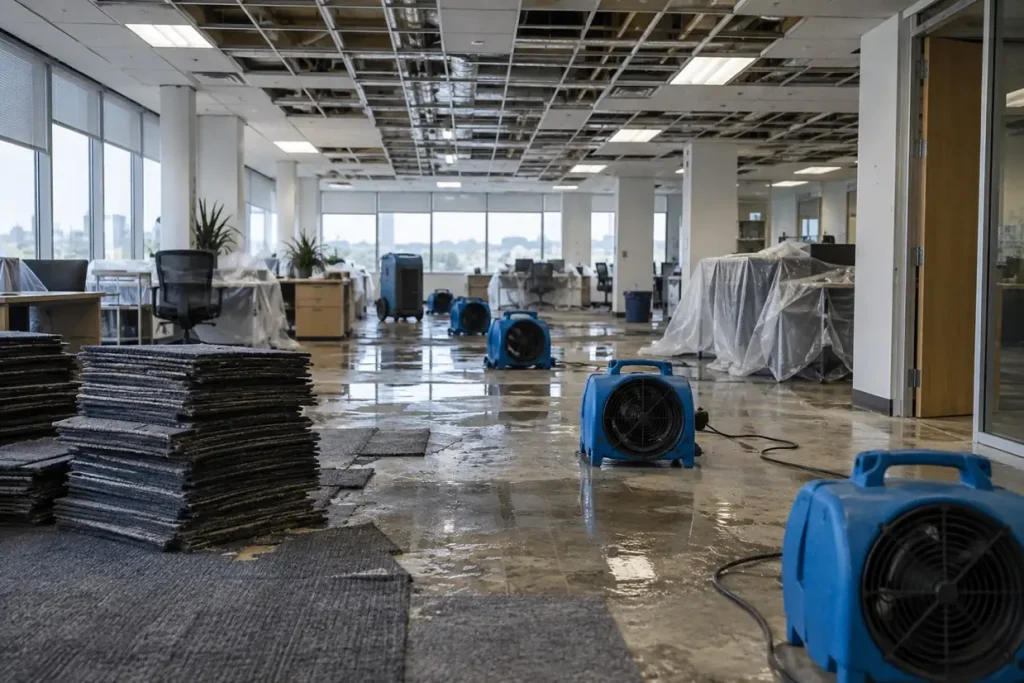
- Sprinkler discharge behaves nothing like a pipe burst: a large volume of clean water over a wide area, often through several floors, with ceiling grid and carpet tile taking the damage.
- Property insurance and business interruption cover are different policies or sections. BI commonly carries a waiting period, often 48 to 72 hours, before it responds. Policy wording governs.
- Sector matters more than square footage, and each sector has a different authority deciding when you reopen.
On this page
- What makes it commercial
- Business interruption inverts the maths
- Scale changes the equipment
- Sprinkler discharge is its own loss type
- Category still governs the scope
- Property cover and BI cover are not the same thing
- Sector differences
- What drives the commercial cost
- Phased reopening and partial occupancy
- How to buy this under pressure
- Questions people actually ask
Most published guidance on commercial water damage restoration is a residential guide with the word commercial inserted, which misses the only thing that genuinely changes. In a house the loss is the building and the contents. In a business it is the building, the contents and the trading, and the third is usually the largest. Decisions about equipment, crew size and sequencing all change direction from there.
What makes it commercial
The technical standard is the same. Extraction, then evaporation, then dehumidification, verified against readings. ANSI/IICRC S500 applies to both. What changes is everything sitting around that process. Our guide to water extraction compares truckmount and portable setups.
Business interruption inverts the maths
Here is the whole argument. If a site turns over a meaningful amount per trading day at a material gross margin, every closed day destroys more value than a day of extra equipment and labour costs. Spending to compress the schedule is then a positive return. In a house, where the occupants can live upstairs, no equivalent return exists, which is why residential advice tells people to minimise the invoice.
| Decision | Residential logic | Commercial logic |
|---|---|---|
| Extra dehumidification capacity | Usually not worth it. The invoice rises, the family still lives there. | Often worth it. Fewer closed days can exceed the equipment cost. |
| Overnight and weekend crews | Rarely justified beyond the emergency response. | Frequently justified. Elapsed hours are the cost being managed. |
| Temporary power and generators | Only if the supply is out. | Common, because the equipment load exceeds the building supply. |
| Containment to allow partial trading | Not normally relevant. | Often the single highest-value line on the scope. |
| Content and document recovery | Replacement value. | Records, stock and equipment with operational value and sometimes a retention duty. |
Do the arithmetic before the first crew arrives
Work out the gross margin lost per closed day for the affected part of the site, from your own figures. That number is the budget for compressing the schedule, and the number to put in front of the contractor and the adjuster. Without it, every conversation defaults to minimising the invoice.
This works the other way too. If the affected area is a storeroom nobody trades from, there is no interruption premium to pay. The test is whether the wet area is on the revenue path, not whether the building is commercial.
Scale changes the equipment
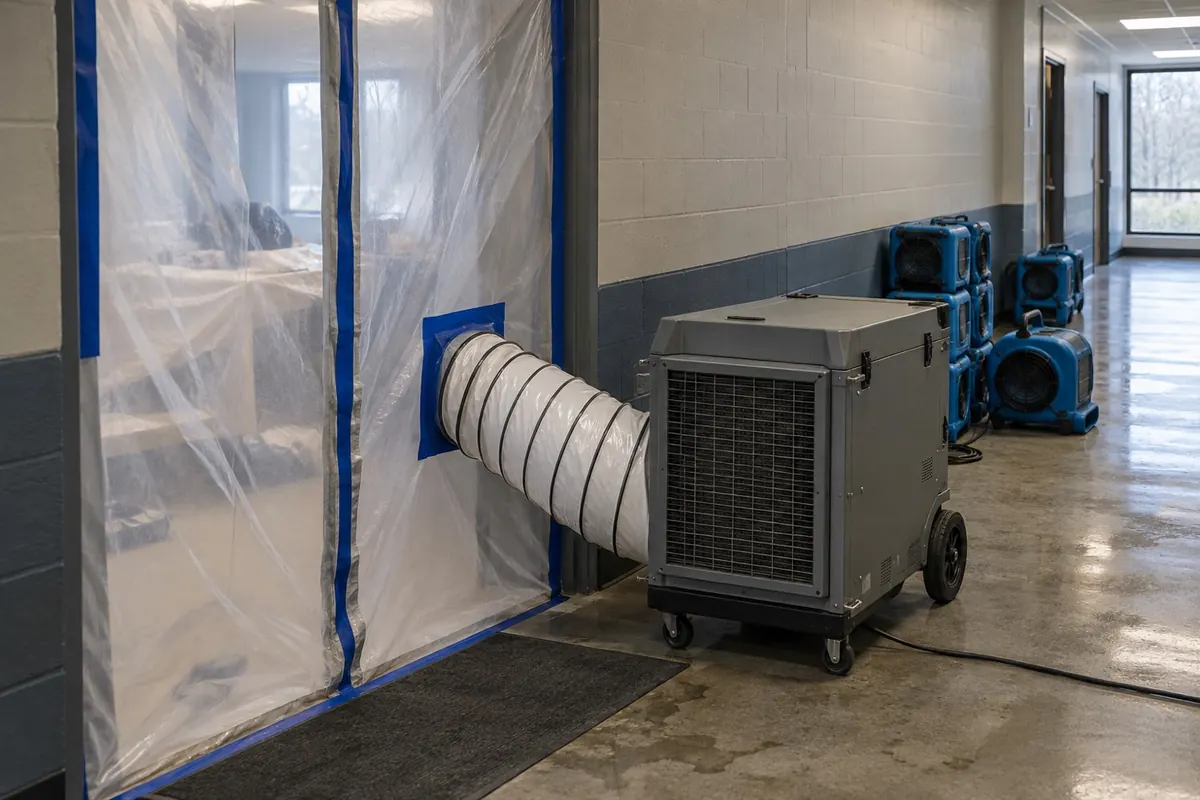
A large warehouse floor is not a big bathroom. Open volume, high ceilings, concrete slabs and a load exceeding the available electrical supply push the specification somewhere a residential job never goes.
| Equipment | Why commercial work uses it | What to watch |
|---|---|---|
| Desiccant dehumidifier | Holds performance at lower temperatures and humidity than a refrigerant unit, and handles large open volumes. | Needs a process air path and an exhaust route for the wet air. Sizing is a calculation. |
| Trailer-mounted desiccant plant | Large capacity delivered from outside the building. | Placement, ducting through openings, noise and fuel. Often needs a site access agreement. |
| Temporary power and distribution | Equipment load routinely exceeds a building panel. | A qualified connection, cable management, generator fuel and noise. |
| Air scrubbers and negative-pressure containment | Separates the working area from the trading area. | The line that lets part of the site keep operating. |
| Specialty drying systems | Injection drying for cavities, mat systems for hardwood, concrete drying for slabs. | Slabs are slow and routinely set the critical path. |
Why desiccant rather than refrigerant
A refrigerant dehumidifier condenses water on a cold coil, which works well in warm damp conditions and loses efficiency as air gets cooler and drier. A desiccant unit adsorbs moisture onto a material and drives it off with heat, so it keeps pulling water at much lower humidity. Commercially that means a large volume taken to low humidity, work in an unheated winter space, and one machine replacing a wall of portables.
Crew rotation and why it is priced differently
On a large loss the first 24 to 72 hours carry most of the value, because that is the window in which category degradation and secondary damage are still preventable. Crews in rotation through it cost premium hours, and that belongs on the scope as a priced decision rather than a surprise on the invoice.
Sprinkler discharge is its own loss type
Sprinkler activation and accidental discharge are among the most common commercial water losses, and the damage pattern is unlike a pipe burst. A burst pipe puts water in one place. A sprinkler head puts a large volume of clean water over a wide floor area, from above, for as long as it takes someone to close the control valve.
| Characteristic | Sprinkler discharge | Pipe burst |
|---|---|---|
| Water quality | Usually Category 1 clean water, though standing pipework carries sediment and corrosion products. | Category depends on the line that failed. |
| Distribution | Wide area, from above, across a floor plate. | Concentrated near the failure, spreading along the path of least resistance. |
| Vertical travel | Commonly through the slab or penetrations to levels below. | Only where the failure sits above an opening. |
| Primary casualties | Suspended ceiling grid and tiles, light fittings, carpet tile, partition bases, anything on desks. | Flooring, wall bases and cabinetry near the failure. |
| Secondary issue | The system is now out of service, which is a fire safety and compliance problem as well as a water one. | The failed pipe needs repairing before reoccupation. |
The ceiling grid decision
Suspended ceilings absorb the first hit. Wetted mineral fibre tiles sag, stain and usually get replaced rather than dried, and part of the grid comes down anyway to get drying air into the void. Whether tiles are replaced wholesale or selectively is one of the larger cost decisions on a sprinkler loss.
Carpet tile is the other big line. It behaves better than broadloom with pad, because tiles lift, dry off the floor and relay with no pad holding water against the slab. The slab is the slower problem: concrete releases moisture gradually, and closing a covering over a slab that has not reached target is how a clean-water loss becomes a mould claim six weeks later.
A sprinkler system that has discharged is a life safety system not currently protecting the building. Restoring it is a separate trade with its own compliance requirements, and in many buildings the system being out of service affects whether occupancy is permitted at all.
Category still governs the scope
ANSI/IICRC S500 classifies water by contamination, and that decides what can be dried in place and what has to be removed. The logic does not change because the building is commercial. What changes is the volume of material and the number of parties who need convincing.
| Category | Common commercial sources | Scope consequence |
|---|---|---|
| Category 1, clean | Sprinkler discharge, supply line failure, chilled water line, rainwater before contact. | Extraction and drying, most assemblies dried in place if reached quickly. |
| Category 2, grey | Failed HVAC condensate, dishwasher or laundry discharge, toilet overflow without solids, failed sump. | Antimicrobial application, selective removal of porous materials. |
| Category 3, black | Sewage backup, grease interceptor overflow, surface flooding, storm surge, or water standing long enough to degrade. | Containment, PPE, mandatory removal of porous materials, disposal, post-remediation verification. |
Commercial losses degrade on a clock you do not control
The category found on arrival, not at the moment of failure, is what gets priced. A discharge at 7pm on a Friday in an empty building can be a different category by Monday. That is the argument for monitored detection and a pre-agreed response arrangement.
Property cover and BI cover are not the same thing
This is where commercial claims most often go wrong. Physical damage to building and contents sits under the property section. Lost income while the business cannot trade sits under business interruption, a separate section or policy with its own trigger, waiting period and measurement basis. Policy wording governs, and there is no substitute for reading yours.
| Element | Property cover | Business interruption cover |
|---|---|---|
| What it responds to | Physical loss or damage to insured property. | Loss of gross profit or revenue caused by that damage. |
| Typical trigger | The damage itself. | The interruption, commonly only after a waiting period. |
| Waiting period | Not normally applicable. | Commonly 48 to 72 hours, sometimes longer. Check the schedule. |
| Duration limit | Until repair or replacement is complete. | An indemnity period stated in the policy, which can expire before trading recovers. |
| What drives the amount | Cost to repair, reinstate or replace. | Your own trading records: turnover, gross profit, comparable period. |
| What you must produce | Scope, readings, photographs, invoices. | Accounts, management figures, evidence of mitigation. |
The waiting period changes the sequencing
A waiting period means the first days of closure may sit with the business regardless of cover. Two consequences follow. Reopening quickly has a value no insurer reimburses, which strengthens the case for spending on speed. And where partial reopening is possible inside that window, containment has a direct cash value on day one.
Mitigation is usually a duty, not a courtesy
Commercial policies generally require the insured to take reasonable steps to prevent further damage. Waiting days for an adjuster before extraction begins can worsen the damage and create a coverage argument. Document conditions, notify the insurer, start mitigation. Our coverage guide covers the residential equivalent.
Sector differences
Two buildings of identical size with an identical wet area can have entirely different losses, because what is in them and who regulates them differ. The drying is often the small part.
| Sector | What dominates the loss | Who gates reopening | Scope consequence |
|---|---|---|---|
| Office | Downtime, IT kit, paper records, ceiling grid, carpet tile. | Employer and landlord. | Containment so unaffected floors work, document recovery, slab drying before coverings return. |
| Retail | Stock, fixtures, trading days in a footfall location. | Retailer, landlord, centre management. | Early stock triage, hoarding so part of the shop trades, out-of-hours working. |
| Restaurant and food service | Food loss, equipment, and the health inspection that decides whether you may serve. | The local health authority as well as the operator. | Food disposal documentation, sanitation of food contact surfaces, grease interceptor and drainage, an inspection-ready finish. |
| Healthcare | Infection control, clinical continuity, sensitive equipment. | Infection prevention and control, plus facility governance. | An infection control risk assessment first, negative-pressure containment, agreed routes and hours, clinical verification. |
| Data centre and server room | Equipment value, data availability, contaminated electronics. | IT and the system owner, plus client obligations. | Power-down decisions, electronics cleaning and corrosion control, low-humidity drying, no general cleaning near live kit. |
| Warehouse and distribution | Stock, packaging, racking, downstream throughput. | The operator and any regulator of the stored goods. | Stock triage and salvage, racking inspection, large-volume desiccant and slab drying. |
| Multi-tenant building | Whose property was damaged, whose income was lost, who caused it. | Landlord and every affected tenant. | Demarcation of common parts from demised premises, one access regime, one scope. |
Multi-tenant buildings: who instructs, who pays
Water does not respect a lease boundary. A failure in a common riser can damage three tenancies and the common parts at once. Agree one instructing party per area on day one. Building cover generally responds for structure and common parts, tenant cover for fit-out, contents and the tenant’s own income loss, subject to lease and policy wording. Settle who funds common containment in writing early.
The regulator is often the critical path
In a restaurant the drying can be finished and the doors stay shut because an inspection has not happened. In healthcare the work may only proceed in agreed hours through agreed routes. Those constraints belong in the programme from day one, because finding them in week two costs more.
What drives the commercial cost
Published per-square-foot figures are less useful commercially, because the drivers that move a commercial number most are not area-based. Our water damage restoration cost page sets out the per-foot mitigation bands, and the same framework applies here with three commercial multipliers on top.
The three commercial multipliers
- Out-of-hours and rotating labour. Premium hours bought to compress elapsed time.
- Equipment class and temporary services. Desiccant plant, distribution and generators are a different cost line from a stack of portable dehumidifiers.
- Containment and phasing. Separation so part of the site keeps operating. A real cost that usually pays for itself on a trading site.
How the estimate is priced
Most insured commercial mitigation in the United States is priced against a carrier price list, line by line, with unit counts and days rather than a lump sum. Understanding that structure is what lets you challenge a scope rather than argue about a total. Our guide to how Xactimate pricing works covers the mechanics.
Phased reopening and partial occupancy
The highest-value move on many commercial losses is not faster drying. It is separating the wet part of the site from the part that can still trade. That needs hard containment under negative pressure, separate access so work traffic never crosses customer or patient traffic, temporary power and lighting for the trading area, and a written position on what is safe to occupy and who says so. The last of those is the document that prevents an argument in week two.
The counter-pressure is the temptation to get coverings down before the slab is dry, which is how a clean-water loss becomes a second claim. Verification readings against unaffected material, not the calendar and not the trading plan, say when the floor is ready.
How to buy this under pressure
The worst time to work out how to buy restoration is at 2am with water coming through a ceiling. These questions make scopes comparable.
- What is the reopening plan, and what does it depend on? Get the programme, not just the price, and get what sits on the critical path.
- What equipment, how many units, how many days? Unit counts and days should follow from the class of loss and from readings, not a fixed assumption.
- Where is the containment? If nobody has proposed it on a trading site, ask why.
- Who is documenting, and what will the file contain? Arrival conditions, daily readings, photographs, a verification record. The BI claim needs this as much as the property claim.
- Mitigation only, or reinstatement too? Get two figures. Different scopes at very different rates.
- What is excluded? Sprinkler restoration, the plumbing repair that caused the loss, specialist electronics, stock disposal and regulatory testing are commonly outside mitigation scope.
Prepare before you need it
A pre-loss arrangement with a contractor, a site plan showing isolation valves and shut-offs, a named out-of-hours decision maker and a written salvage priority for stock and records are all cheap in advance and expensive to improvise. Our methodology sets out how we compile this guidance.
Questions people actually ask
How is commercial water damage restoration different from residential?
The technical drying standard is the same. Business interruption is what changes: revenue lost while the site cannot trade is often larger than the restoration invoice, which justifies spending on speed, desiccant capacity and out-of-hours crews.
What does commercial water damage restoration cost?
It is priced by scope rather than a national average, and the biggest commercial drivers are not area-based: elapsed hours to response, water category, out-of-hours labour, temporary power and desiccant plant, and containment. Our water damage restoration cost page sets out the per-square-foot mitigation bands.
Does business interruption insurance start paying immediately?
Usually not. Business interruption cover commonly carries a waiting period, often 48 to 72 hours, and is limited by an indemnity period stated in the policy. Your own wording and schedule govern, so confirm both with your broker.
Why is desiccant dehumidification used instead of refrigerant?
Desiccant units keep removing moisture at lower temperatures and humidity than refrigerant units, which is what large open volumes, unheated spaces and concrete slabs require. One trailer-mounted plant can also replace many portable units.
Our sprinklers discharged. Is the water contaminated?
Sprinkler water is commonly Category 1 clean water under the IICRC classification, though standing pipework carries sediment and corrosion products, and category degrades with elapsed time. The category assessed on arrival governs the scope. Separately, a discharged system is a life safety system out of service.
Can we stay open while the work happens?
Often yes, and it is usually the highest-value decision available. It needs hard containment under negative pressure, separate access for work traffic, temporary services for the trading area, and a written position on what is safe to occupy.
How long before we can put the floor coverings back?
When verification readings on the slab and assemblies meet the dry standard measured against unaffected material, not when a set number of days has passed. Concrete lags well behind surfaces.
Sources
- Institute of Inspection, Cleaning and Restoration Certification, ANSI/IICRC S500 Standard for Professional Water Damage Restoration, 5th edition, 2021. Water category and class definitions plus the drying and verification framework referenced throughout. The standard text is sold by IICRC; we describe its framework rather than reproduce it. Retrieved 23 September 2026.
- Operating differences between commercial and residential work, equipment classes, sprinkler loss characteristics and sector constraints are compiled from published contractor, manufacturer and public agency guidance current in 2026. We compile published guides and public datasets. We have not conducted a contractor survey or attended commercial losses.
- The business interruption waiting period described as commonly 48 to 72 hours reflects how such cover is generally written, not any specific policy. Waiting periods, indemnity periods, triggers and measurement bases are set by the wording, schedule and endorsements of the policy in question and should be confirmed with a broker or coverage counsel.
- Regulatory gates on reopening, including health inspection for food service and infection control governance in healthcare, vary by jurisdiction and facility. Local requirements govern, and nothing here substitutes for them or for legal advice on lease and recovery questions.
- The commercial cost-driver ordering in the chart is an indicative index reflecting the cost structure described in published contractor guidance. It is not a measured quantity or a survey result.