The short answer
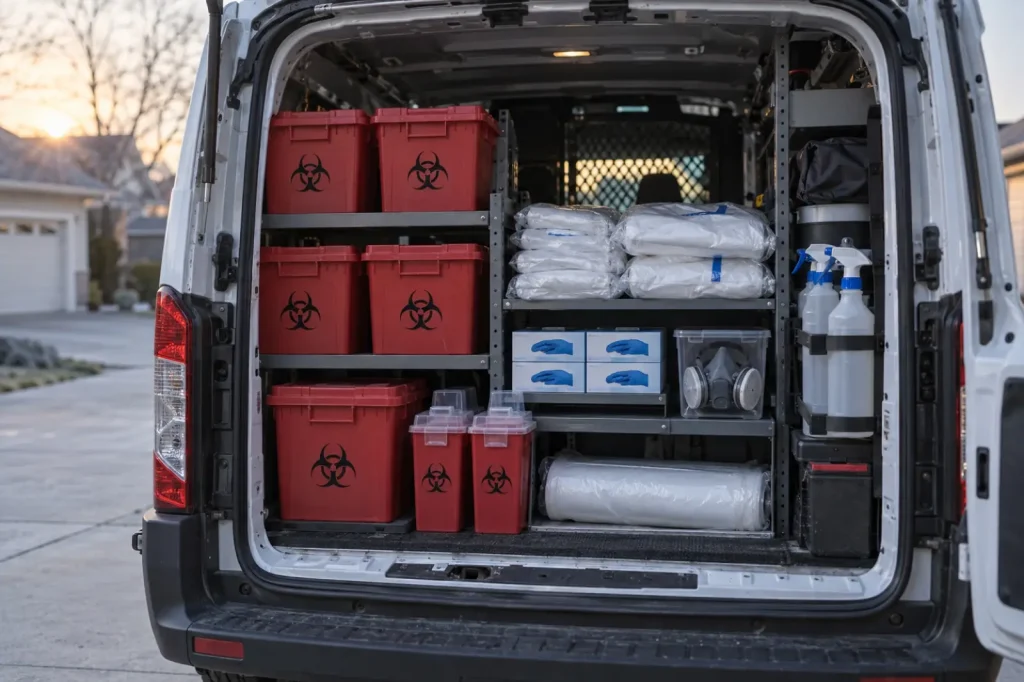
Biohazard cleanup jobs are technician roles that remove blood, body fluids and contaminated material after deaths, injuries and similar events. BLS has no occupation code for them; the closest, hazardous materials removal workers, had a May 2025 median of $23.78 an hour. Federal rules require bloodborne pathogen training every year and a hepatitis B vaccination offer, and California also requires state registration.
Key takeaways
- There is no federal wage figure for crime scene cleaners. SOC 47-4041 is the better proxy: BLS puts its median at $49,450 a year, against $44,040 for the residual cleaning code 37-2019.
- Inside 47-4041 the 90th percentile hourly wage is 2.1 times the 10th, per BLS.
- Job board averages for the same title differ by more than ten dollars an hour, because they count different things.
- OSHA requires bloodborne pathogens training at assignment and at least annually, and a hepatitis B vaccination offer within 10 working days of assignment, at no cost to the worker.
- ABRA’s entry credential, the CBRT, requires a 40-hour HAZWOPER card and a $150 application; the IICRC TCST has no prerequisites.
- California makes companies register as trauma scene waste management practitioners, at $200 a year per the state’s H&SC 118321.1. We found no equivalent Texas registry.
On this page
Most pages ranking for this search are job listings for one city. This page answers what sits underneath them: national pay, the honest wage proxy, and the training, credential and registration a technician needs. For what the service costs a property owner, see our biohazard cleanup guide; for what counts as a biohazard in the first place, see what is a biohazard.
Which wage code fits a biohazard cleanup job
BLS surveys employers, who assign each job to one Standard Occupational Classification code. No code exists for a crime scene, trauma or biohazard technician. Two are plausible, and the evidence favours one.
The 2018 SOC Direct Match Title File lists the job titles BLS maps straight to each code. Under 47-4041 it lists Decontamination Worker and Hazard Waste Handler. Under 37-2019 it lists only building pressure washers and chimney sweeps, and O*NET 37-2019.00 publishes no task data because it is a catch-all. BLS industry data from the BLS Public Data API points the same way: 62% of 47-4041 workers sit in remediation and other waste management, which our technician pay page notes includes remediation contractors.
| Test | 47-4041 Hazardous Materials Removal Workers | 37-2019 Building Cleaning Workers, All Other |
|---|---|---|
| Definition | Identify, remove, pack, transport or dispose of hazardous materials; names asbestos, lead paint, fuel, radioactive material and contaminated soil | All building cleaning workers not listed separately |
| Direct match titles in the SOC file | Decontamination Worker, Hazard Waste Handler, Hazmat Technician, Asbestos Abatement Worker and four others | Building Pressure Washer, Chimney Sweep, Chimney Sweeper |
| O*NET detail | Full task list; includes cleaning mold-contaminated sites | None; O*NET says data is not available for All Other titles |
| National employment, May 2025 | 51,710 | 17,210 |
| Largest industry | Remediation and other waste management, 62% of workers | Services to buildings and dwellings, 70% of workers |
| Verdict | Better fit for blood, regulated waste and decontamination work | Residual code; fits only if the employer files the job as cleaning |
So this page uses 47-4041 as the primary proxy, with 37-2019 beside it. The caveat: the 47-4041 definition names asbestos and lead, not blood, and a cleaning firm may still file its technicians as cleaners. One trap: the SOC file assigns Crime Scene Technician to 19-4092, forensic science technicians, who collect evidence rather than clean.
Biohazard cleanup pay: what BLS says
BLS puts the May 2025 median for 47-4041 at $23.78 an hour, or $49,450 a year, and for 37-2019 at $21.17, or $44,040. The gap at the median is $5,410 a year, per those BLS figures.
| Point | 47-4041 hourly | 47-4041 annual | 37-2019 hourly | 37-2019 annual |
|---|---|---|---|---|
| 10th percentile | $18.49 | $38,460 | $15.56 | $32,370 |
| 25th percentile | $21.50 | $44,720 | $18.00 | $37,440 |
| Median | $23.78 | $49,450 | $21.17 | $44,040 |
| 75th percentile | $29.58 | $61,530 | $24.24 | $50,410 |
| 90th percentile | $39.62 | $82,410 | $30.78 | $64,030 |
| Mean | $27.13 | $56,430 | $22.32 | $46,420 |
Two things sit on top of these numbers. OEWS wages are straight-time pay, so overtime and on-call premiums are not in them, as BLS states and our restoration technician pay page explains. And location moves pay sharply: the restoration wage report finds 47-4041 mean wages from $71,910 in New York down to $31,960 in Puerto Rico in the BLS May 2025 state file.
Crime scene cleaner salary: what job boards advertise
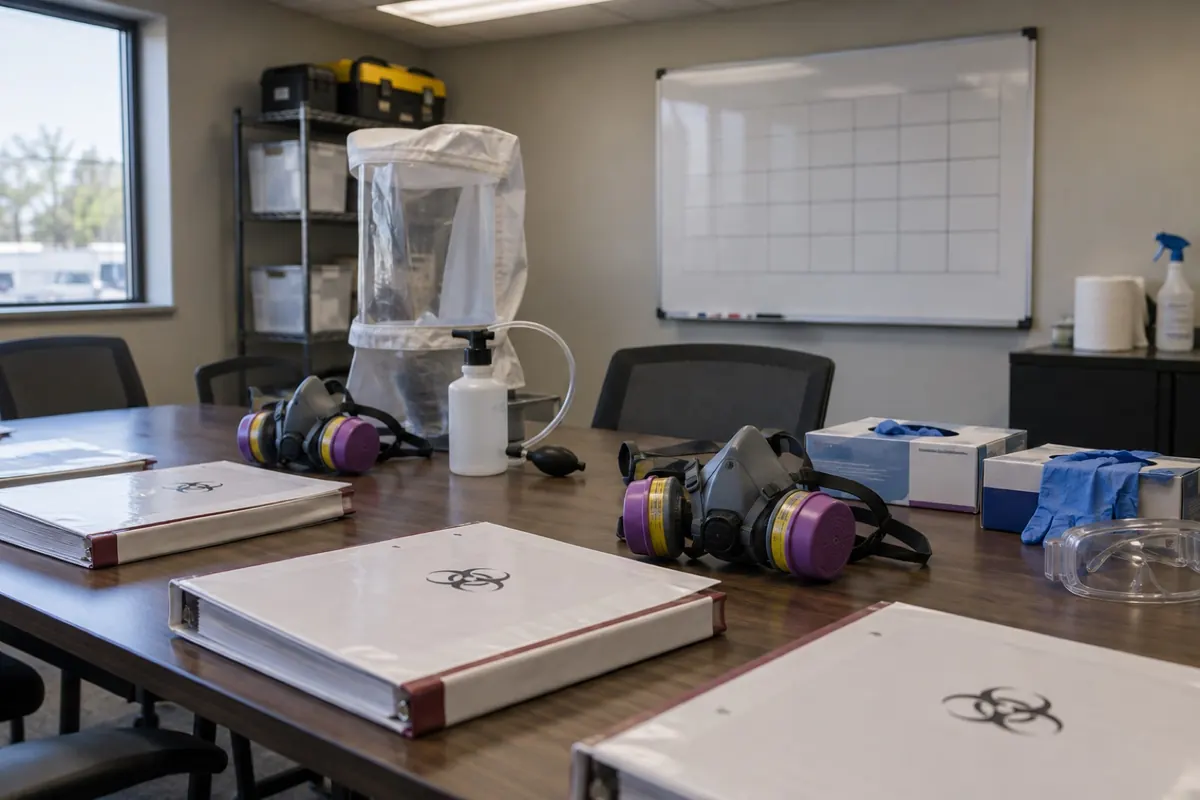
Job boards use the titles people search for, which is why they rank. Their numbers are advertised pay from postings or pay users report themselves, not what employers paid.
| Source | Central hourly figure | Range shown | Basis |
|---|---|---|---|
| PayScale, Crime Scene Cleaner | $22.71 average | $8.66 to $31.49 | 39 self-reported profiles, updated 6 November 2025 |
| Indeed, crime scene cleaner search | $28.99 average | $17.33 to $48.48 | 282 job postings, past 36 months, updated 10 October 2026; page is titled crime scene technician |
| ZipRecruiter, crime scene clean up | $17.77 average | $14.90 to $18.03 | Advertised and estimated pay, as of 6 June 2026; shown in a search result, page refused direct retrieval |
| BLS 47-4041 | $23.78 median | $18.49 to $39.62 | Employer survey, May 2025 |
The spread is the story. According to PayScale, its 39 profiles average $22.71, with entry-level workers at $23.26 on 19 salaries, too few to rank by experience. Indeed resolves the search to a page titled crime scene technician, so its average may include forensic roles.
The work itself
ABRA describes bio recovery as assessing risk, mitigating threats and remediating conditions from the release of biological hazards, which it says may include crime and trauma scenes, suicide cleanup, outbreak response, illicit drugs and clandestine drug labs, per the ABRA CBRT requirements page. Hoarding and sewage jobs are covered in our biohazard cleanup guide.
| Phase | What the technician does | Governing rule or standard |
|---|---|---|
| Assessment | Judge the extent of blood and other potentially infectious material, and plan the work | IICRC TCST scope |
| Containment and protection | Set engineering controls, wear the PPE the employer provides, prevent cross-contamination | OSHA 1910.1030; ABRA CBRT curriculum |
| Removal | Remove affected porous materials and contents; ABRA’s curriculum includes construction practices | S540 structural and contents remediation |
| Cleaning and disinfection | Clean, then apply a disinfectant registered against bloodborne pathogens | EPA List S |
| Waste | Package regulated waste and hand it to a permitted transporter or facility | OSHA (d)(4)(iii); state waste law |
| Confirmation | Confirm the cleaning before handover | S540 scope |
The industry standard is ANSI/IICRC S540, the Standard for Trauma and Crime Scene Cleanup, now in its Second Edition (2023), per the IICRC. For disinfection, EPA retired its older bloodborne lists C to F and consolidated them into List S, which covers HIV, hepatitis B and hepatitis C, according to the EPA disinfectant lists page. The work involves the aftermath of deaths and injuries; anyone who needs to talk can call or text 988, the free and confidential 988 Lifeline, at any hour.
Training the law requires
Two OSHA standards shape a technician’s first week. The Bloodborne Pathogens standard, 29 CFR 1910.1030, applies to anyone with reasonably anticipated contact with blood in the course of the job. The respiratory protection standard, 29 CFR 1910.134, applies whenever the employer requires a respirator, and it requires a written program with worksite-specific procedures.
| Requirement | What OSHA requires | Paragraph | Note |
|---|---|---|---|
| Bloodborne pathogens training | At initial assignment and at least annually; 14 required elements | 1910.1030(g)(2)(ii), (vii) | Training records kept 3 years |
| Hepatitis B vaccination | Offered within 10 working days of initial assignment, at no cost | 1910.1030(f)(1)(ii)(A), (f)(2)(i) | A worker who declines signs the Appendix A statement |
| Post-exposure follow-up | Confidential medical evaluation made available immediately | 1910.1030(f)(3) | Medical records kept for employment plus 30 years |
| Personal protective equipment | Provided by the employer at no cost | 1910.1030(d)(3)(i) | At no cost to the employee |
| Exposure control plan | Written; reviewed and updated at least annually | 1910.1030(c)(1)(iv) | The employer’s document, not the worker’s |
| Respirator medical evaluation | Before fit testing or required use | 1910.134(e)(1) | Applies when a respirator is required |
| Respirator fit test | Before first use, with any new facepiece, and at least annually | 1910.134(f)(2), (f)(5) | OSHA-accepted qualitative or quantitative protocol |
These duties sit with the employer.
How to get certified in biohazard cleanup
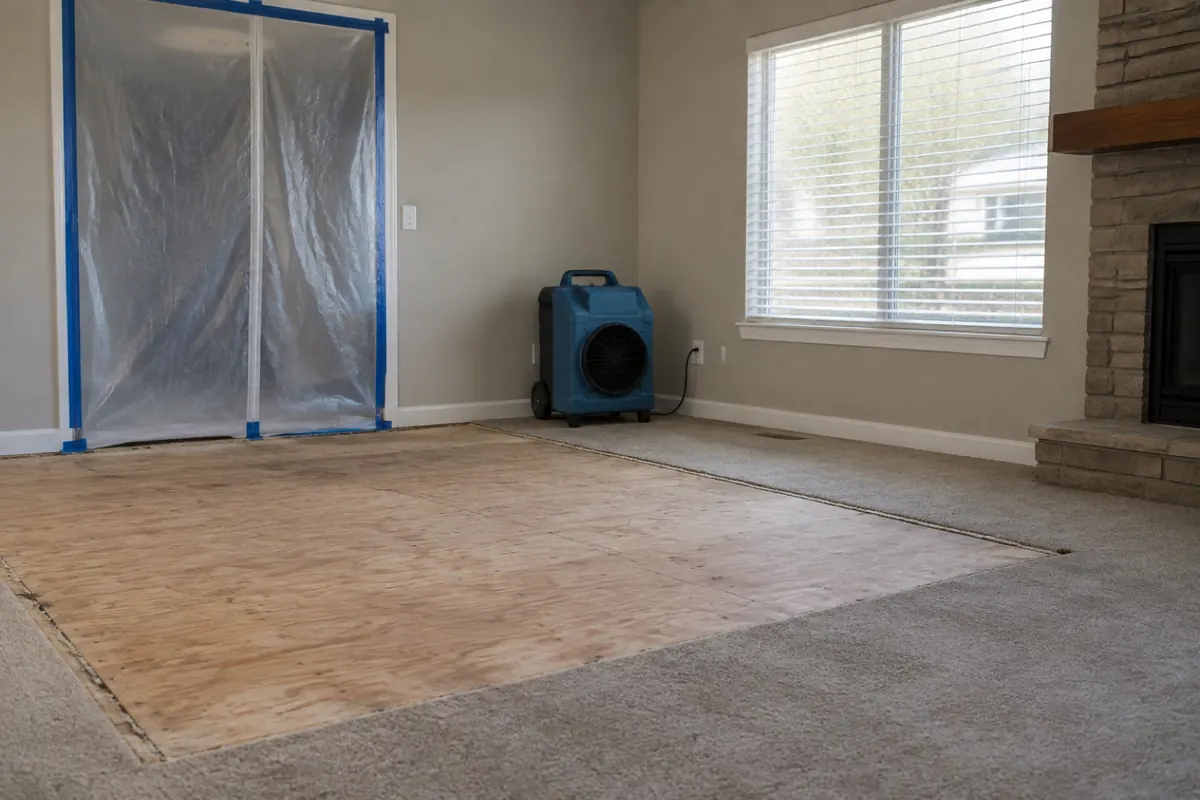
Two bodies issue the credentials employers ask about. ABRA certifies only; it states that a certifying body offering training would be a conflict of interest, per its ABRA certification overview.
| Credential | Prerequisites | Exam and fee | Renewal |
|---|---|---|---|
| IICRC Trauma and Crime Scene Technician (TCST) | None stated | Live-stream or in-person; course length not stated on the page | Not stated on the page |
| ABRA Certified Bio Recovery Technician (CBRT) | 2-day bio recovery course, 40-hour HAZWOPER card, BBP card, OSHA 10 card | $150 application; proctored exam, pass mark 75 | Yearly: $50, 10 CE hours, annual BBP certificate |
| ABRA Certified Bio Recovery Supervisor (CBRS) | Current CBRT plus 5 years as a CBRT, or a 2-year degree and 3 years of field work | $200 application; exam pass mark 85 | Yearly: $100 and 15 CE hours |
| ABRA Certified Bio Recovery Master (CBRM) | CBRT plus a third party credential and 10 years supervising, or a 4-year degree and 5 years of field work | Exam pass mark 85; fee not stated on the page | Not stated on the page |
The IICRC says the TCST has no prerequisites and is built on ANSI/IICRC S540. ABRA reports a 64% exam pass rate and more than 1,500 certifications awarded on its ABRA certification site, figures it publishes about itself. Neither credential is a state licence. Mold work is a separate track; see our mold remediation certification guide.
State registration: California, Texas and the rest
The OSHA rules above protect workers; who may sell the service is a state question. California’s Trauma Scene Waste Management Act, H&SC 118321 to 118321.6, requires a practitioner to register with the Department of Public Health and pay an annual fee of $200, per the text of section 118321.1 in the Medical Waste Management Act text (CDPH) and the CDPH fee schedule. Section 117778 defines a practitioner as a person who removes human blood, body fluids and associated residues from the scene of a serious injury, illness or death as a commercial activity.
| Jurisdiction | Requirement | Citation | Practical detail |
|---|---|---|---|
| California | Trauma scene waste management practitioner registration with CDPH | H&SC 117778 and 118321 to 118321.6 | $200 a year; one application per business address; certificate needed before work starts |
| California, waste | Waste removed at the end of the removal phase; to a permitted facility or a dedicated freezer for up to 14 days | H&SC 118321.5 | Proof of a contract with a permitted transporter or facility |
| Texas | No trauma scene registry found; medical waste transporters register by rule with TCEQ | 30 TAC 326.53 | Apply 60 days before hauling; expires 30 September each year |
Registration attaches to the business, not the technician. The list published on 26 August 2026 holds roughly 370 entries by our count of the CDPH registered practitioner list. Per its notes, registration is not an endorsement, needs no contractor’s licence, and does not cover family or neighbours who clean unpaid.
Texas is different. We found no Texas trauma scene registry in the state sources we searched. Its medical waste transporter rule, 30 Tex. Admin. Code 326.53, grants registration by rule to anyone planning to transport medical waste, requires vehicles marked TCEQ with the registration number, and requires manifests kept for 3 years. Whether a load counts as medical waste is a question for TCEQ. Elsewhere, check the state health and environmental agencies.
How to get a biohazard cleanup job, step by step
The route below orders the requirements above by when they apply.
- Decide which door you are using. The employers ranking for this search include specialist biohazard firms, franchise networks and restoration companies with a biohazard service. The job title varies.
- Get the cards that travel with you. A current bloodborne pathogens card, an OSHA 10 card and a 40-hour HAZWOPER card are ABRA’s documented CBRT prerequisites.
- Expect the employer’s onboarding. Under OSHA the employer trains you, offers the hepatitis B series within 10 working days and medically clears and fit tests you before any required respirator use.
- Add a credential once you are working. The IICRC TCST has no prerequisites; the ABRA CBRT needs the cards above plus a two-day course.
- Check the state. In California, confirm the employer appears on the CDPH registered practitioner list.
- Benchmark the offer. Compare against the BLS 25th to 75th percentile for 47-4041, then ask how overtime and on-call time are paid.
- Plan the next rung. ABRA’s CBRS needs 5 years as a CBRT, or a 2-year degree and 3 years of field work.
For contractors hiring technicians
For a restoration contractor adding a biohazard line, the regulatory duty is the employer’s from the first call. The records the two OSHA standards make the employer keep are the written exposure control plan and its annual review, training records for 3 years, signed vaccination declinations, and the written respirator program, under 29 CFR 1910.1030 and 29 CFR 1910.134. In California, add the CDPH certificate for each business address and the waste contract.
For pay setting, benchmark against the 47-4041 ladder adjusted by state, and price overtime separately because OEWS excludes it. Hazard classification is covered on our biohazard levels page.
Questions people actually ask
How much do you make in biohazard clean up?
BLS has no figure for the job itself. The closest code, hazardous materials removal workers, had a May 2025 median of $23.78 an hour, with the 10th to 90th percentile running from $18.49 to $39.62, per BLS. According to PayScale, self-reported crime scene cleaner pay averages $22.71. Overtime is not in the BLS figures.
How do I get a job doing crime scene cleanup?
Apply to specialist biohazard firms or restoration companies with a biohazard division. OSHA makes the employer provide bloodborne pathogens training and a hepatitis B vaccination offer. A bloodborne pathogens card, an OSHA 10 card and a 40-hour HAZWOPER card help, because ABRA lists them as CBRT prerequisites.
Can you get biohazard cleanup jobs with no experience?
Yes. O*NET reports that 46% of hazardous materials removal workers surveyed said less than a high school diploma was required, and rates the occupation at Job Zone 1 to 2, meaning little to some preparation, with a few days to a year of on-the-job training. The employer then owes you OSHA training.
How do you get certified in biohazard cleanup?
Two credentials dominate. The IICRC Trauma and Crime Scene Technician has no prerequisites and is based on ANSI/IICRC S540. ABRA’s Certified Bio Recovery Technician requires a two-day bio recovery course, a 40-hour HAZWOPER card, a bloodborne pathogens card, an OSHA 10 card, a $150 application and a proctored exam, per ABRA. ABRA renews yearly.
What certifications should a biohazard cleanup company have?
Look for technicians holding the IICRC TCST or an ABRA credential, written OSHA bloodborne pathogens and respiratory programs, and a contract with a permitted medical waste transporter or facility. In California the company must appear on the CDPH registered trauma scene waste practitioner list.
Is crime scene cleanup a good career?
It pays near the middle of the construction and cleaning trades: the 47-4041 median of $49,450 a year sits above janitors at $36,840 and below drywall installers at $58,930, per BLS May 2025. A supervisor track exists through ABRA’s CBRS and CBRM. The trade-offs are on-call work, which the BLS figures leave out, and difficult scenes.
How do I find, compare or get a quote from a biohazard cleanup company?
This page names no companies. To compare firms, ask for their credentials, their OSHA programs and their waste transporter, and in California check the CDPH registered list. Ask for a written quote after an assessment; our biohazard cleanup guide explains what drives the price.
Sources
- BLS Public Data API, OEWS national and industry series for SOC 47-4041 and 37-2019, May 2025; BLS OEWS tables.
- 2018 SOC Direct Match Title File, US Bureau of Labor Statistics.
- O*NET 47-4041.00 and O*NET 37-2019.00, O*NET OnLine.
- 29 CFR 1910.1030, Bloodborne Pathogens, OSHA.
- 29 CFR 1910.134, Respiratory Protection, OSHA.
- IICRC TCST page and ANSI/IICRC S540, Second Edition 2023, IICRC.
- ABRA certification site, ABRA certification overview, ABRA CBRT requirements (updated 8 February 2026), ABRA CBRS requirements and ABRA CBRM requirements, American Bio Recovery Association.
- Medical Waste Management Act text (CDPH), January 2017 compilation; CDPH trauma scene page; CDPH practitioner checklist, rev. 10/25; CDPH fee schedule; CDPH registered practitioner list, 26 August 2026; CDPH.
- 30 Tex. Admin. Code 326.53, TCEQ rule via Cornell LII.
- EPA disinfectant lists, US EPA.
- PayScale, Crime Scene Cleaner hourly rate, updated 6 November 2025; Indeed, crime scene technician salaries, updated 10 October 2026; ZipRecruiter, crime scene clean up, figure as of 6 June 2026.
- 988 Lifeline, 988 Suicide and Crisis Lifeline.
- Remediation Insider, restoration wage report and restoration technician pay, figures as stated there.
- All retrieved 18 October 2026. Our methodology sets out the standing rules.
Wage data describe occupations, not any one employer. Certification rules, fees and state registration change; confirm with the IICRC, ABRA and your state health department before relying on them. See the operations hub for related guides.