The short answer
Mold on leather comes off best dry. Isolate the item, let it dry slowly away from heat, then HEPA vacuum or brush it outdoors, which is the method Canada’s Conservation Institute publishes. Test any liquid on a hidden spot first, keep water off aniline, nubuck and suede, and store leather below 65 percent relative humidity, where conservators say mould starts to be favoured.
Key takeaways
- CCI Notes 8/1, Removing Mould from Leather reports mould growth after about 2 days at 90 to 100 percent RH, 10 days at 80 and 100 days at 70.
- A white haze is often not mold. CCI’s test: a cotton swab of mineral spirits on a hidden spot; if the deposit disappears in about 15 minutes, it is likely wax or oil.
- CCI Notes 8/2, Care of Alum, Vegetable and Mineral-tanned Leather calls saddle soap highly alkaline and says leather dressings can leave fatty blooms that look like mould, the opposite of what two extension pages advise.
- Pigmented leather, used on most car seats, repels liquid; aniline, nubuck and suede absorb it, per Leather Naturally.
- NPS Conserve O Gram 3/4 says leather is particularly susceptible to mold and can be stained and weakened by it.
- 16 CFR Part 423, the Care Labeling Rule excludes footwear and defines its ‘Leather clean’ instruction as cleaning only by a professional using special leather or suede methods.
On this page
- The six-question path
- Mold or bloom? What you are looking at
- Which leather it is decides the method
- Humidity and time
- How to remove mold from leather
- Where the advice disagrees
- Mold on leather shoes
- Mold on leather jacket linings and shells
- Mold on leather couch cushions and seams
- Heat, sun and drying
- Bigger than the spot
- For contractors
- FAQ
The six-question path
Answer in order. Stop at the first ‘professional’.
- Is it wet, or was it in floodwater? Bag it and dry it first; CCI says freeze wet items or dry them quickly. Floodwater on a valuable piece: professional.
- Is it mold at all? Run the swab test below. Wax bloom needs a buff, not a cleaning.
- Which leather is it? Pigmented tolerates a damp wipe; aniline, nubuck, suede and alum-tawed leather do not.
- Is it valuable, antique or sentimental? CCI and NPS both send those to a conservator.
- Is the growth on one item or the whole closet? Many items means a room humidity problem; fix that first.
- Dry, everyday piece, surface growth? Use the dry method below, then the cleaner your leather type allows.
Mold or bloom? What you are looking at on leather
CCI Notes 8/1, Removing Mould from Leather describes mould on leather as low growth in various colours, usually brown or black on light leather and white or light on dark leather, and CCI Notes 8/2, Care of Alum, Vegetable and Mineral-tanned Leather adds thin grey, green or white powder or small black dots. A mouldy smell is often the first sign. Three other things look similar.
| What you see | Most likely | How to tell | Named by |
|---|---|---|---|
| Fuzzy or powdery spots, musty smell | Mould | Smears if damp; smell persists | CCI 8/1 |
| Even white haze on a conditioned item | Wax or fatty bloom | Mineral spirits swab clears it | CCI 8/1, 8/2 |
| White scummy film after saddle soap | Soap residue | Follows where soap was used | CCI 8/2 |
| Red powder on old vegetable-tanned leather | Red rot | Powdery, no smell, brushes off red | CCI 8/2 |
The swab test. Per CCI Notes 8/1, Removing Mould from Leather, dip a cotton swab in mineral spirits, blot it, roll it over a small hidden patch of the deposit and wait about 15 minutes. If the deposit has gone, it is probably wax; if it is still there, or you are unsure, CCI says treat the object as mouldy. For white growth on other surfaces, see white mold.
Which leather it is decides the method
Finish and tannage change how much liquid leather takes, so one recipe for all leather fails.
| Leather | What it is | Water tolerance | Cleaning ceiling |
|---|---|---|---|
| Pigmented (finished, protected) | Pigment finish over the grain | Good liquid repellency | Brush, then a leather cleaner |
| Aniline | Dyed, no pigment finish | Absorbs liquid more readily; may darken | Dry brush or slightly damp cloth, patch test |
| Nubuck | Grain sanded to a nap | Absorbs water | Medium-hard brush; specific cleaners |
| Suede | Reverse side or split | Absorbs water | Brush; no powdered erasers |
| Chrome or mineral tanned | Tannage, any finish | Highly resistant to moisture | Per its finish |
| Vegetable tanned | Plant tannins, often oiled | Can harden with RH swings | Per its finish; watch red rot |
| Alum tawed | Pale, fine, flexible | Easily damaged by water | Dry methods only |
Finish rows: Leather Naturally's care fact sheet. Tannage rows: CCI 8/2, which notes chrome-tanned leather may show a blue-green line on a cut edge.
Humidity and time: why leather molds
NPS Conserve O Gram 3/4 calls leather, a protein material, particularly susceptible. Humidity held long enough turns that into growth, and CCI publishes the timing.
So a jacket in a damp basement closet at 70 percent RH can take about 50 times longer to grow mould than one in a flooded room near saturation, per those CCI figures. Both get there. The bands the three agencies publish line up closely.
Per EPA's Brief Guide to Mold, Moisture and Your Home, keep indoor humidity below 60 percent. NPS sets the leather ceiling at 65 percent and advises storing collections at least 4 inches off the floor and away from outside walls. A closet that molds several items at once is covered on mold in closet.
How to remove mold from leather
This follows CCI Notes 8/1, Removing Mould from Leather, with the wipe step adapted for everyday finished goods. Dry first: water is the problem.
- Isolate it. Seal the item in a plastic bag, label it, and keep it sealed until you clean it. Why this differs from generic advice: CCI and NPS both start here; carrying a moldy jacket through the house spreads spores to other leather.
- Dry it slowly. Air dry outdoors on a clear, dry day, or in a drier, well-ventilated room; freeze a wet item if it cannot dry quickly. Why this differs from generic advice: CCI 8/1 freezes wet leather at about -18 to -28 degrees C, which stops active growth though spores survive; generic advice to blast it with a hair dryer breaks Leather Naturally’s rule.
- Protect yourself. N95 respirator, disposable gloves, an apron and non-vented goggles for a small area. Why this differs from generic advice: That is CCI’s kit for 1 square metre or less, about 10 square feet, which matches EPA’s household line.
- HEPA vacuum it dry. Nozzle close to the surface, whole object, two passes at right angles, a soft brush to steer growth in. Why this differs from generic advice: CCI vacuums the whole item, not just the spot; if growth smears, it is not dry enough yet.
- Wipe only if the leather allows it. Pigmented: a leather cleaner or mild soap on a damp cloth. Aniline: dry brush or a barely damp cloth after a patch test. Why this differs from generic advice: One recipe for every leather is how aniline gets dark patches.
- Dry again, then condition sparingly. Room temperature, away from heat and direct sun. Why this differs from generic advice: CCI warns dressings can leave a bloom that looks like mold; less is better on an item that just molded.
- Clean up and store dry. Bag waste in 6 mil plastic; wipe tools with detergent, then bleach diluted 1 to 10 for 10 minutes; store below 65 percent RH in breathable cover. Why this differs from generic advice: CCI uses the bleach on equipment, not on the leather.
Vinegar is the most repeated tip on ranking pages, and none of the conservation or extension sources here use it on leather; what it does and does not do is on does vinegar kill mold.
Where the published advice disagrees
Official sources split, mostly museum objects against everyday goods.
| Question | CCI and NPS | UF/IFAS and UGA extension | Leather makers |
|---|---|---|---|
| Saddle soap | Highly alkaline, degrades leather, white deposit | Thick suds of mild soap or saddle soap if mildew remains | La-Z-Boy: half mild soap, half distilled water |
| Dressing or conditioner | No longer generally recommended; can bloom like mould | Wax dressing (UF); commercial conditioner (UGA) | Red Wing: conditioner soaked in overnight |
| Alcohol | Not in CCI 8/1 | 1 cup denatured alcohol to 1 cup water after a colourfastness test (UF) | Not on La-Z-Boy’s page |
| Sun | NPS lists sunlight among deactivation options, with a conservator; CCI says avoid direct sun | Air or sun the leather thoroughly (UF) | Leather Naturally and La-Z-Boy: avoid direct sun |
| Drying | Slowly, with air circulation | Where air circulates; an airy place | Room temperature, no radiator or hair dryer |
How to read it: CCI Notes 8/2, Care of Alum, Vegetable and Mineral-tanned Leather says museum objects need not flex; a boot or sofa must, which is why UF/IFAS Extension Jefferson County, University of Georgia Extension and Red Wing's boot care page condition. For everyday goods: no saddle soap on aniline, light conditioner only once fully dry, no sun-baking.
Mold on leather shoes and boots
Shoes mold from the inside as often as the outside, because sweat-damp linings go into a dark cupboard. Red Wing's boot care page says let boots air dry at room temperature, avoid radiators and hair dryers, and store them in a well-ventilated place in a cloth bag or open space rather than a plastic container, since leather needs to breathe. Boot trees keep the shape.
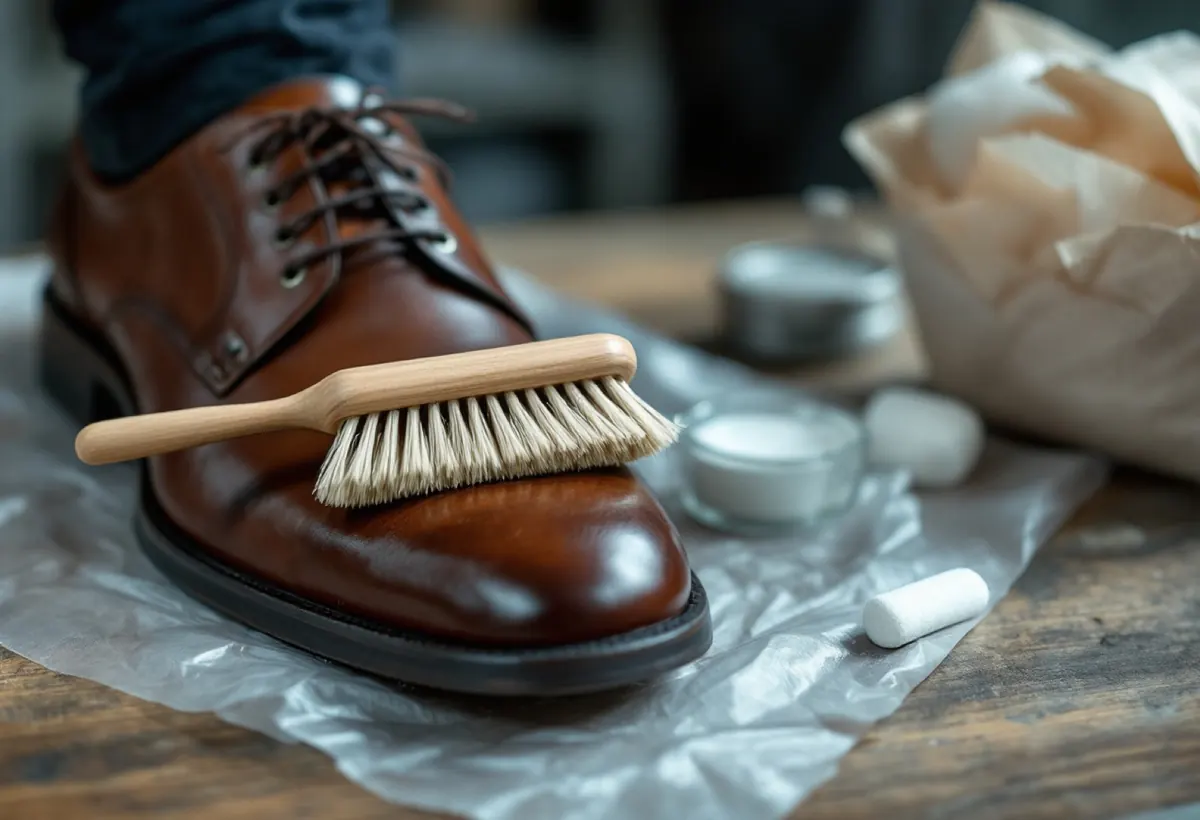
Method changes for shoes: HEPA vacuum or brush the outside, pull the insoles, and stuff the inside loosely with plain paper, as Leather Naturally does for nubuck and suede. Replace moldy foam insoles. Suede uppers get a stiff brush, not liquid.
Mold on leather jacket linings and shells
Check the label first, and expect it might not help. 16 CFR Part 423, the Care Labeling Rule defines a textile product as one made primarily of fiber, yarn or fabric and excludes footwear outright, so leather goods may carry no required care label. When a label says ‘Leather clean’, Appendix A defines it as cleaning only by a professional cleaner who uses special leather or suede care methods.
At home: hang it on a wide hanger outdoors, HEPA vacuum the outside, then turn it and vacuum the lining, often where the smell lives. A fabric lining that stays musty after the leather is clean is a cleaner’s job; fabric garment care is on mold on clothes.
Storage: CCI Notes 8/2, Care of Alum, Vegetable and Mineral-tanned Leather says keep leather out of damp basements and away from heat sources, and dyed items in the dark where possible. Use a breathable bag, not plastic.
Mold on leather couch cushions and seams
La-Z-Boy's leather care page gives the routine for its full aniline leathers: a lint-free cloth slightly dampened with distilled water for dusting, a solution of half mild soap and half distilled water for spills, blot rather than rub, avoid direct sunlight, keep the piece at least 12 inches from radiators, and call a professional leather cleaner for difficult stains.
For mold, HEPA vacuum the dry surface and seams, check under cushions and the back panel, and only then use La-Z-Boy’s soap mix on a pigmented surface. Growth inside cushion foam or on the frame is an upholstery problem, covered on mold on furniture. Leather car seats are on mold in car.
Heat, sun and drying: warm is not hot
Every source here says dry leather slowly. Leather Naturally's care fact sheet says let wet leather dry naturally, with no hair dryer, radiator or direct sunlight. NPS Conserve O Gram 3/4 lists air drying at 30 to 40 degrees C among deactivation options, but only in consultation with a conservator, because objects can be damaged by inappropriate treatment.
| Rule | Figure | Named by |
|---|---|---|
| Distance from radiators | At least 12 in | La-Z-Boy |
| Light, unpainted leather | Up to 150 lux | CCI 8/2 |
| Light, painted or dyed leather | Up to 50 lux | CCI 8/2 |
| Wet leather | Dry naturally; no dryer, radiator or sun | Leather Naturally |
| Wet boots | Room temperature, no direct heat | Red Wing |
| Storage height | 4 in or more off the floor | NPS Conserve O Gram 3/4 |
Signs it is bigger than the spot
| Sign | What it suggests | Next step |
|---|---|---|
| Several leather items molding in one room | Room humidity above the leather line | Hygrometer, dehumidifier, find the water |
| Growth back within weeks of cleaning | Item or room still damp | Dry storage first, then re-clean |
| Growth smears when vacuumed | Leather not dry | Stop and dry, per CCI |
| Leather stiff, cracked or stained after drying | Fibre damage | Leather specialist or conservator |
| Item was in floodwater or sewage | Contaminated, not just damp | Professional; discard low-value items |
| Antique, heirloom or museum piece | Value exceeds cleaning risk | Conservator, as CCI and NPS advise |
NPS Conserve O Gram 3/4 warns that spores reactivate if temperature or humidity rises again, so a clean item returned to the same closet regrows.
For contractors
Leather arrives as contents on mold and water losses: high value and easy to ruin with building chemistry.
| Item | What to do | Why |
|---|---|---|
| Pack-out | Bag each moldy item separately and label it | CCI isolates before cleaning |
| Inventory | Record leather type, finish, label wording, photos | ‘Leather clean’ under 16 CFR 423 means a specialist |
| Triage | Separate everyday goods from valuables | CCI and NPS send valuables to a conservator |
| Drying | Controlled room, no heaters on leather | CCI and Leather Naturally |
| Line item | HEPA vacuum and dry clean per item, or specialist referral | Keeps leather out of bulk textile cleaning |
| Close-out | Odour check after storage closure; RH log | Proves the room is below the mould line |
Adjusters ask whether each item was cleanable or a loss. A note per item citing its leather type and label wording answers that before it is asked.
What this page does not cover. Health effects of mold are outside our scope; see CDC's mold page and EPA's Brief Guide to Mold, Moisture and Your Home, and ask a physician. Moths and other pests in stored leather belong to thepestcontrolbrief.com.
Questions people actually ask
Can mold on leather be removed?
Surface mold on sound leather usually can. Dry the item, then HEPA vacuum or soft-brush it outdoors, the method in CCI Notes 8/1, and wipe only if the leather type allows liquid. Mold often leaves a stain, and growth that went deep into old or aniline leather may not come out fully. Valuable pieces go to a conservator.
Is the white stuff on my leather mold?
Maybe not. Oils and waxes leave a white bloom that looks like mold. CCI’s test: dab a hidden spot with a cotton swab dipped in mineral spirits, blot it, roll it over the deposit and wait about 15 minutes. If the deposit disappears it is likely wax. If it stays, or you are unsure, treat it as mold.
Does vinegar or rubbing alcohol kill mold on leather?
Vinegar does not appear in the conservation or extension sources reviewed here. UF/IFAS Extension uses 1 cup denatured alcohol to 1 cup water, after a colourfastness test. CCI’s method for leather is dry: drying and HEPA vacuuming. On aniline, nubuck and suede, any liquid can darken the surface, so test a hidden spot first.
Why does leather get moldy in a closet?
Leather is a protein material that NPS calls particularly susceptible, and a closet holds still, humid air. CCI reports growth after about 100 days at 70 percent relative humidity and 10 days at 80. Keep the room below 60 percent per EPA, space items apart and use breathable covers, not plastic.
Should I throw away moldy leather shoes?
Not automatically. Shoes with sound uppers can be dried, vacuumed and brushed, and foam or fabric insoles replaced. Throw them out if floodwater or sewage soaked them, if the leather has cracked or rotted, or if the smell returns after full drying and cleaning. Red Wing says store boots in breathable space, not plastic containers.
Can a dry cleaner clean a moldy leather jacket?
Only one that handles leather. The Care Labeling Rule’s ‘Leather clean’ instruction means cleaning only by a professional using special leather or suede methods. Tell the cleaner it is mold, bag the jacket for transport, and vacuum the outside first so you are not carrying loose growth into the shop.
Sources
- CCI Notes 8/1, Removing Mould from Leather, Janet Mason, Canadian Conservation Institute, 1993, revised 2016. Retrieved 31 October 2026.
- CCI Notes 8/2, Care of Alum, Vegetable and Mineral-tanned Leather, Canadian Conservation Institute, 1992, web page updated 22 February 2019. Retrieved 31 October 2026.
- NPS Conserve O Gram 3/4, Mold: Prevention of Growth in Museum Collections, National Park Service, August 2007. Retrieved 31 October 2026.
- UF/IFAS Extension Jefferson County, Mildew Removal, undated. Retrieved 31 October 2026.
- University of Georgia Extension, Remove Stains from Mildew and Mold, undated. Retrieved 31 October 2026.
- Leather Naturally's care fact sheet, Leather Naturally, May 2023. Retrieved 31 October 2026.
- La-Z-Boy's leather care page, La-Z-Boy, undated. Retrieved 31 October 2026.
- Red Wing's boot care page, Red Wing Shoes, undated. Retrieved 31 October 2026.
- 16 CFR Part 423, the Care Labeling Rule, sections 423.1(f) and (g) and Appendix A, via eCFR. Retrieved 31 October 2026.
- EPA's Brief Guide to Mold, Moisture and Your Home, US EPA, updated 18 February 2026. Retrieved 31 October 2026.
- EPA's mold cleanup page, US EPA, updated 4 June 2026. Retrieved 31 October 2026.
- CDC's mold page, 26 September 2024. Retrieved 31 October 2026.
- Ratios and unit conversions are arithmetic on the figures above. No leather was tested. See our methodology and the mold hub.
Care instructions vary by maker and finish. Follow the label and the maker’s own guidance for your item.