The short answer
Does Hardie board have asbestos? No: James Hardie says it stopped using asbestos in building products in 1985 and in pipes in 1987, and its first US fiber cement plant opened in Fontana, California in February 1990. The exception is Australian asbestos cement Hardiplank made from the 1960s to mid-1980s, and older US siding from other makers, which only a lab test can clear.
When did James Hardie stop using asbestos: 1981, 1985 or 1987?
All three years are right, and they mean different things. The James Hardie Australia Asbestos FAQ says the company pioneered the world’s first asbestos free fibre cement products in 1981, ceased using asbestos in its building products in 1985, and ceased using it in its pipes business in 1987. The same sheet states that since then its products have been and continue to be asbestos free.
The FY2025 Form 20-F filed with the SEC tells the same story from the investor side: prior to 1987, the former parent company ABN 60 and two former subsidiaries, Amaca and Amaba, manufactured products in Australia that contained asbestos. The filing adds that ABN 60 held shares in companies that made asbestos products in Indonesia and Malaysia. It describes the asbestos free technology as developed in the late 1970s and brought to market from the early 1980s.
| Date | What changed | Source |
|---|---|---|
| 1981 | World’s first asbestos free fibre cement products | James Hardie Asbestos FAQ |
| 1985 | Asbestos dropped from all building products | James Hardie Asbestos FAQ |
| 1987 | Asbestos dropped from the pipes business; former James Hardie companies stop making asbestos products | Asbestos FAQ and FY2025 Form 20-F |
| February 1990 | First US fiber cement plant opens, Fontana, California | FY2025 Form 20-F |
So a Hardie building board made in 1986 or later sits on the asbestos free side of the maker’s own line, while pipe made before 1987 does not. Readers who need the federal dates behind other products can use our page on when asbestos was banned in the US.
Was any Hardie board sold in the US made before the February 1990 Fontana plant?
The FY2025 Form 20-F says the company expanded into the United States by opening its first fiber cement plant in Fontana, California in February 1990, using expertise developed in Australia. That is five years after the 1985 cutoff for asbestos in Hardie building products and three years after the 1987 date by which the filing says the former companies stopped making asbestos products. The filing’s asbestos history names Australia, Indonesia and Malaysia; it does not name a US asbestos plant.
The same filing reports ten US plants with a combined nameplate capacity of 4,979 million square feet at 31 March 2025, from Tacoma, Washington to Plant City, Florida. It names the raw materials as cellulose fiber (wood pulp), silica sand, Portland cement and water, and the James Hardie US FAQ gives the same list for Hardie siding. Asbestos is not on either list.
The current US range in the 20-F includes Hardie Plank lap siding, Hardie Panel, Hardie Trim, Hardie Artisan siding and Hardie Backer, the tile underlayment board. Because all of them come out of post 1990 US fiber cement plants, the maker’s statement covers backer board in a bathroom as much as siding on a wall. The James Hardie US FAQ lists a 30 year non prorated warranty on Hardie fiber cement products.
Why does a Hardiplank label on a pre 1986 Australian house still need a lab test?
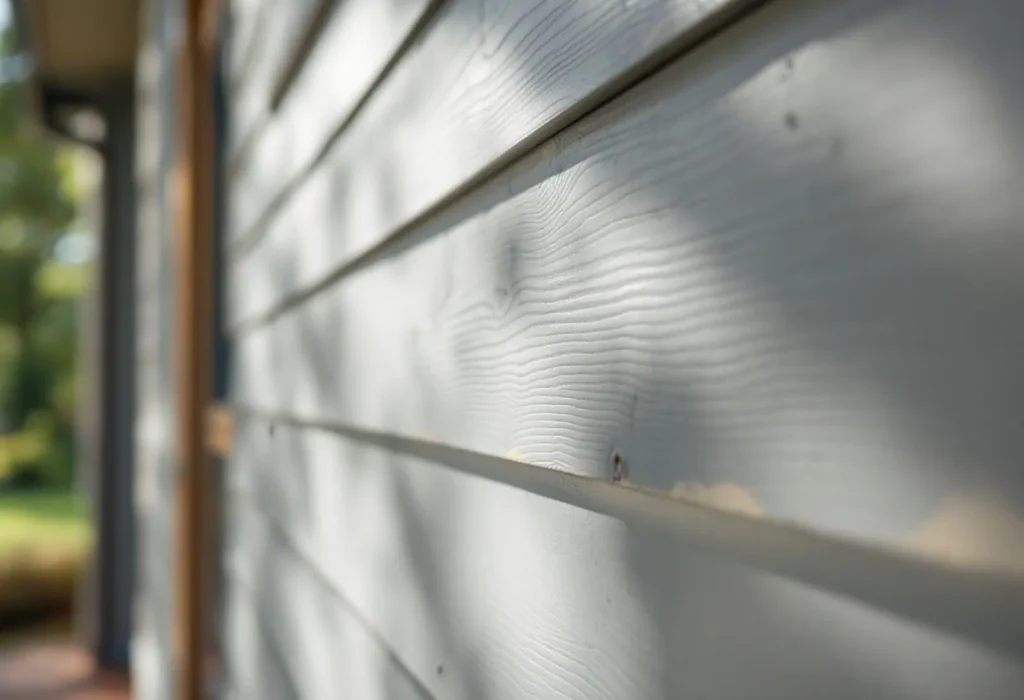
Because the name is older than the formula. According to the Australian government Asbestos Product Guide, Hardiplank, Hardiplank Woodgrain and Hardigrain were asbestos cement individual planks used from the 1960s to mid-1980s, and says that, like AC sheeting, they generally contained around 15% chrysotile asbestos. The planks imitated timber weatherboards in flat or woodgrain finishes, were overlapped horizontally and nailed into studs.
The same entry says that after asbestos use ceased, Hardie made identical looking cellulose fibre replacements sold as Hardiplank II Smooth and Hardiplank II Woodgrain. Its identification notes are punched nail heads, joints that may be filled with putty, and a brand that may be printed on the underside edging. It adds that adhesives used with the planks may contain asbestos, and that sampling for testing by a NATA accredited laboratory is the only way to confirm content.
For a board you believe James Hardie made or sold, the James Hardie Australia Asbestos FAQ gives a customer service number, 13 11 03, for product specific guidance in Australia. Ask for the product name, the year it was made, and whether that line was asbestos cement or cellulose fibre cement in that year; those three answers decide whether a sample is worth taking.
If US siding went up before 1990, which asbestos cement product could it be?
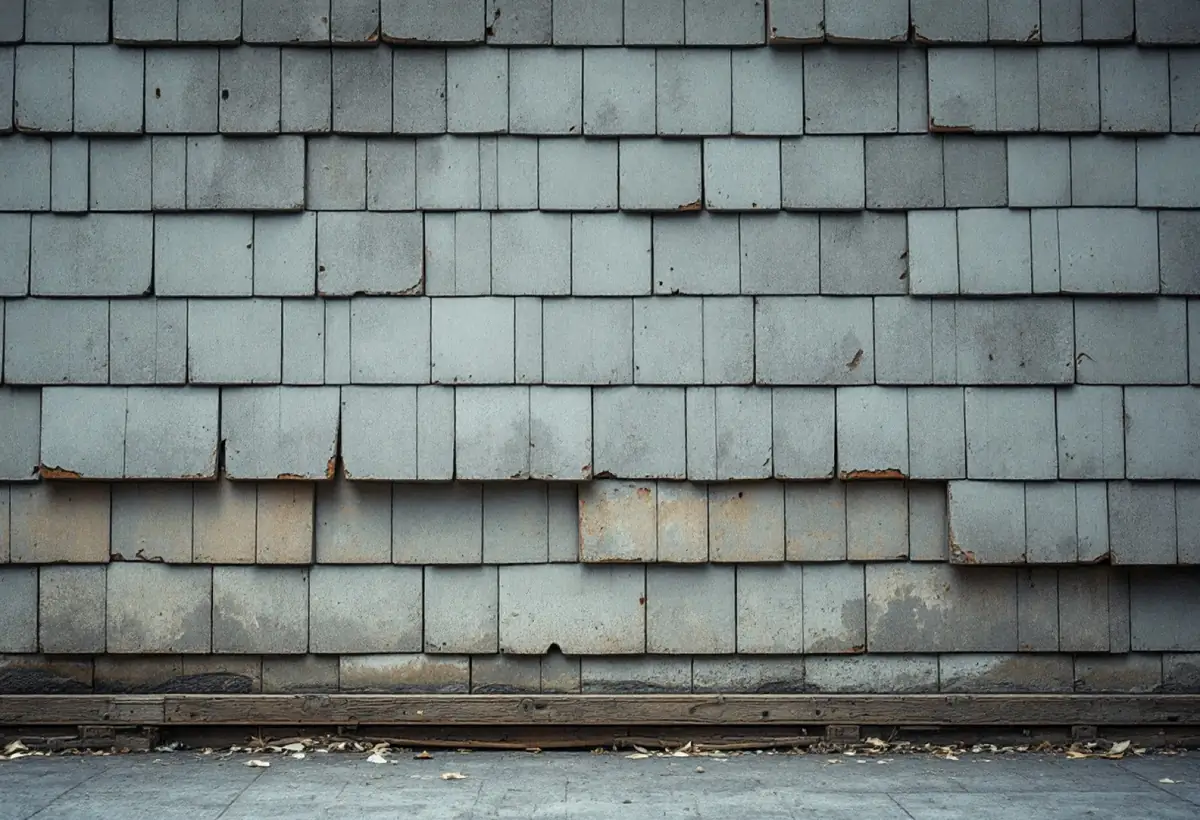
Not Hardie, but a different product family. The EPA 1994 NESHAP roofing guidance manual describes asbestos cement (A/C) sheet as a mix of asbestos, cement and silica with an asbestos content of 15 to 40 percent. A/C shingles were cut from that flat sheet in sizes from 9 in. by 16 in. to 14 in. by 30 in., lasted 30 to 50 years, and came with pilot nail holes punched at the plant.
The same EPA manual says A/C shingles had been in use in the US for more than 80 years by 1994, that asphalt asbestos shingles were sold until 1979, and that A/C shingles were sold until 1992. It adds that corrugated and flat A/C sheets had been used as wall cladding since the 1930s. That 1992 date matters: a US house sided between 1990 and 1992 could carry either product.
On the regulatory side, the EPA 2019 significant new use rule records that EPA’s 1989 ban rule (54 FR 29460, 12 July 1989) covered asbestos cement shingles, flat sheet, corrugated sheet and pipe, and that the Fifth Circuit partially vacated that rule in 1991 in Corrosion Proof Fittings v. EPA. The 2019 rule, effective 24 June 2019, found no evidence that asbestos cement products were still an ongoing use, and now requires EPA review before any return. The broader picture of shingle and panel siding is on our asbestos siding page.
Intact A/C siding is low risk to live with: the University of Wyoming Safety Office fact sheet notes that hard products such as cement shingles contain binders that encapsulate the asbestos, and the EPA homeowner asbestos guidance says material in good condition that will not be disturbed is usually best left alone. Shingle roofs of the same material are covered on our asbestos shingles page.
Built before 1990, between 1990 and 1992, or after: what is the board on your wall?
The table turns the dates above into a decision you can act on before a saw touches the board. Read the left column by installation date, not by the date the house was built: a 1975 house re sided in 2005 sits in the third row. EPA’s 1994 manual, the 20-F and the Australian product guide supply every date in it.
| Where and when installed | What it most likely is | Before cutting |
|---|---|---|
| US, siding installed before February 1990 | Could be A/C siding or shingles from another maker; not Hardie fiber cement | Treat as suspect. Test before cutting, drilling or removal |
| US, installed 1990 to 1992 | Hardie fiber cement or A/C shingles still on sale until 1992 (EPA) | Check the back for a maker name, then test if unbranded |
| US, installed after 1992, Hardie branded | Fiber cement: cellulose, sand, cement, water (20-F) | No asbestos test needed; control silica dust (OSHA Table 1) |
| US, Hardie Backer behind tile | Fiber cement tile underlayment from post 1990 US plants | No asbestos test needed; same silica controls when cut |
| Australia, Hardiplank or Hardigrain on a house built 1960s to 1985 | Likely asbestos cement plank, around 15% chrysotile (Asbestos Product Guide) | Do not cut. NATA accredited lab sample, or ask the maker on 13 11 03 |
| Australia, Hardie building product made 1986 or later | Asbestos free fibre cement, including Hardiplank II (Asbestos FAQ) | Confirm the date of manufacture; silica controls when cut |
Looks will not settle the middle rows. Both A/C and modern fiber cement are grey, cement based and nailed in overlapping courses, and the Australian guide notes that Hardie’s replacements were made to look identical. Printed marks are the next clue, and how to read them is explained on our manufactured without asbestos stamp page. When there is no mark, a sample decides it, and published per sample lab prices are compared on our asbestos testing cost page.
What does OSHA Table 1 require when cutting modern Hardie board with a saw blade of 8 inches or less?
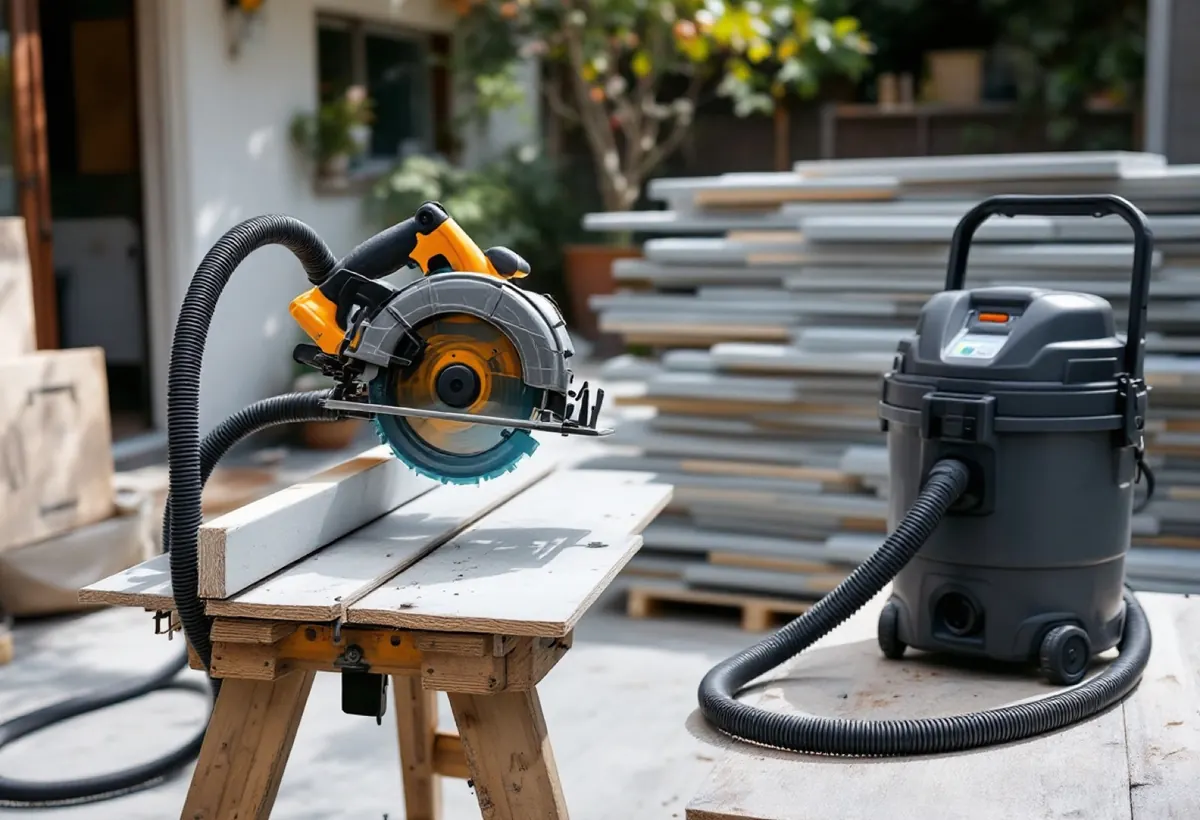
Modern board swaps the asbestos question for a silica one, because sand is a main ingredient. 29 CFR 1926.1153 sets a permissible exposure limit of 50 micrograms of respirable crystalline silica per cubic metre as an 8 hour time weighted average and an action level of 25. Table 1 gives a specific entry for handheld power saws cutting fiber cement board with a blade diameter of 8 inches or less.
Under that OSHA entry, for tasks performed outdoors only, the saw must have a commercially available dust collection system, be run and maintained to the tool maker’s instructions to minimise dust, and the dust collector must provide at least the air flow the tool maker recommends with a filter of 99% or greater efficiency. The required respiratory protection column reads none for both 4 hours or less and more than 4 hours per shift.
Two limits on that rule. The entry is written for outdoor cutting, so indoor cutting falls back on the 50 microgram PEL in paragraph (d) of 29 CFR 1926.1153. And it binds employers, not homeowners. The James Hardie silica safety page repeats the Table 1 controls. According to the maker, typically less than 5% of the dust from cutting fiber cement is respirable silica. The same page names miter saws and panel saws as examples of controls not listed in Table 1, which means an employer using them must meet the PEL under paragraph (d) instead.
What do OSHA and EPA require once old cement siding tests above 1% asbestos?
Siding is not presumed asbestos under 29 CFR 1926.1101: the presumed category (PACM) covers only thermal system insulation and surfacing material in buildings constructed no later than 1980. So a lab result, not the build year, triggers the rules. Once positive, removing it is Class II asbestos work, the class for ACM that is not thermal system insulation or surfacing material.
Paragraph (g)(8)(iii) of the OSHA standard then sets four practices for cementitious siding, shingles and transite panels. Cutting, abrading or breaking them is prohibited unless the employer shows a less fibre releasing method cannot be used. Each panel or shingle is sprayed with amended water before removal. Nails are cut with flat, sharp instruments. Unwrapped panels go down a covered dust tight chute, or are bagged or wrapped and lowered by the end of the shift.
Under the EPA asbestos NESHAP, 40 CFR 61.141 defines Category II nonfriable ACM as material over 1 percent asbestos that cannot be crumbled by hand pressure when dry, and makes it regulated material only if demolition or renovation will crumble or pulverize it. EPA’s 1994 manual, written for A/C roofing shingles, says careful removal with pry bars, spud bars or shovels and hand lowering does not do that, while dropping shingles from a building or scraping them off with heavy machinery does. The friable line is explained on our friable asbestos page.
Questions people actually ask
How can you tell if cement board has asbestos?
Only a lab test confirms it. Date and place narrow the odds: EPA’s 1994 manual says asbestos cement shingles were sold in the US until 1992, and James Hardie says it dropped asbestos from building products in 1985. A maker name on the back helps; an unbranded grey board on a pre 1993 US wall needs a PLM sample before anyone cuts it.
Is Hardie board siding toxic?
Intact board is not an asbestos source: the FY2025 Form 20-F lists its raw materials as cellulose fiber, silica sand, Portland cement and water. The hazard is dust when it is cut, because of the silica. OSHA’s 29 CFR 1926.1153 Table 1 covers that with a saw dust collector and a filter of 99% or greater efficiency for outdoor cutting.
Does Hardie Plank siding have asbestos?
Not in the US product. Hardie Plank sold in the US comes from fiber cement plants that opened from February 1990, five years after the 1985 cutoff the maker gives for building products. The Australian name Hardiplank is different: the Australian Asbestos Product Guide lists it as an asbestos cement plank made from the 1960s to the mid 1980s.
Does Hardie Backer board contain asbestos?
No. Hardie Backer is the tile underlayment in the current lineup listed in the James Hardie FY2025 Form 20-F, made in US fiber cement plants that opened from 1990 onward. Older cement backer boards from other makers are a separate question: date the installation, look for a maker name, and send a sample to an accredited lab if the board is unbranded and pre 1993.
Can I paint or cover old asbestos cement siding instead of removing it?
EPA’s homeowner guidance says asbestos material in good condition that will not be disturbed is usually best left alone, and the University of Wyoming notes cement shingle binders encapsulate the fibres. Nailing new siding over it drives fasteners through the panels, so ask your state asbestos program whether that counts as disturbance before you start.
Out of scope. This page covers what the board is made of and the rules for cutting or removing it. For health effects of asbestos or silica dust, see the EPA, NIH and CDC pages on each.
Sources
- James Hardie Australia Asbestos FAQ, James Hardie Australia Pty Ltd, Asbestos FAQ (2024). Dates 1981, 1985 and 1987, customer service number. Retrieved 16 November 2026.
- FY2025 Form 20-F, James Hardie Industries plc, Annual Report on Form 20-F for the year ended 31 March 2025, filed with the US Securities and Exchange Commission. Company history, Fontana February 1990, plant capacity table, raw materials, asbestos history. Retrieved 16 November 2026.
- James Hardie US FAQ and James Hardie silica safety page, James Hardie Building Products. Composition, warranty, Table 1 cutting controls and respirable fraction statement. Retrieved 16 November 2026.
- Asbestos Product Guide, Asbestos and Silica Safety and Eradication Agency, Australian Government: asbestos cement (individual) planks. Retrieved 16 November 2026.
- EPA 1994 NESHAP roofing guidance manual, US Environmental Protection Agency, Applicability of the Asbestos NESHAP to Asbestos Roofing Removal Operations, EPA 340B94001, August 1994. Retrieved 16 November 2026.
- EPA 2019 significant new use rule, Restrictions on Discontinued Uses of Asbestos; Significant New Use Rule, 84 FR, 25 April 2019, effective 24 June 2019. Retrieved 16 November 2026.
- EPA asbestos regulatory history, US EPA, last updated 21 January 2026, and EPA homeowner asbestos guidance, last updated 25 June 2026. Retrieved 16 November 2026.
- 29 CFR 1926.1153 (respirable crystalline silica in construction, Table 1) and 29 CFR 1926.1101 (asbestos in construction), via the Legal Information Institute, Cornell Law School. Retrieved 16 November 2026.
- 40 CFR 61.141, asbestos NESHAP definitions, via the Legal Information Institute. Retrieved 16 November 2026.
- University of Wyoming Safety Office fact sheet, University of Wyoming Safety Office, Asbestos Fact Sheet. Retrieved 16 November 2026.
- How we choose and check sources is set out in our methodology; more rule explainers sit in the standards hub.
Federal rules set a floor. State asbestos programmes and air agencies can add survey, notice and work practice duties for siding removal; ask yours what applies before work starts.