The short answer
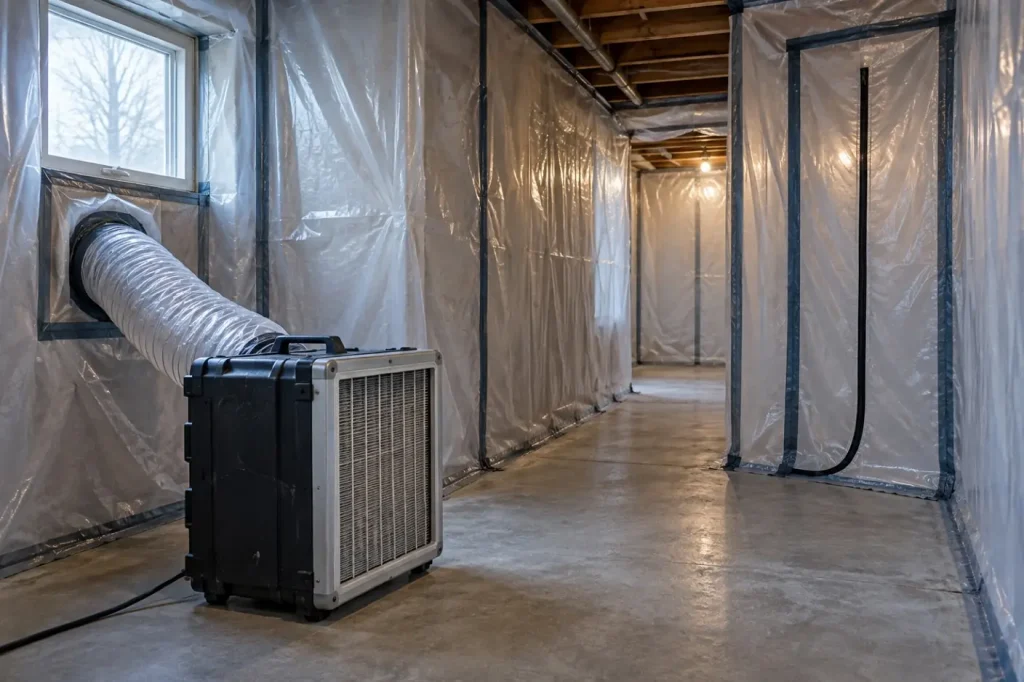
How long does mold remediation take? The hands-on work on a typical home job runs about 1 to 5 days, the range RestoPros and Astrid Environmental Services publish. The calendar is longer: assessment, a written protocol, state notice periods, drying, clearance sampling and lab turnaround sit either side of the work, and an insurance-funded job can also wait on the carrier.
Key takeaways
- RestoPros’ own phase figures sum to 6 to 11 days run back to back, against its headline of 1 to 5 days. Headlines quote the work clock, not the calendar.
- The lab is often the longest wait: the Wisconsin Occupational Health Laboratory averages 5 to 10 working days at normal service, and EMSL prices culture work only at its two-week tier.
- Texas requires state notice at least 5 calendar days before remediating 25 contiguous square feet or more, and work must start on the date filed.
- Texas, New York and Florida bar the remediator from assessing its own job, so a second firm’s diary enters the timeline twice.
- Florida gives an insurer up to 60 days after notice to pay or deny a property claim, per section 627.70131.
On this page
- The clock, phase by phase
- Totals by job size
- Delay one: the lab
- Delay two: the separate assessor and state notice
- Delay three: waiting on the insurer
- Delay four: drying that will not finish
- Five worked timelines
- Estimate your own timeline
- Getting back in
- For contractors
- Questions people actually ask
Ask a remediation firm how long the job takes and you hear the work clock: days inside containment. Ask the owner afterwards and you hear the calendar clock, from first call to usable room. This page measures both, from durations named firms publish, turnaround named labs print, and deadlines in Texas, New York and Florida law. It does not re-explain the steps; our mold remediation process guide covers the method and the order.
The clock, phase by phase
Two firms publish a duration for each phase. COIT and RestoPros agree on the shape and disagree on removal, the step that scales with the size of the job.
| Phase | COIT (April 2024) | RestoPros (June 2025) | What sets the length |
|---|---|---|---|
| Assessment | 1 to 2 days | 1 day | Area size and access to cavities. |
| Written protocol | Not listed | Not listed | Texas: to the client 1 calendar day before work (16 TAC 78.100). |
| Containment | 1 day | 1 day | Rooms sealed; airlock or not. |
| Removal | 1 to 5 days | 1 to 2 days | Porous material coming out. |
| Cleaning and sanitizing | 1 to 2 days | 1 to 2 days | Surface left after removal. |
| Drying and dehumidifying | 1 to 3 days | 1 to 3 days | Measured moisture in the assembly. |
| Clearance testing | Not listed | 1 to 2 days | Whether sampling is specified; the lab. |
| Rebuild | Variable | Inside ‘drying and restoration’ | A separate trade schedule after clearance. |
Added end to end, COIT’s assessment-to-drying figures come to 5 to 13 days. RestoPros‘ phase figures, run back to back, come to 6 to 11 days, against the 1 to 5 days it quotes for homes on the same page. Phases overlap on a well-run job, which explains part of the gap; the rest is that headlines describe the work clock.
Totals by job size
The size bands are EPA’s: Table 2 of EPA's Mold Remediation in Schools and Commercial Buildings splits jobs at 10 and 100 square feet, and the NYC Department of Health guidelines of November 2008 use the same breakpoints. EPA says the bands help select techniques, ‘not on the basis of health effects’. The durations are what firms publish.
| Job size | Published duration | Second published figure |
|---|---|---|
| Small: under 10 sq ft | 1 to 2 days (RestoPros) | ‘Resolved in a day’ for a small patch (Astrid) |
| Medium: 10 to 100 sq ft | 2 to 5 days (RestoPros) | 3 to 7 days for moderate jobs (Restoration 1 NJ) |
| Large: over 100 sq ft | A week or longer (RestoPros) | Several days to a week, multiple rooms (Astrid) |
| Commercial or severe | 1 to 2 weeks (RestoPros) | Up to several weeks (Restoration 1 NJ) |
Delay one: the lab
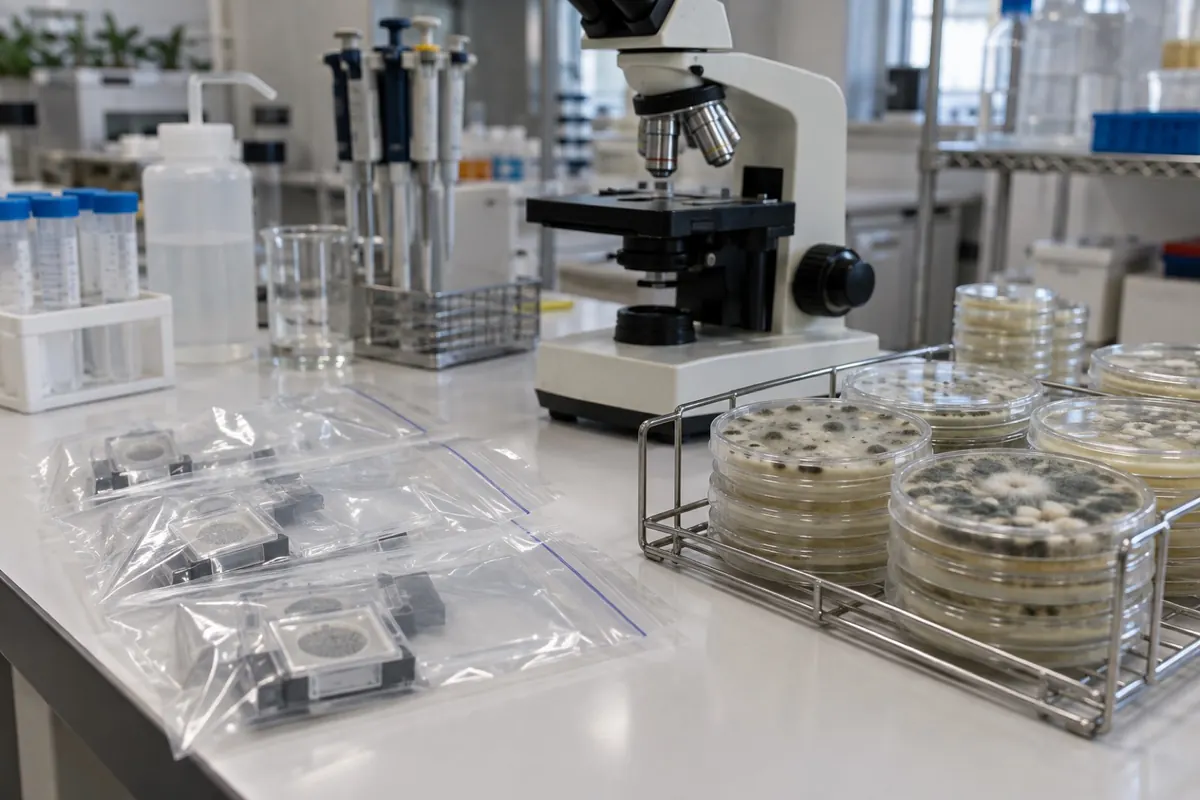
Sampling is not always part of a job: EPA says that in most cases, if visible mold growth is present, sampling is unnecessary. When a protocol does call for clearance samples, the job is not closed until results return, and the turnaround you pay for is the turnaround you get.
| Laboratory | Service | Published turnaround | Published price |
|---|---|---|---|
| Wisconsin Occupational Health Laboratory | Normal | 5 to 10 days (working-day average) | $42 per spore trap, per the WOHL list |
| Wisconsin Occupational Health Laboratory | Priority, spore traps | 3 to 5 days | $63 |
| Wisconsin Occupational Health Laboratory | Rush, spore traps | 1 to 2 days | $84 |
| EMSL Analytical | Spore trap, Air-O-Cell | 3 hours to 2 weeks, by tier | $328 at 3 hours to $68 at 2 weeks |
| EMSL Analytical | Culturable fungi, genus ID | 2-week tier only | $113 |
Speed costs money. On the EMSL Analytical 2026 commercial price list the same spore trap analysis costs 4.8 times as much at 3 hours as at 2 weeks, and WOHL charges 2 times its normal price for rush. Culture is slow by nature, because the fungi must grow before they can be counted. Ask which method the protocol names before planning a move-back date. Test prices are in our mold inspection cost guide.
Delay two: the separate assessor and state notice
In three large states the firm that removes the mold may not judge the job, which puts a second company’s diary on the critical path twice: to write the protocol and to pass or fail the work. Each rule below was read in the statute or regulation itself.
| Jurisdiction | Separation rule | Clocks it adds |
|---|---|---|
| Texas | Same license holder may not assess and remediate one project (1958.155) | Protocol 1 calendar day before work; state notice 5 calendar days before start at 25 contiguous sq ft or more ($25 fee, per the TDLR page); certificate within 10 days after |
| New York State | No licensee may assess and remediate the same property (936); projects are over ten square feet (930) | Plan must state an estimated time frame (945); assessor runs the post-remediation assessment (947) |
| New York City, 10 or more units | Owners and their staff may not do work over ten square feet (24-154) | Notice 2 business days before work; assessor files within 7 days of the post-remediation assessment |
| Florida | No remediating a structure you assessed in the last 12 months, or the reverse (468.8419) | No notice period in the sections read |
The Texas notice has a sting: under 16 TAC 78.110, work may not begin or be completed on a date other than the one filed, except in an emergency, where delay after water damage would increase mold contamination. A slipped start means an amended filing. Other states are mapped in our state mold licensing guide.
Delay three: waiting on the insurer
When an owner waits for a carrier’s decision before authorising work, the claim clock is added to the job clock. States set outer limits for each claim step, and they are long next to a five-day remediation. These are legal maximums, not typical times.
| Step | Days | Counted from |
|---|---|---|
| Florida: pay or deny | 60 | calendar days after notice |
| Texas: extended decision | 45 | days after delay notice |
| Florida: physical inspection | 30 | days after proof of loss |
| Texas: acknowledge and investigate | 15 | days after notice |
| Texas: accept or reject | 15 | business days after all items |
| New York: acknowledge | 15 | business days after notice |
| New York: accept or reject | 15 | business days after proof |
| Florida: acknowledge | 7 | calendar days after a claim message |
These are regulator deadlines, not what any policy pays. Your policy wording decides coverage; read it, ask your state insurance department and a licensed professional. See our guide to whether homeowners insurance covers mold remediation.
Delay four: drying that will not finish
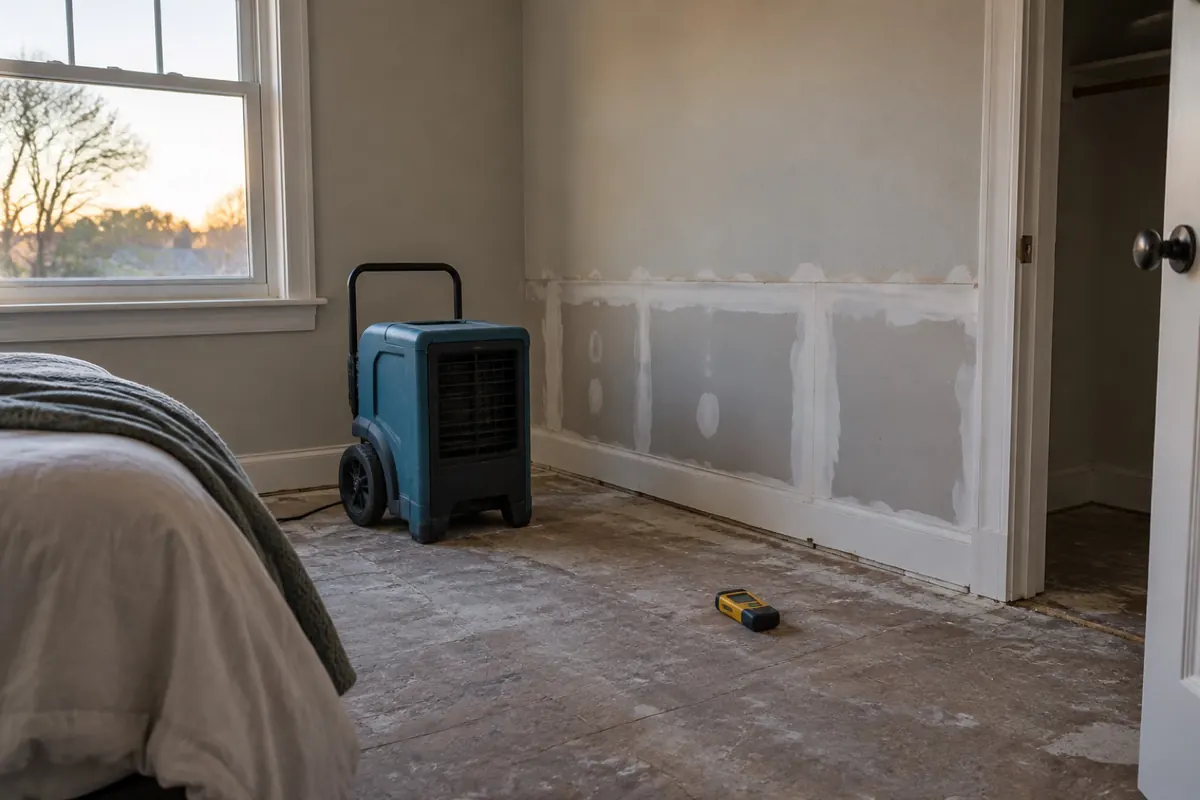
The published drying figures cluster around three days: COIT says 1 to 3, RestoPros says 1 to 3, Greenworks (December 2021) says about three, and Restoration 1 of New Jersey says 24 to 48 hours for drying with fans and dehumidifiers. Those are estimates. The finish line is a condition, not a date: EPA's A Brief Guide to Mold, Moisture and Your Home says the water or moisture problem must be completely fixed before cleanup can be considered finished, and the NYC guidelines say all areas should be left dry. A leak that is still feeding the cavity resets the clock every day it runs.
Drying science, dehumidifier sizing and why slabs and framing lag behind drywall are covered in our guide to how long water damage drying takes.
Five worked timelines
Each total is our arithmetic on the figures above, phases added end to end, with working days counted as calendar days, so real calendars run longer over weekends. None is a quote.
| Situation | Calendar total | How it is built |
|---|---|---|
| Small patch under 10 sq ft, no sampling | 1 to 2 days | RestoPros small-area figure. |
| Medium job, no clearance lab | 5 to 13 days | COIT assessment through drying, end to end. |
| Texas, 25 contiguous sq ft or more, lab at normal service | 16 to 30 days | Adds the 5-day notice, a sampling day or two (RestoPros) and WOHL’s 5 to 10 working days. |
| Same Texas job, rush lab | 12 to 22 days | WOHL rush, 1 to 2 days, in place of normal. |
| NYC covered building, lab at normal service | 13 to 27 days | Adds the 2 business-day notice instead of Texas’s five. |
Once a state program and a lab are involved, the waits outside containment match the work inside it. A Florida claim at the statutory limit could add up to 60 days before a funded start.
Estimate your own timeline
Work down the list, add the days for each yes, and you have a defensible estimate to hold a contractor’s schedule against.
| Step | Question | If yes, add | Source |
|---|---|---|---|
| 1 | Is the moldy area over 10 sq ft (NY, FL) or 25 contiguous sq ft or more (TX)? | A licensed assessor first: 1 to 2 days (COIT). | Labor Law 930; F.S. 468.8411; 16 TAC 78.110 |
| 2 | Texas job of 25 contiguous sq ft or more? | At least 5 calendar days before start, or the next working day in an emergency. | 16 TAC 78.110 |
| 3 | NYC building with 10 or more units, over 10 sq ft? | At least 2 business days before start. | Admin Code 24-154 |
| 4 | How big is the hands-on job? | Small 1 to 2 days, medium 2 to 5, large a week or longer. | RestoPros |
| 5 | Does the protocol specify clearance samples? | 1 to 2 days to sample, then 1 to 2 (rush) or 5 to 10 working days (normal); culture runs to two weeks. | RestoPros; WOHL; EMSL |
| 6 | Did it fail clearance? | Another cleaning cycle and another round of samples. | NY Labor Law 947 |
| 7 | Is work waiting on an insurer’s decision? | Up to the state limits in the claim table. | F.S. 627.70131; TX Ins. Code 542; 11 NYCRR 216 |
| 8 | Is rebuild in the same contract? | Add the trade schedule; COIT lists it as variable. | COIT |
Getting back in
Re-entry advice comes from firms, not regulators. COIT says 24 to 48 hours. AdvantaClean of Fort Lauderdale (June 2025) says 12 to 24 hours for small jobs, 24 to 48 for moderate and 48 to 72 or more for large ones, especially while air scrubbers or negative air machines run. Staying during the work is a planning call: EPA's Mold Remediation in Schools and Commercial Buildings weighs the size of the affected area and the disruption, and the NYC guidelines want the work area unoccupied at every size.
For contractors: putting time into the scope
Duration is a line item, and in New York it is a written one: section 945 makes the assessor’s plan state an estimated time frame. Equipment, containment and monitoring bill by the day, so the schedule is the part of an estimate most likely to be questioned. Keep the dated documents in the job file: the Texas protocol and notice receipt, the New York City work plan notice, the daily moisture log, the lab chain of custody and the passed clearance report or Texas certificate. They show which waiting days a rule or a lab set. Pricing is in our mold remediation cost guide, and owners weighing a small job themselves should start with our guide to DIY mold remediation.
What this page does not cover. Questions about how a person feels after exposure, or how long recovery takes, are medical and outside our scope. Ask a health professional, and see the mold pages of the CDC and EPA. Our mold hub lists our other guides.
Questions people actually ask
How long should you stay out of the house after mold remediation?
Published advice comes from firms, not regulators. COIT says 24 to 48 hours. AdvantaClean of Fort Lauderdale says 12 to 24 hours for small jobs, 24 to 48 for moderate ones and 48 to 72 or more for large ones, especially while air scrubbers still run. If clearance sampling was specified, wait for the passed result.
Can mold be fully remediated?
Not to zero. EPA says it is impossible to get rid of all mold and mold spores indoors, and that a background level of spores will remain. Remediation is finished when the moisture problem is fixed, visible mold and moldy odors are gone, and, where sampling was done, indoor results resemble outdoor air.
Can you stay in your home during mold remediation?
Often, for contained work in part of a house. EPA says the relocation decision should weigh the size and type of the affected area and the disruption the work causes. The NYC Department of Health guidelines say the work area itself should be unoccupied, whatever its size.
How long does clearance testing take?
Sampling usually takes a visit; RestoPros lists post-remediation testing at 1 to 2 days. Results depend on the lab: the Wisconsin Occupational Health Laboratory averages 5 to 10 working days at normal service and 1 to 2 days on rush for spore traps, while culture methods run to two weeks on EMSL’s price list.
Why does mold remediation take longer in Texas?
For remediation of 25 contiguous square feet or more, Texas requires notice to the state at least five calendar days before the start date, and work may not begin on any other date except in an emergency. The assessor must also deliver a written protocol at least one calendar day before work, and a different licensee must do the assessment.
Who pays for mold remediation, and does that slow it down?
That depends on the policy and the cause, which this page cannot decide. What it can say is that state law gives insurers time: Florida allows up to 60 days after notice to pay or deny, and Texas allows 15 business days after receiving all requested items to accept or reject. Check your policy and state insurance department.
Sources
- COIT, dated 1 April 2024; RestoPros, dated 30 June 2025. Retrieved 11 October 2026.
- Astrid Environmental Services, 30 April 2025; Restoration 1 of New Jersey, undated; Greenworks, 14 December 2021; AdvantaClean of Fort Lauderdale, 8 June 2025. Retrieved 11 October 2026.
- Wisconsin Occupational Health Laboratory 2025 fee schedule. Retrieved 11 October 2026.
- EMSL Analytical 2026 commercial price list, revision of 9 January 2026. Retrieved 11 October 2026.
- EPA's A Brief Guide to Mold, Moisture and Your Home, updated 18 February 2026; EPA's Mold Remediation in Schools and Commercial Buildings, EPA 402-K-01-001. Retrieved 11 October 2026.
- NYC Department of Health guidelines, November 2008, archived nyc.gov copy. Retrieved 11 October 2026.
- NYC Administrative Code section 24-154, Local Law 61 of 2018. Retrieved 11 October 2026.
- New York Labor Law section 936, New York Labor Law section 945 and section 947, Labor Law Article 32. Retrieved 11 October 2026.
- Texas Occupations Code section 1958.155, Texas Occupations Code section 1958.154, 16 TAC 78.100, 16 TAC 78.110 and the TDLR notification page. Retrieved 11 October 2026.
- Florida Statutes section 468.8419. Retrieved 11 October 2026.
- Florida Statutes section 627.70131, Texas Insurance Code section 542.055, section 542.056, 11 NYCRR 216.4 and 11 NYCRR 216.6. Retrieved 11 October 2026.
- Totals and ratios are our arithmetic on the figures above. See our methodology.
Durations are published estimates; statutory figures are outer limits. A job’s schedule is set by its protocol, its state and its lab.