The short answer
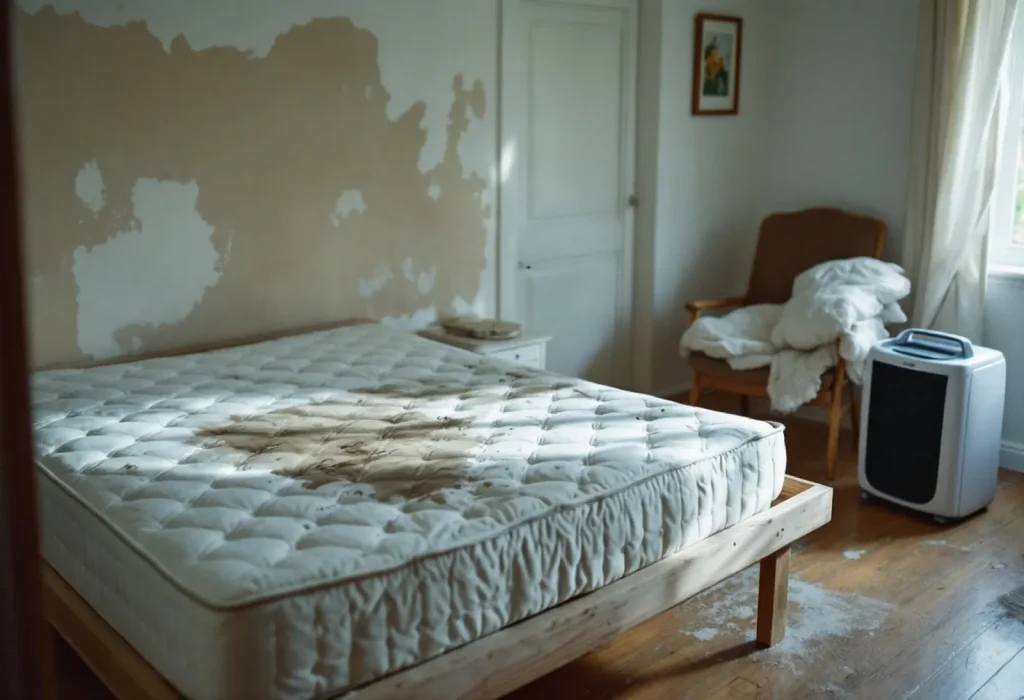
A water damaged mattress can be kept only if the water was clean, the soak was small, and the core dries fully within 24 to 48 hours. Floodwater, sewage or toilet backflow means discard: EPA lists mattresses under Best to Remove It after a flood, and CDC says to throw away mattresses you cannot clean or dry quickly.
Which water soaked it: spill, rain, urine, flood or sewage?
The keep or discard call for a mattress or a water damaged rug starts with the source, because the restoration industry sorts water by contamination before it sorts anything else. The Northern Arizona University Water Damage Restoration Guideline, written to the IICRC S500 standard, puts broken supply lines, sink overflows and falling rainwater in Category 1, puts washing machine discharge and toilet overflows with some urine in Category 2, and puts all flooding from rivers or streams and any sewage in Category 3. The full scale is on our IICRC water categories page.
Category is not fixed. The same guideline says clean water degrades as it mixes with soils and as time passes, and that gray water left untreated longer than 48 hours may become Category 3. A rain soaked mattress that then sat on a muddy driveway for two days is no longer a Category 1 item.
| Water source | Category (NAU, IICRC S500) | All foam or latex core | Innerspring or hybrid core | Source |
|---|---|---|---|---|
| Spilled glass or bottle of tap water | Category 1 | Keep: blot, then dry within 24 to 48 h | Keep: blot, dry, check bottom fabric | Northern Arizona University Water Damage Restoration Guideline; EPA brief guide to mold and moisture |
| Rain on an open truck or porch, no ground contact | Category 1 | Keep only if fully dry within 48 h | Keep only if fully dry within 48 h | Northern Arizona University Water Damage Restoration Guideline (falling rainwater) |
| Burst supply line or water heater, deep soak | Category 1 | Usually discard: core cannot dry in 48 h | Possible if coil gap and fabric dry in 48 h | EPA Table 1 water damage guidance |
| Urine, washing machine discharge, AC condensate | Category 2 | Discard if the soak reached the core | Discard if the soak reached the core | Northern Arizona University Water Damage Restoration Guideline |
| Gray water left over 48 h | Category 3 | Discard | Discard | Northern Arizona University Water Damage Restoration Guideline |
| Floodwater from rivers, streams or storm surge | Category 3 | Discard | Discard | EPA What Can I Keep? flood sheet; CDC disaster cleanup guidance |
| Sewage or toilet backflow beyond the trap | Category 3 | Discard | Discard | Northern Arizona University Water Damage Restoration Guideline |
The two core columns differ only for clean water. Once the water is Category 2 or 3, EPA and CDC guidance treats the mattress as a porous item that cannot be cleaned, whatever is inside it.
Why a foam or latex core stays wet longer than a coil core
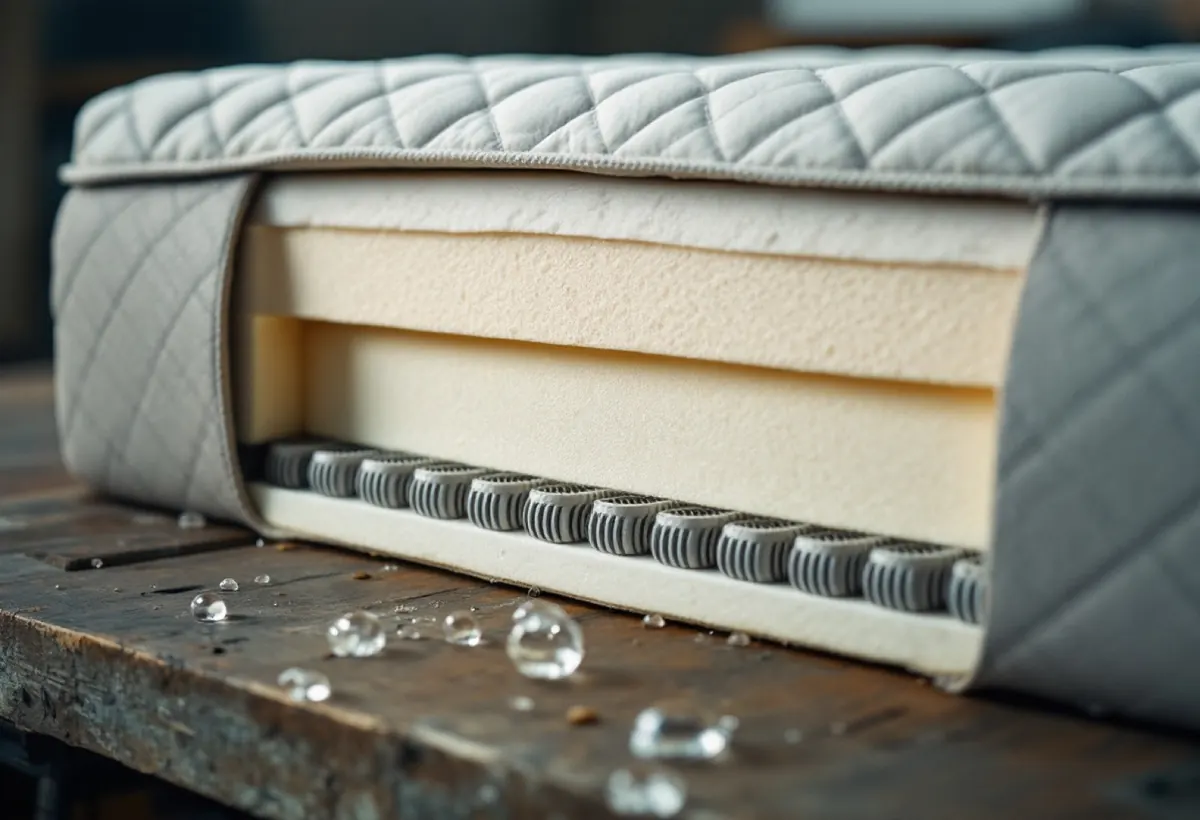
Per the Polyurethane Foam Association product chart, flexible polyurethane foam, the foam used in mattresses, is more than 90% open cell and porous, and the PFA bulletin describes memory foam as an open cell variety of the same material. Open cells let liquid travel through the layer instead of sitting on top, so a spill on a foam bed spreads downward and sideways into a plume that has no air gap to drain into.
Latex behaves the same way: the Gardner Mattress latex materials page describes Talalay latex as having an open cell structure. An innerspring or hybrid bed is different only below the comfort layers. The steel coil unit is mostly air, so water that gets past the foam falls through and lands on the bottom fabric and the foundation, which are the last parts to dry.
Weight is the practical problem. A cubic foot of the 1.8 pound per cubic foot foam PFA used in its test slab weighs 1.8 lb, while a cubic foot of water at 70 F weighs 62.3 lb according to the USGS water density table, about 35 times as much. The table below shows what that means if water fills part of the foam.
| Share of foam volume holding water (assumed) | Water in one cubic foot | Times the dry weight of 1.8 pcf foam |
|---|---|---|
| 10% fill, per the assumption | 6.2 lb | 3.5 times |
| 25% fill, per the assumption | 15.6 lb | 8.7 times |
| 50% fill, per the assumption | 31.1 lb | 17.3 times |
At even a 10% fill, one cubic foot of foam carries 6.2 lb of water, 3.5 times its own weight per the calculation above. That water has to leave through the cover by evaporation, which is why EPA guidance on upholstered items warns they may be hard to dry inside 48 hours.
How to dry a clean water spill inside the 24 to 48 hour window
The EPA brief guide to mold and moisture says wet materials dried within 24 to 48 hours after a leak or spill will, in most cases, not grow mold. That window is the whole test for a Category 1 spill: the order below is built around it.
- Strip the bed and wash sheets and the protector separately. The Mattress Recycling Council care tips say not to make the bed until the mattress has completely dried.
- Blot, do not rub. The Mattress Recycling Council care tips say to remove the liquid as quickly as possible and blot the wet surface until it is fully removed.
- Lift the mattress off the floor onto open slats or a frame so air reaches the bottom fabric, the layer where water collects in a coil bed.
- Move air across both faces. The EPA Table 1 water damage guidance lists dehumidifiers, fans and heaters to speed drying of upholstered items; the CDC disaster cleanup guidance adds opening doors and windows and aiming fans to blow air outdoors.
- Hold the room dry. The EPA brief guide to mold and moisture advises indoor humidity below 60 percent, ideally 30 to 50 percent; the NAU guideline treats 50% RH at 70 F as normal room conditions. The same fan and dehumidifier setup for soaked textiles is laid out on our wet carpet drying page.
- Check the deepest point, not the cover. The NAU guideline judges drying by comparing moisture meter readings against a dry control point; the same idea applied to a mattress means pressing a pin meter into the stain and into a dry corner and comparing the two.
If the stain still smells musty after 48 hours, or spots appear on the cover, the problem is no longer water. That case is handled on our mold on mattress page.
Can a wet mattress go in a washing machine or be hosed down outside?
None of the 5 maker warranty pages or the industry care tips read for this article tells owners to machine wash or hose a mattress core. The Mattress Recycling Council care tips say to lightly spray a stain, never soak it, and dab rather than rub.
Hosing a bed adds exactly the deep water the weight calculation above describes, and the Tuft & Needle limited warranty lists attempting to clean the product in an inappropriate manner as a condition that voids its warranty. A zip off cover is a separate item: follow the care tag on the cover itself, and leave the core out of the machine.
Floodwater or sewage reached the bed: why EPA and CDC say remove it
The EPA What Can I Keep? flood sheet sorts flooded belongings into three groups and puts mattresses in Best to Remove It, alongside cloth upholstered furniture, cushions and pillows; bedding and blankets sit in the Maybe group. The CDC disaster cleanup guidance says to throw away anything you cannot clean or dry quickly, naming mattresses first in its list.
Flood and sewage water is Category 3 under the NAU guideline, and a mattress has no surface that can be scrubbed and rinsed down to the core. The full keep and toss list for a flooded home is on our flood discard page, and sewage handling is on the sewage damage cleanup page.
Disposal has its own rule. The Bye Bye Mattress FAQ says recycling programs run by the Mattress Recycling Council in California, Connecticut, Oregon and Rhode Island separate steel, foam, fabric and wood, but for Connecticut and Rhode Island a mattress that is heavily soiled, moldy or excessively wet needs a call to the drop off site first, and fees may apply. Elsewhere, ask the city or waste hauler for the bulky item pickup rule and whether wet units must be wrapped.
Photograph the mattress, the water line and the law tag before it leaves the house. The Purple limited warranty asks for photos of the overall condition and cleanliness of the mattress and an intact law tag before it processes a claim, and the tag carries the maker and model an insurer will ask for.
Does a mattress warranty cover water damage? Five makers’ terms
Warranties with terms up to 25 years cover defects in materials and workmanship, and all 5 read for this page carve out liquid, stains or an unsanitary condition. The wording is quoted or closely paraphrased below so owners can find it in their own copy.
| Maker | Mattress term | Water and stain wording | Source |
|---|---|---|---|
| Casper | 10 years | Excludes damage from burns, cuts, tears, liquid damage, or stains | Casper limited warranty |
| Purple | 10 years | Excludes damage from liquids, gels, blood or bodily fluids; may void for an unsanitary condition; excludes natural disasters | Purple limited warranty |
| Tuft & Needle | 10 years | Excludes dampness or mold; an unsanitary condition or improper cleaning voids the warranty | Tuft & Needle limited warranty |
| Saatva | Friends for Life terms | Does not apply if the mattress has been stained | Saatva warranty |
| Avocado (latex model) | 25 years | Stains and unsanitary conditions void it; mold, odors and discoloration not covered | Avocado warranty page |
Purple’s terms add that, for the health and safety of anyone who would handle it, the company and its retailers may refuse to inspect a mattress in that condition and deny coverage. The Mattress Recycling Council care tips describe a mattress cover as keeping the mattress clean and dry, the cheapest defence against every clause in the table above.
Will insurance pay for a water damaged mattress?
A mattress is personal property, so the question is what caused the water. The Washington Office of the Insurance Commissioner explains that homeowners policies often cover sudden, accidental water damage such as a burst pipe or a washing machine that fails, and usually do not cover gradual leaks or damage that develops over more than a couple of days.
Flood is a separate policy. The FEMA FloodSmart coverage page says NFIP contents coverage pays for direct physical flood damage to personal property such as clothing and furniture, up to $100,000, and lists personal property kept in basements among the items no NFIP policy covers. A mattress in a basement bedroom is therefore a different question from one upstairs.
What a given policy pays depends on its own wording. Ask the insurer or agent three things: is the cause a covered peril, is contents coverage replacement cost or actual cash value, and what proof of the mattress they need. The state insurance department answers disputes. Our renters water damage page and homeowners water damage page cover the policy language in depth, and the wider set sits in the water damage hub.
Questions people actually ask
Can a water damaged mattress be saved?
Yes, if the water was clean (Category 1 under the NAU guideline written to IICRC S500), the soak was small, and the core dries within the 24 to 48 hours EPA gives for preventing mold. A deep soak in an all foam bed rarely meets that window, and any flood, sewage or urine soak that reached the core is a discard.
Will a mattress be ruined if it gets wet?
Not from a small clean spill blotted at once. The Mattress Recycling Council care tips treat a spill as a blot and air dry job, with the bed left unmade until dry. Damage comes from water that reaches the core and stays past 48 hours, and from warranty clauses: Casper, Purple, Tuft & Needle, Saatva and Avocado all exclude liquid damage or stains.
What pulls moisture out of a mattress?
Moving air and dry air. Airflow across both faces carries water vapor away, and a dehumidifier keeps the room below the 60 percent relative humidity EPA advises. EPA’s table for upholstered items lists dehumidifiers, fans and heaters. Raising the bed onto open slats lets the bottom fabric dry, the layer where water collects in a coil mattress.
How long does a wet mattress take to dry?
No published figure applies to every bed. The useful deadline is EPA’s 24 to 48 hours, the window EPA gives for preventing mold growth, and EPA warns upholstered items may be difficult to completely dry within 48 hours. If the core is still damp at hour 48, treat the mattress as a discard.
Is a mattress soaked by rain on moving day ruined?
Falling rainwater is Category 1 under the NAU guideline, so the water itself is clean. The risk is time and dirt: the guideline says clean water degrades as it mixes with soils. Get it indoors, blot, raise it on slats with fans and a dehumidifier, and discard it if the core is still damp after 48 hours or it smells musty.
Does baking soda dry a wet mattress?
No source read for this page shows baking soda drying a mattress core. The Mattress Recycling Council care tips mention baking soda only to freshen and deodorize a dry mattress before vacuuming, on the maker’s advice. Use airflow and a dehumidifier for the water, then vacuum once the bed is fully dry.
Sources
- EPA What Can I Keep? flood sheet, United States Environmental Protection Agency, flood infographic linked from the page last updated April 2, 2026. Retrieved 20 November 2026.
- EPA brief guide to mold and moisture, United States Environmental Protection Agency, last updated February 18, 2026. Retrieved 20 November 2026.
- EPA Table 1 water damage guidance, United States Environmental Protection Agency, Mold Remediation in Schools and Commercial Buildings, Table 1, last updated September 8, 2026. Retrieved 20 November 2026.
- CDC disaster cleanup guidance, Centers for Disease Control and Prevention, updated August 26, 2026. Retrieved 20 November 2026.
- Northern Arizona University Water Damage Restoration Guideline, Northern Arizona University, written to the IICRC S500 standard. Retrieved 20 November 2026.
- Polyurethane Foam Association product chart and PFA InTouch bulletin on viscoelastic foam (Volume 11, No. 1, revised 2016), Polyurethane Foam Association. Retrieved 20 November 2026.
- USGS water density table, U.S. Geological Survey Water Science School. Retrieved 20 November 2026.
- Gardner Mattress latex materials page, Gardner Mattress. Retrieved 20 November 2026.
- Mattress Recycling Council care tips and Bye Bye Mattress FAQ, Mattress Recycling Council. Retrieved 20 November 2026.
- Casper limited warranty, Purple limited warranty, Tuft & Needle limited warranty, Saatva warranty and Avocado warranty page, maker warranty pages. Retrieved 20 November 2026.
- FloodSmart coverage page, National Flood Insurance Program (FEMA). Retrieved 20 November 2026.
- Washington Office of the Insurance Commissioner, Washington Office of the Insurance Commissioner. Retrieved 20 November 2026.
- The weight table is arithmetic on the PFA and USGS figures above, computed when this page was built; its fill shares are labelled assumptions. Our methodology sets out the standing rules.
This page describes published guidance, warranty text and policy summaries. It does not say what any one warranty or insurance policy pays; read your own documents and ask the maker or insurer.