The short answer
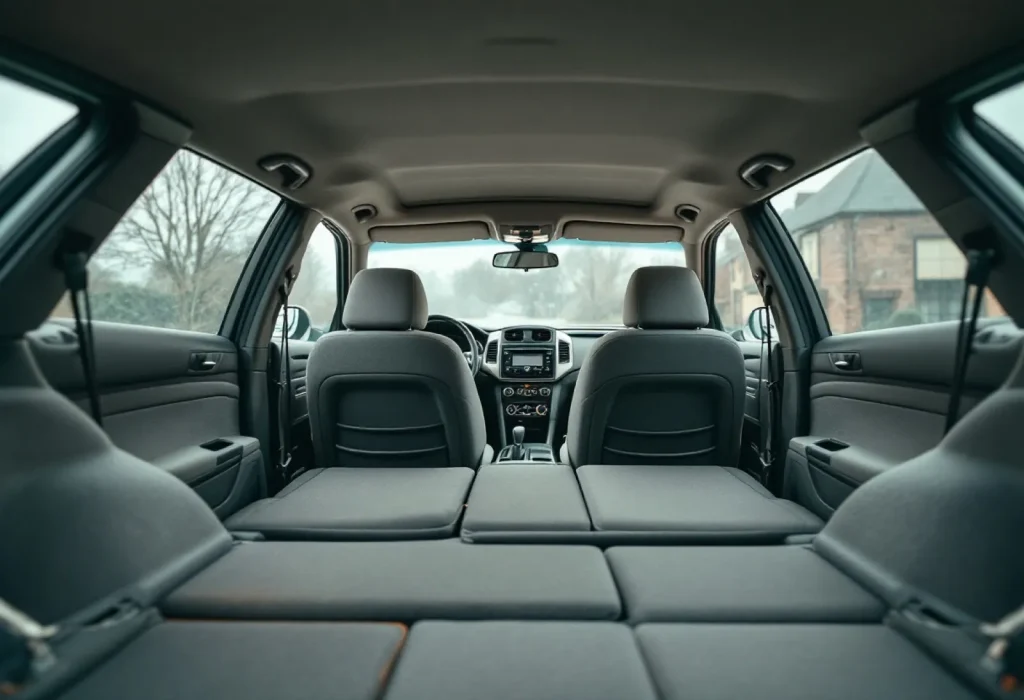
Smoke smell in car interiors goes away only when the residue soaked into the headliner, seat upholstery, carpet, dust and ventilation system is cleaned out or replaced; scenting or airing the cabin does not remove it. In a San Diego State University study of 127 used cars, the usual cleaning and airing out did not lower nicotine contamination; cutting the source did.
Is the smell old cigarette residue, wildfire smoke, or something burning in the car right now?
Three sources produce the same complaint, and only two are cleaning jobs.
- Fresh smoke or a burning plastic or rubber smell while driving, with nobody smoking: the U.S. Fire Administration vehicle fire guidance lists mechanical and electrical issues among common causes of vehicle fires. Its steps: pull over when safe, turn off the engine, get everyone out, move at least 100 feet away from the vehicle and traffic, call 911, and do not open the hood or trunk if you think fire is there. Finding the cause after that is a mechanic’s job, not a detailing job.
- Smoke outside during a wildfire: the EPA smoke exposure guidance says to reduce smoke in a vehicle by closing the windows and running the air conditioner in recirculate mode.
- A stale, sweet, ashy smell that returns on warm days in a car someone smoked in: that is residue, which Matt and colleagues, Nicotine and Tobacco Research (2008) describe as pollution that settles into dust and onto surfaces. The rest of this page is about that case and about wildfire ash left inside afterwards.
A musty smell after a leak or flood is a different source with a different fix, and it is covered in the page on mold in a car.
Where does smoke residue hide in a car, zone by zone?
The San Diego State University summary of the rental car work quotes the lead researcher: car cabins “have relatively large surface areas made with absorptive materials, such as carpets, liners, upholstery and the ventilation system.” Matt and colleagues, Nicotine and Tobacco Research (2008) add dust and hard surfaces, which is where their wipe samples came from.
| Zone | What the residue does | Method | When to check again | Source |
|---|---|---|---|---|
| Headliner fabric | Absorptive liner named as a reservoir by the SDSU team | HEPA vacuum on a soft brush first, then a lightly damp wipe; do not soak an absorbent layer | If odor returns after one pass, the layer is holding residue; replacement is the source control option | SDSU 2012; EPA ash guidance |
| Seat upholstery and foam | Upholstery named as a reservoir; foam sits under the fabric | HEPA vacuum, then upholstery shampoo and extraction with as little water as works | Re-smell after the seats are fully dry | SDSU 2012; EPA ash guidance |
| Carpet and floor mats | Carpets named as a reservoir; dust nicotine measured in used cars | Mats out and washed separately; carpet HEPA vacuumed, then extracted | Re-smell after drying; lift the carpet edge if odor persists | SDSU 2012; Matt 2008 |
| Glass, dash, hard plastics | Surface nicotine is the marker wipe samples measure | Wet wipe with detergent and water; these materials do not absorb water | A clean white cloth that comes back yellow means another pass | Quintana 2013; EPA ash guidance |
| Cabin air filter | Sits in the ventilation path the SDSU team named | Replace with the part and interval in the owner’s manual | Replace again after a wildfire smoke event | SDSU 2012; EPA smoke guidance |
| Ducts and HVAC evaporator | Ventilation system named as a reservoir | New filter, then run the fan; deeper duct or evaporator service is shop work | If the smell blows only from the vents, the HVAC path is the source | SDSU 2012 |
| Ashtray, console, dust | Dust carries nicotine in smoker cars | Empty and wash removable trays; HEPA vacuum seams and rails | Every visit until no ash is found | Matt 2008 |
The headliner and the ventilation path are the two zones a quick detail skips: one cannot be soaked and the other is hidden behind the dash. The EPA page on ozone generators sold as air cleaners ranks source control first, ventilation second and air cleaning third, which is why the table removes or replaces before it deodorises.
Why did airing out and cleaning fail in the SDSU used car studies?
Fortmann and colleagues, Nicotine and Tobacco Research (2010) sampled surfaces, air and dust in 40 nonsmoker and 87 smoker used cars and asked drivers how they cleaned and ventilated. The number of cigarettes the primary driver smoked was the strongest predictor of contamination, and the authors wrote that “commonly used cleaning and ventilation methods did not successfully decrease contamination levels.” Holding the cigarette near or outside the window did not change the result either.
The earlier study, Matt and colleagues, Nicotine and Tobacco Research (2008), compared 20 nonsmoker cars with 87 smoker cars. When smokers banned smoking in the car, air nicotine dropped, but dust and surface contamination stayed at similar levels. That is the pattern behind a car that smells fine on a cool morning and stale again later: the air was cleared, the reservoirs were not.
A wipe test separated the groups well. The cutpoint used in that 2008 paper flagged 82 percent of smoker cars without bans, 75 percent of smoker cars with bans and correctly cleared 100 percent of nonsmoker cars.
Rental fleets show the same persistence. Matt and colleagues, Tobacco Control (2013) sampled 250 rental cars in San Diego County, 100 of them reserved as non-smoker cars. According to the SDSU summary, those cars carried about 3 times the dust nicotine and 10 times the surface nicotine of private cars with smoking bans, and more than 60 percent had been smoked in, judged by signs such as ash and moderate to strong tobacco odor. Older and higher mileage rentals carried more residue, which the authors read as accumulation over time.
Out of scope: health effects. This page covers residue and cleanup only; the CDC secondhand smoke page is the starting point for health questions about tobacco smoke.
What order should the cleanup go in, ashtray to cabin filter?
Top down and dry before wet, because loose ash and dust smear into a paste once water hits them. The EPA ash cleanup guidance makes the same call for fire residue: avoid dry sweeping or dusting, use a HEPA vacuum, and use damp wiping for light deposits on materials that do not absorb water.
- Remove the source. No smoking in the car from now on; Fortmann and colleagues, Nicotine and Tobacco Research (2010) found the cigarette count was what drove contamination, so cleaning a car still being smoked in resets nothing.
- Empty and pull out. Ashtray, cup holders, floor mats, seat covers, loose items and the trunk liner if it lifts out.
- Dry clean top down. HEPA vacuum the headliner on a soft brush, then seats, then carpet, so dust falls onto surfaces not yet cleaned. The EPA ash cleanup guidance recommends a HEPA vacuum where available and dry methods for absorbent materials.
- Wet clean hard surfaces. Glass, dash, door panels, seat belt buckles and console with detergent and water; change cloths as they yellow.
- Extract fabrics. Seats and carpet with an upholstery extractor, using as little water as works, then dry with doors open in dry weather.
- Headliner last and lightly. Damp wipe in one direction; no soaking.
- Ventilation path. Replace the cabin air filter per the owner’s manual, then run the fan on fresh air with windows open.
- Smell test after full drying. If one zone still smells, go back to that zone; adsorbents or a professional treatment come after, not before.
Clothes and bags that rode in the car hold the same residue and will recharge a clean cabin; the page on smoke smell out of clothes covers laundering them.
Detergent, enzyme, carbon or ozone: which cleaner class does what to tobacco residue?
Product shelves sell all six classes as smoke odor removers. The evidence behind them is uneven, and the EPA page on ozone generators sold as air cleaners supplies the ranking that sorts them: source control, then ventilation, then air cleaning, which EPA says “is not generally regarded as sufficient in itself.”
| Cleaner class | What it does | What the sources say |
|---|---|---|
| Detergent and water | Physically lifts residue off non absorbent surfaces | EPA ash guidance lists wet methods for materials that do not absorb water |
| Upholstery extraction | Flushes residue out of fabric and foam | No car specific study found; follows the EPA source control first ranking |
| Enzyme sprays | Sold for organic odors | None of the agency or university sources read evaluate enzymes on tobacco residue in cars |
| Adsorbents (activated carbon) | Hold odor molecules on a surface | EPA: gas adsorbing material is sometimes used to remove gaseous contaminants, as a supplement |
| Fragrance and masking sprays | Add a scent over the residue | EPA treats air cleaning as a supplement to source control, not a substitute |
| Ozone (oxidiser) | Reacts with some odor chemicals, forms by products | EPA: little potential to remove indoor contaminants at levels within public health standards |
Is an ozone generator safe in a car 23 to 25 times smaller than EPA’s test room?
The EPA page on ozone generators sold as air cleaners gives the limits: the FDA caps indoor medical device output at 0.05 ppm, OSHA sets a 0.10 ppm 8 hour average for workers, and NIOSH recommends 0.10 ppm not to be exceeded at any time. EPA then reports what machines did in real rooms: a unit sold for spaces up to 3,000 square feet, run on high in a 350 square foot room, reached 0.50 to 0.80 ppm, and some home units on high with doors shut produced 0.20 to 0.30 ppm.
A car is a far smaller box than either test room. Labelled calculation: the 350 square foot room with an assumed 8 foot ceiling holds 2,800 cubic feet, sized from the EPA example. Under 40 CFR 600.315-08, EPA’s fuel economy rule, a midsize car has an interior volume index of 110 to under 120 cubic feet, passenger and cargo space combined. That room is about 23 to 25 times the volume of the car. EPA states that concentrations will be higher when a device runs in a small space rather than a large one, and that a high setting on some devices produced 10 times the medium setting output.
The materials problem is specific to cars. EPA lists ozone damage to rubber, electrical wire coatings, fabrics and dyes, and a cabin is made of door seals, wiring, seat fabric and dyed trim. EPA adds that ozone does not remove particles and may not affect contaminants embedded in porous material. Where EPA accepts high ozone, in unoccupied spaces such as fire restoration, it says conditions must be controlled so no person or pet is exposed. Machine types and run rules are covered on the ozone generator page.
What changes when the smoke came from a wildfire, with ash inside?
Wildfire smoke leaves particles and ash rather than a tobacco film, and the EPA ash cleanup guidance has car specific rules. Wash hands and change into clean clothes and shoes before getting into the car, and seal ash covered clothing and shoes in a plastic bag in the trunk, away from the riding compartment.
- Do not dry sweep, dust or use a leaf blower on ash; EPA rules out all three.
- Use a HEPA vacuum if available; with an ordinary shop vacuum, EPA says to wear a respirator and air out the space.
- For respirators, EPA names NIOSH Approved N95 or P100 models with two straps; one strap dust masks do not seal.
- Collected ash can go in regular trash in sealed bags, and EPA says to avoid washing ash into storm drains, which applies to washing the outside of the car.
- Replace the cabin air filter after the event, with the part the owner’s manual names; it sits in the outside air path.
House and structure smoke cleanup after a fire runs on a larger scale; the page on wildfire smoke damage covers it.
Does a smoked in car list for up to 9 percent less, and does any federal rule require saying so?
According to Matt and colleagues, Tobacco Induced Diseases (2008), the team interviewed 1,642 private sellers advertising in San Diego and found 22% of used cars were advertised by smokers or had been smoked in during the past year. The paper reports that, holding Kelley Blue Book value and make constant, asking prices were 7.7% lower for a car that had been smoked in, 7.0% lower for a smoker seller and 9.0% lower when both applied.
| Seller and car | Asking price above KBB value, data from the paper |
|---|---|
| Nonsmoker car and seller | 13.5% |
| Smoker seller | 5.2% |
| Smoked in car | 4.8% |
| Smoker car and seller | 3.3% |
The authors’ worked example: a 2000 Toyota Camry LE valued at $7,695 for private sale would have been listed about $700 lower if a smoker sold it and had smoked in it, according to the paper.
On disclosure, the federal used car rule for dealers, 16 CFR Part 455, makes it deceptive to misrepresent a used vehicle’s mechanical condition and requires the Buyers Guide window form; its regulation text does not mention smoking or odor. Both SDSU papers propose “disclosure requirements and smoke-free certifications” as a policy idea, which describes something that did not exist when they wrote. State law is not covered here, and this is not advice on your own sale. Ask your state attorney general’s consumer protection office or a consumer law attorney two things: whether your state’s deceptive practices law covers a known odor condition, and whether answering a buyer’s direct question changes that.
For detailers: can a nicotine wipe test at 0.1 to 10 micrograms per square metre prove the job worked?
Quintana and colleagues, Nicotine and Tobacco Research (2013) pooled 5 field studies covering homes, private cars, rental cars and hotels and found surface wipe sampling for nicotine reliable, with a side by side intraclass correlation of 0.91. They tested thresholds of 0.1, 1 and 10 micrograms per square metre: at 0.1, 74 to 100 percent of smoker environments read above the line, and at 10, 81 to 100 percent of nonsmoker environments read below it.
For a shop, that means a before and after wipe of the same dash or door panel area, sent to a lab that runs nicotine analysis, gives a number a customer can read, where a smell test gives an opinion; state which threshold you measured against. Walls and rooms follow the same chemistry; the page on nicotine stains on walls shows the surface side, and smoke smell out of a house covers whole buildings. More fire and smoke pages sit in the fire and smoke hub.
Questions people actually ask
Will coffee grounds or baking soda get cigarette smell out of a car overnight?
No source among the 13 cited here measured coffee grounds, baking soda or charcoal bags in a car cabin, so there is no evidence for an overnight fix. EPA classes gas adsorbing material as a supplement to source control, not a replacement. In the 2010 SDSU study of 127 used cars, common cleaning and ventilation did not lower nicotine contamination, so expect adsorbents to dull the smell at most.
How long does it take to get cigarette smell out of a car?
There is no published timeline for cars. The 2008 SDSU study found that when smokers stopped smoking in the car, air nicotine fell but dust and surface levels stayed similar, so the time depends on removing those reservoirs, not on waiting: work the 8 step order, let fabrics dry fully, then smell each zone. Timelines for buildings are on the page on how long smoke smell lasts.
Does replacing the cabin air filter get rid of smoke smell?
Only for the share of the odor coming through the vents. The SDSU researchers name the ventilation system as one of 4 absorptive reservoirs, alongside carpets, liners and upholstery, so a new filter alone leaves 3 of them untouched. Replace it with the part and interval in the owner’s manual, and again after a wildfire smoke event, then clean the fabric zones.
Is a car labelled non-smoking at a rental counter free of smoke residue?
Not reliably. In the 2013 Tobacco Control study of 250 San Diego rental cars, the reserved non-smoker cars had lower nicotine than smoker cars but about 3 times the dust nicotine and 10 times the surface nicotine of private cars with smoking bans, per the SDSU summary. More than 60 percent had been smoked in, judged by ash and tobacco odor.
Is smoke smell in car upholstery dangerous to sit in?
This page does not assess health risk. What the SDSU studies measured is exposure: residue re-emitted into the air from surfaces and dust over days, weeks and months, per the 2008 Tobacco Induced Diseases paper. For health questions, the CDC secondhand smoke page is the federal starting point, and a physician can answer questions about a specific person.
Sources
- U.S. Environmental Protection Agency, EPA page on ozone generators sold as air cleaners, “Ozone Generators that are Sold as Air Cleaners”, last updated 19 February 2026. Retrieved 20 November 2026.
- U.S. Environmental Protection Agency, EPA smoke exposure guidance, “Reduce Your Smoke Exposure”, last updated 17 July 2026. Retrieved 20 November 2026.
- U.S. Environmental Protection Agency, EPA ash cleanup guidance, “Protect Yourself from Ash”, last updated 28 July 2026. Retrieved 20 November 2026.
- Matt and colleagues, Nicotine and Tobacco Research (2008): Matt GE, Quintana PJ, Hovell MF and others, “Residual tobacco smoke pollution in used cars for sale: air, dust, and surfaces”, Nicotine and Tobacco Research 10(9):1467 to 1475, PubMed abstract. Retrieved 20 November 2026.
- Fortmann and colleagues, Nicotine and Tobacco Research (2010): Fortmann AL, Romero RA, Sklar M and others, “Residual tobacco smoke in used cars: futile efforts and persistent pollutants”, Nicotine and Tobacco Research 12(10):1029 to 1036, PubMed abstract. Retrieved 20 November 2026.
- Matt and colleagues, Tobacco Control (2013): Matt GE, Fortmann AL, Quintana PJ and others, “Towards smoke-free rental cars: an evaluation of voluntary smoking restrictions in California”, Tobacco Control 22(3):201 to 207, PubMed abstract. Retrieved 20 November 2026.
- San Diego State University Department of Psychology, San Diego State University summary, “Tobacco Chemicals in Smoke-free Rental Cars”, 27 February 2012. Retrieved 20 November 2026.
- Quintana and colleagues, Nicotine and Tobacco Research (2013): Quintana PJ, Matt GE, Chatfield D and others, “Wipe sampling for nicotine as a marker of thirdhand tobacco smoke contamination on surfaces in homes, cars, and hotels”, Nicotine and Tobacco Research 15(9):1555 to 1563, PubMed abstract. Retrieved 20 November 2026.
- Matt and colleagues, Tobacco Induced Diseases (2008): Matt GE, Romero R, Ma DS and others, “Tobacco use and asking prices of used cars: prevalence, costs, and new opportunities for changing smoking behavior”, Tobacco Induced Diseases 4:2, full text on PubMed Central. Retrieved 20 November 2026.
- U.S. Fire Administration, FEMA, U.S. Fire Administration vehicle fire guidance, “Vehicle Fire Safety”, page last reviewed 22 March 2023. Retrieved 20 November 2026.
- Electronic Code of Federal Regulations, 16 CFR Part 455, Used Motor Vehicle Trade Regulation Rule. Retrieved 20 November 2026.
- Electronic Code of Federal Regulations, 40 CFR 600.315-08, Classes of comparable automobiles. Retrieved 20 November 2026.
- Centers for Disease Control and Prevention, CDC secondhand smoke page, “Secondhand Smoke”. Retrieved 20 November 2026.
Study figures are quoted from published abstracts and full text as printed on the retrieval date. The room to car volume comparison is a labelled calculation using an assumed 8 foot ceiling. Remediation Insider did not test any product or vehicle. How we choose and check sources: methodology.