The short answer
Asbestos vs fiberglass cannot be settled by eye: the reliable test is polarized light microscopy, where glass fibers go dark at every angle of rotation and asbestos fibers do not, per NIOSH Method 9002. Width separates them too. A chrysotile asbestos fibril is under 0.01 micrometers wide, at least 100 times thinner than an insulation glass fiber, and OSHA limits asbestos to 0.1 fiber per cubic centimeter.
Can you tell asbestos from fiberglass by color, feel or building age?
Not reliably. The EPA homeowner asbestos page says that you generally cannot tell whether a material contains asbestos simply by looking at it, unless it is labeled, and that a doubtful material should be treated as asbestos and left alone. The table below collects what each source does say about the two fibers, so a reader can see which clues are real and which are not.
| Property | Asbestos | Fiberglass (glass wool) |
|---|---|---|
| What it is | Six natural silicate minerals, crystalline; 40 CFR 61.141 names chrysotile, crocidolite, amosite group, anthophyllite, actinolite and tremolite | Glass melted at about 1,370 C (2,500 F) and spun or blown into fibers; amorphous, with no crystal planes (NTP, ATSDR) |
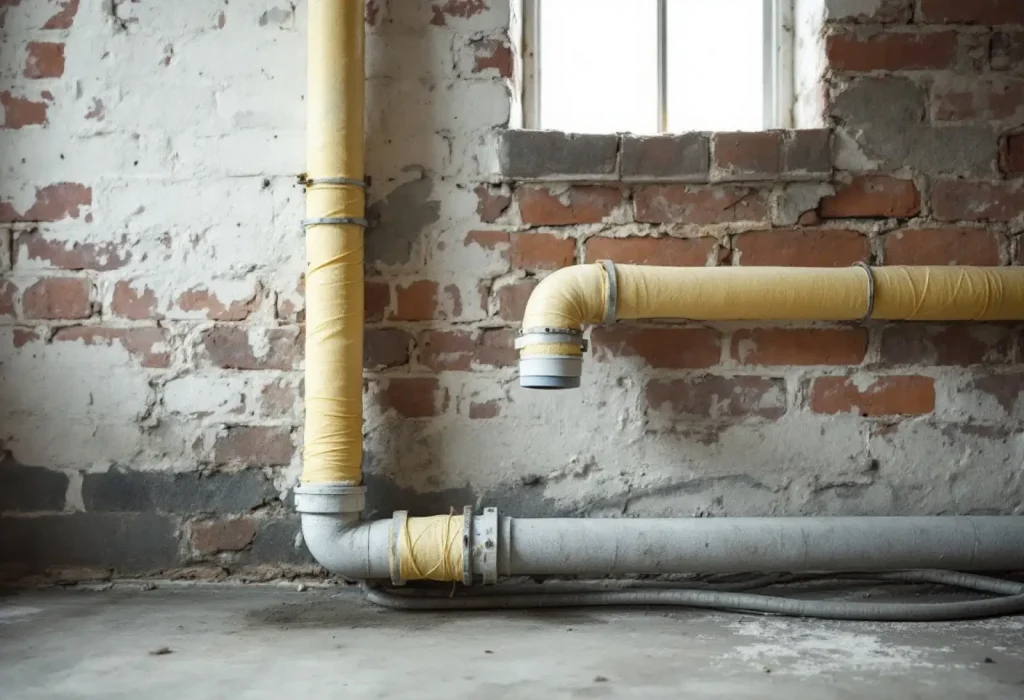
| Color of the fiber | Chrysotile white, gray, green or yellowish; amosite brown, gray or greenish; crocidolite lavender, blue or green (ATSDR Table 4-2) | EPA 1985: yellow or pink wrapped pipe insulation is usually a clear indication of fibrous glass |
| Feel and flexibility | Chrysotile rated good flexibility; tremolite brittle; amosite fair (ATSDR Table 4-2) | Rigid glass; fibers break crosswise into shorter lengths (NTP) |
| Width of one strand | Fibrils under 0.01 um (chrysotile) to 0.04 um or more (amosite), per NIOSH CIB 62 | Insulation glass nominal 1 to 10 um (NTP); ordinary glass wool 3 to 15 um (ATSDR) |
| Era | EPA 1985 lists dates of use from 1900 (insulation cement) to present; OSHA presumes TSI and surfacing in buildings built no later than 1980 contain it | Commercial production began in the early twentieth century (IARC 2002) and continues |
| Where found | Pipe and boiler insulation, sprayed ceiling plaster, ceiling and floor tiles, cement siding and roofing (EPA 1985) | Batts, rolls, loose fill, rigid acoustic boards, pipe coverings (NTP) |
| Lab result under PLM | Anisotropic: parallel extinction, or oblique at 10 to 20 degrees for tremolite and actinolite (NIOSH 9002) | Isotropic: disappears at all angles of rotation, so reported as no asbestos (NIOSH 9002) |
Color helps less than the table suggests. ATSDR Table 4-2 lists chrysotile as white, gray, green or yellowish, colors that overlap with glass products, and a pipe jacket or paint layer hides the fiber underneath. The one visual rule EPA printed in 1985, yellow or pink wrap meaning glass, came with an exception covered further down. Fiber type by fiber type, our types of asbestos page has the six minerals.
How much thinner is an asbestos fibril than a glass fiber?
Between 100 and 1,500 times thinner, using the published ranges, according to NIOSH and NTP. NIOSH Current Intelligence Bulletin 62 gives individual asbestos fibrils a width of under 10 nanometers, or 0.01 micrometers, for chrysotile and 40 nanometers or more for amosite. The NTP glass wool profile puts insulation glass fibers at nominal diameters of 1 to 10 micrometers and notes that a product averaging 5 micrometers can hold fibers from under 1 to over 20.
| Comparison, according to the cited widths | Width ratio |
|---|---|
| Insulation glass, thinnest nominal (1 um) against a chrysotile fibril (0.01 um) | 100 times |
| Ordinary glass wool, thickest (15 um) against a chrysotile fibril | 1,500 times |
| Insulation glass, thinnest nominal against an amosite fibril (0.04 um) | 25 times |
| NIOSH 7400 optical limit (0.25 um) against a chrysotile fibril | 25 times |
The last row explains why air sampling alone cannot settle the question. NIOSH Method 7400, the phase contrast method behind OSHA’s fiber counts, does not detect fibers thinner than about 0.25 micrometers and counts only fibers longer than 5 micrometers with a length to width ratio of at least 3 to 1. A single chrysotile fibril is far below that limit; what the optical count sees are bundles, which CIB 62 says are much wider than single fibrils.
Why does asbestos split lengthwise while fiberglass snaps across?
Because one is a crystal and the other is glass. The ATSDR synthetic vitreous fibers profile, chapter 3 states that synthetic vitreous fibers have amorphous structures without the planes of cleavage found in chrysotile, and that the longitudinal cleavage of asbestos can form thinner fibers. NIOSH CIB 62 says multi-fibril chrysotile fibers commonly split along their length, and describes amphibole asbestos as aggregates of fibrils that separate along grain boundaries.
Glass does the opposite. The NTP profile notes that most fibers in glass wool insulation are several centimeters long but break crosswise, so pieces shorter than 250 micrometers are probably present in all glass wool products. ATSDR adds that where calcium, magnesium and potassium oxides leach out of a low silica glass, below 63 mole percent alumina and silica, the weakened matrix breaks transversely under stress. Either way the piece gets shorter while its width stays fixed at whatever the spinner produced.
Which is it in attic insulation, pipe wrap, ceilings and roofing?
Each location has its own lookalike. The table pairs the glass product the NTP Report on Carcinogens glass wool profile describes with the asbestos product EPA listed for the same spot in Appendix A of its 1985 guidance, with the asbestos content and dates of use EPA printed. Those content figures are EPA’s 1985 ranges for product families, not a measurement of any one house.
| Location | Fiberglass form | Asbestos form, content and dates | What decides it |
|---|---|---|---|
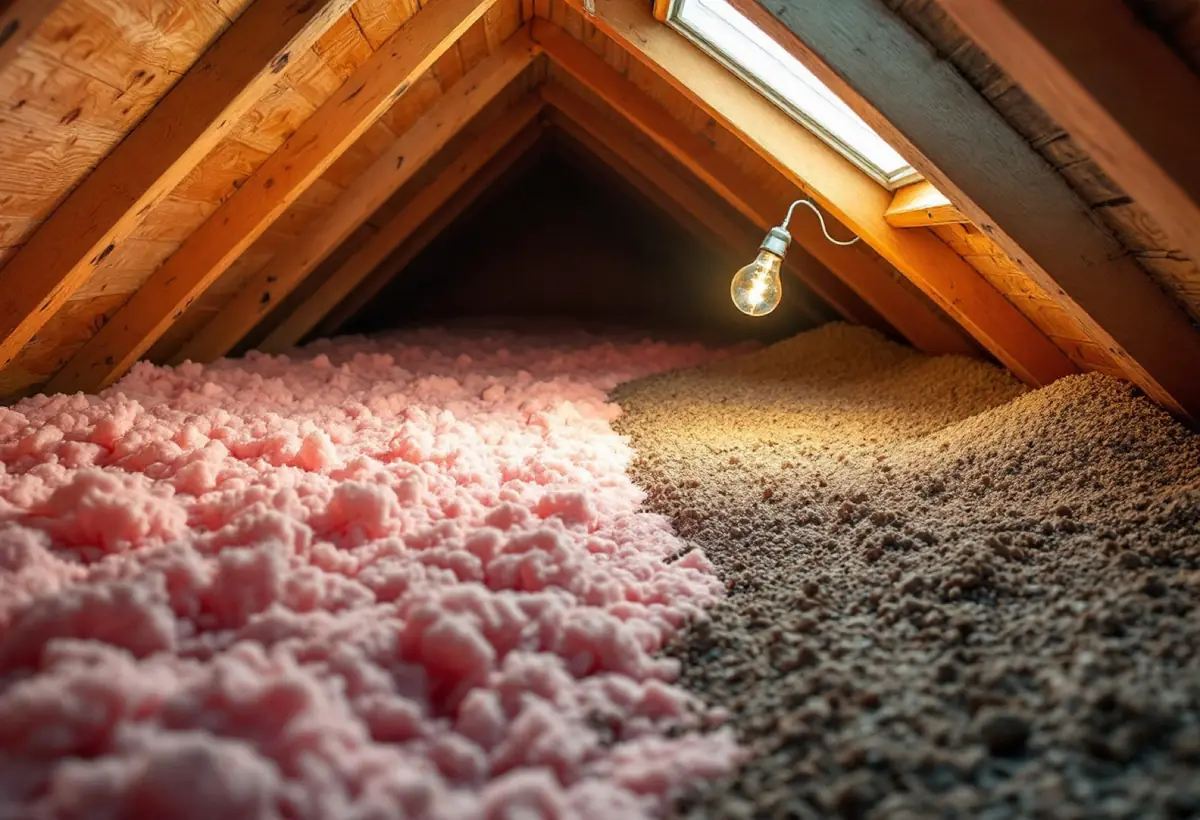
| Attic, loose fill | Loose glass wool (NTP) | Vermiculite: pebble-like, gray-brown or silver-gold; the Libby, Montana mine supplied over 70 percent of US vermiculite from 1919 to 1990 (EPA) | Fluffy fiber against granules; treat granules as suspect |
| Wall and attic batts | Batts, rolls and blankets (NTP) | EPA 1985 Appendix A lists preformed batts, blocks and pipe covering as asbestos thermal products | Lab test of the batt and any facing |
| Straight pipe runs | Glass wool pipe coverings (NTP) | 85 percent magnesia covering at 15 percent asbestos, 1926 to 1949; calcium silicate at 6 to 8 percent, 1949 to 1971; corrugated paper at 90 percent (EPA 1985) | Yellow or pink wrap is usually glass (EPA 1985) |
| Pipe elbows and joints | Glass runs often meet a separate fitting | Insulation cement 20 to 100 percent, 1900 to 1973; finishing cement 55 percent, 1920 to 1973 (EPA 1985) | Sample the fitting as its own material |
| Ceilings | Rigid glass boards for acoustic use (NTP) | Sprayed or troweled surfacing 1 to 95 percent, 1935 to 1970; ceiling tiles listed as asbestos products (EPA 1985) | Lab test; mineral and glass wool both read isotropic |
| Roofing | Not covered here | Asphalt roofing shingles 1 percent, 1971 to 1974; cement roofing shingles 20 to 32 percent (EPA 1985) | Lab test of the shingle |
The attic row is the one case with a visual tell that EPA endorses: its vermiculite page describes the product as pebble-like and pour-in, often sold as Zonolite, and says to look without disturbing it. Batts, wrap and boards are not like that. Product by product detail is on our pages for asbestos insulation, asbestos pipe insulation and asbestos ceiling tiles.
Roofing shingles, fiberglass or otherwise, are covered in depth by our sister site theroofingbrief.com; the 1 percent asphalt shingle line above comes from EPA’s 1985 table.
Did fiberglass pipe insulation ever come with asbestos fittings?
Yes, and EPA said so in 1985. The EPA 1985 Purple Book reports that an EPA nationwide survey found asbestos pipe or boiler insulation in about 16 percent of federal, residential and commercial buildings, and 20 percent of those built before 1970. It then gives the yellow or pink exception: that color is usually a clear indication of fibrous glass. The next sentence is the one guides online leave out: even then, pipe elbows and joints will likely contain asbestos.
So a glass wool run with a hard white elbow is two materials, not one. EPA’s sampling advice in the same chapter is to sort insulation into homogeneous areas, sections that look uniform in color and texture, and sample each one. OSHA reaches the same place by rule: 29 CFR 1926.1101 presumes that thermal system insulation and surfacing material in buildings constructed no later than 1980 contain asbestos until the presumption is rebutted under paragraph (k)(5).
The glass itself is a different story. The NTP Report on Carcinogens glass wool profile describes glass wool as silicon dioxide plus oxide modifiers such as aluminum, calcium, magnesium and sodium oxides, melted at about 1,370 C and sprayed with a binder, typically phenol formaldehyde; none of the six asbestos minerals appears in that recipe. The risk with an old glass wrapped system is the fitting, the jacket or the cement next to it.

What does a lab see under PLM, PCM and TEM?
For a bulk sample, NIOSH Method 9002 sets the order of tests. The analyst mounts fibers in a 1.550 refractive index liquid and crosses the polarizing filters. If every fiber is isotropic, disappearing at all angles of rotation, the fibers are not asbestos; the method names fibrous glass and mineral wool as common isotropic components of suspect samples and says to report no asbestos detected. Anisotropic fibers go on to extinction angle and sign of elongation tests.
- Extinction: tremolite and actinolite show oblique extinction at 10 to 20 degrees; the other asbestos types show parallel extinction (NIOSH 9002).
- Sign of elongation: positive for every asbestos type except crocidolite (NIOSH 9002).
- Legal threshold: under 40 CFR 61.141, material is asbestos containing above 1 percent by the PLM method in 40 CFR Part 763 Appendix E; OSHA uses the same 1 percent line for ACM.
- Air samples: NIOSH Method 7400 gives a working range of 0.04 to 0.5 fiber per cc for a 1,000 liter sample and, according to the method, does not differentiate asbestos from other fibers; it points to electron microscopy such as NIOSH 7402 to identify them.
OSHA’s own sampling appendix to 29 CFR 1926.1101 lists fiberglass, mineral wool and gypsum among the fibers that can interfere with an asbestos count, and names polarized light, dispersion staining or electron microscopy as the tools that tell them apart. What to ask a lab about method and turnaround is on our asbestos testing lab page.
Does OSHA set the same exposure limit for fiberglass as for asbestos?
No. 29 CFR 1926.1101 holds asbestos to 0.1 fiber per cubic centimeter as an eight hour average and 1.0 over 30 minutes. OSHA has no fiber count limit for glass at all: the NIOSH Pocket Guide entry for fibrous glass dust lists OSHA’s limit as 15 milligrams per cubic meter of total dust and 5 respirable, the generic nuisance dust figures, against a NIOSH recommendation of 3 fibers per cc.
| Rule | Asbestos | Fiberglass |
|---|---|---|
| OSHA limit, 8 hours | 0.1 fiber per cc, 29 CFR 1926.1101(c)(1) | No fiber limit; 15 mg/m3 total dust, 5 mg/m3 respirable (NIOSH Pocket Guide) |
| OSHA short term limit | 1.0 fiber per cc over 30 minutes, 1926.1101(c)(2) | None |
| NIOSH recommended limit | 0.1 fiber per cc (CIB 62) | 3 fibers per cc for fibers 3.5 um or thinner and 10 um or longer, plus 5 mg/m3 total |
| Voluntary industry limit | Not applicable | 1 respirable fiber per cc, 1999 OSHA partnership program (ATSDR) |
| EPA NESHAP | Friable material above 1 percent by PLM, 40 CFR 61.141 | Not in the definition, which lists asbestos minerals only |
| IARC, 2002 (Volume 81) | Not reviewed on this page | Insulation glass wool Group 3; E-glass and 475 special purpose fibers Group 2B |
Labelled calculation: the NIOSH glass recommendation of 3 fibers per cc is 30 times the OSHA asbestos limit, and the voluntary 1 fiber per cc limit that OSHA, the North American Insulation Manufacturers Association and two insulation contractor associations agreed in 1999 is 10 times it, according to ATSDR. IARC’s 2002 review placed insulation glass wool, rock wool, slag wool and continuous filament in Group 3, not classifiable, and the NTP Report on Carcinogens changed its listing in the 12th edition to cover only certain inhalable glass wool fibers.
For a homeowner the practical gap is paperwork, not chemistry. Disturbing confirmed asbestos above 1 percent pulls in the NESHAP rules of 40 CFR Part 61 Subpart M and the OSHA Class I to IV work rules for contractors, while glass wool removal falls under general dust limits. Ask the contractor three things: which materials were lab tested, by which method, and whether the fittings were sampled separately from the runs.
If a suspect wrap or batt also shows dark staining after a leak, the moisture side of the problem is on our mold in insulation page; wet glass wool and wet asbestos need different handling from the first day.
Out of scope: health effects, including any disease or cancer comparison between the two fibers. This page reads regulations, test methods and agency product data only; for health information see the EPA homeowner asbestos page and the Agency for Toxic Substances and Disease Registry profiles cited below.
Questions people actually ask
Is mineral wool the same as fiberglass under a microscope?
Under polarized light they behave alike: NIOSH Method 9002 lists both fibrous glass and mineral wool as isotropic, so neither is reported as asbestos. They differ in raw material and width. ATSDR gives rock and slag wool nominal diameters of about 3 to 7 micrometers against 3 to 15 for ordinary glass wool, and rock wool is made from rock or slag rather than glass.
Can an air test tell fiberglass from asbestos?
A standard phase contrast count cannot. NIOSH Method 7400 states that it does not differentiate asbestos from other fibers and misses fibers thinner than about 0.25 micrometers. Identification needs electron microscopy such as NIOSH 7402, or a bulk sample of the material itself read by polarized light under NIOSH 9002.
Is gray brown pebbly attic insulation fiberglass?
No. EPA describes vermiculite as a pebble-like, pour-in product that is usually gray-brown or silver-gold. A mine near Libby, Montana supplied over 70 percent of US vermiculite from 1919 to 1990 and was contaminated with asbestos, often sold under the brand name Zonolite. EPA’s page says to look at it without disturbing it.
Does a fiberglass job need an asbestos abatement license?
Not for the glass alone. The federal NESHAP rules in 40 CFR Part 61 Subpart M and OSHA’s asbestos work classes attach to material above 1 percent asbestos, and the Subpart M definition lists only asbestos minerals. A job that also removes an asbestos elbow or cement fitting is an asbestos job for that part; ask for the lab report on each material.
Sources
- NIOSH Method 9002, Asbestos (bulk) by PLM, Issue 2, 15 August 1994, National Institute for Occupational Safety and Health. Retrieved 12 November 2026.
- NIOSH Method 7400, Asbestos and other fibers by PCM, NIOSH Manual of Analytical Methods. Retrieved 12 November 2026.
- NIOSH Current Intelligence Bulletin 62, Asbestos Fibers and Other Elongate Mineral Particles: State of the Science and Roadmap for Research, NIOSH publication 2011-159. Retrieved 12 November 2026.
- NIOSH Pocket Guide entry for fibrous glass dust, Fibrous glass dust, NIOSH Pocket Guide to Chemical Hazards. Retrieved 12 November 2026.
- ATSDR synthetic vitreous fibers profile, chapter 1, ATSDR synthetic vitreous fibers profile, chapter 3, ATSDR synthetic vitreous fibers profile, chapter 4 and ATSDR synthetic vitreous fibers profile, chapter 8, Toxicological Profile for Synthetic Vitreous Fibers, ATSDR, US Department of Health and Human Services. Retrieved 12 November 2026.
- ATSDR asbestos profile, chapter 4, Toxicological Profile for Asbestos, chemical and physical information, Table 4-2, ATSDR. Retrieved 12 November 2026.
- NTP Report on Carcinogens glass wool profile, Certain Glass Wool Fibers (Inhalable), Report on Carcinogens, Fifteenth Edition, National Toxicology Program. Retrieved 12 November 2026.
- IARC Monographs Volume 81 summary, Man-made Vitreous Fibres, Volume 81 (2002), IARC Monographs, World Health Organization, via INCHEM. Retrieved 12 November 2026.
- EPA 1985 Purple Book, Guidance for Controlling Asbestos-Containing Materials in Buildings, EPA 560/5-85-024, June 1985, Chapter 2 and Appendix A. Retrieved 12 November 2026.
- EPA homeowner asbestos page, Protect Your Family from Exposures to Asbestos, US EPA, last updated 25 June 2026. Retrieved 12 November 2026.
- EPA vermiculite insulation page, Protect Your Family from Asbestos-Contaminated Vermiculite Insulation, US EPA, last updated 17 April 2026. Retrieved 12 November 2026.
- 29 CFR 1926.1101, OSHA asbestos standard for construction, paragraphs (b) and (c) and Appendix B, via Cornell LII. Retrieved 12 November 2026.
- 40 CFR 61.141, asbestos NESHAP definitions, via Cornell LII. Retrieved 12 November 2026.
- Width ratios and limit ratios are arithmetic on the published figures above, computed when this page was built. Our methodology sets out the standing rules.
This page reads regulations, test methods and agency data; it reports no sampling or testing of its own and is not legal advice. Ask your state asbestos program whether its rules are stricter than the federal rules in 29 CFR 1926.1101 and 40 CFR Part 61 described here.
More rules pages sit on our standards hub.