The short answer
Mold in RV cabins grows because a small, tight space saturates fast: Keystone estimates a family of four vaporizes up to 3 gallons of water a day, and that vapor condenses on cold windows, walls and closed cabinets. Fix leaks and condensation first, keep humidity at 30 to 50 percent per EPA, clean small patches with detergent, and expect maker warranties to exclude mold.
Why does an RV saturate faster than a house when 4 people sleep in it?
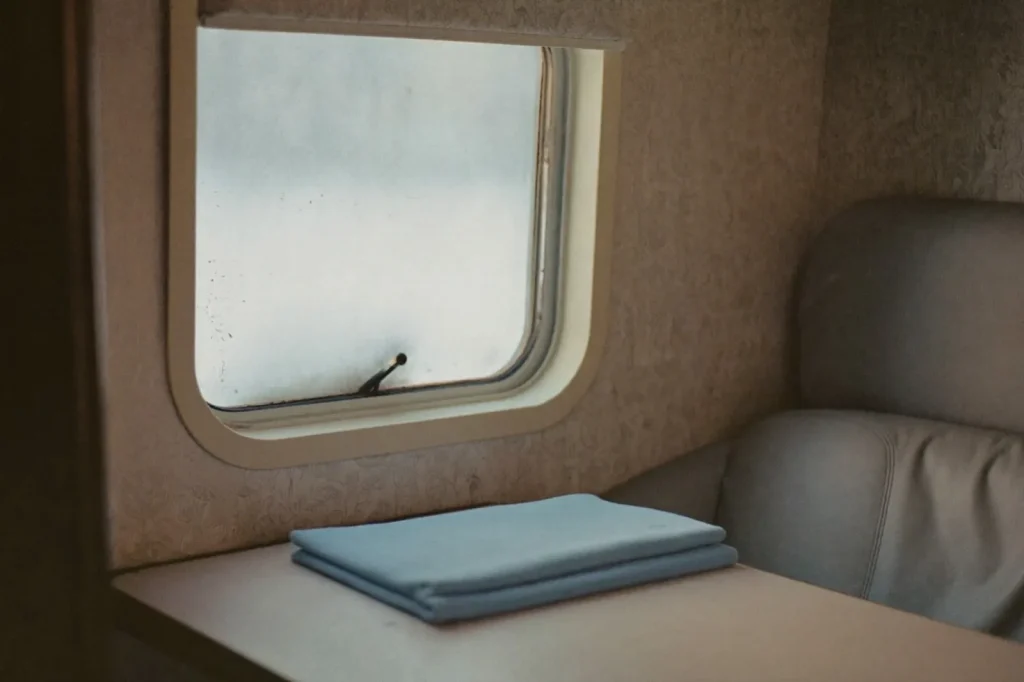
Volume. The Keystone RV owner's manual says the small volume and tight construction of a modern RV mean the normal living of even a few occupants or animals leads to rapid moisture saturation, and it estimates that a family of 4 can vaporize up to 3 gallons of water daily through breathing, cooking, bathing and washing. Unless that vapor is vented outside or pulled out by a dehumidifier, the manual says it condenses inside the coach, often out of sight in cabinets and closets, where it can be mistaken for a leak.
The same manual (p. 13) sets the growth window at 40 to 100 degrees Fahrenheit plus a moisture source, which describes the inside of most occupied campers all year. Its advice runs against instinct in winter: closing the vehicle tightly when it is cold “will actually compound the problem”, and the most effective fix is the roof vents and vent fans. The manual also notes that RV furnaces and air conditioners do not mechanically bring fresh air into the RV, so a coach with every vent shut is recirculating its own moisture.
- Cooking, dishes and showers: run the nearest exhaust fan, and keep the bathroom door shut with the vent open during and after a shower (Keystone, p. 13).
- Wet clothes and towels: Keystone tells owners not to hang them inside the coach.
- Closed cabinets full of stored goods: Keystone says they block circulation and condense; leave doors partly open in cold weather.
- Unvented gas burners: Keystone lists them with cooking and laundry as sources to exhaust.
At what wall temperature does a 68°F camper start to sweat?
At 48.7°F if the cabin air sits at 50 percent relative humidity, and at 57.9°F if it climbs to 70 percent. That is the dew point, the surface temperature below which water comes out of the air. The figures below are our calculation with the Magnus constants documented in the EPA sensortoolkit dew point documentation, not a measurement in any particular RV.
| Cabin humidity | Cabin at 65°F | Cabin at 68°F | Cabin at 72°F |
|---|---|---|---|
| 30 percent | 32.8°F | 35.4°F | 38.9°F |
| 40 percent | 40.1°F | 42.8°F | 46.4°F |
| 50 percent | 45.9°F | 48.7°F | 52.3°F |
| 60 percent | 50.8°F | 53.6°F | 57.4°F |
| 70 percent | 55.0°F | 57.9°F | 61.7°F |
| 80 percent | 58.7°F | 61.6°F | 65.5°F |
Read the table against a cold night. A 68°F cabin at 50 percent stays dry on any surface warmer than 48.7°F, a margin of 19.3 degrees. At 70 percent the margin shrinks to 10.1 degrees, and single pane glass, aluminum frame members and the back of an outside wall cabinet fall below it first. Keystone’s manual names those same spots, windows, vents and wall studs, as where cold weather condensation forms. Turning the furnace up without venting raises the dew point along with the air temperature, which is why the table’s warmer columns do not help unless humidity falls too.
The practical target follows: EPA says keep indoor humidity below 60 percent and ideally 30 to 50 percent, while the Keystone 2023 warranty guide tells Keystone owners 30 to 60 percent. The table shows why the lower number is worth chasing in winter camping. A pin meter settles whether a wall is wet from condensation or from a leak; the readings are explained on our page on moisture meters for water damage.
Leak or condensation: which one is feeding the mold below a window corner?
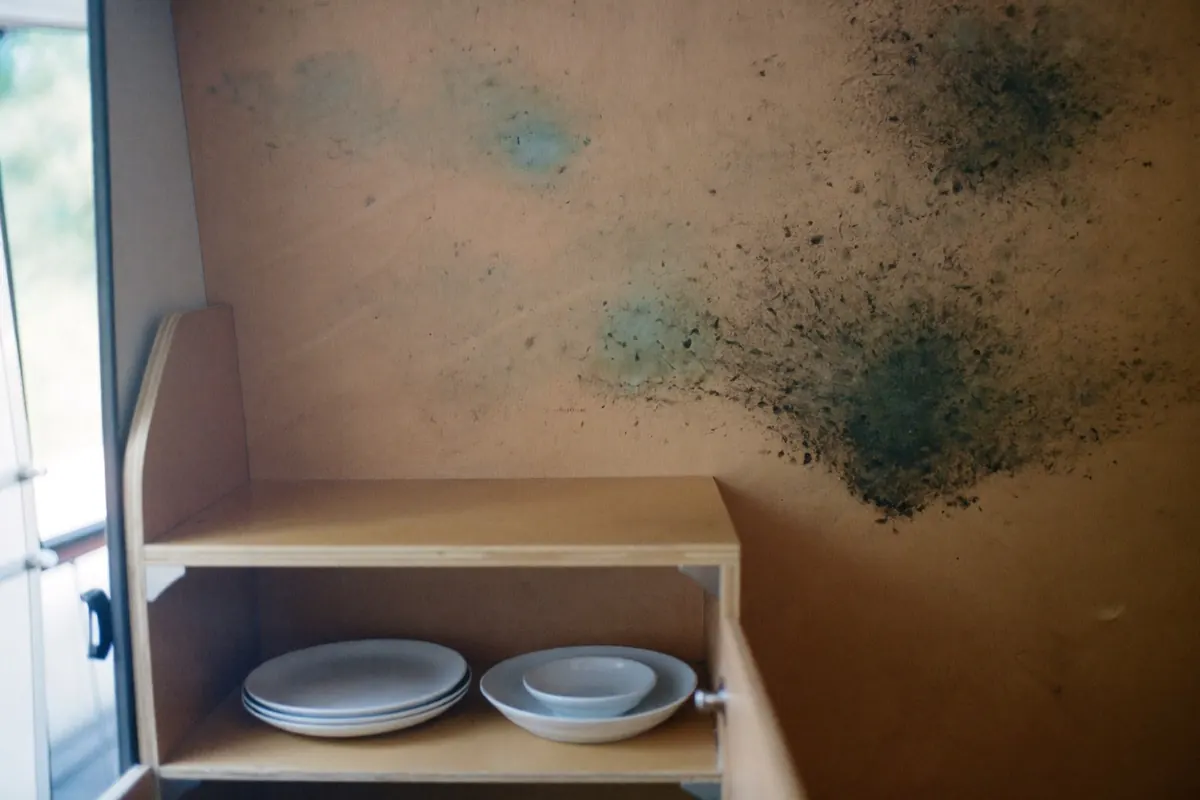
Pattern and location. Condensation mold shows up evenly on cold surfaces: window frames, the outside walls of closets, the backs of cabinets on an exterior wall, and it worsens in cold weather, as the Keystone RV owner's manual describes. Leak mold tracks from one point: below a roof vent, a clearance light, a window corner or the slide out, and it worsens after rain or a wash. A stain that is wetter at the ceiling than at the floor is pointing at the roof.
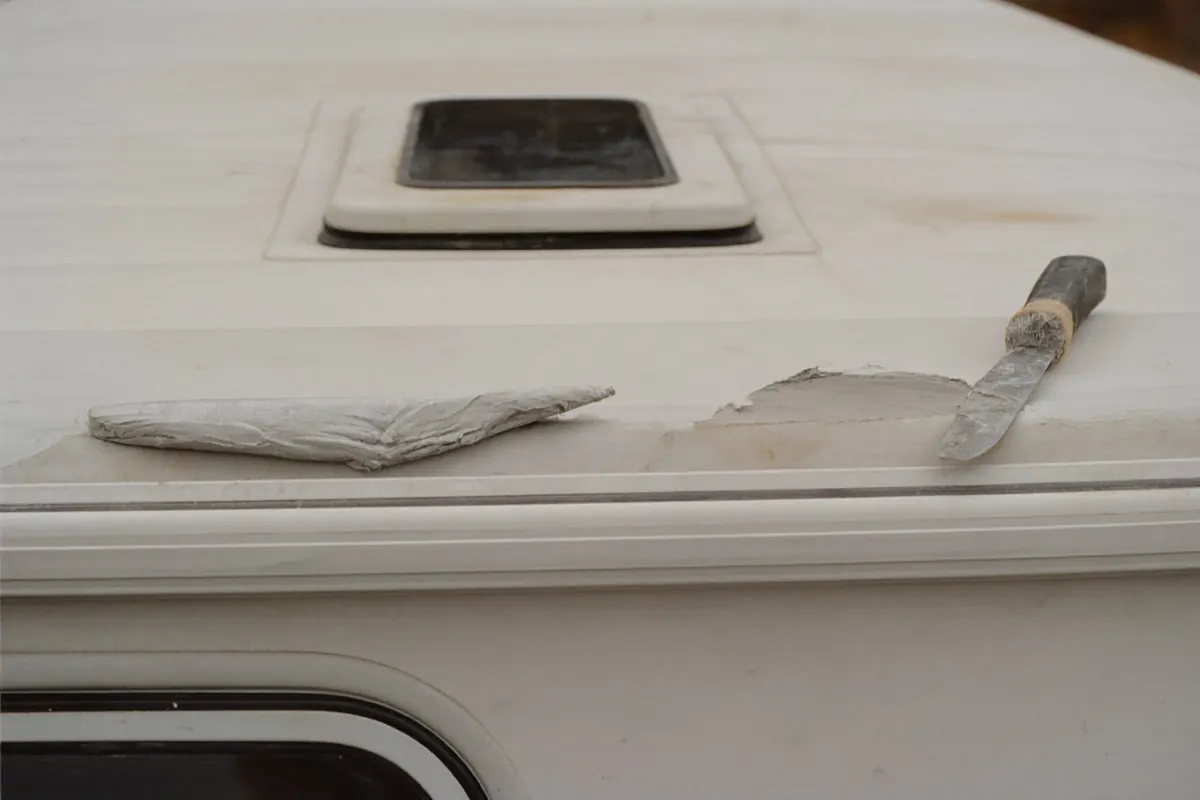
Sealant is where most leaks start, and makers put a clock on it. The Keystone 2023 warranty guide recommends a dealer inspection of seams, joints and sealants every 6 months, and its maintenance schedule lists roof seams and joints for inspection or reseal every 3 months. It warns that one sealant laid over a different type will not bond, and that silicone sealants do not adhere to roofing materials. The Grand Design one year towable warranty requires exterior seals to be inspected every 3 months and maintained annually, and says an owner seeking a seal related repair must provide documentation of those inspections.
Wall construction changes how far a leak spreads. The Camping World construction comparison explains that aluminum stick and tin walls use fiberglass batt insulation, which absorbs water, around a wood frame that can rot, while laminated fiberglass walls bond foam insulation into the wall and are more prone to delamination, where water gets inside and the skin peels. In a stick and tin coach, mold can hide in wet batts behind a panel that looks clean; in a laminated coach, a soft or bubbling sidewall near a window is the warning sign.
How do you clean mold off RV wall panels, upholstery and solid surface tops?
Match the method to the surface. EPA’s rule for hard surfaces is to scrub mold off with detergent and water and dry completely, and it says absorbent materials such as ceiling tiles and carpet may need to be thrown away if they become moldy. EPA also says an area under about 10 square feet is usually a do it yourself job. The Keystone RV owner's manual adds material rules that matter more in an RV than in a house, because thin printed wall panels and fire retardant fabrics are easy to ruin.
| RV surface | What the maker says to use | What to avoid |
|---|---|---|
| Ceiling and wall panels | Mild detergent in warm water, damp cloth | Strong chemicals or excess water (Keystone p. 91) |
| Plastic laminate countertops | Soap and lukewarm water or a mild non abrasive cleaner | Abrasive pads and scouring powder (Keystone p. 91) |
| Solid surface countertops | Soap and mild detergent | Any product containing bleach (Keystone p. 92) |
| Upholstery | Upholstery cleaner, as little water as possible, blot, towel dry | Laundering or soaking (Keystone p. 92) |
| Draperies | Dry clean, telling the cleaner they are fire retardant treated | Water based spotters (Keystone p. 92) |
| Nylon carpet | Spot clean; professional shampoo if needed | Soaking or water logging; EPA says moldy carpet may need discarding |
| Vinyl flooring | Damp mop, warm water, small areas at a time | Solvent based waxes or polishes (Keystone p. 92) |
| Gel coat fiberglass exterior | Automotive or marine non abrasive products | Ammonia or caustic cleaners, which can discolor gel coat (Keystone) |
On bleach, the two sources point the same way with limits. Keystone’s indoor air section allows no more than 1 cup of bleach in 1 gallon of water for visible mold and says never to mix bleach with ammonia; EPA gives the same ammonia warning. The same manual bans bleach on solid surface tops, so check the surface before the bucket. Ratios and contact times are worked through on our bleach to water ratio for mold page.
Wear what EPA lists for small jobs: an N95 respirator, gloves and goggles. Do not blow air across visible growth. Health questions are outside this page; EPA and CDC publish the guidance.
What do Keystone, Grand Design and Forest River warranties say about mold?
All 3 exclude it. The documents below were read in full; the wording differs but the structure is the same. Mold, condensation and ventilation damage are excluded, a leak caused by a factory defect can be covered inside the first year, and the owner’s sealant upkeep decides whether a leak claim survives.
| Maker and document | Mold wording | Leak coverage | What the owner must do |
|---|---|---|---|
| Keystone (manual 4/1/2020; guide 2023) | Mold is a natural growth and not covered; any injury, loss or damage due to mold or fungi excluded | Leaks covered under the 1 year base warranty, not the 3 year structural one; leaks from unmaintained seals excluded | Dealer seal check every 6 months; humidity 30 to 60 percent; mitigate leaks |
| Grand Design (rev. 06.25.2024) | Excludes damage from improper ventilation causing excessive condensation that results in water damage, mold or mildew | 1 year base warranty; seal repairs need inspection records | Inspect seals every 3 months, maintain annually, keep documentation |
| Forest River (towable, 2021) | Excludes injury, damage or loss caused by improper ventilation, interior or exterior condensation, mold, mildew or fungi | 1 year limited warranty on substantial defects | Damage from failure to provide routine maintenance excluded |
Keystone draws the line in its manual as defect against damage: a defect is a failure of workmanship or materials and is covered, while damage after delivery, including lack of maintenance, is not. Its 2023 guide says failure to take reasonable action to mitigate leaks or secondary moisture is not covered, and lists what that means: shut the water off, remove standing water, and run roof vent fans, a dehumidifier, the furnace fan or the air conditioner to dry the coach. So a first year roof leak with mold behind it is a mixed claim: the seal failure may be warranty, the mold is not. Insurance is a separate document, covered on our page on whether RV insurance covers water damage.
When is RV mold a floor, wall or slide out repair instead of a wipe down?
When the material that grew it is still wet or soft. EPA says water damaged areas need drying within 24 to 48 hours to prevent growth; past that, in an RV, mold on a panel face often has a wet substrate behind it. The Camping World construction comparison describes the two failures that turn mold into carpentry: rot in a stick and tin wood frame, and delamination in a laminated sidewall. A floor that flexes at the entry door or a slide out, a wall that bubbles, or a ceiling panel that sags all mean the panel is coming off.
At that point the mold is cut out with the wet wood, not wiped. Wiping a panel whose backing is still wet only resets the clock, and EPA’s advice to fix the water problem first applies with more force in a coach built from thin bonded panels. Shop prices for floors, slide outs and laminated walls are compared on our RV water damage repair cost page.
How do you store a camper so it is not moldy after a winter lay up?
Keep air moving and water out. Keystone’s condensation advice (p. 13) is to let air circulate inside closets and cabinets by leaving doors partly open, and to use the vents rather than sealing the coach. Its 2023 guide lists air conditioners, dehumidifiers and ventilation as the ways to hold humidity down, and its schedule puts a roof seam check every 3 months, which falls inside a normal winter lay up. Store it dry inside:
- Remove towels, bedding and food; Keystone lists damp towels and spills as growth sources.
- Prop the refrigerator door and cabinet doors open, and leave interior doors open so the coach is one volume.
- If on shore power, run a dehumidifier sized for the space toward 50 percent and drain it to a sink or outside; the choices are covered in our dehumidifier guide.
- Walk the roof before and after storage: every 3 months under the Grand Design warranty terms, and keep a dated photo of each check.
Cars share the same small volume problem with less airflow; the vehicle version is on our mold in a car page, and the wider background is on the mold hub. EPA states there is no practical way to remove every spore indoors, which is why the target is moisture, not sterility.
Questions people actually ask
Does RV insurance pay for mold?
The answer sits in the policy wording, not in the maker’s warranty, which excludes mold at all 3 makers compared above. Read the mold, fungi and water sections, then ask the agent in writing whether mold that follows a sudden covered leak is included and whether a dollar sublimit applies. Your state insurance department can explain the filed policy form and how to complain about a denial.
Will a dehumidifier stop mold in a camper?
It addresses the cause if the coach is closed up and on shore power. EPA’s target is 30 to 50 percent, and Keystone’s manual says a dehumidifier may be necessary when venting and exhaust fans are not enough. It will not fix a roof leak, which keeps rewetting the same wall whatever the room humidity reads.
Is vinegar or bleach better for RV mold?
For hard, nonporous RV surfaces EPA’s default is detergent and water. Keystone’s manual permits up to 1 cup of bleach per gallon for visible mold but forbids bleach on solid surface countertops and ammonia on gel coat. Vinegar is not named in either document, so test it on a hidden spot of the panel first. Never mix bleach with ammonia products.
Why is there mold under my RV mattress?
The platform under a mattress is a closed, unheated space against an outside wall or floor, which is the same condition Keystone’s manual describes for packed cabinets: poor circulation lets surfaces drop below the dew point. At 68°F and 60 percent humidity that point is 53.6°F by our calculation. Lift the mattress daily in cold weather or add a ventilating underlay.
How fast does mold grow in a wet RV?
EPA says wet materials must be dried within 24 to 48 hours to prevent growth, and Keystone’s 2023 warranty guide repeats that window. In a coach that means drying starts the day the leak is found, with roof vent fans and a dehumidifier, the tools Keystone lists for mitigation.
How do you get a musty smell out of a camper?
Find and dry the source first; odor from a wet wall returns after any spray wears off. Clean visible growth on hard surfaces, launder or dry clean fabrics per the maker’s label, and hold humidity under 60 percent. Odor removal methods are compared on our mold smell page.
Sources
- Keystone RV owner's manual, Keystone RV Company, Goshen, Indiana, Owner’s Manual dated 4/1/2020: owner responsibilities, what is not covered, indoor air quality, condensation, mold and interior care sections. Retrieved 8 November 2026.
- Keystone 2023 warranty guide, Keystone RV Company, 2023: owner responsibilities, EPA mold facts, seal maintenance and maintenance schedule. Retrieved 8 November 2026.
- Grand Design one year towable warranty, Grand Design RV, LLC, revision 06.25.2024: exclusion (q) and owner duties. Retrieved 8 November 2026.
- Forest River one year towable warranty, Forest River, Inc., 2021: exclusions from coverage. Retrieved 8 November 2026.
- EPA guide to mold, moisture and your home, United States Environmental Protection Agency, last updated 18 February 2026. Retrieved 8 November 2026.
- EPA sensortoolkit dew point documentation, United States Environmental Protection Agency, Office of Research and Development, Magnus formula constants. Retrieved 8 November 2026.
- Camping World construction comparison, Camping World, aluminum against fiberglass RV construction. Retrieved 8 November 2026.
- Dew point figures are our calculation from the documented formula, computed when this page was built; they are not measurements. Our methodology sets out how we use published sources.
Warranty terms differ by maker, model year and product line. Read the warranty booklet supplied with your RV and confirm coverage with the maker or selling dealer in writing.