The short answer
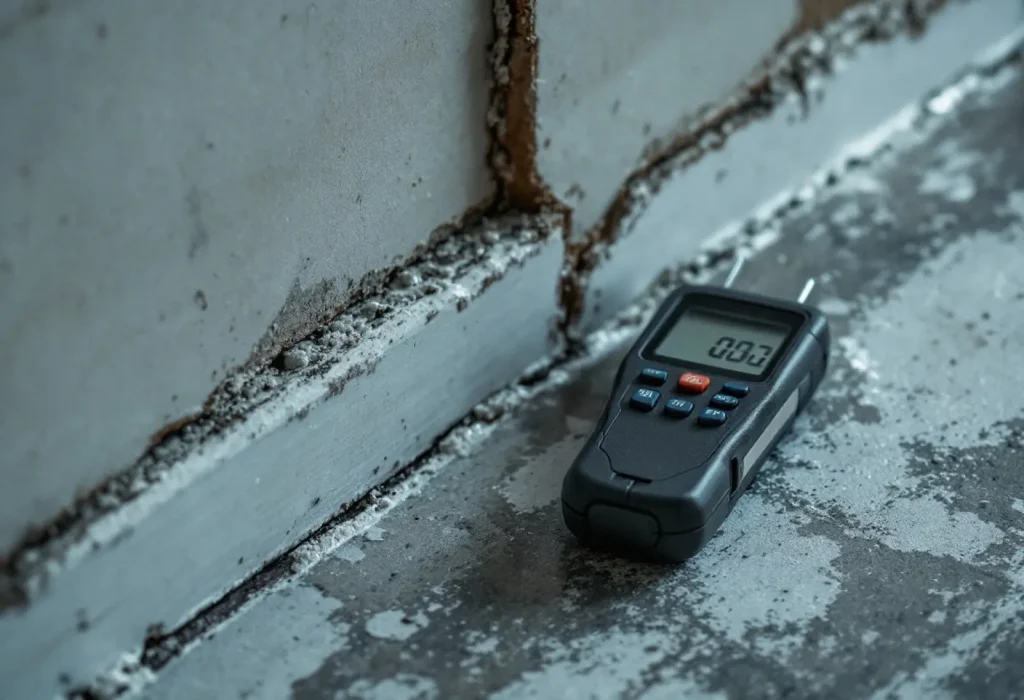
Moisture meters for water damage come in two kinds: pin meters read at the pin tips, and pinless meters give a relative reading to about 3/4 inch deep. Compare readings only on one meter: Delmhorst flags drywall above 0.5% on its gypsum scale, while Protimeter flags 17 on its WME scale, so one wall can show different numbers.
Key takeaways
- Wood has a shared number: under 15% before closing a wall, per NDSU Extension and LSU AgCenter.
- Drywall has at least three scales, and 0.5% on a gypsum scale and 17 on a WME scale are each that meter’s first warning, per the Delmhorst BD-2100 manual and the Protimeter Surveymaster manual.
- Pinless finds the edge of the wet area, and pins put a number on the layer you drove them into.
- At 80% RH wood settles at 16.0%, per Purdue Extension, so check the air before blaming the meter.
On this page
What does each moisture reading mean, material by material?
Wood is the one material where a percentage means much the same from meter to meter, and even wood needs a species check. Everything else is tied to the scale that produced it, so this table names the scale before the number. Read across, and do not carry a number from one row to another.
| Material | Scale | Reading | What the source says it means |
|---|---|---|---|
| Wall framing | Wood %MC | Under 15% | Target before closing the wall, per NDSU Extension and LSU AgCenter. LSU says the older target was 19%, the framing lumber standard. |
| Wood, BD-2100 | Wood %MC | 6 to 15, 15 to 17, over 17 | Green, yellow (borderline), red (too wet for most applications), per the Delmhorst BD-2100 manual. |
| Subfloor, wood flooring | Wood %MC | 10% to 12% | As low as they will go before insulating a raised floor, per LSU AgCenter. Heimerdinger in R&R Magazine gives 6% to 9% for floors, doors and cabinets. |
| Drywall, BD-2100 | Gypsum %MC | 0 to 0.5, 0.5 to 1, over 1 | Green, yellow, red (too wet for painting or wallpaper), per the Delmhorst BD-2100 manual, whose scale runs 0.2% to 50%. |
| Drywall, Tramex | Drywall %MC | Over 0.5% | “Higher than generally acceptable”, needs drying or investigation, per Tramex. Per the Tramex MEX5 datasheet, pins stop at 8.5%. |
| Drywall, in the field | Drywall %MC | 1.3% and 6% | 1.3% in a shower wall read too high, and 6% is very wet, per Heimerdinger in R&R Magazine. |
| Drywall, Surveymaster | %WME | 7 to 16.9, 17 to 19.9, 20 to 99.9 | Dry, at risk, wet, per the Protimeter Surveymaster manual. WME is what wood would read in balance with that wall. Over 30 is relative. |
| Drywall, pinless | Comparative | No fixed number | Compare to a known dry spot. Green Building Advisor logged 8 over an empty cavity and 35 at a metal corner on one meter. |
| Plaster, masonry | Reference 0 to 100 | 0 to 85, 85 to 95, over 95 | Green, yellow, red, and qualitative only, per the Delmhorst BD-2100 manual. |
| Concrete slab | Reference 0 to 100 | 85 to 95 | About 2% to 4% moisture content even in the red band, per the Delmhorst BD-2100 manual. Comparative only: ASTM F2170, F1869 or F2420 decide flooring acceptance. |
Note how far the two drywall conventions sit apart. Anything over 1% is red on the gypsum scale per the Delmhorst BD-2100 manual, while on the Surveymaster the at risk band does not begin until 17. Each number is right on its own scale, and neither translates to the other. Tear-out calls then belong to the page on wet drywall.
Why can dry drywall read 0.3, 8 or 20 depending on the meter?
Because those meters do not report the same quantity. Accuserve says most meters are calibrated for wood only, and calls drywall readings “relative or qualitative, not quantitative”. Wagner Meters puts it directly: a meter set for wood “will still show a number on drywall, but that number isn’t a true moisture content”. On the Accuserve example, a day two reading of 15 would mean finished on the BD-10 and unfinished on the Surveymaster.
| Reported by | Meter and scale | Reading | Where |
|---|---|---|---|
| Green Building Advisor | BD-2100 pins, gypsum scale | 0.3% | Over an empty cavity |
| Green Building Advisor | Delmhorst pinless, comparative | 8 | Same wall spot |
| Green Building Advisor | Delmhorst pinless, comparative | 35 | At a metal corner bead |
| Green Building Advisor | Ryobi pinless | 0.00% and 78% | Plain wall, then outside corner |
| Accuserve | Delmhorst BD-10 | 20% | Dry standard, flood house drywall |
| Accuserve | Protimeter Surveymaster | 8% | Same drywall, dry standard |
Relative scales compound it. The R&R Magazine primer lists comparative ranges of 0 to 100, 0 to 200, 0 to 300 and 0 to 1000 depending on maker, and the Surveymaster’s search mode runs 70 to 999. Heimerdinger in R&R Magazine warns that readings like 30 and 50 mean nothing unless the range is recorded with them. Accuserve quotes ANSI/IICRC S500-2021 for the fix: use the same meter on the same materials throughout the drying process.
WME is the bridge, with limits. The Protimeter Surveymaster manual defines it as the theoretical %MC a piece of wood would reach in moisture balance with the material at that point, and Heimerdinger in R&R Magazine gives an example: WME 10 on drywall corresponds to stability near 55% RH at 70 F. That makes WME useful for judging risk across materials, and it still is not a measure of water in the gypsum.
What should dry wood read at your indoor humidity?
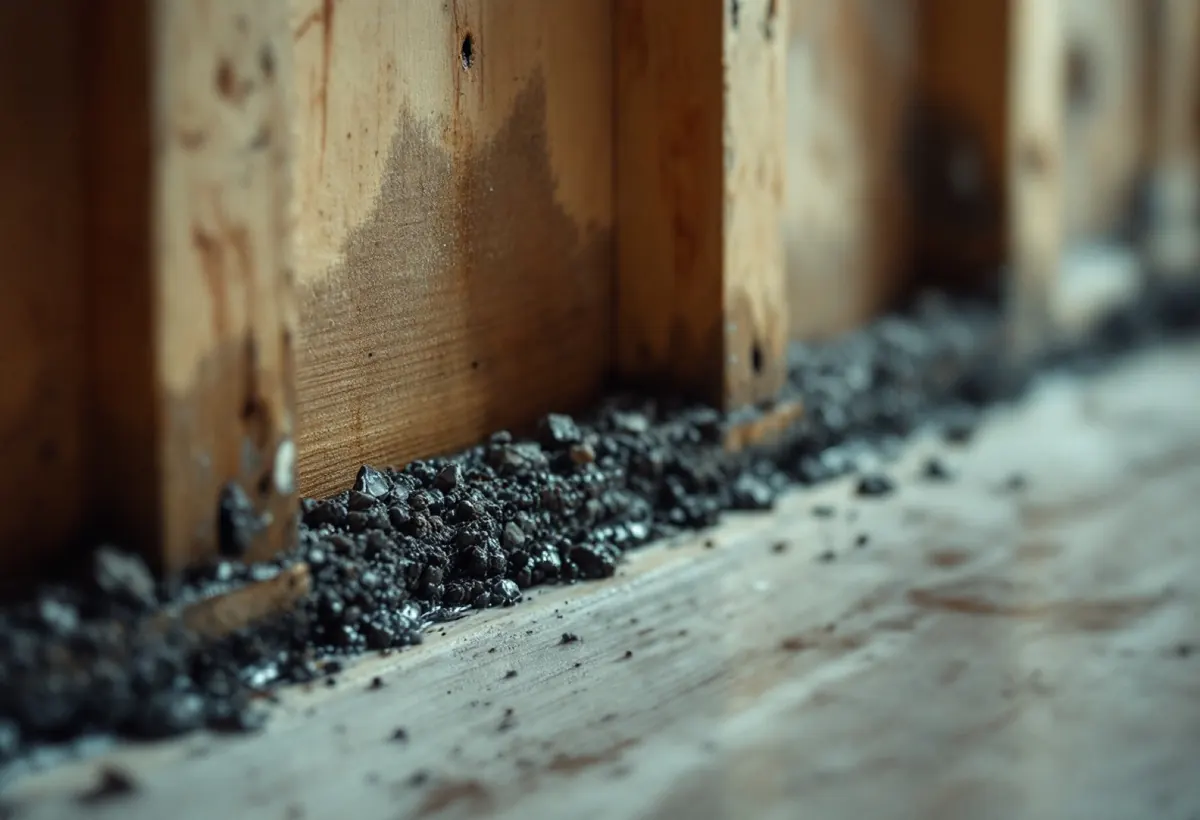
About 9.2% at 70 F and 50% RH, per the Wood Handbook table in Purdue Extension, and R&R Magazine uses the same figure for softwood framing. The number moves with the room. The chart shows why a stalled reading can be an air problem: at 80% RH wood settles at 16.0%, above the 15% target, so the material cannot reach it until the air drops to roughly 75% RH or below. That threshold is our reading of the table. EPA advises keeping indoor RH below 60%.
Species shifts the display too. The Delmhorst BD-2100 manual calibrates on Douglas fir and prints corrections, because species read differently at the same moisture. It says construction grade lumber can often be taken at face value, and that flooring and furniture work should apply corrections. Hardwood floor decisions go to our page on hardwood floor water damage repair.
| Species | Display 12 becomes | Display 16 becomes |
|---|---|---|
| Douglas fir (calibration basis) | 12 | 16 |
| Red oak | 12 | 16 |
| White oak | 11.5 | 15 |
| American elm | 10 | 13 |
| Southern yellow pine* | 14.5 | 19 |
| SPF* | 15.5 | 20.5 |
Temperature matters at the extremes. The same manual needs no correction between 50 F and 90 F, and says lower wood temperature gives lower indicated moisture, which is a reason to distrust a low number from a cold crawlspace. LSU AgCenter adds that treated bottom plates can give false readings on some meters.
Pin or pinless: how deep does each one actually read?
Pin meters measure electrical resistance between the tips, per the R&R Magazine primer. Pinless meters emit a low level electromagnetic signal and average what sits under the plate, per Delmhorst, and the Protimeter Surveymaster manual calls that mode ideal for rapid surveys. Heimerdinger in R&R Magazine treats pin and pinless side by side as the best option, and the depth figures show why.
Depth is the trap on drywall. Lignomat advises 1/4 inch on drywall so the meter does not read studs and other materials in the measuring field, and the Tramex MEX5 datasheet shallow setting exists for the same reason. R&R Magazine primer puts most pinless penetration at 1/2 to 3/4 inch, so on a half inch panel the deep setting is partly reading the cavity behind it. FLIR adds that pin meters report the wettest portion between the surface and the lowest point of penetration, so a high pin number with uninsulated pins does not say which layer is wet. Insulated pins read only at the tip, per R&R, and the BD-2100 manual lists 3 1/4 inch and 6 inch insulated options for reaching inside a wall assembly.
| Meter | Type | Scales and ranges | Read depth | Correction | Source and status |
|---|---|---|---|---|---|
| Protimeter Surveymaster BLD5365 | Pin and pinless | Pin 7.9 to 99 %MC or %WME; search 70 to 999 relative | Pin 0.4 in; search up to 3/4 in | Reference mode stores a baseline | Protimeter Surveymaster manual; ITS marks it no longer available |
| Delmhorst BD-2100 | Pin | Wood 6 to 40%; gypsum 0.2 to 50%; reference 0 to 100 | 5/16 in; 3 1/4 in and 6 in electrodes | Species and temperature tables | Delmhorst BD-2100 manual; ITM lists it discontinued, pointing to BDX-20 and BDX-30 |
| Tramex MEX5 | Pinless, optional pin probes | Wood 0 to 30% pinless, 6 to about 50% pin; drywall pin 0 to 8.5%; reference 0 to 100 | Shallow to 10 mm; deep to 30 mm | 500+ species, specific gravity, auto temperature | Tramex MEX5 datasheet; $1,020 at InspectorTools |
| Tramex ME5 | Pinless | Qualitative comparative, drywall scale | Shallow to 10 mm; deep to 30 mm | Not stated on the page | Tramex drywall page |
| Extech MO55 | Pin and pinless | Pin wood 5 to 50%, materials 1.5 to 33%; pinless 0 to 99.9% | About 25 mm pinless | Not stated on the page | Extech MO55 page; discontinued, MO55A named as replacement |
| Lignomat Ligno-DuoTec BW | Pinless | Wood 5 to 60% | 1/4 in and 3/4 in | Not stated for this model | Lignomat |
How do you read a moisture meter on a wet wall, step by step?
- Set the scale first and write it down. On the BD-2100 that means scale 1 for wood, 2 for reference, 3 for gypsum. Changing it later breaks the comparison.
- Check the meter. The BD-2100 should display 12% with the read and calibration keys held, and the Surveymaster should read 18.2 plus or minus 1.0 on its Calcheck. Protimeter states its accuracy specs hold for one year from calibration.
- Read the same material in an unaffected area. That is the S500 dry standard as quoted by R&R Magazine, “a reasonable approximation of the moisture content or level of a material prior to a water intrusion”. The Surveymaster’s Reference Mode stores that reading and shows later readings above or below it.
- Scan pinless to find the edge. Keep the sensor flat and in full contact. Protimeter says to place the meter on each spot rather than slide it, which wears the back.
- Confirm with pins. Push them in to full penetration, parallel to the grain on wood per the Delmhorst BD-2100 manual. LSU AgCenter says to read middles and edges of studs, plates, sheathing and subfloor, and not to reuse pin holes.
- Log the same spots with the same meter. LSU AgCenter says readings can shift as moisture equalizes between wetter and drier areas, so one good number is not the finish.
What counts as finished comes from that baseline, not a chart. R&R Magazine defines the drying goal as the target moisture for the end of drying, and its author accepts within 10% of pre-loss readings on similar materials, a summary he offers rather than S500 text. Equipment and logs for hitting that goal are covered under structural drying, and time estimates under how long water damage drying takes.
What gives a false high or low reading?
| Cause | Effect | What the source says and what to do |
|---|---|---|
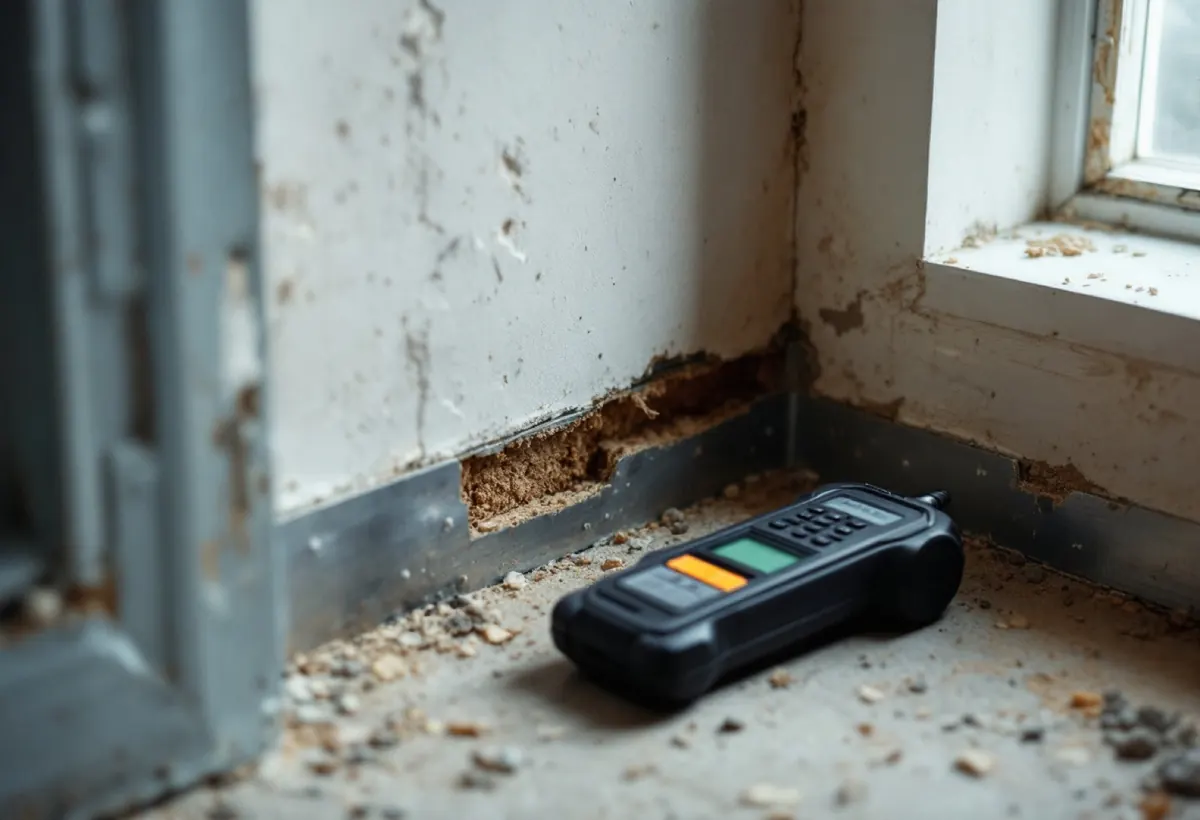
| Metal behind the surface | False high | Green Building Advisor: comparative 8 rose to 35 at corner bead sitting under 1/2 in of joint compound. Confirm any spike at a corner with pins. |
| Conductors other than water | False high | The Protimeter Surveymaster manual warns they can raise search mode readings. Accuserve names metal and wiring. |
| Surface condensation | Sources disagree | Accuserve lists condensation as a pinless false positive. The Protimeter Surveymaster manual says surface moisture has little effect on search mode. Wipe the spot and re-read. |
| Wood scale used on gypsum | Wrong units | Wagner Meters: a number shows but it is not moisture content. Use a gypsum, drywall or relative scale. |
| Pressure treated plates | False reading | LSU AgCenter notes this on some meters. Read the stud above as a check. |
| Insulated pins on a non-insulated calibration | Slightly low | The Delmhorst BD-2100 manual says insulated pins read slightly lower and prints a correction. |
| Fast surface drying | False low | The Delmhorst BD-2100 manual says rapid drying can leave plaster dry at the surface and moist below; on slabs a surface reading can be dry while a subsurface test reads wet. |
Cheap meters add a calibration problem to all of this. Green Building Advisor recorded a pinless Ryobi showing 0.00% on a plain wall and 78% at an outside corner with its alarm sounding, and a wrong call there is a demolition decision. Where the wet line runs inside a cavity is a separate question, handled under water damage in walls.
Which moisture meter should you get for your situation?
Work down this path and stop at the first line that fits. It is our reading of the specs above, not a ranking, and the only current price we could open was $1,020 for the MEX5 at InspectorTools.
- One flood, wood framing, homeowner. Borrow before buying. NDSU Extension says hardware stores and lumberyards rent meters and many county Extension offices lend them. A pin meter with a wood scale answers the NDSU under 15% question.
- You need a number for drywall. Pick a meter with a named gypsum or drywall %MC scale and pins, as the BD-2100 and MEX5 specs show. A wood scale or a pinless reading alone cannot give one.
- You survey whole rooms on billable jobs. Pair pinless with pins, ideally with a shallow setting for thin panels. Add a thermo-hygrometer, because the EMC chart depends on air data; the EPA mold guide says inexpensive ($50) humidity models exist.
- You cannot make holes, such as tile, good wallpaper or finish flooring. The Protimeter Surveymaster manual names tile and wallpaper as the case for search mode, so compare to a known dry area of the same assembly.
- You are clearing a slab for flooring. Stop. The Delmhorst BD-2100 manual says meters do not give quantitative results for acceptance and names ASTM F2170, F1869 and F2420 instead.
If you would rather hire the reading done, ask the inspector which scale each number is on and for the unaffected-area baseline, then see what a water damage inspection should include. More on this topic sits on the water damage hub.
Questions people actually ask
Can a moisture meter detect water behind a wall or tile?
Partly. The Protimeter Surveymaster reads relative moisture up to 3/4 inch beneath a surface and names ceramic tile as a use, and the Tramex MEX5 reaches up to 30 mm. Past that you need holes: Delmhorst lists 3 1/4 inch insulated pins and Lignomat an electrode reaching 7 inches. A clean pinless result does not clear the far side of a stud cavity.
Can a moisture meter detect mold?
No. EPA describes moisture meters as measuring moisture content in materials such as carpet, wallboard, wood, brick and concrete. Lignomat’s R&R article records a mold stained wall that had dried out and read low, so a low number says nothing about past growth. Use the meter to find the water source, then read the separate guidance on mold testing.
Are cheap moisture meters accurate enough?
For finding a wet zone, often; for a number, less so. Extech rates its MO55 pin mode at plus or minus 3% of reading plus 5 digits, and Green Building Advisor recorded a Ryobi pinless swinging from 0.00% to 78% between a plain wall and a corner. A meter with only a wood scale cannot report drywall moisture content, whatever it costs.
Why did my reading go back up after the room felt dry?
LSU AgCenter says readings can shift as moisture equalizes between wetter and drier areas, so a surface that dried quickly can rewet from the core. Delmhorst describes the same pattern in plaster dried fast with high heat or strong air movement. Keep logging the same points, and close the wall only when readings hold and meet the under 15% framing target NDSU Extension gives.
Can I use a wood moisture meter on drywall?
Only as a comparison. Wagner Meters says a wood-set meter shows a number on drywall that is not a true moisture content, and Accuserve recorded 20% on a BD-10 and 8% on a Surveymaster on the same dry drywall. Take a reading on a known dry stretch of the same wall, then look for spots above it. Do not compare that number to a percentage chart.
How often should moisture readings be taken during drying?
Accuserve on moisture maps recommends that readings be provided daily during drying, and the point is the trend at fixed spots. Mark each location on a sketch, record the meter model, scale and range with every value, and keep the same instrument throughout, as Accuserve quotes ANSI/IICRC S500-2021. Log air readings beside them too: per the Wood Handbook table, wood settles at 16% in 80% RH air at 70 F.
Sources
- Protimeter Surveymaster manual, GE Measurement and Control, INS5365 Rev. A, June 2013: modes, bands, WME definition, specifications. Retrieved 2 November 2026.
- Delmhorst BD-2100 manual, Delmhorst Instrument Co.: scales, LED bands, species and temperature tables, concrete and plaster sections. Retrieved 2 November 2026.
- Tramex MEX5 datasheet and Tramex drywall page, Tramex Ltd; Tramex, What is an acceptable moisture level for drywall, 26 February 2024. Retrieved 2 November 2026.
- Extech MO55 page, Extech Instruments: MO55 specifications. Retrieved 2 November 2026.
- Lignomat, Lignomat USA, Measuring drywall with pinless meters. Retrieved 2 November 2026.
- FLIR, Teledyne FLIR, Wet and dry moisture meter values. Retrieved 2 November 2026.
- Wagner Meters, Wagner Meters, How to use a wood moisture meter on drywall. Retrieved 2 November 2026.
- Delmhorst, Delmhorst, Choosing moisture meters for water damage restoration. Retrieved 2 November 2026.
- Green Building Advisor, Pinless moisture meters. Retrieved 2 November 2026.
- Accuserve, How to take conclusive moisture content readings on drywall, and Accuserve on moisture maps, Accuserve. Retrieved 2 November 2026.
- R&R Magazine, Josh Woolen, What is acceptable dry, 3 June 2021; R&R Magazine primer, A moisture meter primer; Heimerdinger in R&R Magazine, Grete Heimerdinger, 11 May 2022. Retrieved 2 November 2026.
- Purdue Extension, FNR-403-W, Controlling Moisture Content in Stored Lumber, Table 1, citing the Wood Handbook. Retrieved 2 November 2026.
- NDSU Extension, Flood recovery: dry out and rebuilding; LSU AgCenter, wood moisture guidance. Retrieved 2 November 2026.
- EPA mold guide, chapter 3, moisture and humidity meters, and EPA, chapter 2, indoor humidity. Retrieved 2 November 2026.
- Seller status and price: ITM, ITS, InspectorTools. Retrieved 2 November 2026.
- The 75% RH threshold is our reading of the EMC table. We did not test any meter. Our methodology sets out the standing rules.
Meter thresholds are maker guidance for that instrument, not limits for your building. Confirm calibration and scale with the manual for your own model.