The short answer
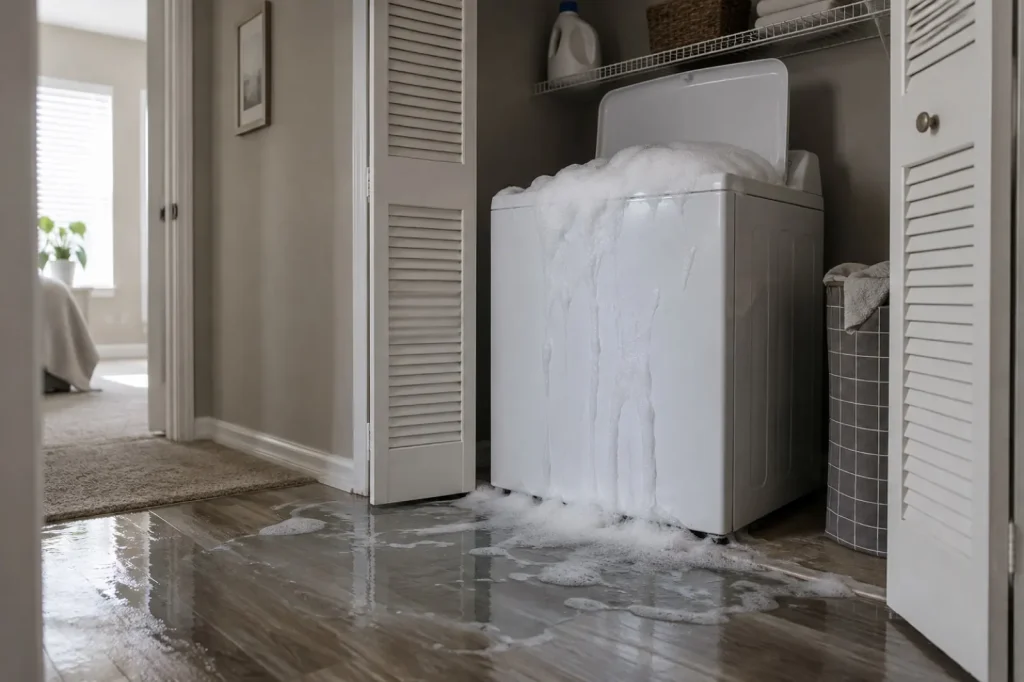
A washing machine overflow is usually one of five things: an inlet valve stuck open, a failed water level sensor, a drain standpipe that cannot take the pump’s flow, a clogged drain path, or oversudsing. Unplug the washer, close both supply valves and contain the water. Treat it as Category 2 grey water and start drying within 24 to 48 hours.
Key takeaways
- The cause decides whether it happens again. A washer that fills with the power off likely has a failed water valve, per GE Appliances support, and will repeat; a detergent mistake will not.
- One load is 14 gallons in an ENERGY STAR washer and 20 in a standard one, according to ENERGY STAR. A stuck valve has no ceiling.
- Washer discharge is a listed grey water source in the Northern Arizona University water damage guidelines.
- A 28 by 30 inch pan holds about 9.1 gallons to the brim, on our arithmetic from Oatey's drain pan guide: less than one load.
- According to the IBHS washing machine claims study, overflows and drain line failures caused 28% of washer claims.
On this page
What you are looking at: overflow, leak or drain backup
Three failures put water on a laundry floor. An overflow means the machine took on more water than it should, or could not hold its foam. A drain backup means it pumped out correctly and the standpipe could not carry the water away. A leak is a part letting go, usually a slow puddle rather than a sheet. Where the water appears, and when in the cycle, separates them.
| Where the water is | Usually points to | Cycle stage |
|---|---|---|
| Foam at the door, drawer or lid | Oversudsing | Wash or rinse |
| Water over the top of the tub | Inlet valve or level sensor | Fill |
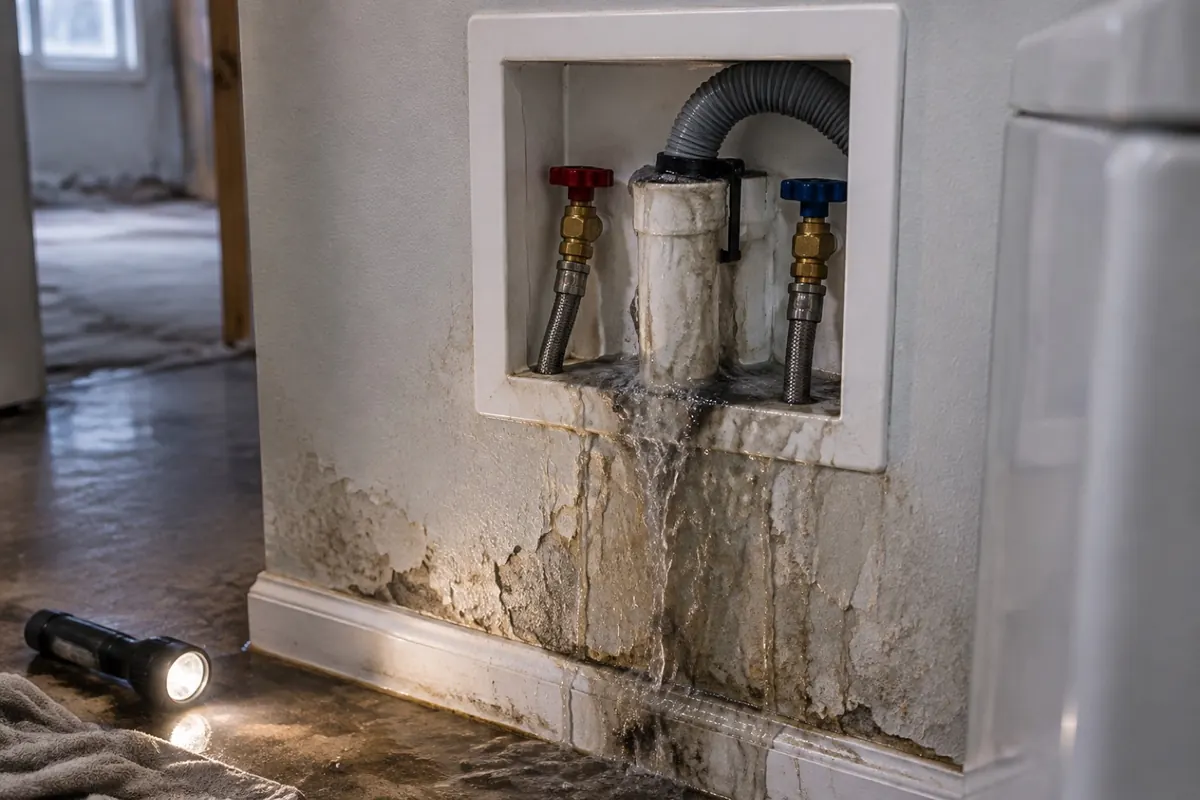
| Water out of the standpipe or wall box | House drain cannot take the flow | Drain or spin |
| Tub fills with the machine off | Inlet valve failed open | No cycle running |
| Small puddle at the front base | Filter cap, door boot or hose: a leak | Any |
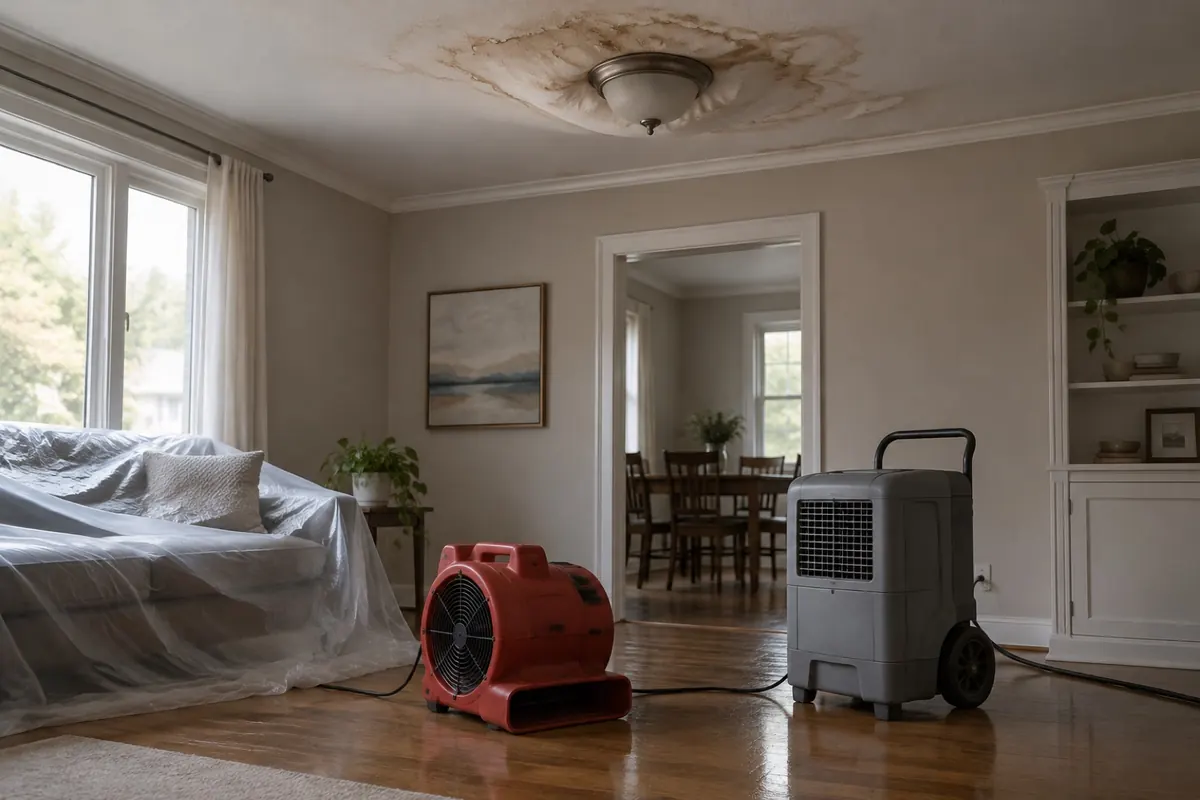
| Stain on the ceiling below | Any of the above, upstairs | Afterwards |
Washer leaking water on floor, but no overflow
If the drum never overfilled and the wall box stayed dry, the water came from the machine: door boot, pump filter cap or a hose. Hose failure data and replacement intervals are on our washing machine mold page and are not repeated here.
Five reasons a washer overflows
Keep this table. The third column matters most for cleanup: a cause that repeats means the machine stays off until it is fixed, however clean the floor is.
| Cause | Sign | Will it repeat? |
|---|---|---|
| Inlet valve stuck open | Drum keeps filling with the power off | Yes, whenever the supply valves are open, even unattended |
| Water level sensor or pressure switch | Overfills during a cycle; Samsung shows OE or OF | Yes, every cycle |
| Drain standpipe backup | Water out of the standpipe top at pump out; drum level normal | Yes, every drain until cleared |
| Clogged pump filter or drain hose | Water left in the drum; leaks at the filter cap | Yes, until cleared |
| Too much or non HE detergent | Foam at the door, drawer or vents | No once the dose is fixed; yes in soft water at the same dose |
Inlet valve
GE Appliances support says a washer that fills while not turned on may have a failed water valve, and to close the supply valves first; Samsung water fill troubleshooter says the same. It is the worst overflow because no cycle needs to be running.
Water level sensor or pressure switch
The Samsung overflow error page says OE or OF means the level sensor detected more water than the cycle needs, and names faulty valves or sensors. A failed sensor usually stops when power is cut; a failed valve does not. Unplug during fill and watch.
Washer drain overflow at the standpipe
Here the washer works. It pumps a full drum quickly and the standpipe, trap or branch drain cannot accept it, so grey water comes out of the top. That is a drain repair, which The Plumbing Brief covers; this page stays with the water damage.
Clogged drain path inside the washer
The Samsung overflow error page tells owners to check the drain hose for kinks and clean the drain filter. A blocked pump leaves water in the drum, which on a front loader finds the filter cap or door.
Detergent
Samsung says excess detergent or softener causes foam that interferes with level detection. The LG excessive suds page says liquid detergents can suds more than HE powder, and LG says soft water over-suds, so cut the dose. The Whirlpool WFW97HED installation instructions specify HE detergent only.
The drain standpipe: the specs manufacturers print
Most pages say clogged drain and stop. The installation documents say exactly what drain a washer expects. A drain that met the spec at installation and overflows now has changed, and that is a clog until shown otherwise.
| Spec | Whirlpool front load WFW97HED | Whirlpool top load WTW5700 | LG front load WM3997HWA |
|---|---|---|---|
| Standpipe diameter | 2 in minimum | 2 in minimum | Not stated |
| Drain must carry | 17 gal per minute | 17 gal per minute | Not stated |
| Lowest hose end | 30 in | 39 in | 29 in |
| Highest hose end | 96 in | 96 in | 96 in |
| Hose inside standpipe | 4.5 in | 4.5 in at most | 8 in at most |
| Supply pressure | 20 to 100 psi | Not stated | 20 to 120 psi |
Two findings follow. A standpipe that suits a front loader can be too short for a top loader: Whirlpool’s minimum is 30 inches for one model and 39 for the other. And the 17 gallon per minute requirement in Whirlpool’s guides tests the house drain, not the washer, so a backup there is a plumbing finding.
The first 30 minutes
Order matters more than speed: power, then water supply, then evidence, because the cause must be known before the next load.
| Step | Why this differs from generic flood advice |
|---|---|
| 1. Unplug, or switch off the circuit if the outlet is wet | The machine may still be filling or pumping |
| 2. Close both supply valves | Unplugging does not stop a valve stuck open, per GE and Samsung |
| 3. Photograph the drum, foam and wall box | The cause dries up with the evidence |
| 4. Towels at doorways, wet vacuum on the sheet | Upstairs, every minute is water entering the ceiling below |
| 5. Check the room and ceiling below | A laundry overflow rarely stays in the laundry |
| 6. Leave the washer off | Four of the five causes repeat on the next load |
Grey water, and when it gets worse
The Northern Arizona University water damage guidelines, reproduced in Building Services Management in January 2025, list discharge from dishwashers or washing machines as Category 2 grey water, which carries microorganisms and nutrients for them, and say grey water left untreated for longer than 48 hours may change to Category 3. Clean supply water from a burst valve caught before a wash starts is a different case, which is why the source should be recorded.
The IICRC S500 Consensus Body position statement says what the label changes: for Category 2 or 3 intrusions, remediation should occur before restorative drying, with contamination controls and worker protection. In a laundry that usually means carpet pad soaked by wash water is removed, not dried. How categories are assigned is set out in the IICRC water categories.
Second-floor laundries and the ceiling below
An upstairs overflow drains through the floor assembly into the ceiling under it, following joists and pipe penetrations, so the stain below can sit off to one side of the washer. Ceiling repair is on our ceiling water damage page; EPA’s cleanup table gives the material calls.
| Material below the laundry | EPA Table 1 action |
|---|---|
| Ceiling tiles | Discard and replace |
| Drywall ceiling | Dry in place if no obvious swelling and seams intact; if not, remove and replace |
| Fiberglass insulation above | Discard and replace |
| Carpet and backing | Extract, dehumidify, fans; dry within 24 to 48 hours |
| Hard flooring | Damp wipe; make sure the underflooring is dry |
According to the IBHS washing machine claims study, first-floor failures produced 28% greater losses because of nearby furnishings, and IBHS recommended an upper floor or basement where possible. That weighs contents; it does not spare the ceiling below an upstairs laundry.
Washer pans and automatic shutoff valves
The IBHS washing machine claims study and the later IBHS washing machine guidance tell owners to close the supply valves when the machine is idle, never overload it, use the right detergent and run it when someone is home. Neither mentions pans or automatic shutoffs. On attendance, the study reports that about 6% of failures were in unoccupied homes and those claims ran nearly two and a half times as severe.
According to Oatey's drain pan guide, its 28 by 30 inch pan is 2.5 inches deep and typically connected to a drain, and matters most under upper-floor laundries. To the brim that is about 9.1 gallons, roughly 65% of one ENERGY STAR load, by our arithmetic on data from Oatey and ENERGY STAR. A pan catches leaks; it handles an overflow only if its drain line keeps up.
Automatic devices act on the supply. The Watts A2C-WB product page describes a valve that senses the washer’s current and a floor sensor that closes both hot and cold. A whole-home shutoff watches the main: the LexisNexis Risk Solutions study, run with Flo by Moen, reports results for 2,306 device homes against a control group.
| Device | Catches | Misses |
|---|---|---|
| Pan with a drain line | Leaks and spills, routed away | Flow faster than the drain line |
| Pan without a drain line | A leak, until full | Anything over about 9.1 gallons |
| Outlet shutoff with floor sensor | Water at the sensor; closes hot and cold | Water that never reaches it |
| Whole-home flow shutoff | Abnormal supply flow | Water already in the drum or drain |
| Valves closed after each load | Valve failure while away | An overflow mid-cycle |
Insurance: what the policy wording says
The IRMI analysis of HO 00 03 03 22 quotes the ISO Homeowners 3 form: it covers loss resulting from an accidental discharge or overflow of water from within a household appliance, including tear out needed to repair it, and does not cover loss to the appliance from which the water escaped. The wording separates the floor from the washer. IRMI also notes ISO sells a separate water back up endorsement, so a drain backup can be read differently.
Duration is the usual dispute. The Eighth Circuit, Croxdale v. Travelers (2026) quotes a Travelers form excluding constant or repeated seepage or leakage over 14 days or more. A sudden overflow reads differently from a slow leak, which is why step 3 photographs matter.
What a policy pays depends on its own form, endorsements and state law. Ask the insurer which clause it relies on, and take questions to your state insurance department or a licensed professional. See homeowners insurance and water damage.
Washing machine flood cleanup and drying
The EPA mold and moisture guide says to dry water-damaged areas and items within 24 to 48 hours. In a laundry, check the places that stay wet after the floor looks dry: the recess behind the pulled-out machine, wall bottom plates and drywall that wicks, particleboard toe kicks, and the subfloor under floating floors (water under vinyl plank). Method is on structural drying and timing on how long drying takes.
Escalation triggers: bigger than the puddle
- A stain, sag or drip on the ceiling below.
- Water reached an adjoining room or ran down stairs.
- Laundry drywall is soft or shows a tide line.
- Wash water sat more than about 48 hours.
- Water came out of the standpipe: the branch drain may serve other fixtures.
- It overflowed while nobody was home.
Which overflow is this? A decision path
Stop at the first yes.
- Drum filling with the power off? Failed inlet valve. Supply valves stay closed until it is replaced.
- Overfilled mid-cycle, stopped when unplugged? Level sensor or pressure switch. Service call first.
- Foam at the door, drawer or lid? Oversudsing. Cut the dose, use HE detergent, run a clean cycle.
- Water out of the standpipe during the drain? Drain backup. Plumbing repair; check other drains on the line.
- Water left in the drum, wet front base? Pump filter or drain hose. Clear it.
- None of these? A leak, not an overflow. Start with hoses and the door boot.
Then size the damage separately: water in another room, the floor below or the walls needs moisture readings, not a mop.
For contractors: documenting a washer overflow
Scope follows category. Under the IICRC S500 Consensus Body position statement, Category 2 means remediation before drying, contamination controls and worker protection, with an indoor environmental professional where elevated risk factors exist. Expect three questions: what failed, how long it ran, and appliance or drain.
| Record | Why the adjuster asks |
|---|---|
| Cause evidence in place | Appliance overflow and drain backup can fall under different clauses |
| Timeline: cycle start, found, stopped | Seepage exclusions turn on duration |
| Category and its basis | A preliminary determination under the IICRC statement |
| Moisture map, room below included | Sets drying and removal scope |
| Removed materials with reasons | Category 2 removals get questioned |
| Model, standpipe height and diameter | Compared with the installation spec |
Questions people actually ask
What do I do if my washing machine overflows?
Unplug it, or switch off the circuit if the outlet is wet, then close both supply valves. GE and Samsung put the valves first because a failed inlet valve keeps filling with the power off. Contain the water, photograph the scene, check the room below, and leave the washer off until the cause is known.
Why is my washer overflowing?
Usually an inlet valve stuck open, a failed level sensor or pressure switch, a standpipe that cannot take the pump’s flow, a blocked pump filter or hose, or oversudsing. Samsung’s OE or OF code means its sensor detected more water than the cycle needs.
Why does my washer drain overflow?
The house drain cannot carry what the pump delivers. Whirlpool’s installation guides call for a standpipe at least 2 inches in diameter that carries 17 gallons per minute. Water out of the standpipe during the drain means a drain cleaning or plumbing repair, not a washer repair.
Can too much detergent make a washer overflow?
Yes. Samsung says excess detergent creates foam that interferes with water level detection, and LG says to use HE detergent and cut the dose in soft water. It is the one cause that does not repeat once the dose is corrected.
Is washing machine overflow water dangerous?
It is grey water. Northern Arizona University’s water damage guidelines list washing machine discharge as Category 2 and say it may become Category 3 if untreated beyond 48 hours. Wear gloves, keep children and pets out, and remove soaked porous items rather than drying them.
Does homeowners insurance cover a washing machine overflow?
Standard HO 3 wording, as quoted by IRMI, covers accidental overflow from a household appliance but not the appliance, and forms exclude repeated seepage over a stated period, 14 days in the Travelers form quoted by the Eighth Circuit. Your own policy decides; ask your insurer or state insurance department.
Sources
- IBHS washing machine claims study (2012, archived) and IBHS washing machine guidance (archived 2017), Insurance Institute for Business and Home Safety. Retrieved 30 October 2026.
- Whirlpool WFW97HED installation instructions (via AJ Madison) and Whirlpool WTW5700 dimension guide (via Abt), Whirlpool Corporation. Retrieved 30 October 2026.
- LG WM3997HWA quick install guide, LG Electronics, via Home Depot, dated 2017. Retrieved 30 October 2026.
- Samsung overflow error page (Samsung Gulf) and Samsung water fill troubleshooter (Samsung US). Retrieved 30 October 2026.
- GE Appliances support, washer fills when not turned on. Retrieved 30 October 2026.
- LG too many suds page and LG excessive suds page, LG Electronics USA. Retrieved 30 October 2026.
- ENERGY STAR, clothes washers, US EPA and DOE. Retrieved 30 October 2026.
- Oatey's drain pan guide, Oatey Co. Retrieved 30 October 2026.
- LexisNexis Risk Solutions study, release of 5 May 2020. Retrieved 30 October 2026.
- Watts A2C-WB product page, Watts Water Technologies (discontinued model). Retrieved 30 October 2026.
- IICRC S500 Consensus Body position statement, 01.2026. Retrieved 30 October 2026.
- Northern Arizona University water damage guidelines, in Building Services Management, January 2025. Retrieved 30 October 2026.
- EPA mold and moisture guide (updated 18 February 2026) and EPA Table 1, Water Damage: Cleanup and Mold Prevention (updated 8 September 2026), US EPA. Retrieved 30 October 2026.
- IRMI analysis of HO 00 03 03 22, quoting ISO HO 00 03 03 22. Retrieved 30 October 2026.
- Eighth Circuit, Croxdale v. Travelers (2026), No. 25-2454. Retrieved 30 October 2026.
- Pan capacity is arithmetic on the figures above. See our methodology and the water damage hub.
Specifications differ by model; check the guide for the machine on site, and your own policy for coverage.