The short answer
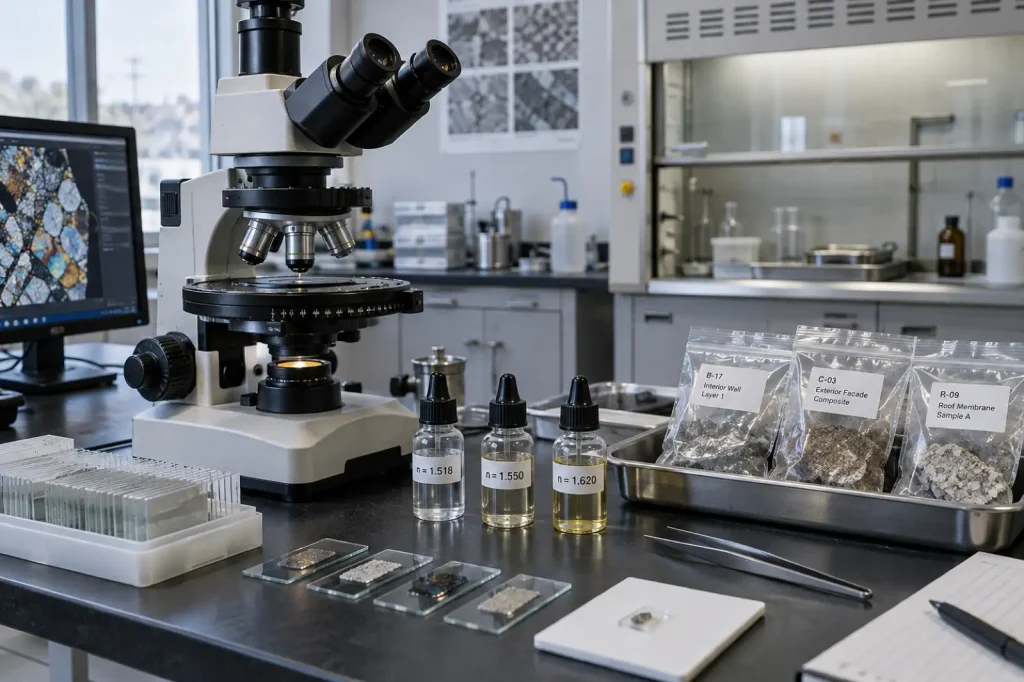
An asbestos testing lab identifies asbestos under a microscope: polarized light microscopy (PLM) for bulk building materials, phase contrast microscopy (PCM) for counting fibers on an air filter, and transmission electron microscopy (TEM) for fibers too thin for a light microscope. Use a lab accredited for the exact method you need, usually through NIST’s NVLAP, and read the result layer by layer.
Key takeaways
- Accreditation is method by method: NVLAP accredits bulk PLM and air TEM separately, so check the scope, not just the lab’s name.
- In a 400 point count each point is worth 0.25 percent, which is how a count settles a result near the 1 percent line.
- PCM does not tell asbestos from other fibers; NIOSH 7400 says so and points to TEM for identification.
- A PLM negative on floor tile or mastic is weak: EPA warned in 1994 that thin fibers escape PLM, and New York calls it inconclusive until TEM confirms.
- Every layer is its own result, so one bag can hold an asbestos layer and a clean one.
On this page
- From bag to report
- Which method answers which question
- Floor tile, mastic and the TEM follow-up
- New York and the ELAP 198 methods
- Accreditation, and how to look a lab up
- Chain of custody
- Turnaround tiers
- Reading the lab report
- Choosing a lab: seven checks
- For contractors
- Questions people actually ask
The pages ranking for this term are lab sales pages and directories. This one reads the method documents and accreditation rules, so you can order the right test, check the lab and read the result. Prices are on our asbestos testing cost page.
What this page does not cover: health. It describes lab methods, accreditation and paperwork. For exposure and health questions, see the EPA homeowner guidance and your doctor.
From bag to report: what happens to a sample
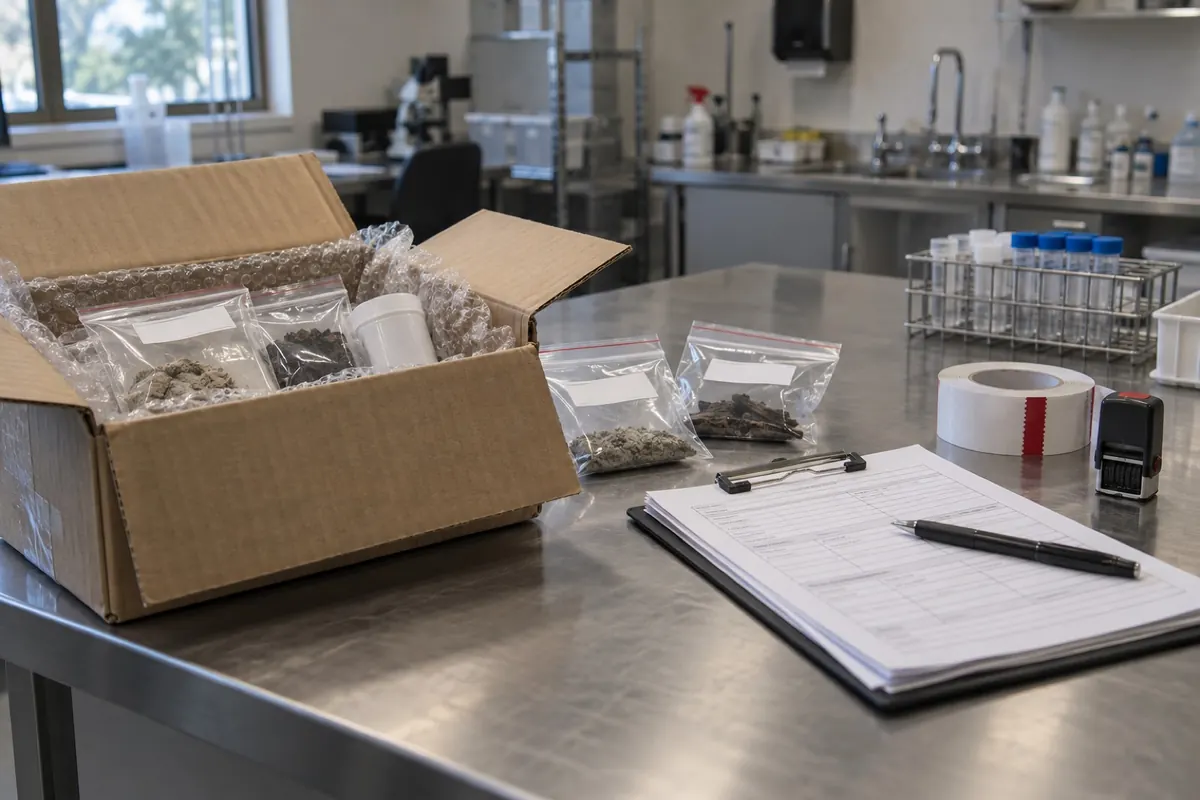
What makes a result defensible is the trail around the microscope. 40 CFR 763 Appendix A tells the lab to note the package condition, keep the shipping slips, check the custody seal, have whoever breaks it sign for it, and assign a lab number before analysis.
For bulk material the key step is separating layers. The EPA 1994 advisory announced EPA’s improved method, EPA/600/R-93/116, because the 1982 method let labs report one result across all layers, so an asbestos layer could be averaged away. The improved method reports each layer. The EMSL 2026 guide adds gravimetric reduction for non-friable organically bound (NOB) materials such as floor tile, mastic, roofing, caulk and glazing.
Which method answers which question
How is asbestos tested? By matching the method to the sample and the question. Mail-in kits, covered on our asbestos testing kit page, almost always buy one PLM result.
| Method | Method document | Sample | What it reports |
|---|---|---|---|
| PLM, visual estimate | EPA/600/R-93/116 | Bulk material | Type and estimated percent per layer |
| PLM, point count | EPA/600/R-93/116; Appendix E | Bulk material | Counted percent, 400 points or more |
| PLM, NOB | EPA/600/R-93/116; NY 198.6 | Tile, mastic, roofing | Percent after the binder is removed |
| PCM | NIOSH 7400 | Air filter | Fibers per cc; does not identify them |
| TEM, AHERA | 40 CFR 763 Appendix A | Air filter | Asbestos structures per mm2 of filter |
| TEM, NIOSH 7402 | NIOSH 7402 | Air filter | Which PCM-sized fibers are asbestos |
| TEM, NOB | EPA/600/R-93/116; NY 198.4 | Tile, mastic | Thin fibers PLM can miss |
PLM: the default for bulk material
Per 40 CFR 763.87, school bulk samples are analyzed by PLM, never composited, and a homogeneous area is clear only if every required sample shows 1 percent or less. The analyst identifies fibers by their optical properties, then estimates the amount by eye or counts it. 40 CFR 763 Appendix E sets the count at 400 points over at least 8 preparations: no asbestos detected if no point lands on asbestos, under 1 percent if one to 3 do.
Per the EMSL list, a visual estimate is 4 times coarser than a 400 point count. The NESHAP builds this in: per 40 CFR 61.141, a visual result under 10 percent must be verified by point counting.
PCM: counting fibers, not identifying them
NIOSH Method 7400 counts fibers longer than 5 micrometers with a 3 to 1 aspect ratio on a 25 mm filter. Its own applicability statement says PCM does not differentiate asbestos from other fibers, misses fibers under about 0.25 micrometers wide, and should be paired with electron microscopy for identification. 29 CFR 1926.1101(c) sets its limits in the same fibers per cc.
TEM: the fibers light cannot resolve
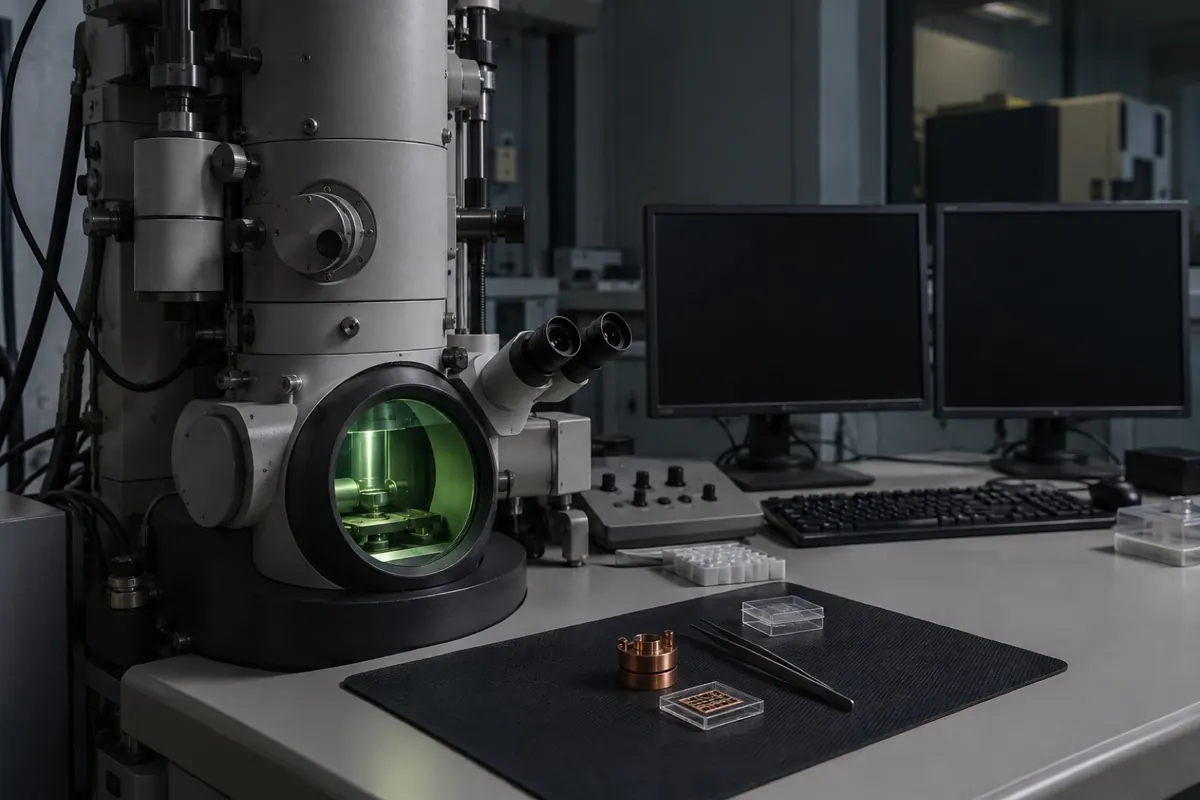
Electron microscopy identifies structures by diffraction and chemistry. 40 CFR 763 Appendix A, the AHERA method, counts asbestos structures 0.5 micrometers or longer at 5 to 1. NIOSH Method 7402 counts the same population as PCM, over 0.25 micrometers wide and longer than 5, so a lab can say what share of a PCM count is asbestos. In schools, 40 CFR 763.90(i) clears abatement on 5 TEM samples inside compared with five outside, or an inside average at or below the 70 structures per square millimetre filter background.
The AHERA TEM cut-off is 10 times shorter than the PCM one, so a TEM clearance and a PCM count of the same room are not interchangeable.
Floor tile, mastic and the TEM follow-up
The EPA 1994 advisory is the source of the floor tile caution. EPA wrote that the 1982 method gave no guidance for fibers thinner than 0.25 micrometers, so tiles reported negative under it may hold undetected asbestos, and that the improved method adds TEM.
| Situation | What the sources say | Practical step |
|---|---|---|
| PLM over 1% on tile or mastic | Positives over 1% stand whatever the method (EPA 1994) | Treat as asbestos |
| PLM none detected or under 1% on NOB | EMSL recommends TEM; New York calls it inconclusive | Order TEM, or assume asbestos |
| Old report with one result for several layers | May hide an asbestos layer (EPA 1994) | Resample, or assume |
| Gypsum board | A single-layered material (EPA 1994) | Sample joint compound and texture separately |
EPA added that material may always be assumed asbestos-containing instead of sampled. Visual clues are on our floor tile identification page.
New York and the ELAP 198 methods
New York approves labs through the Wadsworth Center’s ELAP, with methods numbered as items, per the NY DOH sampling page and the NY ELAP PLM checklist.
| ELAP item | Technique | Used for | Notable rule |
|---|---|---|---|
| 198.1 | PLM, stratified point count | Friable bulk | No visual estimation in New York |
| 198.6 | PLM after gravimetric reduction | NOB bulk | 1 percent or less carries a required disclaimer |
| 198.4 | TEM after gravimetric reduction | NOB bulk | The method that can clear NOB |
| 198.8 | PLM | Fireproofing with vermiculite | Required item since a 2014 notice |
The Item 198.6 disclaimer states the problem plainly: PLM is not consistently reliable in detecting asbestos in floor coverings and similar NOB materials, and quantitative TEM is currently the only method that can show such material is non-asbestos. A New York job needs a lab holding the ELAP items, not only NVLAP.
Accreditation, and how to look a lab up
Accreditation is why an asbestos analytical lab’s result counts with a regulator. 40 CFR 763.87(a) requires school labs accredited by the National Bureau of Standards, which the NIST history page confirms is now NIST. Its programme is NVLAP, and per the NIST NVLAP page it accredits PLM and TEM under separate handbooks, 150-3 for bulk and 150-13 for air. 29 CFR 1926.1101(k)(5) also accepts NVLAP or the AIHA bulk round robin.
| Programme | Covers | Recognized for | Proficiency or standard |
|---|---|---|---|
| NIST NVLAP | Bulk PLM; air TEM | AHERA (763.87, 763.90); OSHA rebuttal | 2 PLM and 1 TEM proficiency rounds a year |
| AIHA LAP (IHLAP) | PCM by NIOSH 7400 | Its PAT programme: PCM clearance in some AHERA cases | ISO/IEC 17025:2017, scope per lab |
| State, for example NY ELAP | State items 198.1 to 198.8 | Work under that state’s rules | State proficiency and audits |
| A2LA | Environmental scopes | Where accepted | Listed as a search route by Minnesota |
Looking a lab up in the NVLAP directory
- Open the NVLAP directory.
- Set Program to Asbestos Fiber Analysis, then country and state, or enter a lab name or NVLAP lab code.
- Read the scope: bulk PLM, airborne TEM or both. A PLM-only lab is not accredited for clearance air.
- Match the address to your report; the EMSL 2026 guide counts 38 laboratories in one network.
- Lab missing? Check the directory’s suspended or terminated list.
For PCM, AIHA LAP publishes scopes; an example AIHA LAP scope lists NIOSH 7400 under its asbestos/fiber microscopy core and urges clients to verify current status. The Minnesota lab list gives search settings for NVLAP, AIHA LAP and A2LA. Accreditation of the people who take samples is shown on our asbestos accreditation map.
Chain of custody
A custody form ties a bag to a place, a time and a person, and records every handover. The AHERA method has the sampler initiate custody at the start of sampling if the client asks, and address the package to the lab’s sample coordinator.
| Field on the form | Why it matters later |
|---|---|
| Sample ID matching the bag | One result, one bag, one spot |
| Location and homogeneous area | Lets anyone find the point |
| Date and collector | Shows who sampled |
| Layers seen | Exposes a layer the lab skipped |
| Method and turnaround | The lab runs what you order |
| Positive stop or analyze all | Sets how many results |
| Signature at each handover | Proves control throughout |
Keep the signed form with the report. 29 CFR 1910.1001(j)(3) has owners keep asbestos records for the duration of ownership and pass them on, and the form makes those records traceable.
Turnaround tiers
Turnaround is a priced tier, and the clock starts at the lab. The EMSL 2026 guide lists 8 tiers, 3 hours, 6 hours, 1 day, 2 days, 3 days, 4 days, 1 week and 2 weeks, with two weeks cheapest, so expedited same day work is widely sold; the Wisconsin State Laboratory of Hygiene quotes 12 to 14 working days normal, plus priority and rush. Prices per tier are on our asbestos testing cost page.
Because 40 CFR 763.87(c)(2) makes an area asbestos-containing on one sample over 1 percent, labs offer a positive stop. The EMSL terms make full analysis the default unless you ask. A stop saves analyses; a full set is easier to defend in a claim.
Reading the lab report
| Report line | What it means | What to check |
|---|---|---|
| Sample and layer | One row per layer | Every layer has a row |
| Method | Visual, point count, NOB, TEM | What you ordered, within accreditation |
| Asbestos type | Chrysotile, amosite and others | Any type named means asbestos seen |
| None detected | Not seen by that method | Not proof of zero; on NOB, ask about TEM |
| Under 1% or trace | Seen, below 1 percent | Not ACM federally; ask for a point count |
| Analyst, date, accreditation | Signed and dated | Required for AHERA by 763.87(d) |
The less than 1 percent problem
Federal definitions draw the line at more than 1 percent, per 40 CFR 61.141. Trace therefore means asbestos was seen but the material is not federally asbestos-containing. Three cautions. Under 40 CFR 763 Appendix E, up to 3 points in 400 still reads under 1 percent, so a visual call near the line is weak. State rules can add requirements. And the OSHA limits in 29 CFR 1926.1101(c) are set on airborne concentration, not material percent, so many contractors treat trace as a work practice question. Definitions are on our asbestos containing material page.
| Your result says | Read it as | Next step |
|---|---|---|
| Over 1%, any method | Asbestos-containing | Stop disturbance; plan abatement |
| Under 1% or trace, visual PLM | Borderline | Point count |
| Under 10% visual, NESHAP job | Count required | Point count, per 61.141 |
| None detected, friable, all samples | Not ACM for that area | File with the survey |
| None detected, NOB, PLM | Inconclusive | TEM, or assume asbestos |
| PCM over a limit | Fibers, type unknown | TEM by NIOSH 7402 |
Choosing a lab: seven checks
- Name the question. Is it asbestos (PLM), is the air clear after abatement (TEM), or what are workers breathing (PCM)? The question picks the method; the method picks the lab.
- Find it in the NVLAP directory and confirm the scope lists your method. For PCM, read the AIHA LAP scope.
- Check your state. New York requires ELAP items; other states run their own approvals.
- Ask how NOB is handled. A good answer names gravimetric reduction and TEM for negatives.
- Ask about layers. Every layer should be reported, and billed as agreed.
- Put turnaround and positive stop on the custody form.
- Keep it independent. The EPA homeowner guidance advises a different firm to assess than to remove; apply that to who commissions the lab.
For an asbestos test lab, scope matters more than distance; NIOSH Method 7400 asks only that shipped cassettes be packed against shock.
For contractors
- Water and fire losses in older buildings. Per 29 CFR 1926.1101(k)(1), surfacing material and thermal system insulation in buildings constructed no later than 1980, and asphalt or vinyl flooring installed by then, are treated as asbestos until shown otherwise. A lab result is how that presumption is lifted.
- Emergency work. A burst pipe can be an emergency renovation under 40 CFR 61.141; 40 CFR 61.145 allows notice by the following working day but not cutting blind, so order same day or 24 hour turnaround. The Florida DEP FAQ says the 10 working day wait cannot be shortened otherwise.
- Documentation an adjuster asks for. Custody form, accredited report, sample point photos.
- The line item. Bill sampling, analysis and TEM follow-up apart from abatement, with the tier stated.
Who may collect samples is on our asbestos inspection page; survey scope is in our asbestos survey guide; more standards are on the standards hub.
Questions people actually ask
Is there a lab test for asbestos?
Yes, and only a lab can confirm asbestos. Bulk material is analyzed by polarized light microscopy under EPA/600/R-93/116, air filters are counted by phase contrast microscopy under NIOSH 7400, and transmission electron microscopy identifies fibers too thin for light microscopes. Federal rules name these laboratory methods; none is a field test.
How much does an asbestos lab test cost?
It depends on the method, the number of layers and the turnaround tier, with TEM and rush service costing most. Our asbestos testing cost page compares the published price lists of named labs line by line, so prices are kept there rather than repeated here.
What is the 3-5-7 rule for asbestos testing?
It is the AHERA minimum number of bulk samples for friable surfacing material in schools, according to 40 CFR 763.86(a): at least three for a homogeneous area of 1,000 square feet or less, five for over 1,000 up to 5,000, and seven above 5,000. It governs sampling, not the lab, and does not bind private homes.
Can I do an asbestos test myself?
Only a lab can analyze a sample. Whether you may collect one depends on your state and building. EPA’s homeowner guidance says a trained and accredited professional should take samples and that sampling yourself is not recommended. Mail-in kits pay for lab analysis of a sample you collect.
How do I arrange asbestos testing during water damage restoration in an older building?
Pause before demolition, ask the owner for any existing survey, and have an accredited inspector sample what you will cut. Send samples to an NVLAP-accredited lab on same day or 24 hour turnaround, request TEM for floor tile or mastic that reads negative, and keep the custody form and report in the job file.
How do I find a certified asbestos testing lab near me?
Search the NIST NVLAP directory with Program set to Asbestos Fiber Analysis and your state selected, then confirm the scope covers your method. For PCM air counts, check AIHA LAP’s accredited lab list. In New York, also confirm the lab holds the ELAP items for your material.
Sources
- 40 CFR 763 Appendix E, 40 CFR 763 Appendix A, 40 CFR 763.86, 40 CFR 763.87, 40 CFR 763.90, 40 CFR 61.141 and 40 CFR 61.145. eCFR, Title 40 as of 15 October 2026. Retrieved 18 October 2026.
- 29 CFR 1926.1101 and 29 CFR 1910.1001. eCFR, Title 29 as of 14 October 2026. Retrieved 18 October 2026.
- EPA 1994 advisory on EPA/600/R-93/116, Federal Register, OPPTS-62136, hosted by Connecticut DPH. Retrieved 18 October 2026.
- NIOSH Method 7400 and NIOSH Method 7402, Issue 2, 15 August 1994. Retrieved 18 October 2026.
- NIST NVLAP page (updated 17 July 2026), NVLAP directory, NIST history page. Retrieved 18 October 2026.
- AIHA LAP; an example AIHA LAP scope (LAP-180179). Retrieved 18 October 2026.
- NY DOH sampling page (October 2023); NY ELAP PLM checklist (August 2020). Retrieved 18 October 2026.
- Minnesota lab list (October 2023). Retrieved 18 October 2026.
- EMSL 2026 guide, revision 1.6, January 2026. Retrieved 18 October 2026.
- Wisconsin State Laboratory of Hygiene. Retrieved 18 October 2026.
- EPA homeowner guidance (June 2026). Retrieved 18 October 2026.
- Florida DEP FAQ (October 2025). Retrieved 18 October 2026.
- No samples were analyzed for this page. Our methodology sets out how we source everything.
Methods, scopes and state rules change. Confirm a lab’s current scope and your state’s rules before relying on a result.