The short answer
Water damage to books is a race against mold, which the Library of Congress says can start in as little as 48 hours. Books that are only damp, on ordinary paper, can be air dried standing up with paper towel interleaving. Glossy coated paper, running inks and soaked volumes should be frozen at once and later vacuum freeze dried by a recovery vendor.
Key takeaways
- Coated, glossy paper goes in the freezer wet. NEDCC Leaflet 3.6 says air dried coated pages fuse into a block.
- Interleave about every 16 pages from the back, never more than one third of the page count, per NEDCC.
- Aim fans past the books, never at them.
- A freezer pauses mold; the National Archives family papers guidance says it does not kill it.
- Vacuum thermal drying is not vacuum freeze drying. CCAHA says the thermal method suits no cultural heritage material.
- The newest published per-cubic-foot price we found is a 1994 average of $45 to $65, according to Miriam Kahn, Conservation DistList.
On this page
- The clock: 48 hours, or 72?
- What you are looking at
- Triage by paper and binding
- The first-hours decision path
- How to dry wet books
- Freezing a wet book
- Vacuum freeze drying vs vacuum thermal drying
- What drying costs, as published
- Photographs and documents
- Mold, and signs it is bigger
- Recovery firms and contractors
- Questions people actually ask
The clock: 48 hours, or 72?
The Library of Congress guide (2025) says mold may start in as little as 48 hours, and NEDCC Leaflet 3.6 agrees. The National Park Service NCPTT brief (2020) says about 72. Plan on 48. According to the Library of Congress, best practice is to keep the space below 65 degrees F and 60% RH, and a warm, humid room shortens every estimate. EPA Table 1 adds that growth will not always follow at 48 hours; it is a guideline, not a switch.
What you are looking at
NEDCC grades wetness by the stain line. Slightly wet books show staining no more than half an inch in from the edges; wet books show more, up to saturation; damp books just feel cool. Two common mold look-alikes on old books are harmless.
| What you see | What it is | Next move |
|---|---|---|
| Wavy, rippled pages | Cockling | Expected after air drying, per the Library of Congress. Press; conservator if severe. |
| Glossy pages fused into a slab | Blocking of coated paper | Do not pry. Freeze wet. |
| Brown lines where water stopped | Tidelines | CCAHA: freezing stops them forming. |
| Feathered or running ink | Soluble media | Freeze now, unrinsed (NEDCC). |
| Fuzzy or slimy growth | Active mold | Do not disturb. Isolate, then freeze or dry. |
| Dry powdery growth | Dormant mold | PPE; dry; clean later. |
| Small reddish brown spots | Foxing | NEDCC 3.8: harmless, often mistaken for mold. |
| White crystals on leather or starched cloth | Efflorescence | NEDCC 3.8: harmless, not mold. |
Triage by paper and binding
Work from this table. What the book is made of decides whether it waits on a table or goes into a freezer today.
| Material | Air dry or freeze | Urgency | Source note |
|---|---|---|---|
| Ordinary paper, damp or wet at the edges | Air dry, fanned | Within 48 hours | NEDCC Leaflet 3.6: suits damp and slightly wet books. |
| Ordinary paper, wet past half an inch or saturated | Freeze, then vacuum freeze dry | Freeze within 48 hours | NEDCC: limits cockling and binding distortion. |
| Coated or glossy: art books, yearbooks, magazines, journals | Freeze immediately | Same day | Library of Congress air drying guide: clay coated pages fuse as they dry. |
| Running ink, watercolour, soluble colour | Freeze immediately, unrinsed | Same day | NEDCC. |
| Leather, parchment or vellum | Freeze, or air dry under restraint | High; ask a conservator | Library of Congress: air drying can damage them. Betty Walsh, WAAC Newsletter: air dry leather. Sources split. |
| Paperbacks and pamphlets | Air dry flat or supported | Within 48 hours | Library of Congress: thin E flute board supports. Glossy covers stick. |
| Cased photographs, wet collodion glass | Never freeze | Immediate | Library of Congress freezing guide; NEDCC Leaflet 3.7. |
| Tapes, CDs, DVDs on the same shelf | Do not freeze | Pull out first | Library of Congress; NEDCC. |
Coated paper jumps the queue because its clay coating turns to glue as it dries. The National Archives drying methods study found that coated sheets left touching almost always adhered, except in the vacuum freeze dried sets. With no freezer, the 1993 National Archives sheet says to interleave every page with wax paper and expect distortion.
The first-hours decision path
- Sewage or chemicals? NEDCC: call a professional recovery service, no in-house salvage. See water categories and sewage cleanup.
- Stop the water, cool and dry the room.
- Move dry books out. NEDCC: left in a damp room, they mold too.
- Freeze coated paper and running ink now.
- Replaceable? The Library of Congress says salvage can cost more than replacement, and Peter Waters, via the National Archives says replacement is nearly always cheaper.
- Count. NEDCC limits air drying to fewer than 100 damp or slightly wet books.
- Grade each book. Stain within half an inch of the edge: air dry. Beyond: freeze.
- Cannot start within 48 hours? Freezer.
How to dry wet books: air drying and fanning
For damp and slightly wet books on ordinary paper. Each step notes why it differs from the household advice that ranks for this search.
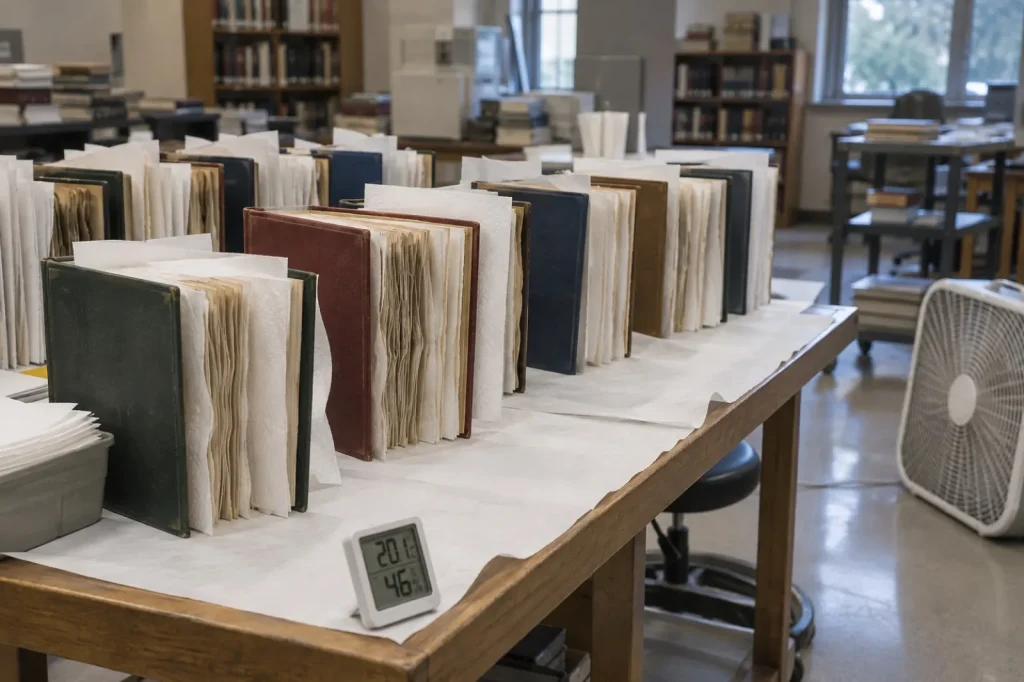
- Set the room first. According to the Library of Congress, hold 72 degrees F or less and 30 to 60% RH, with fans. Why it differs: technique cannot beat a humid room.
- Aim fans past the book. NEDCC: airflow parallel to the volumes. Why it differs: the Heritage Emergency National Task Force says hair dryers, irons, ovens and long sun exposure do irreversible damage.
- Fan damp books on end, no interleaving. Why it differs: damp books need air, not towels.
- Interleave slightly wet books about every 16 pages from the back, capped at one third of the page count, with blotter inside both covers (NEDCC). The Library of Congress air drying guide says every quarter to half inch; National Park Service NCPTT says every 20 to 30 pages. Why it differs: stuffing every page makes the spine concave.
- Change sheets often, turning the book head to tail each time. Why it differs: a wet sheet left in place is a poultice.
- Press it dry but still cool, overnight under a board and weight, repeating until dry (NEDCC). Why it differs: pressing a fully dry book does far less.
- Check gutter and boards before shelving. NEDCC often finds mold between boards and flyleaves of books shelved too soon.
NEDCC reports a shortcut: in a room held at 25 to 35% RH and 50 to 65 degrees F, books with only wet edges dry in about two weeks without interleaving. For partly wet books of moderate size, the Library of Congress also describes compression drying: corrugated board inside each cover and between volumes, packed snug on a cart, a fan on the text block edges, and every book checked once or twice a day.
Freezing a wet book
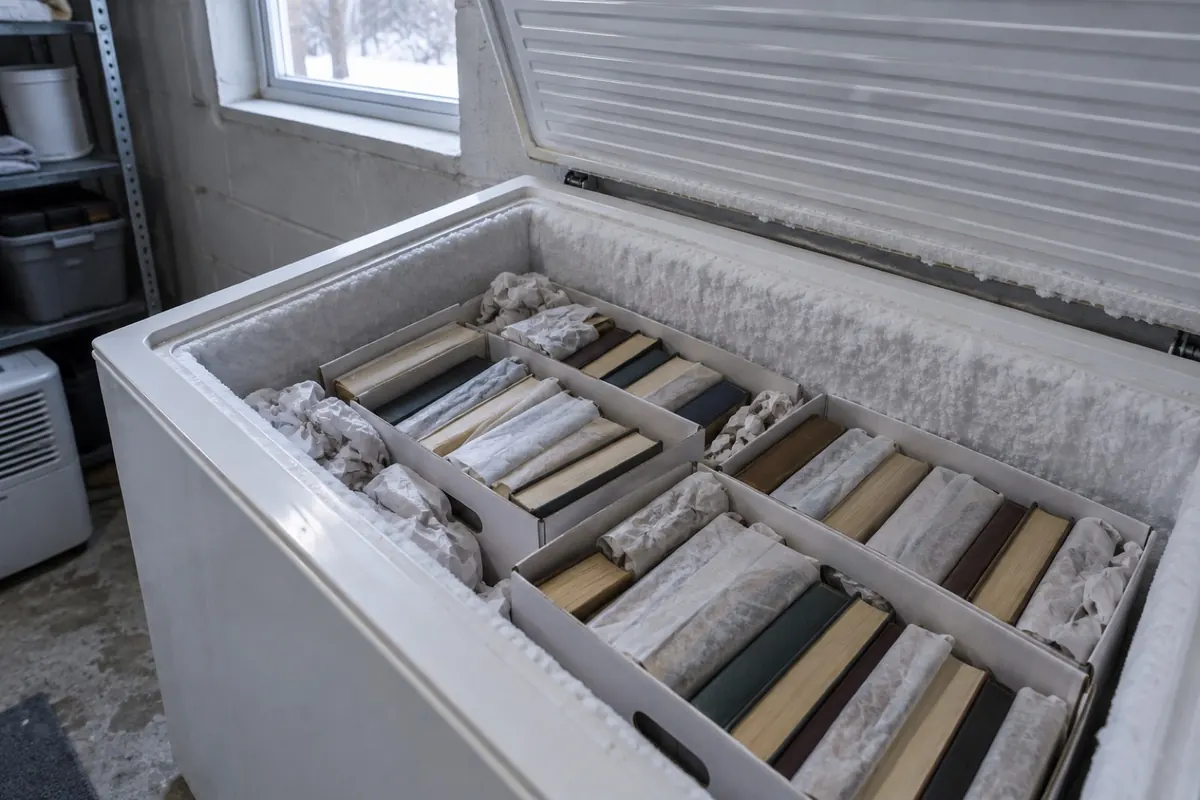
The Library of Congress freezing guide says to freeze within 48 hours where needed, in a kitchen freezer at its coldest for small incidents. A frost-free freezer slowly dries books over months, which NEDCC puts at weeks to many months. Freezing does not kill mold, per the National Archives.
| Step | Rule | Why |
|---|---|---|
| Shape | Square the text block first | National Park Service NCPTT: it dries in the shape it froze in. |
| Rinse only if muddy | Hold shut, dip through clean tubs | NEDCC; never with soluble ink. |
| Wrap | Freezer paper, glossy side in, around every other book | Library of Congress: covers will not freeze together. |
| Orient | Spine down or flat, never flat and stacked | Library of Congress. |
| Load | Ten to twelve books per records box | Library of Congress: weight and slumping. |
| Sort | Pack very wet, partly wet and damp apart | Peter Waters, via the National Archives: cheaper, less over drying. |
Vacuum freeze drying vs vacuum thermal drying
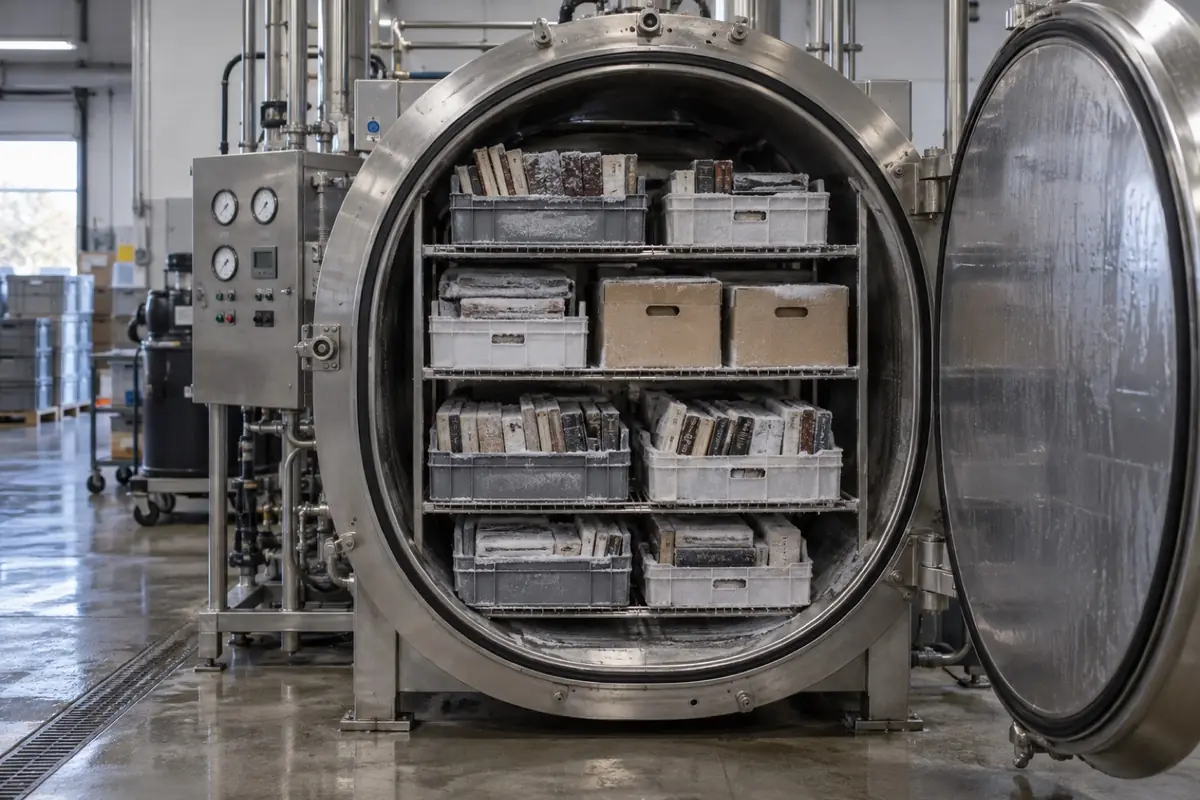
Per Betty Walsh, WAAC Newsletter, vacuum freeze drying keeps frozen books below 0 degrees C in a vacuum so ice turns straight to vapour. Vacuum thermal drying runs above 0 degrees C in cycles of heated air and vacuum, so water passes through the liquid state. NEDCC Leaflet 3.6 says those cycles cause considerable distortion and tidelines, and limits the method to short retention records. CCAHA warns vendors use the names loosely; the National Archives ordered thermal drying for its own study and received a patented freeze drying process instead.
| Method | Coated paper | Distortion | Best fit |
|---|---|---|---|
| Air drying | Blocks unless every page interleaved | Variable; NEDCC reports about 20% more shelf space on average | Under 100 damp books |
| Desiccant dehumidification | Not recommended (NEDCC) | Greatest swelling in the NARA test | Damp collections, buildings |
| Vacuum freeze drying | Only method where coated pages did not stick (NARA) | Least in the NARA test | Wet books, coated paper, soluble ink |
| Vacuum thermal drying | Blocks; Walsh says never | Considerable, with tidelines | Low value records only |
That National Archives study (Kaplan and Ludwig, 2003) wetted matched boxes and dried them four ways. Two boxes of records needed four after dehumidification drying, and even freeze dried books felt stiff. No route returns the original book.
What drying costs, as published
We found no current per-cubic-foot price list from a recovery vendor. These are the figures conservation sources printed, with their dates.
| Report or source | Year | Published figure | Covers |
|---|---|---|---|
| Miriam Kahn, Conservation DistList | 1994 | $45 to $65 per cubic foot; $2 to $5 per book | Freeze drying or dehumidification; freight, packing, reboxing extra; 4 to 8 weeks |
| Miriam Kahn, Conservation DistList | 1994 | Drying plus rebinding about 10% = 25% of replacement cost | Her insurance benchmark |
| National Archives drying methods study | 2003 | $250 per cubic foot | Patented rare book drying, over 4 times traditional freeze drying |
| the same National Archives study | 2003 | $8 per box; two boxes billed as 2.4 cubic feet | Unannounced box charges |
| Abbey Newsletter, 1986 | 1986 | Same or a little more than vacuum drying | Freeze drying, relative price |
| Abbey Newsletter, 1992 | 1992 | $12,000 to $50,000 | Four freeze dry chamber models |
If $250 was more than 4 times traditional freeze drying in 2003, the traditional service was under about $62.50 per cubic foot according to the National Archives figures, inside Kahn’s 1994 range. Vendors billed each records box as 1.2 cubic feet, so compare quotes per cubic foot, not per box.
Photographs and documents
NEDCC Leaflet 3.7 sets the photo order: colour first, then black and white prints, then film. Ambrotypes, tintypes, inkjet prints and colour materials go first; salted paper and albumen prints can survive 48 hours or more in water. Dry them face up on blotter with air moving, and do not touch the emulsion. On freezing, guidance changed over thirty years.
| Source | Freeze wet photographs? | Exceptions |
|---|---|---|
| National Archives family papers guidance, 1993 | Never freeze old photographs or negatives | Air dry face up |
| CCAHA, 2019 | Prints, negatives, slides: yes, temporarily | Not cased photos or wet collodion |
| NEDCC Leaflet 3.7, 2020 | Yes, if they cannot be air dried or are stuck | Wet collodion never freeze dried; no vacuum thermal |
| Library of Congress freezing guide, 2025 | Most photographs and negatives: yes | Not cased photos or collodion glass |
Water damaged documents
For loose papers, the National Archives says to air dry loose papers flat in piles about half an inch high, and to freeze quantities that cannot be handled in 48 hours (National Archives wet records guidance). Wet coated sheets need separating at once: NEDCC Leaflet 3.6 lifts each one off on polyester film and hangs it to dry. EPA Table 1 says to photocopy valuable papers, discard the rest, and freeze or freeze dry what must be kept.
Mold, and signs it is bigger
Per the Library of Congress mold guidance, active mold is fuzzy or slimy and should not be disturbed; dormant mold is dry and powdery. According to NEDCC Leaflet 3.8, quarantine moldy books in a clean area below 55% RH and avoid sealing them in plastic unless they go into a freezer. The Library of Congress says treatment often costs more than replacement; irreplaceable books are dried with a fan blowing out a window, bagged and sent to a conservator. Timing is covered on how long mold takes to grow, rooms on DIY mold remediation and bookcases on mold on furniture.
Out of scope. Health effects of mold exposure are not covered here; see EPA and CDC.
Escalate when any of these is true:
- The water was sewage or floodwater.
- More than about 100 books, or hundreds of loose sheets, are wet.
- Several volumes are coated paper; freezer space runs out first.
- Shelves have swollen. Waters notes swollen shelves mark the wettest material.
- Dry books are growing mold: the room humidity is the problem.
- The wall or floor behind the bookcase got wet and is still wet.
Recovery firms and contractors
Call a document recovery firm for coated paper in quantity, rare or unique volumes, or contaminated water. NEDCC Leaflet 3.7 lists the NEDCC 24/7 hotline (1-855-245-8303), National Heritage Responders (1-202-661-8068) and the AIC Find a Conservator directory. CCAHA says to document condition before handoff and sign a letter of agreement that names the service, forbids thawing before drying and sets a return date.
For contractors, books are a contents line won or lost at pack-out: segregate by wetness, keep frozen boxes frozen, and keep original order and labels, which vendors in the National Archives study did not always do. Waters warns it may be unwise not to attempt salvage if an insurance assessment is required. Coverage is set by the policy; see our water damage coverage page, the state insurance department and a licensed professional. Building-wide losses are flood damage restoration jobs; more on the water hub.
Questions people actually ask
Can water damaged books be restored?
Usually stabilised and kept, but not returned to new. NEDCC says no drying method restores pre-damage condition, though fast action can put books back on the shelf with little visible damage. Damp books air dry well; wet, coated or valuable ones do best frozen and vacuum freeze dried, then repaired by a conservator if needed.
Is a book ruined if it gets wet?
Not necessarily. A damp book, or one wet only at the edges, usually air dries with some rippling if you start within about 48 hours. Glossy coated paper, running inks and sewage-soaked books are the likely losses, along with any book left wet long enough for mold to take hold in the gutter.
What should I do if my books got wet?
Stop the water, then cool and dry the room. Move dry books out, put glossy and ink-bleeding books straight into a freezer, and grade the rest by the stain line: within half an inch of the edge, interleave and air dry; beyond it, freeze. Anything you cannot start within 48 hours goes in the freezer too.
How do I flatten water damaged books?
Press while the book is dry but still cool, per NEDCC: close it, lay it flat, ease it into shape and weight it overnight, repeating until dry. The National Park Service showed a curled book flattening after seven hours under weight. Severe cockling may still need a conservator.
Can I dry a wet book with a hair dryer?
Conservators advise against it. The Heritage Emergency National Task Force says hair dryers, irons, ovens and prolonged sunlight do irreversible damage. Use fans moving room air, aimed past the books, and expect the gutter and boards to stay damp after the pages feel dry.
How does freeze drying books work?
The book stays frozen in a vacuum chamber below 0 degrees C, so ice becomes vapour without turning liquid. Inks stop spreading and coated pages do not stick. The National Archives found it gave the least distortion of the methods it tested. Vacuum thermal drying runs above freezing and is a different, rougher service.
How do I fix a wet book that has already dried wavy?
Pressing can help, but the Library of Congress says some distortion is permanent or needs conservation treatment. Take a valuable book to a conservator rather than re-wetting it yourself; replace a cheap one, which Waters says is nearly always less costly than restoration.
Sources
- Library of Congress: Salvaging Wet Collections guide (air drying, freezing, mold pages), April 2025.
- NEDCC NEDCC Leaflet 3.6, revised 2023; NEDCC Leaflet 3.7, revised 2020; NEDCC Leaflet 3.8. Read via the Internet Archive copy of each URL, as NEDCC’s site refused automated requests.
- National Archives family papers guidance, August 1993, and National Archives wet records guidance, reviewed January 2020.
- Peter Waters, via the National Archives: Procedures for Salvage of Water Damaged Library Materials, 1993 text.
- National Archives drying methods study: Comparison of Drying Methods, Kaplan and Ludwig, 2003.
- CCAHA: Freezing and Drying of Books, Paper and Photographic Materials, December 2019, with summary chart.
- Betty Walsh, WAAC Newsletter, volume 27 number 3, September 2005.
- National Park Service NCPTT: Saving Wet Books After a Flood, November 2020.
- Heritage Emergency National Task Force: Save Your Treasures the Right Way, 2014.
- EPA Table 1, Mold Remediation in Schools and Commercial Buildings, updated September 2026.
- Miriam Kahn, Conservation DistList, 3 October 1994; Abbey Newsletter, 1986; Abbey Newsletter, 1992.
- All retrieved 19 October 2026. Derived figures are arithmetic on published numbers. See our methodology.
Sources do not always agree. For rare or valuable items, consult a conservator first.