The short answer
New carpet smell is mostly 4-phenylcyclohexene (4-PCH), a byproduct of the SBR latex that bonds the backing, and it fades slowly: in a Lawrence Berkeley Laboratory house study it still read 3.2 ppbv on day 52, above its odor threshold of probably under 0.5 ppbv. Airing the roll out and ventilating 48 to 72 hours clears faster compounds such as styrene; 4-PCH mostly needs weeks.
Which chemical is the new carpet smell, and which layer holds it?
The 1992 Lawrence Berkeley Laboratory report LBL-31916 for the Consumer Product Safety Commission measured four new carpets in a 20 cubic metre environmental chamber and named the odor compound directly: the two carpets with styrene butadiene rubber (SBR) latex adhesive on the backing emitted mainly styrene and 4-phenylcyclohexene, both derived from the SBR latex, and “the 4-PCH produces the ‘new carpet’ odor.” The face fiber (nylon in one, olefin in the other) changed the styrene numbers but not the 4-PCH: both carpets released about 11 milligrams of 4-PCH per square metre over the first week.
The same report reproduces an EPA dataset (Black and colleagues, 1991) in which all 19 of 19 SBR latex backed carpets tested in small chambers emitted styrene and 4-PCH. Seven years later the 1999 Lawrence Berkeley National Laboratory study for the California Air Resources Board found that every carpet it screened still emitted 4-PCH, which it describes as an unwanted byproduct in the production of SBR latex, while styrene had fallen to near detection limits.
So the smell lives in the backing adhesive, not in the yarn. Carpets without SBR latex smelled different in LBL-31916: a commercial hard-back carpet with a polyvinyl chloride secondary backing released formaldehyde, vinyl acetate and propylene glycol, and a carpet with a polyurethane foam backing released mostly BHT (butylated hydroxytoluene).
How long did 4-PCH last in a real house? 52 days of readings
LBL-31916 is the rare study that followed a carpet out of the lab: researchers sampled a house on eight days across 52 days after new nylon cut pile carpet on SBR latex was installed. 4-PCH peaked at 5.1 ppbv on day 6 and was still 3.2 ppbv on day 52, about 7.4 weeks in. That is roughly 6.4 times the odor threshold of probably below 0.5 ppbv that the report cites from Van Ert and colleagues (1987).
The emission rate, which removes the effect of ventilation, tells the same story. The report estimates 4-PCH release at about 320 micrograms per square metre per hour on day 2 (flagged as uncertain), 150 on day 6 and 30 to 60 near the end. Its conclusion: the SBR latex held a large reservoir of 4-PCH that was emitted over a period of months at a slow rate, probably controlled by diffusion through the materials.
| Day after install | Air changes per hour | Styrene, ppbv | 4-PCH, ppbv |
|---|---|---|---|
| Day 2 | 7.3 | 0.44 | 1.6 |
| Day 4 | 1.0 | 1.12 | 4.7 |
| Day 6 | 1.1 | 0.89 | 5.1 |
| Day 12 | 0.8 | 0.62 | 4.1 |
| Day 18 | 1.3 | 0.3 | 2.1 |
| Day 25 | 0.8 | 0.5 | 2.4 |
| Day 40 | 0.4 | 0.68 | 3.2 |
| Day 52 | 0.7 | 0.66 | 3.2 |
Read the dips with the ventilation column beside them. Day 2 looks low only because the doors were open at 7.3 air changes per hour; day 18 dropped to 2.1 ppbv at 1.3 per hour; when the house was closed up to 0.4 per hour on day 40, 4-PCH climbed back to 3.2 ppbv. the 1999 CARB study saw the same pattern over a longer run: at 0.5 air changes per hour, several dominant carpet and flooring compounds stayed roughly constant or fell by less than a factor of three between weeks 2 and 12.
Why does styrene fall 90 percent in a week while 4-PCH drops only 25 to 39 percent?
Volatility. In the 20 cubic metre chamber run near 1 air change per hour and 23 C, LBL-31916 found most compounds fell exponentially over the first 12 hours, fastest for the most volatile ones, then slowed to a diffusion limited tail. Styrene from the olefin carpet started at 260 micrograms per square metre per hour at 24 hours and was down 94 percent by 168 hours. 4-PCH from the same carpet went from 81.9 to 50.2, a 39 percent drop; from the nylon carpet, 85.1 to 64.0, a 25 percent drop.
The cumulative numbers make the point sharper. Only 18 to 20 percent of the 4-PCH a carpet released in its first week came out in the first 24 hours, against 55 to 64 percent for styrene, according to LBL-31916 Table 17. That is why a room can smell better on day 3 and still smell of new carpet on day 30: the fast compounds leave first and the slow 4-PCH is left behind. The report observed a distinct new carpet odor at the end of each week long run, when 4-PCH was 3 to 4 ppbv.
Carpet, pad, glue or seam tape: which layer emits what, and which label caps it?
A wall to wall install is four products, and only three of them have a low emission label. CRI Green Label Plus Emissions Criteria, Issue 5 (dated 20 August 2026) sets separate compound lists for carpet, cushion and adhesive, each in micrograms per cubic metre in a modelled private office at 14 days. Seaming tape has no category, yet it was the layer that, in the CARB screening, raised one carpet’s TVOC emission rate at 48 hours by more than a factor of three.
| Layer | What the chamber studies found it emits | Label that limits it | Green Label Plus cap, micrograms per cubic metre |
|---|---|---|---|
| Carpet with SBR latex backing | 4-PCH, styrene, 4-ethenylcyclohexene (LBL-31916; all carpets in the 1999 CARB study emitted 4-PCH) | Green Label Plus, carpet category | 4-PCH 27; styrene 450 |
| Carpet with PVC hard-back (commercial) | Formaldehyde (57.2 micrograms per square metre per hour at 24 h), vinyl acetate, propylene glycol, isooctane | Green Label Plus, carpet category; CDPH Section 01350 list | Formaldehyde 9; vinyl acetate 100 |
| Bonded urethane cushion | BHT plus a mixture of unsaturated hydrocarbons; BHT in the room rose over time under the carpet (the 1999 CARB study) | Green Label Plus, cushion category | BHT 160; 4-PCH 27 |
| Synthetic fiber cushion | TVOC substantially lower than bonded urethane (the 1999 CARB study) | Green Label Plus, cushion category | BHT 160; 4-PCH 27 |
| Adhesive (glue down installs) | Not measured for carpet in these studies; CARB found even “solvent free” vinyl flooring adhesives emitted VOCs | Green Label Plus, adhesive category | 2-ethyl-1-hexanol 160; 4-PCH 27; vinyl cyclohexene 44; benzothiazole 16.5 |
| Thermal seaming tape | Added BHT and branched alkanes; raised TVOC at 48 h more than 3 times on one carpet (the 1999 CARB study) | No Green Label Plus category | None |
The cushion row explains a common complaint: the smell seems to change after a week. the 1999 CARB study recorded BHT concentrations that gradually increased with time in all three carpet experiments while other compounds fell, and read it as the carpet acting as a diffusion barrier over the bonded urethane pad. Ask for the pad’s own label, since a Green Label Plus carpet says nothing about the cushion under it.
Can a Green Label Plus carpet still smell? The 27 microgram arithmetic
Yes, and the numbers say why. The cap for 4-PCH in the carpet category of CRI Green Label Plus Emissions Criteria, Issue 5 is 27 micrograms per cubic metre. Converting with the PubChem molecular weight of 158.24 and the 24.45 litre molar volume at 25 C that CCOHS gives for ppm conversions, 27 micrograms per cubic metre is about 4.2 ppbv. That is inside the 3 to 4 ppbv range where the LBL team still smelled new carpet, and about 8 times the probable odor threshold.
| Benchmark | Micrograms per cubic metre | ppbv | Source |
|---|---|---|---|
| Green Label Plus 4-PCH cap at 14 days | 27 | 4.2 | CRI Green Label Plus Emissions Criteria, Issue 5 |
| 4-PCH level where LBL noted a distinct odor | 3 to 4 | LBL-31916 | |
| House reading on day 52 | 21 | 3.2 | LBL-31916 Table 18 |
| Odor threshold, probably below | 3.2 | 0.5 | Van Ert 1987, cited in LBL-31916 |
The label does real work, but not on odor. 4-PCH is not on the California list in CDPH Standard Method v1.2, whose test conditions a product for 10 days and then runs a 96 hour chamber test so the result reflects day 14, which CDPH calls an early but realistic time for first occupancy. CRI adds 4-PCH as a carpet, cushion and adhesive specific compound. According to CRI's Green Label Plus testing protocol, initial certification uses the 14 day test, annual checks are evaluated at 24 hours, and TVOC is reported on the certificate with no stated limit. A label caps exposure at day 14; it does not promise a scent free room on day 1.
Airing the roll out, 72 hours of fans or turning up the heat: which one moves 4-PCH?
the 1999 Lawrence Berkeley National Laboratory study for the California Air Resources Board is the one study that tested consumer steps against a base case in a furnished, painted room chamber. Its carpet assembly was olefin carpet over bonded urethane cushion with thermal seaming tape, installed on a tack strip in about 50 minutes.
| Step | How it was run | What happened |
|---|---|---|
| Air the carpet and pad out before install | 48 h in a room above 10 air changes per hour, backing up | Large cuts in styrene and glycol ethers; TVOC about halved; 4-PCH and BHT cuts small and possibly insignificant |
| Extra ventilation after install | 2 air changes per hour for 3 days against a 0.5 base case | Lower levels while it ran; levels returned to base case values once it stopped |
| Heat the room | 33 C (91 F) for 72 h with extra ventilation, all sources together | More emission during heating; relatively ineffective for later levels of most compounds |
| Air out 12 to 24 h and vacuum the unrolled carpet | Suggested in LBL-31916, not tested | Report expects little effect on formaldehyde, 4-PCH and BHT |
Two practical rules follow. First, the airing out that counts happens before the carpet goes down, which is why EPA's The Inside Story tells buyers to ask the retailer to unroll and air out the carpet in a well ventilated area before installation. Second, ventilation helps only while it runs: EPA says to keep window fans or other mechanical ventilation exhausting outdoors for 48 to 72 hours after install, and CARB concluded extra ventilation should be kept up for longer than 3 days to lower exposures more. On a carpet whose smell is 4-PCH, plan on weeks of steady fresh air rather than one weekend of fans.
Some guides online suggest raising the thermostat. Running a room at 33 C pushed more VOCs out during the heating period, but concentrations of most compounds went back to the unheated values once it stopped, so heat buys a stronger smell now without a lasting payoff.
Do baking soda, vinegar bowls or an air freshener remove 4-PCH?
None of the studies above tested baking soda or bowls of vinegar. LBL-31916 attributes the long 4-PCH tail to a reservoir in the SBR latex released by diffusion, and CARB adds that desorption from fiber and backing surfaces may also play a role; neither names a household product that speeds it. Air fresheners work against you: EPA's page on volatile organic compounds lists moth repellents and air fresheners among household VOC sources, and notes that levels of several organics average 2 to 5 times higher indoors than outdoors. A fragrance adds compounds to the room without removing any.
The same goes for ozone machines, which none of these carpet studies used as a treatment. EPA’s position on them is covered on our ozone generator page. If the smell in the room is new paint rather than new carpet, the chemistry is glycols and coalescing solvents, a separate problem covered in how to get rid of paint smell.
Musty and getting stronger: is the smell a wet pad, not new carpet?
In the LBL house, 4-PCH peaked on day 6 and then eased off. A damp, earthy smell that grows over time, or appears after a spill or a leak, points to moisture in the pad or subfloor. EPA's The Inside Story says water damaged carpets and building materials should be cleaned and dried within 24 hours if possible or removed, and advises an effective moisture barrier before carpet goes into a new home. The drying steps are in how to dry wet carpet.
If the pad was wet for more than a day or two, the question becomes growth, not off gassing, and the inspection steps in mold on carpet apply. A consumer VOC index reading does not name the compound; an EPA Method TO-15 canister sample sent to a lab does, as explained in indoor air quality testing.
What to ask the retailer before the carpet is cut
These questions come straight from EPA's The Inside Story and the two Berkeley reports, in the order they matter for 4-PCH.
- Is the backing SBR latex? If yes, expect the 4-PCH note for weeks; every SBR carpet in the 1991 EPA dataset emitted it.
- What are the Green Label Plus numbers for the carpet, the cushion and the adhesive separately? A carpet label does not cover the pad.
- Is a synthetic fiber cushion an option? CARB measured substantially lower TVOC from it than from bonded urethane.
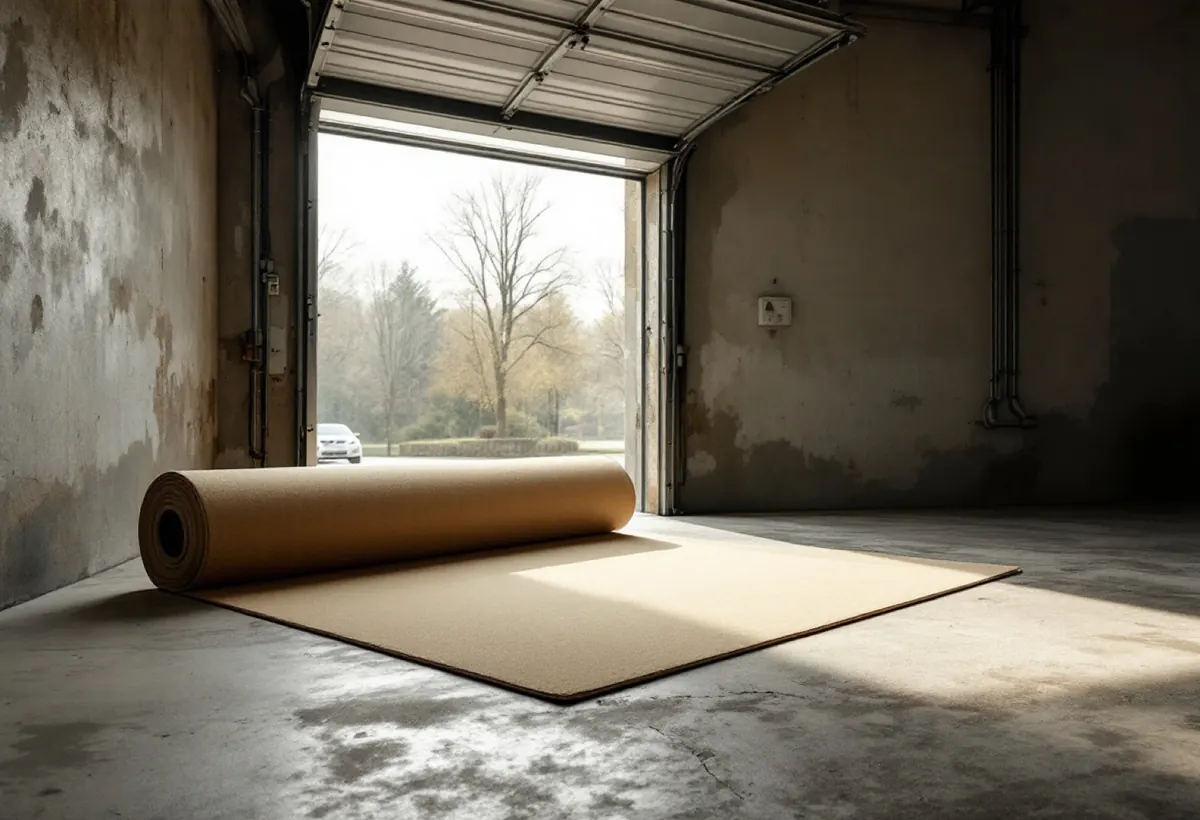
- Can the roll and pad be unrolled and aired out before delivery? CARB used 48 hours at over 10 air changes per hour.
- Will the installer follow the Carpet and Rug Institute installation guidelines, as EPA recommends, and use a low emitting adhesive if the carpet is glued down?
- Can the job be scheduled when the household is away? EPA suggests leaving during and immediately after installation.
Out of scope: this page covers odor chemistry and emission data, not health effects. For what is and is not known about indoor VOC exposure, see EPA's page on volatile organic compounds.
Questions people actually ask
Is it safe to sleep in a room with new carpet?
EPA does not give a sleep rule. EPA's The Inside Story advises considering leaving the premises during and immediately after installation and running exhaust ventilation for 48 to 72 hours after install. In the LBL house study 4-PCH peaked on day 6, so keeping a bedroom door open to a ventilated space through the first week follows the data.
Is new carpet smell formaldehyde?
Usually not. In LBL-31916 only the PVC hard-back commercial carpet emitted formaldehyde, 57.2 micrograms per square metre per hour at 24 hours; the SBR carpets emitted 4-PCH and styrene. Every carpet in the 1999 CARB study emitted 5 micrograms or less, against a CRI limit then of 50. Green Label Plus now caps formaldehyde at 9 micrograms per cubic metre.
Why does the new carpet smell get stronger on hot days?
In the one test of heat we found, it raised emissions. When CARB heated a room with new carpet to 33 C (91 F), emissions rose during the 72 hour heating period. Green Label Plus tests at 22 to 24 C, 45 to 55 percent relative humidity and 0.95 to 1.05 air changes per hour, so a sunny, closed room runs hotter and tighter than the test.
How does Green Label Plus test carpet emissions?
According to CRI's Green Label Plus testing protocol, a new product goes through a 14 day chamber test evaluated after 10 days of conditioning and at 24, 48 and 96 hours, then annual tests evaluated at 24 hours plus biennial testing. Per CRI's Green Label Plus program page, CRI launched the original Green Label program in 1992. Results are compared with caps such as 27 micrograms per cubic metre for 4-PCH.
What should I ask the retailer if the smell will not fade?
EPA's The Inside Story says to contact the carpet retailer if objectionable odors persist. Ask for the Green Label Plus certificate for the carpet, cushion and adhesive, the manufacture date, and whether the roll was stored sealed: LBL noted carpet odor outside double polyethylene bags after almost five months of storage and assumed styrene declined more than 4-PCH while it sat.
Sources
- Lawrence Berkeley Laboratory report LBL-31916 for the Consumer Product Safety Commission: A. T. Hodgson, J. D. Wooley and J. M. Daisey, Volatile Organic Chemical Emissions from Carpets, Final Report, Lawrence Berkeley Laboratory, April 1992, Tables 16, 17, 18 and 19, via OSTI. Retrieved 21 November 2026.
- the 1999 Lawrence Berkeley National Laboratory study for the California Air Resources Board: A. T. Hodgson, Common Indoor Sources of Volatile Organic Compounds: Emission Rates and Techniques for Reducing Consumer Exposures, Final Report, Contract No. 95-302, California Air Resources Board, January 1999. Retrieved 21 November 2026.
- CRI Green Label Plus Emissions Criteria, Issue 5: Green Label Plus Emissions Criteria, Carpet and Rug Institute, Issue 5, dated 20 August 2026. Retrieved 21 November 2026.
- CRI's Green Label Plus testing protocol: GLP Testing Protocol and Product Requirements, Carpet and Rug Institute. Retrieved 21 November 2026.
- CRI's Green Label Plus program page: Green Label Plus, Carpet and Rug Institute. Retrieved 21 November 2026.
- CDPH Standard Method v1.2: Standard Method for the Testing and Evaluation of Volatile Organic Chemical Emissions from Indoor Sources Using Environmental Chambers, Version 1.2, California Department of Public Health, January 2017. Retrieved 21 November 2026.
- EPA's The Inside Story: The Inside Story: A Guide to Indoor Air Quality, US EPA, section What about Carpets? Retrieved 21 November 2026.
- EPA's page on volatile organic compounds: Volatile Organic Compounds’ Impact on Indoor Air Quality, US EPA, last updated 23 June 2026. Retrieved 21 November 2026.
- PubChem: 4-Phenylcyclohexene, CID 21096, National Library of Medicine, molecular weight 158.24. Retrieved 21 November 2026.
- CCOHS: Converting Occupational Exposure Limits from mg/m3 to ppm, Canadian Centre for Occupational Health and Safety. Retrieved 21 November 2026.
We read published chamber studies, standards and agency guidance; we did not measure any carpet. How we source and check figures: methodology. More on smoke, odor and air quality: fire and smoke hub.