The short answer
How does mold spread? Four ways: as microscopic spores that ride room air and settle on surfaces, through HVAC air movement, as threadlike hyphae creeping across a wet surface at about 1 to 5 mm a day, and on dust, debris and clothing when moldy material is disturbed. Spores land everywhere but grow only on damp surfaces, from about 76% humidity according to Fraunhofer research.
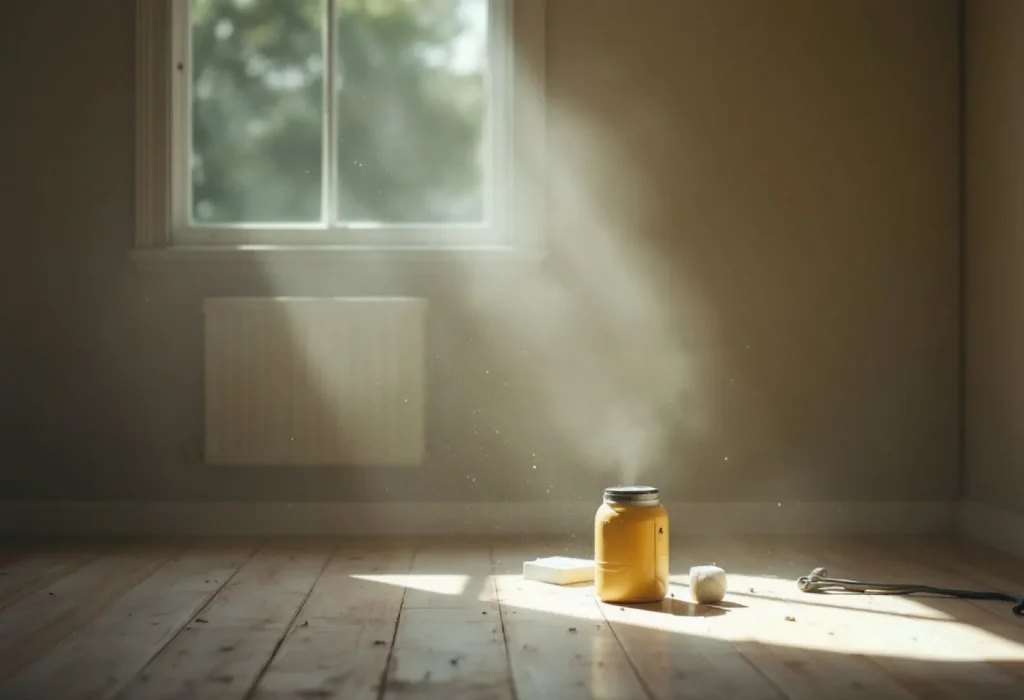
How long does a 3 µm mold spore hang in the air before it lands?
About 2.2 hours to fall from an 8 ft ceiling in dead still air, by Stokes law. Per Sedlbauer, Fraunhofer Institute for Building Physics, most mold spores are 2 to 20 µm long with a density of 1.1 to 1.4 g/cm³, and the same report uses 1.15 g/cm³ as a mean spore density. The settling velocity grows with the square of the diameter, so a spore twice as wide falls four times as fast.
The spread is wide. A 10 µm spore reaches the floor in about 12 minutes; a 2 µm spore takes 4.9 hours; a 1 µm particle, smaller than an intact spore, stays up for 19.5 hours. The NIOSH Manual of Analytical Methods, chapter BA puts the aerodynamic diameter of airborne fungal spores and spore clusters at 0.9 to 5 µm, which is the slow end of the chart.
How we counted. According to Stokes law, terminal velocity v = ρ g d² / (18 μ), the Stokes flow form given in the Penn State ME 405 notes on particle motion, with g = 9.81 m/s², μ = 1.830 × 10⁻⁵ kg/(m s) for air at STP from the same notes, and ρ = 1,150 kg/m³ from Sedlbauer. Spores are treated as spheres; the Cunningham slip correction is left out. As a check, the same formula gives 0.048 cm/s for a 4 µm unit density sphere and 1.19 cm/s for a 20 µm one; NIOSH chapter BA states 0.05 and 1.21 cm/s. The 2.4 m drop is an assumed 8 ft ceiling.
Any draft swamps these numbers. In the spore release tests by Kildesø and colleagues (2003), the gentlest air jet over moldy gypsum board was 0.3 m/s, about 973 times faster than a 3 µm spore falls (0.031 cm/s). A spore therefore goes wherever the air goes long before gravity puts it down. Sedlbauer, Fraunhofer Institute for Building Physics gives 0.1 cm/s as a mean settling velocity for mold spores, which works out to 40 minutes from a 2.4 m ceiling.
Air counts, and why an indoor reading never drops to zero, are covered on our page about mold spores in air.
Which of the four routes moves mold farthest, and what stops each one?
Air carries spores farthest; growth moves the shortest distance but is the only route that makes new mold. The table lines up the four routes against distance, speed and the control that breaks each one, using EPA's Mold Remediation in Schools and Commercial Buildings guide, chapter 3 for the controls.
| Route | How far | How fast | What stops it | Source |
|---|---|---|---|---|
| Spores settling from room air | Room scale; whole floor if air moves | 3 µm spore falls 2.4 m in about 2.2 hours (calculation above) | HEPA filtration, HEPA vacuuming of settled dust, and a dry surface to land on | Sedlbauer; Penn State; NIOSH; EPA chapter 3 |
| HVAC and fan air movement | Every room the system serves | Air speed; spore release tested at 0.3 to 3 m/s | Do not run a contaminated system; seal supply vents, doors, chases and risers inside containment | EPA chapter 3; Kildesø 2003 |
| Hyphae growing across a wet surface | Only as far as the material stays damp | About 1 to 5 mm/day on paper-faced board at 82% to 97% RH, 25 °C | Drying below about 76% RH at the surface; EPA: dry within 24 to 48 hours | Sedlbauer Fig. 35; EPA Brief Guide |
| Carried on debris, dust, clothing, shoes, pets | Anywhere people, tools or bags go | Fragments released up to 320 times the spore count when surfaces are disturbed | 6 mil polyethylene containment, negative pressure, double bagging, decontamination of PPE | Górny 2002; EPA chapter 3; CDC |
The fourth row is the one most guides online leave out. Górny and colleagues (2002) found that fragments came off contaminated agar and ceiling tile in numbers up to 320 times the spores, and that release depended on the species, the air velocity, and the texture and vibration of the material.
How fast does mold creep across wet drywall at 85 versus 95 percent humidity?
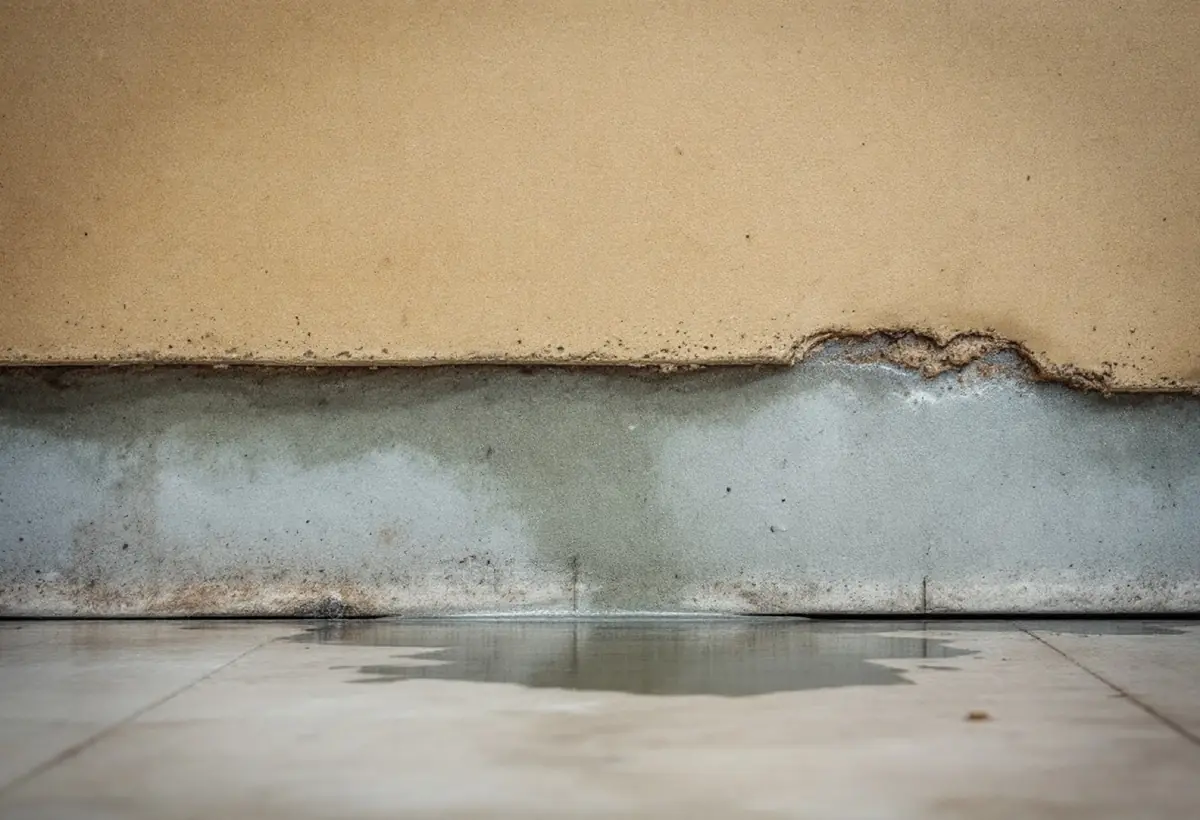
Roughly 2 mm a day at 85% to 86% relative humidity and 4 to 5 mm a day above 93%, at 25 °C, per the generalised isopleths in Sedlbauer, Fraunhofer Institute for Building Physics. That report sorts building materials into substrate categories: category I is wallpaper, plaster cardboard (gypsum board) and other biodegradable materials; category II is renders, mineral materials, certain wood and insulation; category III, with no nutrients, gets no growth without dirt on it.
| Growth rate | RH needed, category I | RH needed, category II | Colony width after 14 days |
|---|---|---|---|
| 1 mm/day | 82% | 86% | 14 mm |
| 2 mm/day | 86% | 90% | 28 mm |
| 3 mm/day | 89% | 93% | 42 mm |
| 4 mm/day | 93% | 97% | 56 mm |
| 5 mm/day | 97% | above 97% | 70 mm |
| No growth (LIM) | below 76% | below 80% | 0 mm |
Before hyphae spread, spores must germinate, and humidity sets that clock too. On category I material at 25 °C, according to Sedlbauer’s Figure 34, germination takes about 1 day at 90% RH, 2 days at 85%, 4 days at 82%, 8 days at 80% and 16 days at 77.5%. Those curves are why EPA's Brief Guide to Mold, Moisture and Your Home says to dry water-damaged areas within 24 to 48 hours.
Onset timing after a specific leak, by material, is on our page how long it takes for mold to grow after water damage.
Can mold spread through a wall into the next room?
Only along wet material. According to the isopleths, growth needs the surface above roughly 76% RH for paper-faced board and 80% for mineral materials, per Sedlbauer, Fraunhofer Institute for Building Physics, so a colony in one stud bay stops at the edge of the damp. Spread room to room is a moisture map: trace the leak, the condensation line or the wicking height and you have traced the mold.
EPA's Mold Remediation in Schools and Commercial Buildings guide, chapter 3 lists where that hidden growth sits: the back side of drywall, wallpaper, paneling, the top of ceiling tiles, the underside of carpet pads, pipe chases with leaking or condensing pipes, and walls behind furniture where condensation forms. The same EPA chapter warns that vinyl wallpaper and wood paneling can act as vapor barriers that trap moisture behind them. Wallpaper specifics are on our sibling page about mold behind wallpaper.
Dry the cavity and the front edge stops. Per Sedlbauer, below the lowest isopleth (LIM) no biological activity is expected on that material group, yet the colony is still there and can restart when water returns. What dormant mold does is covered on does mold die when it dries out.
Why does tearing out moldy drywall release up to 320 times more fragments than spores?
Because disturbance turns a stuck colony into dust. EPA's Brief Guide to Mold, Moisture and Your Home warns that pulling wallpaper with mold on its underside can cause a massive release of spores, and Górny and colleagues (2002) measured release rising with vibration and surface texture. Once airborne, the settling times above apply: the fine fraction stays up for hours and follows every draft.
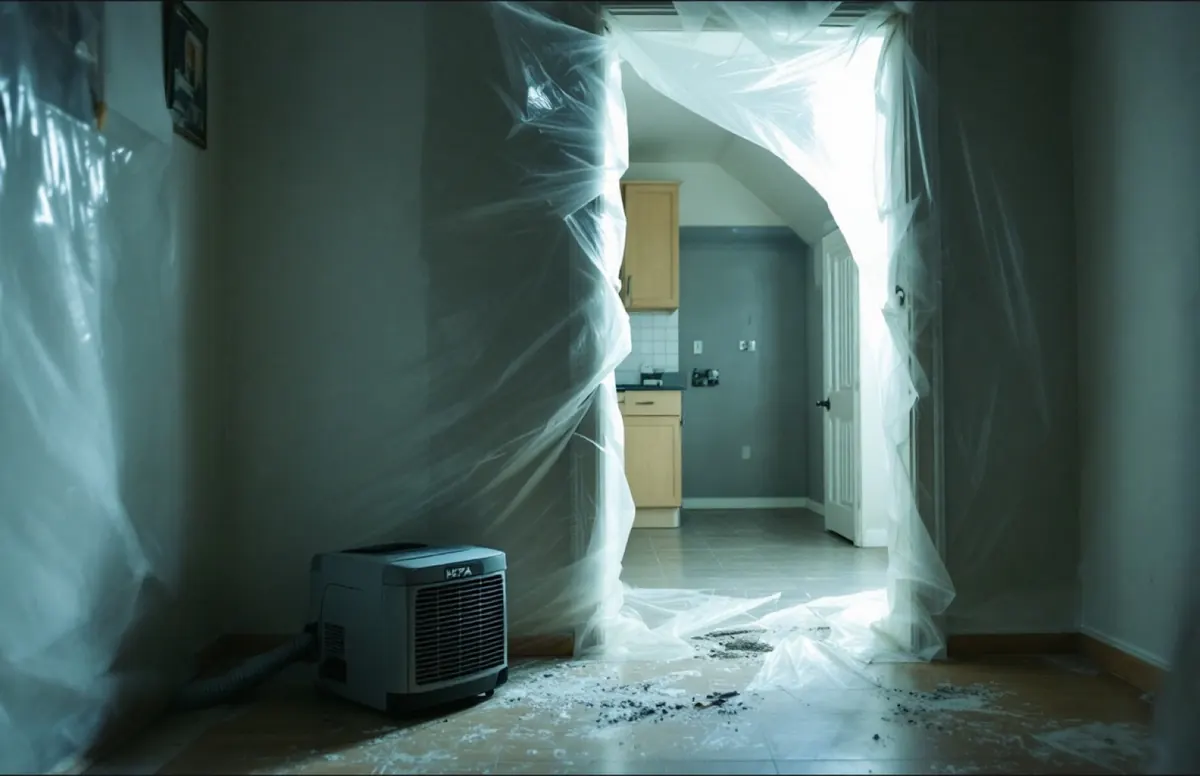
That is why EPA's Mold Remediation in Schools and Commercial Buildings guide, chapter 3 scales containment by area. Limited containment, for 10 to 100 sq ft, is a single layer of 6 mil fire retardant polyethylene with a slit entry and covering flap. Full containment, for more than 100 sq ft or wherever occupied space would otherwise be contaminated, uses double layers of polyethylene and a decontamination chamber or airlock.
Negative pressure is the air side of the same idea. EPA chapter 3 says the containment must be held under negative pressure, for example with a HEPA filtered fan unit exhausted outside, and that the sheeting should billow inward on all surfaces; if it flutters or billows outward, containment has been lost. Debris leaves double bagged in 6 mil polyethylene, and HEPA vacuums pick up dust settled outside the work area. How those machines differ from a room purifier is explained in what is an air scrubber.
Which containment level a given job needs, by area and by guideline, is set out on mold remediation levels.
Does running the furnace fan spread mold to other rooms?
It can: EPA's Mold Remediation in Schools and Commercial Buildings guide, chapter 3 says not to run an HVAC system you know or suspect is contaminated, and the EPA's Brief Guide to Mold, Moisture and Your Home adds that doing so could spread mold throughout the building. Inside containment, EPA has supply and air vents sealed with polyethylene and, where the ceiling space is a return air plenum, the air handler filters replaced after the work. Duct inspection and cleaning are covered on mold in air ducts.
Can mold spread from house to house or from the unit next door?
Not as an outbreak that jumps buildings. Every house already breathes outdoor spores: the CDC mold page says mold enters through open doorways, windows, vents and heating and air conditioning systems, and rides in on clothing, shoes, bags and pets. According to Shelton and colleagues (2002), who analysed 12,026 air samples from 1,717 US buildings, culturable indoor concentrations ran lower than outdoor ones, with Cladosporium, Penicillium and Aspergillus the most common genera in both.
According to the same study, Stachybotrys chartarum was in indoor air in 6% of buildings and outdoor air at 1%, which points to growth inside on wet material rather than drift from next door. In attached housing, the shared item that matters is water: a leak in the unit above wets your ceiling, and the mold follows the water, not the neighbour. EPA's Brief Guide to Mold, Moisture and Your Home says spores will always be found in air and house dust, and none of them grow without moisture.
Mold by surface and by room, from brick to metal, is indexed on the mold hub.
What stops mold spreading in the first 48 hours after a leak?
Take moisture away from the surface before the germination clock runs out. In order, using the EPA documents cited on this page:
- Stop the water source and dry wet materials within 24 to 48 hours, per the EPA's Brief Guide to Mold, Moisture and Your Home.
- Hold indoor humidity below 60%, ideally 30% to 50%, per the same EPA guide; Sedlbauer’s curves show growth on paper-faced board starts near 76% at the surface.
- Leave the HVAC off if it serves the wet area and may be contaminated, per EPA chapter 3.
- If growth is under about 10 sq ft, EPA says a homeowner can usually handle it; above that, plan containment before anything is cut or scraped.
- Skip dry brushing, dry sanding and fans blowing across visible growth: EPA chapter 3 warns fans can distribute spores into unaffected areas, and wet vacuums spread spores without enough liquid present.
Health effects of mold exposure are outside the scope of this page; the CDC mold page covers them.
Questions people actually ask
How easily does mold spread?
Spores move easily, colonies do not. A 3 µm spore can stay airborne for about 2.2 hours in still air by Stokes law and far longer in drafts, but it only grows where the surface stays above roughly 76% relative humidity on paper-faced materials, according to Sedlbauer’s Fraunhofer IBP isopleths. Dry surfaces stop the spread even when spores land.
Can clothes, shoes and pets carry mold into a house?
Yes. The CDC says mold in outdoor air can be brought indoors on clothing, shoes, bags and pets. During remediation EPA chapter 3 has workers bag contaminated PPE inside a decontamination chamber, with respirators worn until they are outside it, so the work area does not travel through the house on people.
Does killing mold with bleach stop it from spreading?
Not reliably. EPA chapter 3 says the goal is to remove mold, not just kill it, because dead mold is still allergenic and some dead molds are potentially toxic, and it does not recommend biocides such as chlorine bleach as a routine remediation practice. Dead spores and fragments still blow around when disturbed.
Will an air purifier stop mold spores spreading?
It lowers the airborne count but not the source. EPA chapter 3 relies on HEPA filtered fan units for negative pressure in containment and HEPA vacuums for settled dust, alongside drying and removal. A room purifier cannot reach the 1 µm to 3 µm particles already settled into carpet or behind drywall until something stirs them up.
Does dried out mold still spread spores?
Yes, when it is disturbed. Górny and colleagues (2002) found fragments released from moldy ceiling tile in numbers up to 320 times the spores, depending on air velocity, texture and vibration. A dried stain does not grow, but sanding, scraping or pulling it releases particles that settle over hours.
Sources
- EPA's Brief Guide to Mold, Moisture and Your Home, United States Environmental Protection Agency, last updated 18 February 2026. Retrieved 17 November 2026.
- EPA's Mold Remediation in Schools and Commercial Buildings guide, chapter 3, United States Environmental Protection Agency, last updated 29 April 2026: containment, negative pressure, HVAC, hidden mold and cleanup methods. Retrieved 17 November 2026.
- CDC mold page, CDC: how mold enters homes. Retrieved 17 November 2026.
- NIOSH Manual of Analytical Methods, chapter BA, Sampling and Characterization of Bioaerosols, Lindsley and colleagues, NIOSH NMAM 5th edition, March 2017: aerodynamic diameter, settling velocity benchmarks, fungal spore sizes. Retrieved 17 November 2026.
- Penn State ME 405 notes on particle motion, J. M. Cimbala, Penn State ME 405, section 8.4 Equations of Particle Motion: Stokes flow and air viscosity at STP. Retrieved 17 November 2026.
- Sedlbauer, Fraunhofer Institute for Building Physics, K. Sedlbauer, Prediction of mould fungus formation on the surface of and inside building components, Fraunhofer Institute for Building Physics (English version of the 2001 thesis): spore size and density, substrate categories, Figs. 34 and 35. Retrieved 17 November 2026.
- Górny and colleagues (2002), Fungal fragments as indoor air biocontaminants, Applied and Environmental Microbiology 68(7):3522 to 3531, PubMed abstract. Retrieved 17 November 2026.
- Kildesø and colleagues (2003), Determination of fungal spore release from wet building materials, Indoor Air 13(2):148 to 155, PubMed abstract. Retrieved 17 November 2026.
- Shelton and colleagues (2002), Profiles of Airborne Fungi in Buildings and Outdoor Environments in the United States, Applied and Environmental Microbiology 68(4):1743 to 1753, abstract. Retrieved 17 November 2026.
- Settling times, the NIOSH check values and the 14 day colony widths are arithmetic on the cited inputs, computed when this page was built; isopleth values were read from printed figures and are approximate. Our methodology sets out the standing rules.
This page explains how mold moves; it is not a remediation plan for a specific building. For growth over 10 sq ft, ask a remediator which EPA containment level they will use and how they will hold negative pressure.