The short answer
Does UV light kill mold? Yes, but only where the UV-C lands directly and only at a high dose. A 2024 compilation of studies reports one 90% kill of common indoor spores at about 24 to 750 mJ/cm2, versus a 6 mJ/cm2 daily limit for human skin and eyes. UV-C does not reach into drywall, wood or shadows, and EPA says dead spores still have to be removed.
How many mJ/cm2 does it take to kill 90% of household mold spores?
UV-C kills by dose, the irradiance on the spore multiplied by the seconds it is exposed, written in millijoules per square centimetre (mJ/cm2). Gierke, Vatter and Hessling, AIMS Microbiology 2024 compiled about 400 published data sets on fungi and reports the mean dose for each 90% (one log) reduction. The chart pulls the indoor mold genera from that table, grouped by where the spores sat during the test.
Three patterns decide whether a lamp works on a real wall. Airborne spores of Aspergillus versicolor, Penicillium chrysogenum and Cladosporium herbarum all needed 33 to 36 mJ/cm2 per 90%, according to the compilation. The same genera dried onto stainless steel needed 300 (Penicillium commune) and 750 mJ/cm2 (Cladosporium cladosporioides), and Aspergillus fumigatus trapped in an air filter needed 2,437 mJ/cm2, per the 2024 table.
Studies of the same species also disagree. The authors report one to two orders of magnitude between the lowest and highest UV-C dose for Aspergillus niger in liquid, and they say dark, pigmented fungi have been known to resist radiation for about 100 years. That is why the chart shows a spread rather than one number for Penicillium chrysogenum (23.9 to 82.7) and Aspergillus fumigatus (54 to 224).
Black mold is the hard case. Green and colleagues, Canadian Journal of Microbiology 2005 report exposing Stachybotrys chartarum on agar to 50 to 200 microwatts per square centimetre for doses of 12 to 144 mJ/cm2 and did not reach a 90% kill at the top dose; the authors wrote that the species “was not susceptible to an appropriate dose of UVGI”. Physical removal of that genus is covered in how to kill black mold.
How many minutes must a lamp sit over the mold for a 99.9% kill?
Exposure time is dose divided by irradiance. The table below multiplies each mean 90% dose by 3 to reach 99.9% (3 log), then divides by three irradiances, per the Kyushu and Green reports: 1.38 mW/cm2 measured 5 cm under a 6 W Toshiba GL6 tube and 0.213 mW/cm2 at 20 cm in a Kyushu University study in Food Science and Technology Research 2015, and 0.05 mW/cm2, the lowest flux in the 2005 Stachybotrys test.
| Species and setting | mJ/cm2 per 90% (high value) | mJ/cm2 for 99.9% | Minutes at 5 cm | Minutes at 20 cm | Minutes at 0.05 mW/cm2 |
|---|---|---|---|---|---|
| Aspergillus versicolor, airborne, 55% RH | 33.3 | 100 | 1.2 | 8 | 33 |
| Penicillium chrysogenum, airborne, 41% RH | 33.9 | 102 | 1.2 | 8 | 34 |
| Cladosporium herbarum, airborne, 53% RH | 35.9 | 108 | 1.3 | 8 | 36 |
| Cladosporium herbarum, agar plate | 23.9 | 72 | 0.9 | 6 | 24 |
| Penicillium chrysogenum, agar plate | 82.7 | 248 | 3.0 | 19 | 83 |
| Aspergillus flavus, agar plate | 85.3 | 256 | 3.1 | 20 | 85 |
| Aspergillus versicolor, agar plate | 55.2 | 166 | 2.0 | 13 | 55 |
| Aspergillus fumigatus, agar plate | 224 | 672 | 8.1 | 53 | 224 |
| Cladosporium cladosporioides, agar plate | 313 | 939 | 11.3 | 73 | 313 |
| Penicillium commune, stainless steel | 300 | 900 | 10.9 | 70 | 300 |
| Stachybotrys chartarum, agar plate | 572 | 1,716 | 20.7 | 134 | 572 |
| Cladosporium cladosporioides, stainless steel | 750 | 2,250 | 27.2 | 176 | 750 |
| Aspergillus fumigatus, air filter | 2437 | 7,311 | 88.3 | 572 | 2,437 |
| Aspergillus flavus, coffee beans | 3429 | 10,287 | 124.2 | 805 | 3,429 |
The straight line assumption flatters the lamp. The Kyushu team reports that the Cladosporium cladosporioides survival curve was “biphasic”: about 99.86% of spores died at 45 mJ/cm2 per log, while a resistant 0.136% needed 1,355 mJ/cm2 per log. Solving their fitted model, our arithmetic gives:
- 90% killed at 45 mJ/cm2 and 99% at 92 mJ/cm2 per the fitted model, close to the simple per log figure.
- 99.9% only at 201 mJ/cm2, not the 135 a straight line predicts per the same data, because the resistant fraction now dominates.
- 99.99% at 1,536 mJ/cm2 per the model, which is about 2 hours under the same tube at 20 cm, against the 30 minute maximum the study ran.
Light after treatment can undo part of the work. Duque-Sarango and colleagues, Frontiers in Environmental Science 2023 report that the dose for a 99% kill of waterborne Penicillium spores rose 53.8%, from 123.8 to 190.4 mJ/cm2, when treated spores were kept in light for a day, because the spores repaired UV damage (photoreactivation). The same report gives Aspergillus niger 220.1 mJ/cm2 for 99%.
Why does moving a 6 W tube from 5 cm to 20 cm cut the dose 6.5 times?
The inverse square law in NIOSH Publication 2009-105 says irradiance falls with the square of distance from a source, so quadrupling the distance from 5 to 20 cm should cut it 16 times. The Kyushu measurements fell only 6.5 times over that span, because a tube up close behaves like a line of light, not a point.
Both versions point the same way: every centimetre costs minutes. At the measured values, 100 mJ/cm2 takes 72 seconds at 5 cm and 469 seconds at 20 cm, per the Kyushu table. A 5 second pass at 5 cm delivers about 6.9 mJ/cm2 per the Kyushu table, which is below the 90% dose of every species in the chart.
Humidity cuts the effect too. According to NIOSH Publication 2009-105, keep relative humidity at 60% or less where UVGI is installed, because studies show effectiveness drops as humidity rises, which is the same damp air that lets mold grow in the first place.
Why can’t UV-C reach mold inside drywall, wood or grout?
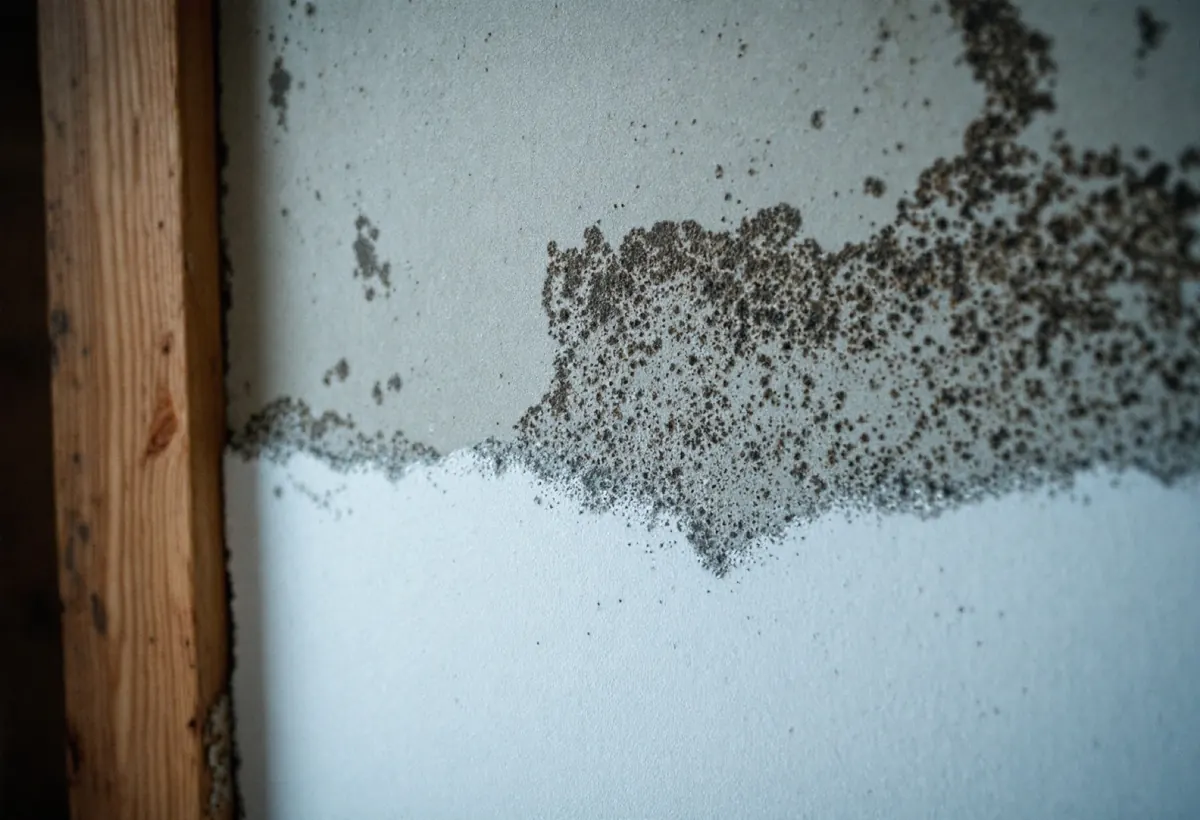
Whatever sits between the lamp and the spore absorbs or scatters UV-C. The authors of Gierke, Vatter and Hessling, AIMS Microbiology 2024 report that a 2 mm layer of a dense spore suspension cuts 254 nm irradiance by about 50%, and a 10 mm layer leaves about 2%. Mold growing into the paper face of drywall, the end grain of a stud or a grout joint sits behind its own spores, dust and the material.
The compilation’s numbers show the cost. Aspergillus flavus needed 35 mJ/cm2 per log on agar but 3,429 on coffee beans, about 98 times more, and Aspergillus fumigatus needed about 45 times more in an air filter than on agar, per the 2024 table. Even smooth steel raised the Cladosporium cladosporioides dose about 7.5 times over its lowest agar value.
Colour matters as well. a Kyushu University study in Food Science and Technology Research 2015 links the low UV-C sensitivity of Cladosporium to melanin-like pigments, and found the unpigmented Penicillium digitatum died at about 17 mJ/cm2 per log in its sensitive phase. The dark colonies people most want gone are the ones a lamp is worst at.
For that reason EPA's A Brief Guide to Mold, Moisture and Your Home says absorbent or porous materials, such as ceiling tiles and carpet, “may have to be thrown away” if they become moldy. No lamp changes that call for a cut-out of wet drywall; the sequence for a larger job is in our mold remediation process breakdown.
How many seconds before a germicidal lamp exceeds the 6 mJ/cm2 skin and eye limit?
Per NIOSH Publication 2009-105, the recommended exposure limit at 254 nm is 6 mJ/cm2 in an 8 hour shift, the same as the ACGIH threshold limit value, which equals a steady 0.2 microwatts per square centimetre. Permissible time is 6,000 microjoules divided by the measured irradiance, per the same document. Applied to the irradiances above, our arithmetic gives:
| Where you stand | Irradiance (uW/cm2) | Time to reach the 6 mJ/cm2 limit |
|---|---|---|
| 5 cm under a 6 W tube (Kyushu) | 1,380 | 4.3 seconds |
| 20 cm under the same tube | 213 | 28 seconds |
| Lowest flux in the Stachybotrys test | 50 | 120 seconds |
| NIOSH 1 minute limit | 100 | 60 seconds |
| NIOSH 8 hour limit (occupied room) | 0.2 | 28,800 seconds (8 hours) |
The asymmetry is the point. The smallest mold dose in the chart, about 24 mJ/cm2 per 90%, is roughly 4 times the daily human limit, per the 2024 compilation and NIOSH. Any lamp strong enough to work on mold in minutes exceeds the limit for exposed skin and eyes in seconds. NIOSH notes that eye inflammation (photokeratitis) usually appears 6 to 12 hours after exposure, so the link to the lamp can be missed.
Lamp type matters too. The same NIOSH guide says some lamps emit at 184.9 nm and produce ozone, so germicidal lamps “should be rated for low or no ozone generation”, and that each should hold 5 mg of mercury or less. About 95% of a low pressure mercury lamp’s energy is at 253.7 nm, per the guide.
What does EPA say UV lamps can and cannot do about mold?
EPA's answer on UV lamps and mold, last updated 8 September 2026, says properly designed ultraviolet germicidal irradiation (UVGI) cleaners “may destroy” some molds growing on moist HVAC surfaces such as cooling coils, drain pans or ductwork, but that “typical UVGI cleaners used in homes have limited effectiveness” and that most mold spores need much higher UV exposure than a typical home unit provides. Coil lamp selection is an HVAC equipment question, covered at The HVAC Brief.
EPA’s remediation advice in EPA's A Brief Guide to Mold, Moisture and Your Home has no UV step at all. It says the key to mold control is moisture control, dry water-damaged areas within 24 to 48 hours, scrub mold off hard surfaces with detergent and water and dry completely, and get EPA’s larger-job guidance when growth covers more than 10 square feet. The same page warns that dead mold may still cause allergic reactions, so killing it in place is not the goal.
Airborne spores are the one place the dose arithmetic is kind. Kim and Kang, Applied and Environmental Microbiology 2018 reported 4 log reductions of Aspergillus flavus and Alternaria japonica at 23 mJ/cm2 in a sealed LED chamber, while four bacteria fell 2.5 to 4 log within 1.5 to 4.6 mJ/cm2. A room unit only treats the air it pulls through it, which is the job a HEPA unit also does; see what an air scrubber is.
Does an ozone-making UV unit kill more mold than plain UV-C?
Not at a level anyone can breathe. EPA's page on ozone generators sold as air cleaners says that at concentrations that do not exceed public health standards, ozone “does not effectively remove viruses, bacteria, mold, or other biological pollutants”, and that it would take 5 to 10 times the standards to decontaminate air. The same EPA page lists the limits: FDA 0.05 ppm for indoor medical devices, OSHA 0.1 ppm as an 8 hour average and the outdoor standard of 0.08 ppm. More on these machines is on our ozone generator page.
Labels are the other check. Per EPA's consumer guide to pesticide devices, UV light units that claim to kill fungi are pesticide devices: they carry an EPA Establishment Number but no EPA Registration Number, and that establishment number “does NOT indicate that the product has been reviewed for safety or efficacy by EPA”. Registered chemical products, which do submit efficacy data, are compared on our mold killer page, and the label record for one active is in does hydrogen peroxide kill mold.
Out of scope: this page covers dose, distance, labels and exposure limits only. For how mold exposure affects people, see EPA’s mold pages linked above and the CDC mold pages.
Questions people actually ask
Does UV light kill black mold?
Poorly. Green and colleagues (Canadian Journal of Microbiology, 2005) report that up to 144 mJ/cm2 on agar did not kill 90% of Stachybotrys chartarum; a 2024 compilation puts its 90% dose near 572 mJ/cm2. That is about 95 times the 6 mJ/cm2 NIOSH daily limit for skin and eyes, and growth inside wet drywall is shielded from the light.
Does UV light kill mold on clothes?
Only on the fibres facing the lamp. Fabric is porous, and the 2024 AIMS Microbiology compilation shows doses rising roughly 45 to 98 times on porous carriers such as filters and beans. Folds and seams add shadow. EPA’s mold guide says absorbent or porous items may have to be thrown away if they become moldy.
Does UV light kill mold in a shower?
Not usefully. EPA’s guide says to scrub mold off hard surfaces with detergent and water and dry completely, and growth inside silicone caulk or grout sits behind material that absorbs UV-C; Gierke and colleagues 2024 calculate that just 2 mm of a dense spore suspension halves 254 nm light. Cleaning steps are on mold in the shower.
Does sunlight kill mold?
Sunlight has no UV-C at ground level. NIOSH Publication 2009-105 says ozone in the atmosphere absorbs UV below 290 nm before it reaches the surface, so sunlight brings only UVA, UVB and drying. A 2025 Journal of Medical Investigation study found the energy needed for the same Cladosporium kill differed significantly between UVA and UVC.
Does UV light kill mold on plants?
Some growers use it. EPA’s pesticide devices guide lists ultraviolet units used to kill plant pathogens, giving powdery mildew on strawberries as its example. Those units are devices, not registered products, so EPA has not reviewed their efficacy, and leaf undersides in shadow get little or no dose.
What is the best light to kill mold?
Germicidal UV-C near 254 nm: per the NIOSH guide, about 95% of a low pressure mercury lamp’s energy falls there. A 2025 Journal of Medical Investigation study found UVC caused DNA damage in Cladosporium sphaerospermum that UVA did not. NIOSH 2009-105 notes that lamps made for tanning radiate UVA or UVB, which it calls of negligible use for killing airborne microorganisms.
Sources
- EPA's answer on UV lamps and mold: Does ultraviolet (UV) radiation from UV lamps kill mold?, US EPA, last updated 8 September 2026. Retrieved 12 November 2026.
- EPA's A Brief Guide to Mold, Moisture and Your Home, US EPA, last updated 18 February 2026. Retrieved 12 November 2026.
- EPA's page on ozone generators sold as air cleaners, US EPA, last updated 19 February 2026. Retrieved 12 November 2026.
- EPA's consumer guide to pesticide devices, Pesticide Devices: A Guide for Consumers, US EPA, last updated 29 September 2026. Retrieved 12 November 2026.
- NIOSH Publication 2009-105, Environmental Control for Tuberculosis: Basic Upper-Room Ultraviolet Germicidal Irradiation Guidelines for Healthcare Settings, CDC NIOSH, March 2009. Retrieved 12 November 2026.
- Gierke, Vatter and Hessling, AIMS Microbiology 2024, Fungal photoinactivation doses for UV radiation and visible light: a data collection, vol. 10, doi 10.3934/microbiol.2024032. Retrieved 12 November 2026.
- Green and colleagues, Canadian Journal of Microbiology 2005, Ultraviolet germicidal irradiation disinfection of Stachybotrys chartarum, vol. 51, pp. 801 to 804. Retrieved 12 November 2026.
- Duque-Sarango and colleagues, Frontiers in Environmental Science 2023, Assessing the potential of ultraviolet irradiation for inactivating waterborne fungal spores, vol. 11. Retrieved 12 November 2026.
- a Kyushu University study in Food Science and Technology Research 2015: Inactivation characteristics of UV-C radiation on decay-inducing molds, vol. 21, no. 3, J-STAGE. Retrieved 12 November 2026.
- Kim and Kang, Applied and Environmental Microbiology 2018, UVC LED irradiation effectively inactivates aerosolized viruses, bacteria, and fungi in a chamber-type air disinfection system. Retrieved 12 November 2026.
- The Journal of Medical Investigation 2025, wavelength dependence of UV inactivation of Cladosporium sphaerospermum, vol. 72, pp. 260 to 265 (abstract). Retrieved 12 November 2026.
- How this page was built is described in our methodology, and more mold pages are on the mold hub.
Doses are laboratory means from the cited studies, not a rating of any product. Ask a lamp seller for the measured 254 nm irradiance at a stated distance and the test organism behind any kill claim, then run the arithmetic above.