The short answer
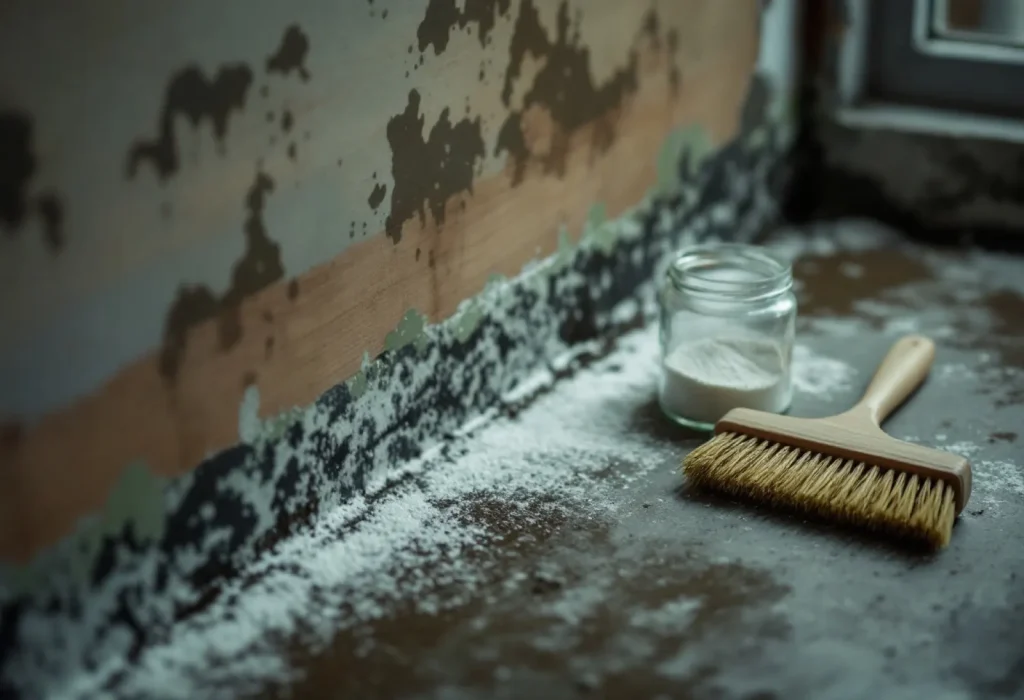
Does borax kill mold? Not reliably on its own. USDA Forest Products Laboratory researchers found borates alone have negligible or no mold inhibitor activity, even though they stop wood decay fungi and termites. A borax wash can scrub surface growth off hard surfaces, but EPA still says moldy porous materials such as drywall and carpet may have to be thrown away.
Seven borax mold claims from guides online, graded against the test or label behind them
Each row below takes a claim that recurs in borax cleaning guides and sets it beside the study or regulation that actually tested it. The studies are USDA Forest Products Laboratory (FPL) work on wood; none of them sprayed household borax on a painted wall, which is itself the first finding.
| Claim found online | Grade | What the source shows |
|---|---|---|
| Borax kills mold on contact | Not supported | Forest Products Laboratory paper FPL-RP-673: boric acid or DOT alone show negligible or no mold inhibitor activity; estimated MFC90 for a borate product alone was 7.6% in Clausen and Yang (2004) |
| Borax stops mold from coming back | Weak, lab only | 5% DOT could not substantially inhibit mold on pine (cited in Clausen and Yang (2004)); 3% borax built into fiberboard noticeably retarded mold in Kartal, Burdsall and Green (2003) |
| Borax works when paired with another fungicide | Supported in lab tests | Borate base plus 0.1% azole or 0.5% thujaplicin inhibited Aspergillus, Penicillium and Trichoderma in Clausen and Yang (2007) |
| Borax stops wood rot | Supported for decay fungi | the EPA-accepted Bora-Care label lists brown rot, white rot and dry rot; Forest Products Laboratory paper FPL-RP-673 credits borates with substantial potency against decay fungi |
| Borax fixes moldy drywall or carpet | Contradicted | EPA's Mold Cleanup in Your Home: porous materials may have to be thrown away because mold fills their crevices |
| Leave it on, no rinse, it is harmless | Contradicted | International Chemical Safety Card 0567: GHS signal word DANGER, causes eye irritation, may damage fertility or the unborn child; TLV 2 mg/m3 |
| Borax is an EPA-approved mold killer | Not for a laundry box | 40 CFR 152.15 requires registration for any product sold with a pest claim; check the box for an EPA Reg. No. |
The pattern across the seven rows is consistent: borates are strong against decay fungi and insects, weak against the surface molds people see on walls, and only useful against those molds when another fungicide joins them, per Forest Products Laboratory paper FPL-RP-673 and Clausen and Yang (2007).
Is 1 cup of borax per gallon a 4.6% solution, and does it all dissolve?
Yes, about 4.6% by weight per the arithmetic below, close to the most borax cold water will hold. The math: NIST puts a cup at 0.24 litre and a gallon at 3.79 litres. U.S. Borax gives a bulk density of 769 kg/m3 (48 lb/ft3) for borax decahydrate, so a level cup weighs about 185 g. Taking water at 1 kg per litre, a gallon is 3,790 g, and per the figures above 185 g in 3,790 g of water is 4.6%.
The two published solubility figures disagree. International Chemical Safety Card 0567 gives 5.1 g per 100 mL at 20 C, which caps a gallon at about 193 g. According to U.S. Borax, a saturated solution at room temperature is 5.93% by weight, which allows about 239 g. Either way, a second cup per gallon cannot dissolve, and the white crust left on a wall after drying is undissolved or recrystallized borax, not extra protection.
| Mix | Borax per gallon | Percent by weight | Against the solubility limit |
|---|---|---|---|
| Half cup per gallon | 92 g | 2.4% | Dissolves at room temperature |
| 1 cup per gallon | 185 g | 4.6% | 95% of the ICSC limit, 77% of the U.S. Borax limit |
| 2 cups per gallon | 369 g | 8.9% | Above both limits: grit stays in the bucket |
| Saturated, ICSC 0567 (20 C) | 193 g | 4.9% | About 1.05 cups per gallon |
| Saturated, U.S. Borax (room temp) | 239 g | 5.93% | About 1.29 cups per gallon |
Set against the research, 4.6% borax is below the 5% DOT that, according to Clausen and Yang (2004), could not substantially inhibit mold on pine, and far below the 7.6% minimum fungicidal concentration the same paper estimated for a borate product used alone. The mix is alkaline: PubChem reports pH 9.2 for a 1.0% solution and pH 9.3 for 0.1% at 20 C.
Is a box of laundry borax an EPA-registered mold killer under 40 CFR 152.15?
Only if its label says so. Under 40 CFR 152.5, any fungus growing where it harms people or property counts as a pest, and 40 CFR 152.15 bars selling a product as a pesticide unless it is registered under FIFRA. A seller who claims, states or implies that a product kills or prevents a pest must register it, and a registered product carries an EPA Reg. No. on its label.
A borax box sold as a laundry booster makes no mold claim on its label, so it carries no EPA directions for mold: no dilution, no contact time, no list of surfaces. Any mold recipe printed on a blog is outside that label. Borax itself does appear in registered pesticides: PubChem records borax under EPA pesticide code 011102 with active products, mostly insect baits, which is a different claim from killing mold.
Ant and termite uses of borates belong to The Pest Control Brief; the mold question stays here.
Why does a 40% borate wood preservative send mold control to a second product?
The clearest evidence comes from the EPA-accepted Bora-Care label, EPA Reg. No. 64405-1, accepted by EPA on 26 June 2020 under the boric acid registration review. Per the label, it contains 40% disodium octaborate tetrahydrate and is registered as a termiticide, insecticide and fungicide for fungi (rot) and algae. Its label’s dilution table runs from 9% DOT at 5:1 to 23% DOT at 1:1, per the EPA-accepted text.
Even at those strengths, the label does not rely on the borate for surface mold. It says Bora-Care solutions can be mixed with Mold-Care Moldicide Concentrate (EPA Reg. No. 6836-212-64405) or other registered products for mold, mildew, non-decay fungi and surface fungi control. That matches the FPL finding that borates protect wood from decay but need a partner for mold.
The label also limits where a borate can work. Per the label, application goes only to bare wood, plywood, particle board and other cellulosic materials without an intact paint, stain or sealer, and for floors it requires wood moisture content of 16% or less before refinishing. A borax wipe on painted trim or sealed cabinets cannot soak in the way the label assumes.
What did Forest Service lab tests find when borates met Aspergillus and Penicillium?
Forest Products Laboratory paper FPL-RP-673 (Coleman, Yang and Clausen, March 2013) states the core result in its abstract: boric acid or DOT alone have substantial potency against insects and decay fungi but negligible or no mold inhibitor activity. Combined with C7 to C9 fatty acids, the same borates inhibited mold, and one vacuum treatment controlled mold growth on Southern Pine through 12 weeks, including after water leaching.
Clausen and Yang (2007), published in International Biodeterioration and Biodegradation volume 59, reports tests of a borate base with 0.1% voriconazole, 0.1% thiabendazole or 0.5% thujaplicin against Aspergillus niger, Penicillium chrysogenum and Trichoderma viride under ASTM D4445. The combinations performed well, and the authors observed synergy between the borate and voriconazole against mold.
Kartal, Burdsall and Green (2003), an International Research Group on Wood Preservation paper, is the one test of plain borax. According to that paper, in fiberboard made with 0.1% to 3% borax, mold overgrew the specimens within the first week, and only the 3% borax and 3% boric acid boards noticeably retarded it. That borax was mixed into the board at manufacture, at 24 kg/m3, not wiped onto a finished wall.
None of the four FPL papers sprayed household borax on drywall, tile or paint, which is the setting of every borax cleaning recipe online.
Drywall, carpet or bare joists: where borax fits and where EPA says throw it out
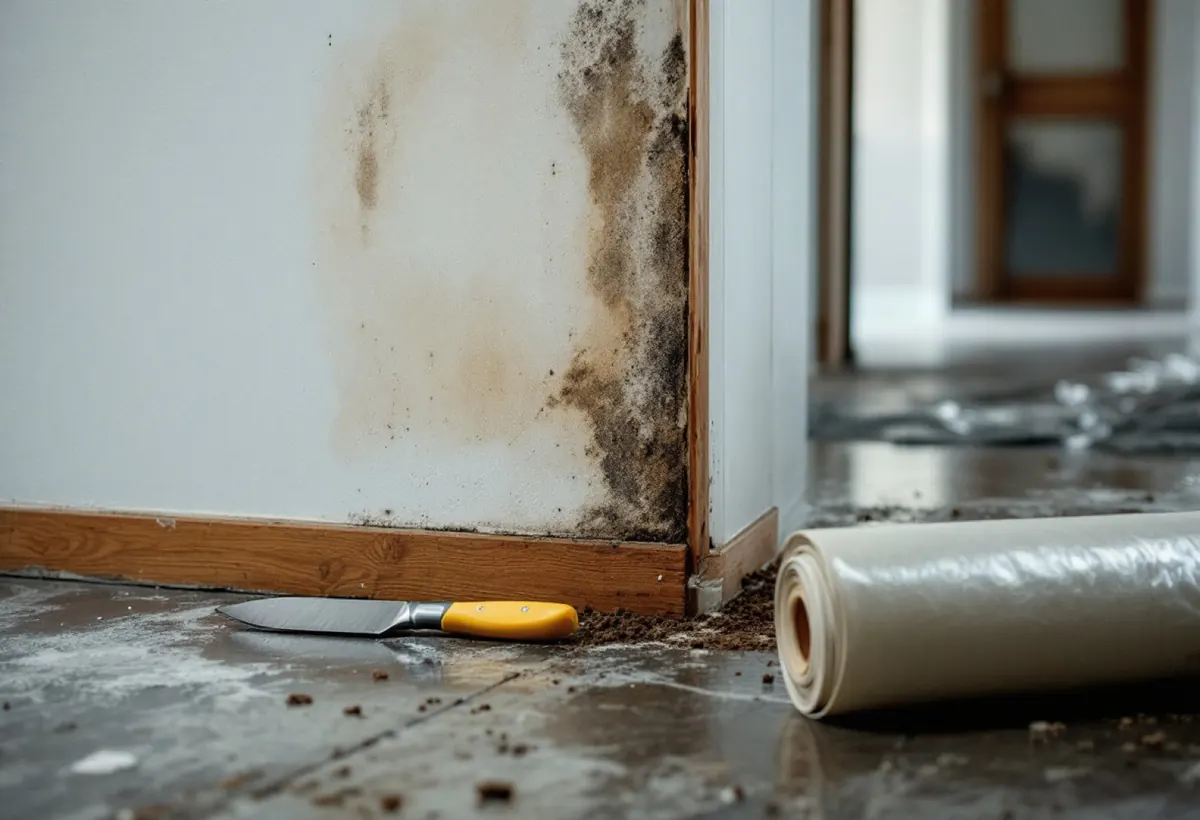
EPA's Mold Cleanup in Your Home gives the dividing line. On hard surfaces, EPA says to scrub mold off with detergent and water and dry completely. Absorbent or porous materials such as ceiling tiles and carpet may have to be thrown away, because mold can grow in their empty spaces and crevices and be difficult or impossible to remove. EPA also says not to paint or caulk over moldy surfaces.
EPA's Brief Guide to Mold, Moisture and Your Home adds that killing mold is not the goal: a biocide is not recommended as a routine practice, and dead mold may still cause allergic reactions, so it must be removed. That turns borax into a scrubbing agent like detergent, not a treatment that lets moldy drywall stay. Wet or moldy wallboard decisions are covered at wet drywall.
| Surface | Where borax fits | Basis |
|---|---|---|
| Glazed tile, glass, metal | Scrub agent, then rinse and dry | EPA: detergent and water on hard surfaces |
| Bare structural wood (joists, sill plates) | Registered borate preservative against rot, after cleaning | the EPA-accepted Bora-Care label: bare wood only, 16% moisture before finishing |
| Painted or sealed wood | Surface cleaning only | Label: no application over intact paint, stain or sealer |
| Drywall, ceiling tile, carpet | Not a fix | EPA: porous materials may have to be thrown away |
Cleaning steps for structural lumber are at mold on wood. For a comparison of registered products with EPA mold claims, start at the mold killer guide. The other household agents get the same treatment in does vinegar kill mold, does bleach kill mold, does baking soda kill mold and does dish soap kill mold. The full set lives on the mold hub.
Questions people actually ask
Is borax the same as boric acid?
No. Borax is sodium tetraborate decahydrate, Na2B4O7 with 10 waters of crystallization and a molecular mass of 381.4, according to ICSC 0567. Boric acid is a separate compound. EPA reviews them together: the 2020 Bora-Care letter cites the Boric Acid Interim Decision even though that product’s active ingredient is a third borate, disodium octaborate tetrahydrate.
Do I need a mask when mixing borax powder?
ICSC 0567 sets a TLV of 2 mg/m3 for the inhalable fraction and says a harmful concentration of airborne particles can be reached quickly when the powder is dusty. It recommends local exhaust or a particulate filter respirator, eye protection and gloves. Pour slowly into water rather than shaking powder over a surface.
Does hot water make a stronger borax mold spray?
Hot water dissolves far more: PubChem lists 1 g of borax per 16 mL of water against 1 g per 0.6 mL of boiling water. Once the mix cools toward 20 C, the ICSC limit of 5.1 g per 100 mL applies again, so the extra borax comes back out as crystals on the surface instead of staying in solution.
How big a moldy patch can I clean myself with any solution?
EPA’s home cleanup guidance says that under about 10 square feet, roughly a 3 foot by 3 foot patch, most people can handle the job themselves. Above 10 square feet, or after heavy water damage, EPA points to its Mold Remediation in Schools and Commercial Buildings guide. Ask any contractor which EPA or IICRC guidance their containment plan follows.
Can borax stop mold on lumber before it is installed?
Only partly, per USDA Forest Products Laboratory work. According to Clausen and Yang, a 2003 test found 5% DOT could not substantially inhibit mold on unseasoned southern pine, while borate plus a fatty acid in FPL-RP-673 held mold off treated pine through 12 weeks. Borate preservatives are labelled for decay fungi, not surface mold.
Sources
- EPA's Mold Cleanup in Your Home, United States Environmental Protection Agency, last updated 4 June 2026. Retrieved 16 November 2026.
- EPA's Brief Guide to Mold, Moisture and Your Home, United States Environmental Protection Agency, last updated 18 February 2026. Retrieved 16 November 2026.
- the EPA-accepted Bora-Care label, EPA Reg. No. 64405-1, registration review label accepted 26 June 2020, via EPA Pesticide Product Label System. Retrieved 16 November 2026.
- Forest Products Laboratory paper FPL-RP-673: Coleman, Yang and Clausen, Performance Characteristics of Borate Fatty Acid Formulations as Mold Inhibitors, USDA Forest Service, March 2013. Retrieved 16 November 2026.
- Clausen and Yang (2007): Protecting wood from mould, decay, and termites with multi-component biocide systems, International Biodeterioration and Biodegradation 59 (2007) 20 to 24, USDA FPL. Retrieved 16 November 2026.
- Clausen and Yang (2004): Multicomponent biocide systems protect wood from decay fungi, mold fungi, and termites for interior applications, IRG/WP 04-30333, USDA FPL. Retrieved 16 November 2026.
- Kartal, Burdsall and Green (2003): Accidental mold/termite testing of high density fiberboard treated with borates and NHA, IRG/WP 03-10462. Retrieved 16 November 2026.
- International Chemical Safety Card 0567, Sodium borate, decahydrate, ILO and WHO, April 2014. Retrieved 16 November 2026.
- PubChem, compound 16211214, National Library of Medicine: pH, solubility and pesticide use records. Retrieved 16 November 2026.
- U.S. Borax, Borax Decahydrate product properties (bulk density, solubility, boric oxide content). Retrieved 16 November 2026.
- NIST, Approximate Conversions from U.S. Customary Measures to Metric, Office of Weights and Measures. Retrieved 16 November 2026.
- 40 CFR 152.15 and 40 CFR 152.5, Code of Federal Regulations via eCFR. Retrieved 16 November 2026.
- Recipe weights and percentages are arithmetic on the NIST, U.S. Borax and ICSC figures above, computed when this page was built. Our methodology sets out the standing rules.
This page describes published research, labels and regulations. It is not a product label. Follow the label of any product you use and EPA’s mold cleanup guidance.