The short answer
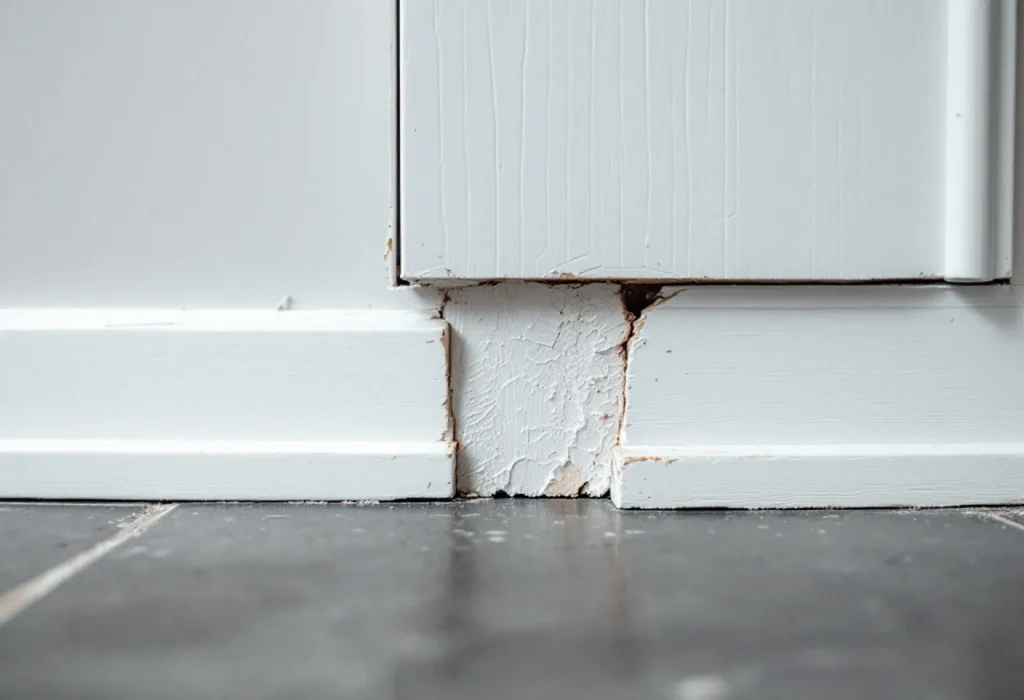
Bathroom door water damage usually starts at the bottom or top edge, where the slab is raw or only primed and Masonite says primer is no moisture barrier. If the rail is hard, dry it, reglue the facing and seal all six sides. Soft rail or wet core: replace the slab, about $300 to $500 installed per HomeAdvisor.
Key takeaways
- None of the warranty or finishing documents we read from Masonite, JELD-WEN or Therma-Tru contains the word bathroom. They exclude it through water, humidity and finishing language instead.
- Trim a swollen bottom by 1/4 inch at most on Masonite and JELD-WEN molded or flush slabs; beyond that you are into hollow space or outside the instructions.
- Bathroom air alone tops out near 23.9% wood moisture at 95% humidity, per the Wood Handbook, below the 30% line for serious decay. Puddles and splash do the structural damage.
Which of these five failures is on your door?
Door water damage looks similar from the hallway and splits into five different jobs up close. Take the door off its pins if you can, because the top and bottom edges carry the evidence. Masonite's molded panel spec sheet describes a molded hollow door as wood fiber facings bonded to wood or MDF stiles and rails around a corrugated cell core, and each failure below is one of those layers.
| What you see | What failed | Quick check | What to do |
|---|---|---|---|
| Facing or veneer lifting at a corner or along the bottom | The bond between facing and rail or stile. Masonite calls the door a 3-ply structural attachment, so a lifted face is a lost layer. | Press it. Hard rail behind the lift means repairable. | Dry, reglue, clamp, then seal all six sides |
| Bottom edge swollen, paint cracked along the rail, door rubbing | The raw rail took up water; hollow core door swelling starts here. | Push an awl into the rail from below. | Hard: trim up to 1/4 inch and seal. Crumbling: replace |
| Face bulges or dents inward when pressed, away from the edges | Corrugated core is wet or crushed and the facing has lost support. | Knock across the panel for a dead, soft area. | Replace the slab |
| Door binds at the latch or head with clean edges | Slab or frame moved. JELD-WEN treats swelling of 1/4 inch or less as natural movement. | Hold a straightedge to the face; check the jamb for swelling. | Wait, adjust hinges; frame swelling is a jamb job |
| Dark specks on paint, surface still hard | Surface mold. JELD-WEN says superficial mold or mildew does not indicate wood decay. | Wipe a spot and probe beneath it. | Clean and repaint; fix the moisture source |
Bathroom door frame water damage is a separate repair, because a swollen jamb can bind a healthy slab. Check it before you trim the door, using our guide to water damage to door frame parts, since a door trimmed to fit a swollen frame keeps the extra gap once the jamb dries, and the 1/4 inch allowance below cannot be put back. Walls, floors and trim around the door have their own entries in our water damage library.
Why does shower steam hit the bottom and top edges first?
Edges are the door’s open grain. The Wood Handbook, chapter 4 says liquid absorption is most rapid along the grain, where end grain meets water, and a slab’s top and bottom rails expose exactly that. Paint does not protect them by default: Masonite's molded panel spec sheet says factory latex primer goes on the facings, with stiles and rails only on request, and Masonite's interior door warranty states that “primer does not function as a sealer or moisture barrier”. An installer who rolls the two faces and rehangs the door leaves both ends bare.
The numbers show what steam can and cannot do. Per Table 4-2 of the Wood Handbook, wood at 70 F moves from 6.2% moisture at 30% humidity to 16.0% at 80%, a swing of 9.8 points that takes the door’s fit with it. Even at 95% humidity it settles near 23.9%, under the 30% fiber saturation point. The Wood Handbook, chapter 14 says water vapor alone will not wet wood enough for significant decay, though it permits some mold fungi; rot needs liquid water such as condensate running down a face, a shower splash or a wet bath mat. Exhaust limits the steam part, and our mold in bathroom page covers fan sizing.
How do you fix a swollen hollow core door without ruining it?
Trim limits come first because they set the repair. Masonite's interior door warranty says not to trim more than 1/4 inch off the bottom unless it is accommodated by additional blocking, and not to trim the top. JELD-WEN JII110 allows a maximum of 1/4 inch per side on hollow or solid core molded and flush doors. Forum carpenters on a Brownstoner forum thread put the solid fillet at the bottom of modern hollow doors somewhere between under 1 inch and about 1.5 inches, and describe cutting 1 inch off, peeling the facings from the offcut and gluing that fillet back up into the hollow. That is a workaround outside both makers’ instructions.
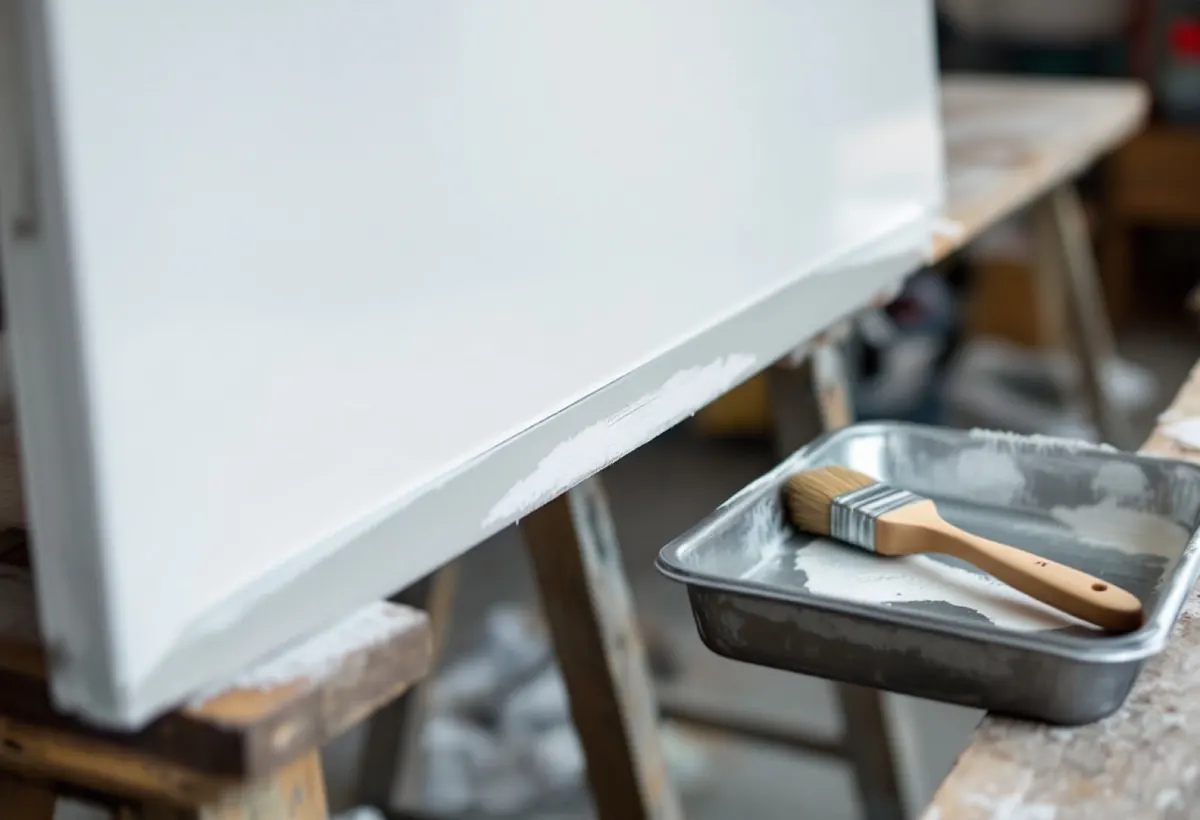
How to fix a water damaged door that passed the checks above:
- Lift the door off and stand it in a dry room. JELD-WEN JII110 asks for at least 48 hours of acclimation, 72 in extreme weather, and warns against finishing in damp weather.
- Confirm it is dry with a meter, since air dried wood reads 20% or below per the Wood Handbook, chapter 14. Our page on moisture meters covers how to read one.
- Reglue lifted facing with wood glue and clamp it flat. One builder in a Fine Homebuilding forum thread suggests working thinned glue under the skin with a syringe and clamping between plywood with wax paper between. That is forum advice, and he warns the glue spreads poorly.
- Trim the bottom if you must, no more than 1/4 inch. JELD-WEN JII110 calls for masking tape on the cut line and a fine toothed circular saw to limit chipping.
- Seal all six surfaces, including every cut. Masonite's interior door warranty requires at least 2 coats of paint, varnish or lacquer; JII110 asks for an equal number of coats on every side and recommends satin or semi-gloss.
- Reinspect the edges once a year, as Masonite's molded panel spec sheet directs, and reseal as needed.
Stains that remain on stained wood doors need different treatment, covered by our guide to water stains on wood. On homes built before 1978, JELD-WEN JII110 flags lead paint, and 40 CFR 745.83 names modification of painted doors as renovation for paid work, with a minor repair exemption at 6 square feet per interior room. Read our lead paint removal page before sanding an old slab.
What do Masonite, JELD-WEN and Therma-Tru warranties say about edges and bathrooms?
All three makers name the top and bottom edges and none names the room. We searched the text of each document for the word bathroom on 2 November 2026 and found zero hits, so no clause we read denies coverage because of the room itself. Water, humidity and unfinished edges are what they exclude, and a bathroom supplies all three.
| Clause | Masonite | JELD-WEN | Therma-Tru |
|---|---|---|---|
| Document read | Interior Door Warranty, doors bought after 15 May 2020; molded panel spec sheet, 2018 | Limited Warranty, doors made on or after 1 June 2019; JII110, 2018; JCM004 and JCM-90005 finishing instructions | Fiberglass Doors Warranty, bought on or after 1 June 2024; Owner’s Manual, 2015 |
| Term on the slab | Hollow core 5 years, solid core 7 years | Interior MDF 10 years, other interior 5 years | Lifetime for Fiber-Classic and Smooth-Star slabs; scope is “entry and patio doors” |
| Edge sealing | “all six (6) edges (top, bottom, sides) and other unfinished surfaces must be sealed with at least two (2) coats” | Excludes “improper field finishing of all surfaces (front and back) and edges (top, bottom, and sides)” | “All doors must have all 6 sides finished”; the bottom is exempt if a genuine Therma-Tru sweep is fitted |
| Deadline | Within 7 days of delivery to a job site | Factory primed wood within 14 days of purchase, raw wood within 7 | Fiberglass within 6 months of installation |
| Bathroom or humidity | Word bathroom absent. Excludes “damage caused by sunlight, water, or extremes of heat and/or humidity”, and doors installed where HVAC is not operating and balanced (25% to 55% RH, 50 F to 90 F) | Word bathroom absent. “If installed into a high-humidity environment, we require all six sides to be finished and regularly inspected with adequate ventilation and/or exhaust” (JCM-90005) | Word bathroom absent. Excludes “condensation, frost or mold resulting from humidity within the building” (2015) |
| Primer | “Primer does not function as a sealer or moisture barrier” | “standard factory-applied primer is not a finish coat” | Excludes failure to properly finish all surfaces before weather exposure |
| Swelling or warp | Warp under 1/4 inch in the stated section is within tolerance; may defer a warp claim up to 12 months | Swelling or shrinkage of 1/4 inch or less not covered; may defer up to 12 months | Warp not a defect unless over 1/4 inch; may defer up to 12 months |
| Labor if a claim succeeds | No labor, rehanging or painting; liability capped at purchase price | Skilled labor 1 year, where deemed necessary; no repainting labor | No installation or reinstallation of the door system |
The closest thing to a bathroom rule is JELD-WEN JCM-90005, the finishing sheet for Reliabilt doors, and it is conditional rather than a ban: high humidity is allowed if six sides are finished, inspected and ventilated. Masonite's 2017 wood door warranty is stricter on timing for wood panel doors, naming “failure to protect and seal all six sides within 72 hours of installation” as an exclusion. JELD-WEN JCM004 puts the deadline on purchase rather than installation, which catches anyone who stores a door in the garage for a month.
If you plan to claim, gather what the makers ask for. Masonite's interior door warranty wants a photo of the defect, proof of sale and a statement that none of the exclusions caused it, and JELD-WEN's limited warranty wants the identification from the tag on the top edge of the slab. Photograph the sealed top and bottom edges when you finish the door, because nobody can prove two coats on a bottom edge later, and ask the maker in writing whether a shower room counts as a high humidity installation for your model.
Is repair or a new slab cheaper on published prices?
| Job | Published range | Source and date |
|---|---|---|
| Fix a hollow core door, professional | $75 to $250 | HomeAdvisor, updated 25 April 2025 |
| Repair an interior door including plaster, paint and trim | $350 to $650 | HomeAdvisor, updated 25 April 2025 |
| Fill holes up to 1/2 inch with putty or auto body filler | $5 to $15 | HomeAdvisor, updated 25 April 2025 |
| New hollow core door only, what most pay | $50 to $150 | HomeAdvisor, updated 29 October 2025 |
| Buy and install a slab door | $300 to $500 | HomeAdvisor, updated 29 October 2025 |
| Replace an interior door, hollow core | $60 to $500 | HomeAdvisor, updated 25 April 2025 |
| Replace an interior door, solid wood | $250 to $800 | HomeAdvisor, updated 25 April 2025 |
| Interior door installation | $374 to $697 | Fixr, updated 31 January 2025 |
| Install an interior door, starting range | $444 to $675 | Homewyse, May 2026 national average |
Our calculation from HomeAdvisor's door repair guide and HomeAdvisor's interior door guide: the top of the hollow core repair range ($250) is 83% of the bottom of the installed slab range ($300), so one repair undercuts a new slab on these figures. Two repairs change that: at the same rates they run $150 to $500, which overlaps the slab range. The decision rule follows. Pay for a repair once, on a hard rail, and seal six sides as part of it. If the same door has already failed, or the core is wet, put the money into a new slab.
Installed figures rise fast with scope. According to Fixr, installation runs $374 to $697, and Homewyse starts at $444 to $675, both above HomeAdvisor’s slab figure. Ask a quote to separate slab, mortising, boring and finish, because the top and bottom edge coats are the part easiest to skip. Fixr also says reusing the frame costs significantly less, so check the jamb before pricing. Vanity doors are a different build, covered in our page on water damaged cabinets.
Which door type holds up better in a wet bathroom?
The only federal ranking of door materials we found is a flood rule, FEMA Technical Bulletin 2 (August 2008), so read it as a guide to water tolerance rather than a bathroom test. It places hollow, panel and solid wood doors together in Class 2: materials for predominantly dry spaces with occasional water vapor or slight seepage. Moving to solid wood alone does not change the class.
| Door type | FEMA class | NFIP use below flood level |
|---|---|---|
| Wood, hollow | Class 2 | Unacceptable below flood level |
| Wood, lightweight panel | Class 2 | Unacceptable below flood level |
| Wood, solid | Class 2 | Unacceptable below flood level |
| Metal, hollow | Class 4 | Acceptable; not advised for salt water |
| Metal, wood core | Class 4 | Acceptable; not advised for salt water |
| Metal, foam filled core | Class 4 | Acceptable; not advised for salt water |
| Fiberglass, wood core | Class 4 | Acceptable |
Warranty terms point a similar way. Masonite's interior door warranty gives solid core slabs 7 years against 5 for hollow core, and JELD-WEN's limited warranty gives interior MDF doors 10 years against 5 for other interior doors, yet both keep the water and finishing exclusions. Metal and fiberglass are the class upgrade, with one catch: Therma-Tru's 2024 fiberglass warranty scopes its coverage to entry and patio doors, so ask before hanging one inside. Questions for the dealer: what is the bottom rail made of, are the edges factory sealed, and does the warranty apply beside a shower?
Questions people actually ask
Do bathroom doors need to be solid core?
Nothing in the documents we read requires it. FEMA Technical Bulletin 2 places hollow and solid wood doors in the same Class 2, so going solid buys sound control more than water tolerance. Masonite does warrant solid core slabs for 7 years against 5 for hollow core, and both still need all six edges sealed with 2 coats.
What paint should go on a bathroom door?
JELD-WEN’s JII110 highly recommends a satin or semi-gloss finish and warns that heavy or thinned water based coats drive water into the board. Masonite requires at least 2 coats of paint, varnish or lacquer on all six edges and says primer alone is no moisture barrier. Paint in a dry room, avoiding damp weather, rather than in the bathroom.
Why does my bathroom door stick after showers but not in winter?
Wood moves with humidity. Table 4-2 of the Wood Handbook has wood at 70 F near 6.2% moisture at 30% humidity and 16.0% at 80%, and a door with bare edges tracks those swings faster. JELD-WEN treats 1/4 inch or less of slab movement as natural, not a defect. Seal the edges first and wait a season before planing, since clearance removed in humid weather does not come back.
Can I fill a damaged bottom edge with wood filler?
For small damage on a hard rail, yes. HomeAdvisor prices putty or auto body filler at about $5 to $15 for holes up to 1/2 inch wide, let dry fully before sanding and painting. Filler does nothing for a crumbling rail or a wet core, and it needs the same 2 coats over it as the rest of the edge.
Is mold on a bathroom door a sign the door is ruined?
Not by itself. JELD-WEN’s warranty states that superficial mold or mildew does not indicate wood decay, and the Wood Handbook says humid air can support some mold fungi without reaching the 30% moisture that serious decay needs. Check that the rail is hard, then follow our mold on wood cleanup steps and reseal.
How much gap should a bathroom door have at the bottom?
JELD-WEN’s JII110 leaves it to fit: the opening is usually 1/4 to 1/2 inch taller than the slab, with 1/8 inch clearance at the head and enough room to swing without rubbing the flooring. A door that rubs tile keeps its raw edge in contact with mop water, so resolve the rubbing before repainting.
Sources
- Masonite, Interior Door Warranty, doors purchased after 15 May 2020, PROD-20001, retrieved 2 November 2026.
- Masonite, Molded Panel Series Hollow Core Interior Doors specification, 2018, retrieved 2 November 2026.
- Masonite, Wood Door Limited Warranty, 2017, retrieved 2 November 2026.
- JELD-WEN, Interior and Exterior Door Slab and System Limited Warranty, products made on or after 1 June 2019, retrieved 2 November 2026.
- JELD-WEN, Installation Instructions for Interior Door Slabs, JII110, 2018, retrieved 2 November 2026.
- JELD-WEN, Finishing and Refinishing Instructions, JCM004, retrieved 2 November 2026.
- JELD-WEN, Finishing and Refinishing Instructions for Reliabilt doors, JCM-90005, retrieved 2 November 2026.
- Therma-Tru, Fiberglass Doors Warranty Information, purchases on or after 1 June 2024, retrieved 2 November 2026.
- Therma-Tru, 2015 Owner's Manual, retrieved 2 November 2026.
- USDA Forest Products Laboratory, Wood Handbook FPL-GTR-282, chapter 4: Moisture Relations, including Table 4-2 (Internet Archive copy; the FPL server refused direct requests), retrieved 2 November 2026.
- USDA Forest Products Laboratory, Wood Handbook FPL-GTR-282, chapter 14: Biodeterioration of Wood (Internet Archive copy), retrieved 2 November 2026.
- FEMA, Technical Bulletin 2: Flood Damage-Resistant Materials Requirements, August 2008, retrieved 2 November 2026.
- HomeAdvisor, Door repair cost guide, updated 25 April 2025 (Internet Archive capture of 23 October 2025), retrieved 2 November 2026.
- HomeAdvisor, Interior door cost guide, updated 29 October 2025 (Internet Archive capture of 10 January 2026), retrieved 2 November 2026.
- Fixr, Interior door installation cost, updated 31 January 2025, retrieved 2 November 2026.
- Homewyse, Cost to Install Interior Door, May 2026, retrieved 2 November 2026.
- Brownstoner, Planing a hollow core door, forum archive (anecdotal), retrieved 2 November 2026.
- Fine Homebuilding, Repairing delaminated flat veneer, forum thread (anecdotal), retrieved 2 November 2026.
- Legal Information Institute, 40 CFR 745.83, retrieved 2 November 2026.
Warranty clauses are quoted from the versions named above and change by purchase date and product line; check the document for your door. We read warranties, standards and published prices and did not inspect any door. How we check facts: our methodology.