The short answer
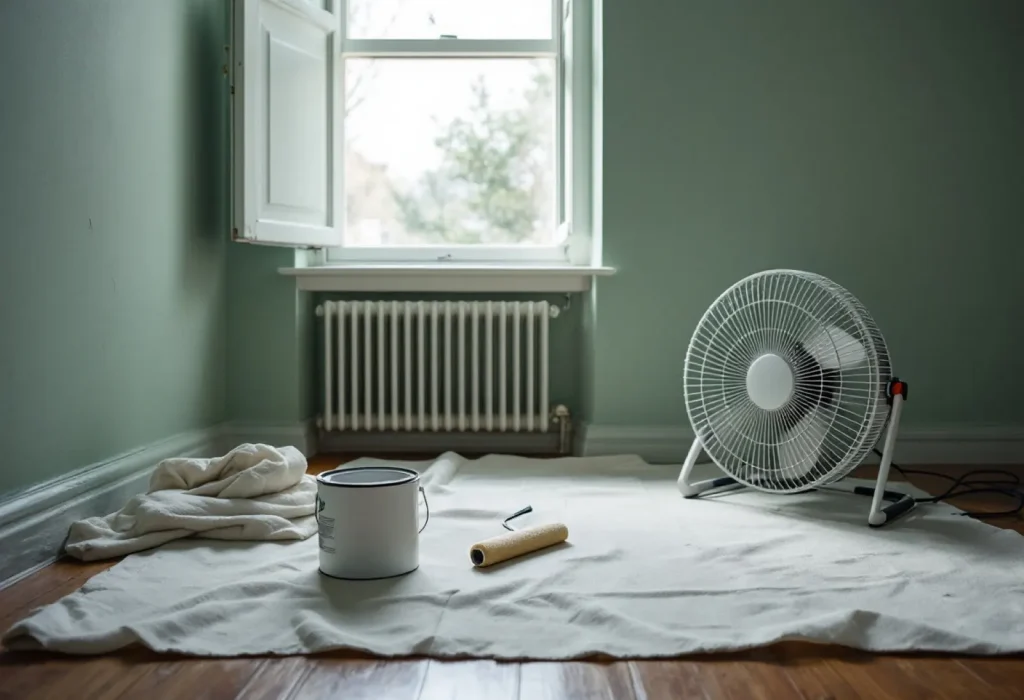
How to get rid of paint smell: exhaust the room outdoors with a window fan blowing out for at least 2 to 3 days, the EPA rule of thumb, and longer if you can. In a 1999 California chamber study, latex paint VOCs fell about 90 percent in 14 days but drifted back toward closed room levels when extra ventilation stopped. Bowls and sprays do not replace airflow.
On this page
What are you smelling 3 hours after latex paint, and what is left at day 14?
Interior latex paint is mostly water, but the 1999 report prepared by Lawrence Berkeley National Laboratory for the California Air Resources Board found its emissions dominated by two ingredients: a glycol solvent (ethylene or propylene glycol, 2.0 to 3.6 percent of the paint by weight) and a coalescing aid sold as Texanol (0.7 to 1.5 percent by weight). The 1999 Berkeley Lab report for the California Air Resources Board also measured acetaldehyde and formaldehyde, which were raised only in the first 6 hours and first day.
The EPA guide Healthy Indoor Painting Practices (EPA 744-F-00-011) draws the main line between paint types: water based latex paints emit fewer chemicals, while short term exposure to solvents from oil based alkyd paints can be significantly higher, and some paints carry drying oils that take several days to go away. Alkyd work needs the same tactics over a longer stretch.
The chart below is the measured decay in one test room: walls and ceiling of a 25.5 cubic meter compartment (about 901 cubic feet, a small bedroom) were rolled with a latex primer, a flat latex and a semi gloss on 16.0 square meters, then held at 0.5 air changes per hour. According to Appendix H of the same report, the sum of the six target VOCs peaked at 20,000 micrograms per cubic meter at 3 hours, was 76 percent lower by 24 hours, and stood at 1,900 at 336 hours (14 days), 10 percent of the peak.
Why does a painted drywall wall keep emitting for months?
Gypsum board soaks up the solvent. An EPA chamber study summarized on OSTI found most Texanol leaves within the first few days but the glycols come out over several months, because after the film dries the release is limited by diffusion inside the paint and gypsum board (EPA chamber study abstract on OSTI).
The large room tests put numbers on it. Across four runs, only 4.5 to 14 percent of the ethylene glycol and 19 to 35 percent of the Texanol that went onto the walls had reached the air after 336 hours, per Table 10 of the 1999 Berkeley Lab report for the California Air Resources Board. The rest was still in the board.
| Run | Glycol applied | Glycol emitted | Glycol share | Texanol applied | Texanol emitted | Texanol share |
|---|---|---|---|---|---|---|
| P-1, base case | 90 g | 4.08 g | 4.5% | 39 g | 8.6 g | 22% |
| P-2, base case | 103 g | 6.8 g | 6.6% | 45 g | 8.6 g | 19% |
| P-3, 2 ACH for 72 h | 100 g | 14.2 g | 14% | 43 g | 15.0 g | 35% |
| P-4, 2 ACH plus fans | 104 g | 10.0 g | 9.6% | 45 g | 11.8 g | 26% |
| EPA small chamber, Chang 1997 | n/a | n/a | 9% | n/a | n/a | 29% |
The same report cites the EPA small chamber work by Chang and colleagues (1997): 9 percent of the ethylene glycol, 14 percent of the DEGBE and 29 percent of the Texanol left painted gypsum board in 336 hours, emissions were still detectable 11 months after painting, and full release could take as long as 3.5 years. Painted metal released 2 to 10 times more in two weeks, mostly in the first 100 hours.
By 12 weeks in the long run test, Texanol had fallen fourfold to 294 micrograms per cubic meter, per the CARB report. That slow tail is the faint smell people notice in a closed room weeks later. Fabrics and carpet in the room act as a second sink, the same mechanism that holds mothball vapor in closets. The mothball smell page covers airing out absorbent items.
How many air changes does a window fan give a 12 by 14 bedroom?
Air changes per hour (ACH) is airflow times 60 divided by room volume. CDC Appendix B, Table B.1 gives the time to clear 99 percent of an airborne contaminant: 138 minutes at 2 ACH, 46 minutes at 6 ACH, 23 minutes at 12 ACH. The CDC notes the figures assume an empty room with no ongoing source and perfect mixing.
| Room | Volume (ft3) | Assumed delivered airflow (cfm) | ACH | Minutes to 99% removal, per the CDC formula |
|---|---|---|---|---|
| 10 x 10 ft, 8 ft ceiling | 800 | 100 | 7.5 | 37 |
| 10 x 10 ft, 8 ft ceiling | 800 | 300 | 22.5 | 12 |
| 10 x 10 ft, 8 ft ceiling | 800 | 600 | 45.0 | 6 |
| 12 x 14 ft, 8 ft ceiling | 1,344 | 100 | 4.5 | 62 |
| 12 x 14 ft, 8 ft ceiling | 1,344 | 300 | 13.4 | 21 |
| 12 x 14 ft, 8 ft ceiling | 1,344 | 600 | 26.8 | 10 |
| 14 x 16 ft, 9 ft ceiling | 2,016 | 100 | 3.0 | 93 |
| 14 x 16 ft, 9 ft ceiling | 2,016 | 300 | 8.9 | 31 |
| 14 x 16 ft, 9 ft ceiling | 2,016 | 600 | 17.9 | 15 |
The catch is the CDC caveat. Paint is an ongoing source, so a fan that flushes the room air in under an hour does not empty the walls. With the windows shut, the room falls back to its natural rate: the CARB base case of 0.5 ACH needs about 9.2 hours to swap out 99 percent of the air, and the 0.35 ACH the CARB report cites for 66 post 1980 California houses needs about 13.2 hours. Those slow rates are why the smell builds back up overnight.
The EPA guide Healthy Indoor Painting Practices (EPA 744-F-00-011) says to put a box fan in the window blowing out, secure it so it cannot fall or be tipped, and pull it out and switch it off if rain or snow reaches it, to avoid an electrical shock hazard. The same guide says an air conditioner is not a substitute for a fan and that bathroom and kitchen exhaust fans do not always vent outdoors. A contractor sized negative air machine is a different tool, described on the air scrubber page.
Does running fans for 3 days, then shutting the windows, clear the smell?
Partly. In run P-3 the room got 2 ACH for the first 72 hours, four times the base rate. At 48 hours the VOC total was 2,170 micrograms per cubic meter against 4,040 in base run P-1 and 3,180 in P-2, per Appendix H of the same report. Once the rate dropped back to 0.5 ACH, the gap closed: P-3 was only 14 percent below P-1 at 96 hours and 36 percent above it at 168 hours.
The CARB report explains why the cut was smaller than fourfold: faster airflow raised the emission rate at the painted surface. P-3 released 14 percent of its glycol and 35 percent of its Texanol in 336 hours, the highest shares of the four runs, so the fans pulled solvent out of the wall sooner even though the room air later looked similar. Adding two oscillating fans at the walls (run P-4, air speed raised about 2.5 times) did not produce a large further drop.
The report’s own conclusions for latex paint: keep extra ventilation for longer than three days, maximize it, and delay occupancy for several days, which it calls the most effective way to cut exposure. The EPA guide Healthy Indoor Painting Practices (EPA 744-F-00-011) sets the floor at 2 to 3 days of open windows and says to avoid freshly painted rooms for 2 to 3 days when possible, keeping young children and people with breathing problems out. For health questions about VOCs, the EPA page on VOCs and indoor air is the starting point; this page covers odor and air, not medical advice.
Should you heat the room to 33 C (91 F) or keep it cool?
Guides online often say to keep a freshly painted room cool. The chamber data say heat speeds the release and the release is what you want, if the air is going outdoors. In the CARB report, warming the room to about 33 C for 72 hours while ventilating at 2 ACH raised VOC levels during heating; once the heater went off most compounds returned to the unheated levels, but Texanol, the main paint coalescent, stayed lower for the rest of the run. A small chamber study cited there (van der Wal, 1997) found faster Texanol decay at 30 C than at 23 C.
Humidity mattered less. CARB screening at 30, 50 and 70 percent relative humidity found a negligible or minor effect on the primary emission rates from a latex primer and flat paint on gypsum board; a dip in glycol readings during a dry spell below 30 percent was attributed to sorption on room surfaces. Heat only helps with the window fan running, and room occupants breathe the raised levels during the heated hours, so warm the room while it is empty.
Do cut onions, vinegar bowls, baking soda or charcoal bags remove paint VOCs?
No primary study opened for this page tests onions, vinegar or baking soda on paint emissions, and none of the agency guidance recommends them. The EPA page on VOCs and indoor air lists air fresheners as a VOC source in their own right, so a scented spray or candle adds compounds rather than removing glycol or Texanol. A bowl of anything has a few square inches of surface against 16 square meters of emitting wall in the CARB test room.
Activated carbon is the one adsorbent with agency backing. The EPA Guide to Air Cleaners in the Home says to choose a portable air cleaner with an activated carbon or other filter designed for gases, that such filters can be effective when they hold a large amount of material (the thicker the better), and that no widely used rating system exists for gas removal: CADR covers particles only. EPA also says research has not shown plasma, photocatalytic oxidation or UV removing gases effectively in home units.
Ozone is the wrong tool. The EPA review of ozone generators says that at concentrations within public health standards ozone is generally ineffective against indoor air pollution, does not remove formaldehyde, and reacts with some chemicals to form aldehydes; in one new carpet test the total organic chemicals in the air went up. The ozone generator page covers when restorers use it on unoccupied fire jobs.
Paint smell will not go away after a week: five checks in order
- Oil based or alkyd product? The EPA guide says alkyd solvent exposure can be significantly higher than latex and drying oils can take several days; plan on the long end.
- Open cans in the house? EPA warns vapors leak from improperly sealed containers and advises buying only what you will use right away. Close lids tight and move leftover cans out of the living space.
- Apartment or shared wall? EPA guide 744-F-00-011 says paint vapor moves as shared air through gaps around pipes and electrical outlets, and suggests venting the painted unit and neighboring units outdoors with box fans.
- Room with no window? Prop the door and set the fan in the nearest window blowing out; the same guide warns bath and kitchen fans may not vent outdoors, so confirm the duct ends outside before relying on one.
- Still strong after 2 weeks with ventilation? The CARB test room was about 10 percent of peak at day 14. A sharp solvent smell beyond that points to another source, such as stored fuel or stripper, worth measuring with the methods on the indoor air quality testing page.
Scraping or sanding before a repaint is a separate hazard in any home built before 1978, when the EPA Renovation, Repair and Painting page notes lead based paint was banned for residential use; read the lead paint removal guide before disturbing old coats. New flooring installed with the paint adds its own VOCs, covered on the new carpet smell page.
Picking the next can matters more than any trick. The CARB screening found two new generation non VOC paints had emission rates 25 to 50 times lower than the conventional paints, with a different mix of compounds, so lower but not zero odor. Federal law under 40 CFR 59 Subpart D caps interior flat coatings at 250 grams of VOC per liter and interior nonflat at 380, and 40 CFR 59.405 requires the label or lid to show the VOC content or the limit it meets; the subpart defines no zero VOC category. More odor problems are filed under fire, smoke and odor.
Questions people actually ask
Is it safe to sleep in a freshly painted room?
The EPA guide Healthy Indoor Painting Practices (EPA 744-F-00-011) says to avoid freshly painted rooms for 2 to 3 days whenever possible and to keep young children and people with breathing problems out. The 1999 CARB chamber data show paint VOCs falling about 76 percent from peak by 24 hours, so a second night elsewhere cuts the dose further.
Does zero VOC paint still smell?
Usually a little. The 1999 CARB study measured two non VOC latex paints with total emission rates 25 to 50 times lower than conventional latex, but their emissions were a different mix, not nothing. 40 CFR 59 Subpart D sets maximum VOC content, 250 grams per liter for interior flat, and defines no zero VOC category, so read the grams per liter figure on the label.
How do you get rid of gloss or oil based paint fumes?
Use the same window exhaust but plan for longer. The EPA painting guide says solvent exposure from alkyd paints can be significantly higher than from latex and that drying oils can take several days to go away. Keep the fan blowing out, keep flames and sparks away since the guide warns about flammable cleaners near water heaters and furnaces, and do not use gasoline to clean brushes.
Will an air purifier remove paint smell?
Only one with a gas filter. EPA’s Guide to Air Cleaners in the Home (2018) says an activated carbon filter can work when it holds a large amount of material, and that the CADR rating on the box covers particles only, so a HEPA only unit carries no rating for glycol or Texanol vapor. EPA adds that plasma, photocatalytic and UV units have not been shown to remove gases in homes.
How do you get rid of paint smell in an apartment fast?
Vent your unit outdoors with a window box fan blowing out and keep the hallway door shut so vapor does not move into the corridor. The EPA guide (EPA 744-F-00-011) notes paint vapor travels between units through gaps around pipes and outlets and tells property managers to give neighbors advance notice and consider loaning box fans.
Sources
- U.S. EPA Office of Pollution Prevention and Toxics, “Healthy Indoor Painting Practices,” EPA 744-F-00-011, May 2000. EPA guide Healthy Indoor Painting Practices (EPA 744-F-00-011). Retrieved 21 November 2026.
- Hodgson, A.T., Lawrence Berkeley National Laboratory, “Common Indoor Sources of Volatile Organic Compounds: Emission Rates and Techniques for Reducing Consumer Exposures,” final report, California Air Resources Board Contract 95-302, January 1999. 1999 Berkeley Lab report for the California Air Resources Board. Retrieved 21 November 2026.
- Same report, appendices (Appendix H, latex paint experiments, Tables H-01 to H-09). Appendix H of the same report. Retrieved 21 November 2026.
- OSTI.GOV, “Test methods for determining short and long term VOC emissions from latex paint” (EPA research abstract). EPA chamber study abstract on OSTI. Retrieved 21 November 2026.
- U.S. Centers for Disease Control and Prevention, “Appendix B. Air,” Guidelines for Environmental Infection Control, Table B.1. CDC Appendix B, Table B.1. Retrieved 21 November 2026.
- U.S. EPA, “Volatile Organic Compounds’ Impact on Indoor Air Quality.” EPA page on VOCs and indoor air. Retrieved 21 November 2026.
- U.S. EPA, “Ozone Generators that are Sold as Air Cleaners.” EPA review of ozone generators. Retrieved 21 November 2026.
- U.S. EPA, “Guide to Air Cleaners in the Home,” 2nd edition, 2018. EPA Guide to Air Cleaners in the Home. Retrieved 21 November 2026.
- Electronic Code of Federal Regulations, 40 CFR Part 59 Subpart D, sections 59.402 (Table 1) and 59.405. 40 CFR 59 Subpart D. Retrieved 21 November 2026.
- U.S. EPA, “Lead Renovation, Repair and Painting Program.” EPA Renovation, Repair and Painting page. Retrieved 21 November 2026.
Chamber results come from single test rooms at 23 C and stated air change rates; a real house will differ. The ventilation table is a labelled calculation with assumed airflow, not a fan rating. How we source and calculate is described on our methodology page.