The short answer
How to tell if mold is behind walls: look for staining, peeling paint or warped baseboards, smell for a musty odour strongest at one wall, then confirm wetness with a moisture meter. Meters and thermal cameras find water and cold, not growth; only a borescope through a small drilled hole or an opened wall shows the mold itself, per EPA investigation guidance.
On this page
What does the wall face show when mold is growing on the back of the drywall?
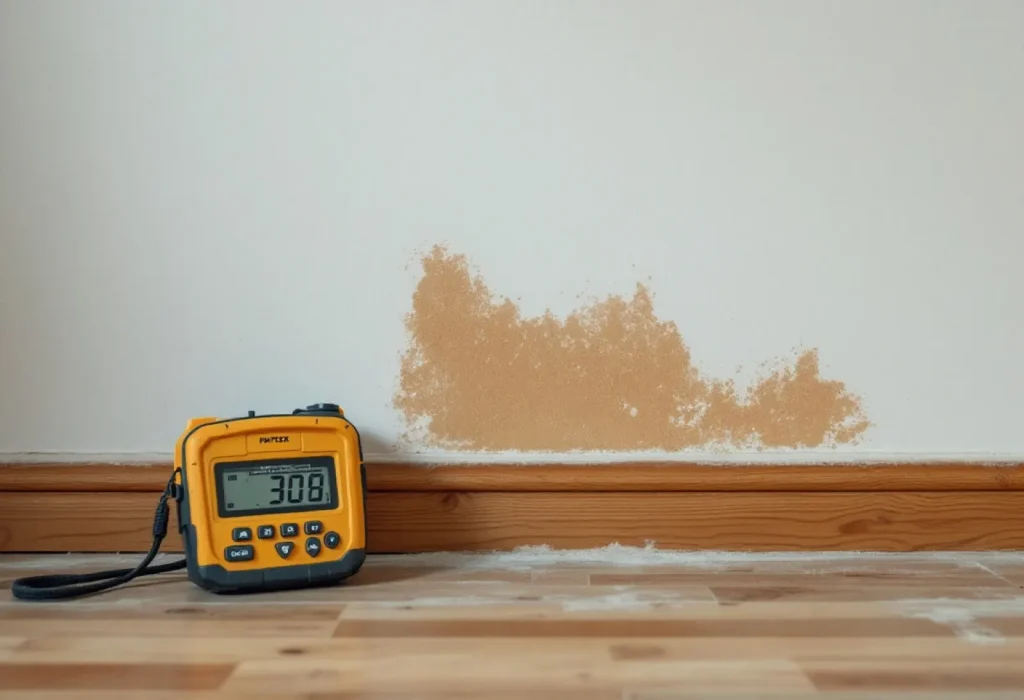
Usually water evidence, not mold. The NIOSH Dampness and Mold Assessment Tool (NIOSH publication 2019-114) scores three separate things on every wall: damage or stains, visible mold, and wet or damp. Its damage column lists peeling paint, efflorescence, rust, warping and crumbling material, and its stain column covers discoloration from leaks, flooding or condensation.
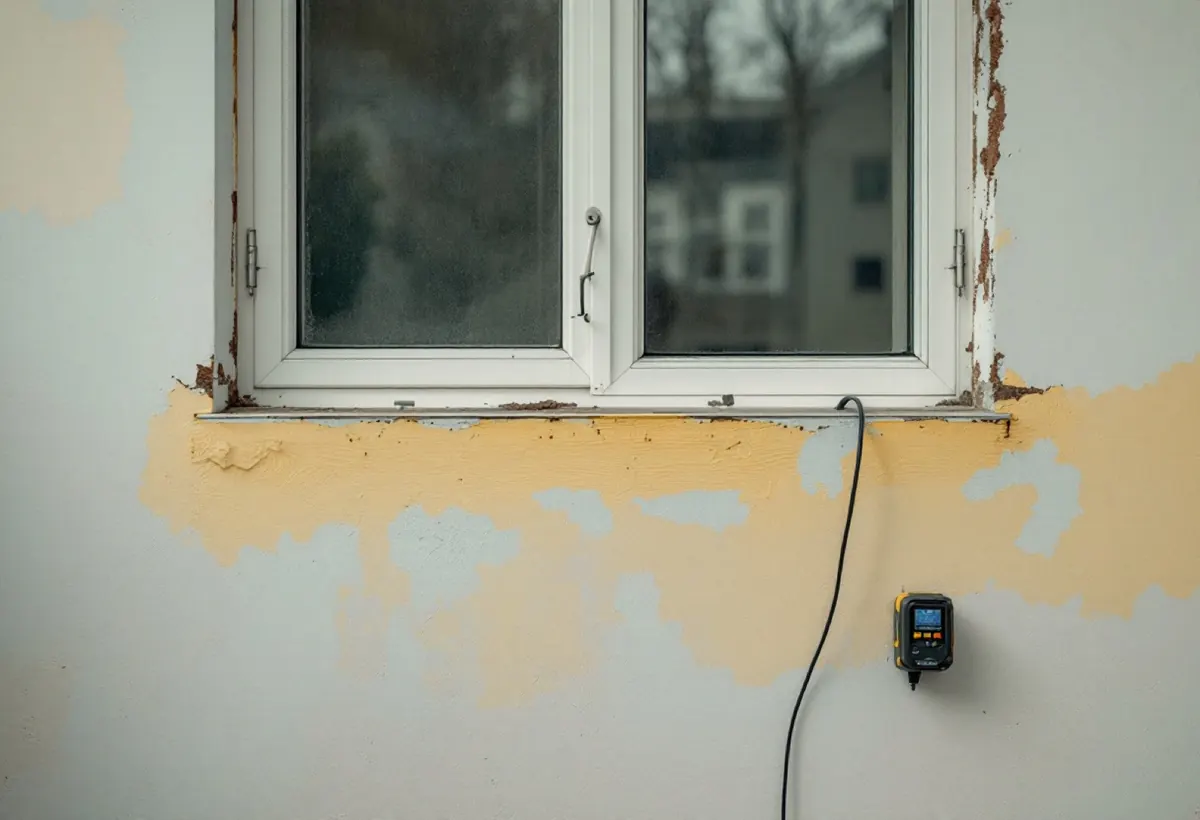
- Tide line stains with a darker edge low on a wall or under a window point to water that wet the paper face and dried. NIOSH treats these as damage, not mold.
- Bubbled or peeling paint: EPA notes that paint applied over moldy surfaces is likely to peel, per the EPA homeowner mold guide.
- Warped or swollen baseboard and a soft bottom edge on the drywall fall in the NIOSH warping and crumbling category; water that runs down a cavity collects at the bottom plate first.
- Spots colored differently from the wall, typically gray, brown or black and sometimes fuzzy, are what NIOSH counts as visible mold.
A clean face proves little. The EPA remediation guide, chapter 3 warns that drywall with vinyl wallpaper over it or wood paneling may act as a vapor barrier, trapping moisture underneath where mold can grow out of sight. That wallpaper case has its own page: mold behind wallpaper.
Measure what you see before going further. NIOSH scores area against two household objects, and the conversion below turns those into square feet so they line up with the EPA thresholds used later on this page.
| Score, per the NIOSH DMAT | Combined affected area | Square inches | Square feet | What NIOSH says to do |
|---|---|---|---|---|
| 0 | No problem areas found | 0 | 0 | Recheck over time |
| 1 | Up to one sheet of paper, 8.5 by 11 in | 93.5 | 0.65 | Compare rooms over time |
| 2 | Larger than the paper, smaller than a 32 by 80 in interior door | 93.5 to 2,560 | 0.65 to 17.8 | Compare rooms over time |
| 3 | Larger than a 32 by 80 in interior door | over 2,560 | over 17.8 | Immediate attention to source and remediation |
Does a musty smell with no visible mold mean it is inside a wall, and which wall?
It is the main clue EPA names. The EPA homeowner mold guide says you may suspect hidden mold if a building smells moldy but you cannot see the source, or if you know there has been water damage. The EPA mold course, chapter 3 adds that damp or musty odors suggest water is or was present and mold growth is likely.
NIOSH turns the nose into a repeatable check. Its DMAT form asks the assessor to smell for mold odor when first walking into each room, grade it none, mild, moderate or strong, and name the source or tick source unknown. A score of 3, a strong odor, should trigger attention to identify areas of hidden mold, per the NIOSH Dampness and Mold Assessment Tool.
To narrow it to one wall, grade each room on entry with the same four step scale, then grade along the suspect room at the closet, behind furniture and at the baseboard of each wall. The highest grade marks the wall to meter first. More on musty odor sources sits on the mold smell page.
Guides online suggest sniffing at outlets because the box opens into the cavity. Do not remove cover plates or push anything into an outlet: the CPSC electrical safety page covers shock hazards, and work inside an electrical box is an electrician’s job.
Where inside the wall does hidden mold start in a bathroom, kitchen or bedroom?
Next to the water source, and usually below it. The EPA homeowner mold guide lists areas inside walls around leaking or condensing pipes and wall surfaces behind furniture where condensation forms. EPA’s 2013 EPA moisture control guidance (EPA 402-F-13053) adds that small plumbing leaks inside walls may continue unnoticed for some time, and that panned sill flashing exists to stop seepage running into the wall beneath a window.
Condensation is the source people miss. EPA 402-F-13053 says that in cold weather condensation is most likely on the inside of exterior walls, and that condensation inside an assembly is hidden and may be mistaken for rainwater or plumbing leaks. The NIOSH form has a separate tick box for any problem within 3 feet of an exterior wall for the same reason.
| Room | Water source to suspect | Check first | Source |
|---|---|---|---|
| Bathroom | Tub and shower valve, drain and supply lines; sink supply lines | Low on the wall beside the tub and under the vanity | EPA moisture control guidance; EPA mold course, chapter 3 |
| Kitchen | Sink supply and drain; a window over the sink | Stud bay behind the sink base and under the window | EPA moisture control guidance; IAQ Radio wall cavity presentation |
| Bedroom | Cold exterior wall; window sill seepage | Wall surface behind dressers and beds; bay below the sill | EPA homeowner mold guide; EPA moisture control guidance |
| Any room on an upper floor in winter | Warm humid air leaking out through gaps in the exterior wall | Inside of exterior walls | EPA moisture control guidance |
A leak inside a wall is a plumbing repair before it is a mold question; the plumbing side is covered at theplumbingbrief.com. How a wet cavity dries, and what gets cut out, is on the water damage in walls page.
Which test finds mold behind drywall, from no holes to an open wall?
Each rung answers a narrower question than the one people ask. EPA’s EPA mold course, chapter 3 says the most important equipment is your own eyes and nose, that many investigators use moisture meters to find wet areas where mold may be growing, and that some use a borescope to look behind walls without significantly damaging the drywall. The U.S. Army Technical Guide 278 (October 2018) adds IR cameras and removing drywall to that list.
| Rung | What it actually finds | What it misses | Damage to the wall | Source |
|---|---|---|---|---|
| 1. Look | Stains, peeling paint, warping (NIOSH DMAT) | Growth on the back of the board with a dry, clean face; vinyl wallpaper acting as a vapor barrier (EPA) | None | NIOSH Dampness and Mold Assessment Tool |
| 2. Smell | Musty odor graded none to strong on entry | Subjective by NIOSH’s own description; does not locate the bay | None | NIOSH Dampness and Mold Assessment Tool |
| 3. Moisture meter | Moisture in the material; pinless to about 19 to 22 mm deep | Old leaks that have dried; cannot see mold | None pinless; pin holes in pin mode | Klein Tools ET140 product page; Extech MO265 product page |
| 4. Thermal camera | Surface temperature differences | Cold is not wet; dried leaks; needs a meter to confirm | None | Restoration and Remediation magazine |
| 5. Borescope | Optical view of a small part of the cavity | Growth outside the field of view; prone to false results | One small drilled hole | EPA mold course, chapter 3; IAQ Radio wall cavity presentation |
| 6. Cavity air sample | Spores in cavity air at one moment | Air methods prone to false negatives (U.S. Army) | A probe hole for the sampler | U.S. Army Technical Guide 278 |
| 7. Open the wall | Direct view and bulk samples | Sections not opened | A cut section, under containment | EPA remediation guide, chapter 3 |
The ladder is cumulative. A rung 3 reading only matters at a spot rungs 1 and 2 already flagged, and EPA’s EPA remediation guide, chapter 3 says investigating hidden mold requires caution once it involves disturbing potential growth sites, which rungs 5 to 7 all do. Published inspection prices live on the mold testing page.
Can a moisture meter or thermal camera detect mold behind a wall?
No. Both detect conditions, not organisms. EPA’s EPA mold course, chapter 3 frames the meter’s value carefully: because mold often grows where moisture is high, a meter can help locate hidden areas of growth. A wet reading says water is in the board today.
Pinless meters read into the wall, not just the face. The Klein Tools ET140 product page gives the ET140 a sensing depth of 3/4 in (19 mm) on a relative scale, and the Extech MO265 product page lists pinless depth to 22 mm. Lignomat sells dual depth meters with a 1/4 in setting specifically to avoid reading studs and other materials in the measuring field, per its Lignomat drywall note. A high pinless reading over a stud is therefore weaker evidence than one mid bay.
Thermal cameras see temperature. Writing in Restoration and Remediation magazine in March 2018, Mitch Byrom put it bluntly: IR cameras show the heat emitted from surfaces and do not accurately show moisture content, and an exterior wall will show colder than an interior wall in winter whether wet or not. His fix is to verify every cold spot with a moisture meter.
The bigger limit is time. In a September 2025 IAQ Radio wall cavity presentation, industrial hygienist Joe Spurgeon lists moisture meters and thermal imaging as tools for current water intrusions with limited information about contaminants. A leak fixed months ago can leave a dry wall with growth on its back, and both tools will read it as normal. Reading the numbers on a drywall meter is covered on the drywall moisture reading page, and choosing a meter on the moisture meters for water damage page.
What does a borescope through one small hole actually show?
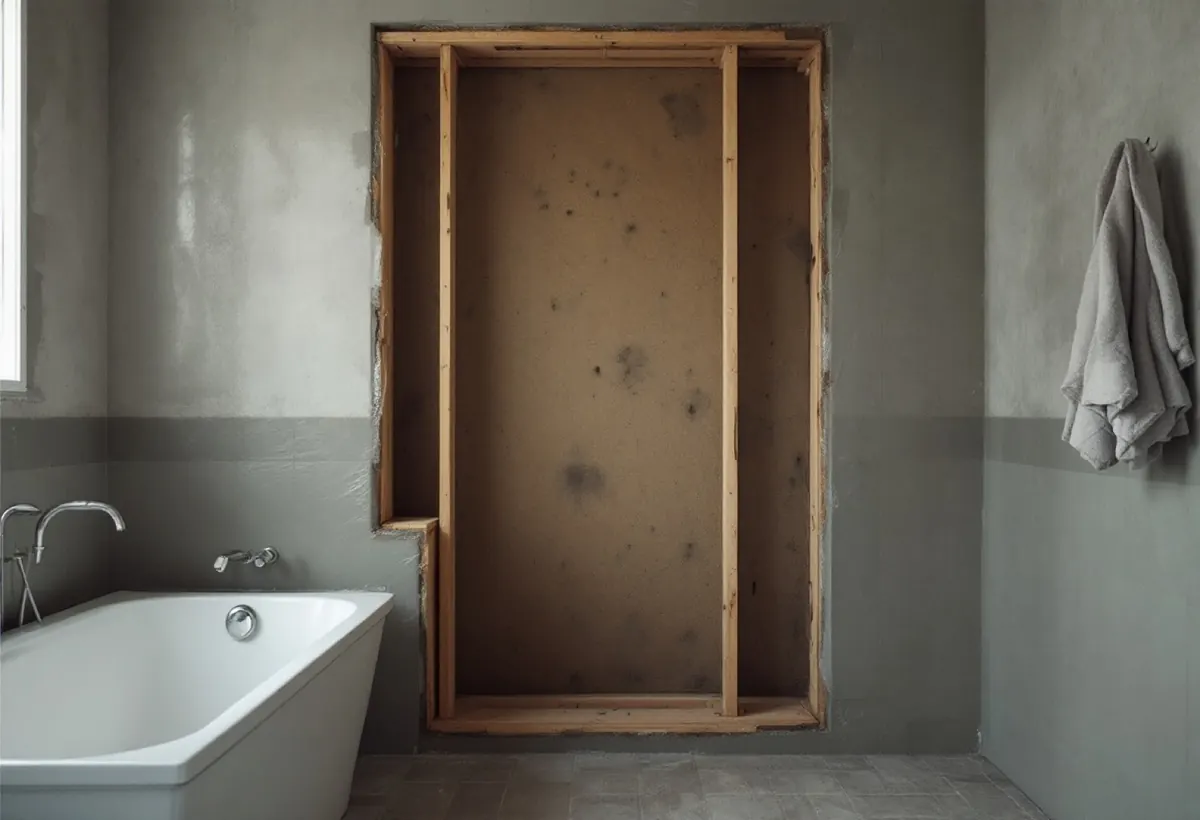
A borescope is an optical probe inserted through a small hole drilled into a wall that lets an investigator inspect a small portion of the wall without extensive damage, in the words of EPA’s EPA mold course, chapter 3. That definition holds the limit too: one hole shows one part of one stud bay.
- Drill where rungs 1 to 3 pointed: mid bay, low on the wall above the bottom plate or just below a sill corner, where the EPA examples place water.
- Look at the back of the drywall and the framing: EPA lists the back side of drywall first among hidden surfaces.
- Expect false results: Spurgeon’s 2025 slides class borescope imaging as qualitative only and prone to false results; paint on the back of drywall or wood may look like mold growth, per the EPA course.
EPA notes that personal protective equipment is not always needed when looking for mold but should always be available, and that investigators should use it if mold might be released into the air. A drilled hole in a moldy bay is that case.
Is a wall cavity air test worth it, and why can two tests of the same wall disagree 120 times over?
It can locate a contaminated bay, but it cannot say what you breathe. Spurgeon’s 2025 IAQ Radio wall cavity presentation quotes the AIHA book Recognition, Evaluation and Control of Indoor Mold (2008): wall cavity air samples should never be used in an attempt to determine exposure to occupants. Across 117 rooms in his data, cavity results and room air results correlated at 0.07.
Method moves the number more than the mold does. According to the slides, on the same test wall a WallChek probe read 94 spores per cubic metre with the cavity left still and 11,317 when the cavity air was disturbed, a ratio the slide prints as 120. Per the same slide, an Allergenco-D cassette went from 11 to 25,183, a printed ratio of 2,290.
Government guidance is cooler still. The U.S. Army Technical Guide 278 says air sampling should never be part of a routine assessment, that air methods for some molds are prone to false negatives, and that when mold is suspected behind walls a better approach may be IR cameras, borescopes or removing drywall. The CDC mold page says CDC does not recommend mold testing and that there are no set standards for an acceptable quantity of mold in a home. EPA adds that no EPA or other federal limits exist for mold or spores, per the EPA homeowner mold guide.
If you do pay for one, ask the inspector three things the slides raise: was the cavity sampled still or disturbed, was an outdoor sample taken at the same time (the Army guide calls for one), and which bay and why. Lab test types are compared on the mold testing page.
When is opening the wall the only answer, and how big an opening needs containment?
When the lower rungs disagree, or a meter stays high after the leak is fixed. EPA’s EPA remediation guide, chapter 3 is direct about the risk: removal of wallpaper can lead to a massive release of spores from mold growing underneath, and if hidden mold turns up the plan should be revised to the total affected area.
| Affected area | EPA containment | What it involves |
|---|---|---|
| Under 10 sq ft | Below EPA’s limited containment range | Professional judgment; EPA says heavy growth in a small area can release more spores than light growth in a large one |
| 10 to 100 sq ft | Limited | Single layer of 6 mil fire retardant polyethylene, slit entry with flap, negative pressure |
| Over 100 sq ft | Full | Double polyethylene layers, decontamination chamber or airlock, negative pressure |
Two practical consequences follow. First, a NIOSH score of 3, anything over 17.8 sq ft, already sits above EPA’s 10 sq ft line, so a stain that size calls for limited containment before the first cut. Second, EPA says to maintain negative pressure with a HEPA filtered fan unit exhausted outdoors and to double bag debris in 6 mil polyethylene. Do not aim a fan at an open moldy bay.
How remediation scales by size is set out on the mold remediation levels page. The broader topic sits in the mold hub.
Out of scope: this page covers finding hidden mold, not health effects. For those, start with the CDC mold page and the EPA homeowner mold guide.
Questions people actually ask
How fast can mold start behind a wall after a leak?
EPA says that if wet or damp materials are dried within 24 to 48 hours after a leak or spill, in most cases mold will not grow. Inside a wall, EPA 402-F-13053 warns that wet porous insulation takes a long time to dry or may never dry, so a leak found days later should be treated as possible growth and checked with a meter and, if wet, a borescope.
Can a home mold test kit tell me if mold is behind my walls?
Not reliably. A settle plate or room air kit samples the room, and a 2025 industrial hygiene presentation found cavity and room air results correlated at only 0.07 across 117 rooms. CDC does not recommend mold testing and notes there are no set standards for acceptable mold levels in a home.
Can I just paint over a stain on the wall?
No. EPA says do not paint or caulk moldy surfaces, and that paint applied over moldy surfaces is likely to peel. Stains and peeling paint are both NIOSH damage signs, so painting hides the evidence. Find and fix the water source, confirm the board is dry with a meter, and remove growth before any primer goes on.
How do I get rid of mold behind drywall?
Fix the water source, then remove the affected board rather than spraying through holes. EPA says porous materials with mold growing on them may have to be discarded because mold fills their crevices, and it recommends limited containment from 10 sq ft. Debris goes out double bagged in 6 mil polyethylene, followed by HEPA vacuuming.
Is mold behind drywall dangerous to leave alone?
For the building, EPA says yes over time: in a long term leak, molds can weaken floors and walls as they feed on wet wood, and a structural engineer should be consulted if integrity is in doubt. For effects on people, see the EPA and CDC guidance linked in the out of scope note above.
Sources
- EPA homeowner mold guide, A Brief Guide to Mold, Moisture and Your Home, U.S. Environmental Protection Agency. Retrieved 20 November 2026.
- EPA remediation guide, chapter 3, Mold Remediation in Schools and Commercial Buildings (EPA 402-K-01-001), hidden mold, containment and sampling. Retrieved 20 November 2026.
- EPA mold course, chapter 3, Mold Course Chapter 3, building investigation, borescopes and moisture meters, U.S. EPA. Retrieved 20 November 2026.
- EPA moisture control guidance, Moisture Control Guidance for Building Design, Construction and Maintenance, EPA 402-F-13053, December 2013. Retrieved 20 November 2026.
- NIOSH Dampness and Mold Assessment Tool, Dampness and Mold Assessment Tool for School Buildings, Form and Instructions, NIOSH publication 2019-114, 2018. Retrieved 20 November 2026.
- U.S. Army Technical Guide 278, Mold Assessment Guide, Technical Guide 278, U.S. Army Public Health Center, October 2018. Retrieved 20 November 2026.
- CDC mold page, Mold: home testing, Centers for Disease Control and Prevention. Retrieved 20 November 2026.
- Klein Tools ET140 product page, ET140 pinless moisture meter specifications, Klein Tools. Retrieved 20 November 2026.
- Extech MO265 product page, MO265 pin and pinless moisture meter, Extech (Teledyne FLIR). Retrieved 20 November 2026.
- Lignomat drywall note, Measuring Drywall with Pinless Meters, Lignomat USA. Retrieved 20 November 2026.
- Restoration and Remediation magazine, Thermal Imaging: It’s Cold, Not Wet!, Mitch Byrom, Restoration and Remediation, 21 March 2018. Retrieved 20 November 2026.
- IAQ Radio wall cavity presentation, Wall Cavity Sampling Strategies, Joe Spurgeon, IAQ Radio episode 762, 12 September 2025, quoting AIHA Recognition, Evaluation and Control of Indoor Mold (2008), section 10.2.3. Retrieved 20 November 2026.
- CPSC electrical safety page, U.S. Consumer Product Safety Commission. Retrieved 20 November 2026.
- Square inch and square foot conversions of the NIOSH size bands are arithmetic on the dimensions NIOSH prints, computed when this page was built. Our methodology sets out the standing rules.
This page describes how hidden mold is found, from published agency guidance and maker specifications. It is not an inspection of any building.