The short answer
Can mold grow on glass? Not on the glass itself, but yes on the film that sits on it. MIL-STD-1250A lists glass as funginert in all grades, so mold on a window, shower door, lens or jar feeds on dust, soap scum, skin oil or drink residue and condensation. Wash the glass with detergent and water, then check the frame, gasket and sill.
If MIL-STD-1250A calls glass funginert, what is the mold on it eating?
Table VIII of MIL-STD-1250A, the Department of Defense standard for keeping fungi out of electronic assemblies, puts glass in the column of materials that are funginert in all grades and conditions, alongside ceramics, mica and metals. Section 5.11.2 adds the catch: glass and ceramics are not funginutrient themselves, but the coatings used on optics often support fungal growth, so the standard asks for surfaces that are smooth, clean and unbroken.
Bowdoin College's housing mold guidance says the same thing in plain words for dorm rooms: mold seen on plastic, vinyl, glass or metal is growing on an accumulated organic layer of dust, dirt, soap scum, food or drink residue. On a window that layer is cooking grease and dust; on a shower door it is soap; on a camera lens it is the oil from a fingerprint.
The optics literature is the clearest test case, because a lens is nothing but polished glass. Rod Watkins in the Community Eye Health Journal (2003) cites ISO 9022-11:1994, the International Organization for Standardization mould growth test for optics, as stating that moulds cannot grow on the glass surfaces of lenses, prisms, mirrors or filters without another nutrient such as textile fibres, dust, grease, fingerprints or varnish. The growth usually starts at the edge, where the lens meets its mounting cell.
The practical result is the reverse of the rule for drywall. EPA's A Brief Guide to Mold, Moisture and Your Home tells owners to scrub mold off hard surfaces with detergent and water and dry them completely, while absorbent materials such as ceiling tiles and carpet may have to be thrown away. So the pane is almost never the loss; the paper, wood or fabric touching it can be.
Why does window mold start at the bottom edge and corners, not in the middle of the pane?
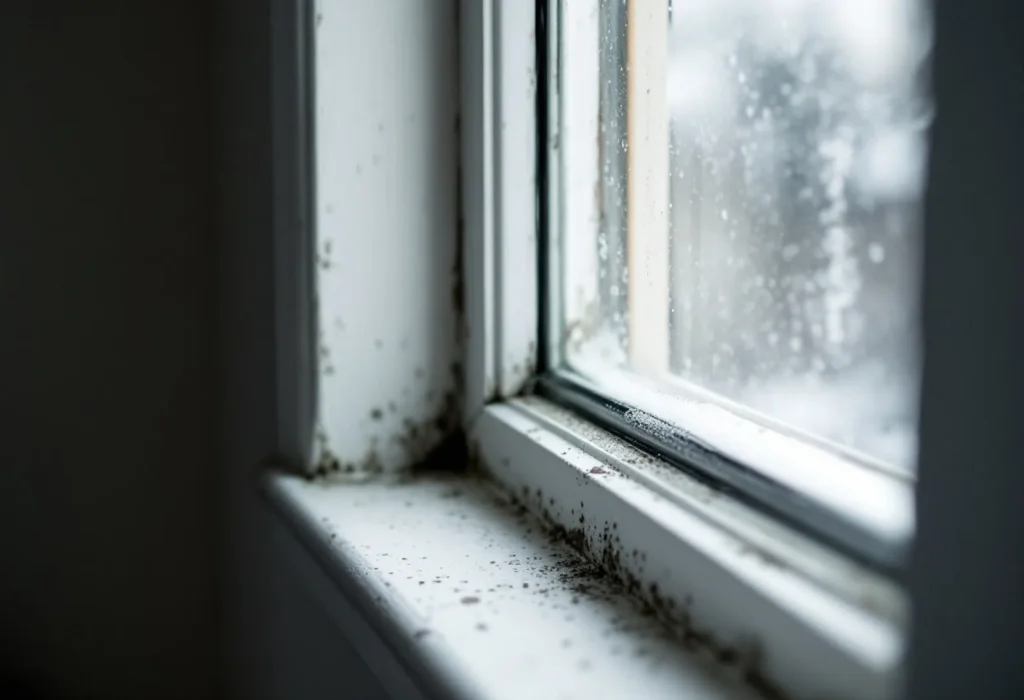
Because those are the coldest inside surfaces. a 1974 University of Minnesota Agricultural Extension fact sheet by H. A. Cloud and D. W. Bates says the first visible condensation on a window appears along the lower edge or in the lower corners, since condensation forms on surfaces cooled below the dew point of the inside air. The water then runs down onto the glazing bead, gasket and sill, which is where dust collects.
Newer windows move the cold spot but keep it at the perimeter. a University of Utah window condensation study ran almost 600 THERM heat transfer simulations of 11 window systems. In frames with little or no thermal break, condensation began along the interior edges of the frame; in frames with wider thermal breaks it always began along the interior edge of glass, which the authors call the weakest link. A warm edge spacer reduced condensation potential compared with an aluminum spacer.
So the mold line on a window is a frame problem more than a glass problem: the sash, gasket and sill hold water and dust. Cleaning the sill and track is covered in mold on window sills. Aluminum frames and the dew point math behind sweating metal are on can mold grow on metal, and gaskets and sealants as materials are on can mold grow on plastic.

How humid can a room be at 0 F outdoors before double windows fog?
Lower than most people expect. According to a 1974 University of Minnesota Agricultural Extension fact sheet, the inside the inside relative humidity that homes with double windows can usually hold without window condensation is 35 to 40% at 20 F outdoors, 30 to 35% at 10 F, 25 to 30% at 0 F, 20 to 25% at minus 10 F and 15 to 20% at minus 20 F. The fact sheet adds that regardless of what a gauge says, window condensation is the measure of a tolerable moisture level.
A newer source sets the line higher. North Dakota State University Extension reports (2011) that with a double pane window at 40% indoor relative humidity, condensation should begin when the outdoor temperature dips below zero, and that triple glazed windows should stay clear until about 40 below zero F.
Published thresholds differ by source and conditions, so we show them side by side rather than averaging. According to Table I of NRC Canada's Canadian Building Digest CBD-4 gives about 41% for double glass at 0 F outdoors, assuming a 70 F room, a 15 mph wind and no sun, against 25 to 30% in the Minnesota table; glass and spacer type, wind, room temperature and air movement over the pane all shift the number. That calculation is worked through on does mold grow in winter.
Both numbers sit inside EPA's A Brief Guide to Mold, Moisture and Your Home, which says to keep indoor humidity below 60% and ideally between 30 and 50%, and notes that a humidity meter costs about $10 to $50. The humidity thresholds for growth on other surfaces are worked through in what humidity does mold grow.
Seven kinds of household glass: what feeds the growth, where the water comes from, how to clean it
Our compilation of the sources in the last column separates the glass, which per MIL-STD-1250A is never the food, from the material touching it, which sometimes has to go.
| Glass situation | What feeds the growth | Where the water comes from | How to clean it | Source |
|---|---|---|---|---|
| Inside face of a window pane | Dust, cooking grease, fingerprints | Condensation when the pane drops below the room’s dew point; lower edge first | Detergent and water, then dry. The pane is not discarded | MIL-STD-1250A Table VIII; Bowdoin; EPA brief guide; UMN 1974 |
| Gasket, glazing bead, sill and sash | Dust in the track, paint film, bare wood | Condensate running off the glass and pooling | Hard parts: damp wipe. Moldy wood: EPA adds Method 4, discard, for wood in the 10 to 100 sq ft class | EPA Chapter 3 Method 2; EPA Chapter 5 cleanup table |
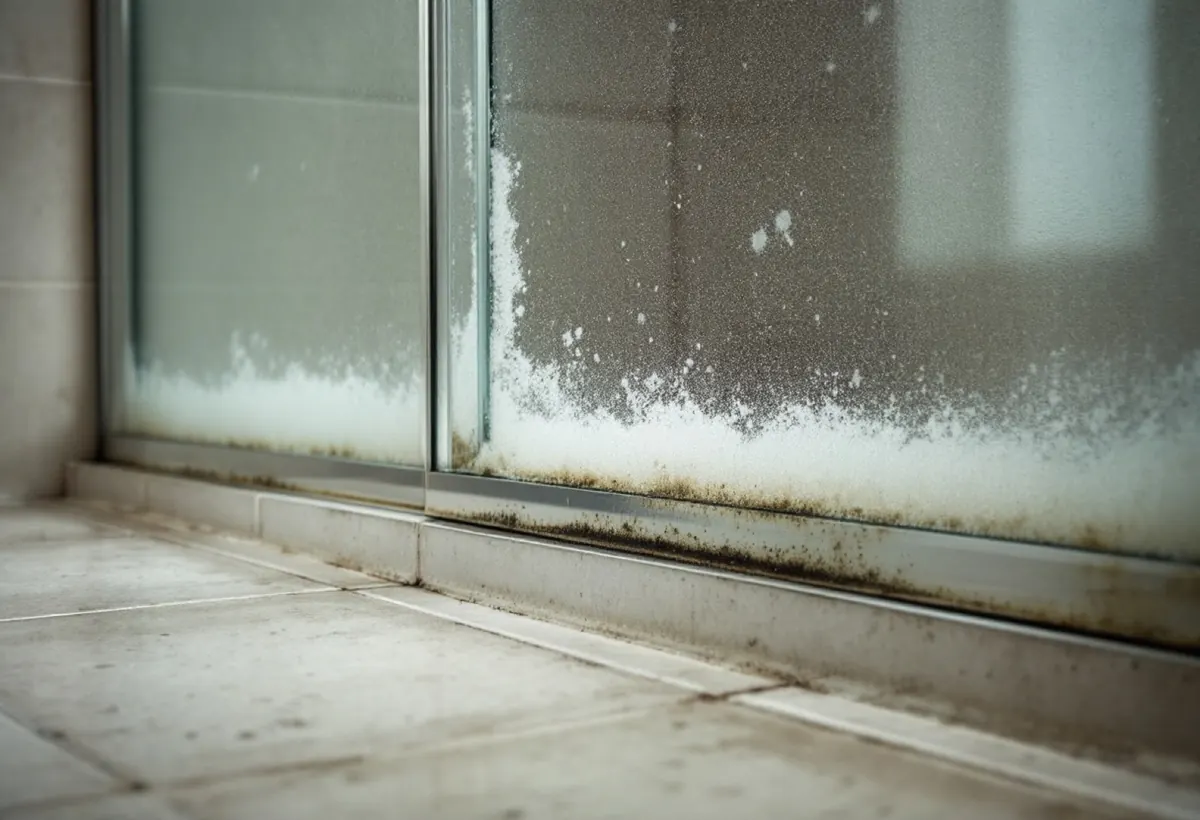
| Glass shower door | Soap scum and body oils | Daily shower water and steam | Scrub with detergent, run the fan or open a window, clean more often | Bowdoin; EPA brief guide bathroom tip |
| Camera, binocular or microscope lens | Fingerprint grease, lint, dust, varnish in the mounting cell, some lens coatings | Storage above about 65% RH; 70% for more than 3 days triggers germination | Outer surfaces: lens cloth and cleaning fluid. Internal elements: maker’s service. Etching is permanent | ISO 9022-11 via Watkins 2003; Cordero 2013; MIL-STD-1250A 5.11.2 |
| Picture frame glass | The photograph, mat or paper behind it | Humid air trapped where an unmatted print touches the glass | Clean the glass; a print stuck to it goes to a photograph conservator | Library of Congress FAQ; Canadian Conservation Institute |
| Drinking glass, jar or bottle | Drink or food residue left inside | The liquid itself | Discard the contents, wash in hot soapy water, dry. Glass is nonporous | Bowdoin; MIL-STD-1250A Table VIII; EPA brief guide |
| Old bottles or glass sheets with a white haze | Nothing: this is usually glass corrosion, not mold | Humidity leaching alkali out of the surface; sheets stored face to face | Not a mold cleanup; ask a conservator about valuable pieces | Western Australian Museum conservation manual |
Can fungus permanently etch a camera or binocular lens?
Yes, and lenses are the one place where mold on glass destroys the glass. Rod Watkins in the Community Eye Health Journal (2003) explains that a growing mould network produces organic acids that etch minute grooves into the glass surface, leaving a print of the network, and that anti reflection coatings are etched along with the glass. Section 5.11 of MIL-STD-1250A lists etched optics among the damage that fungus resistant design exists to prevent.
Watkins reports a preferred growth range of 20 to 30 C with relative humidity above 90%, says spores take only a few days to germinate and a few weeks to grow extensively, and recommends storage below 65% relative humidity. According to clinical engineer Ismael Cordero in the same journal (2013), the germination conditions are at least 70% relative humidity for more than 3 days, little or no airflow, darkness and nutrients such as lint, grease, varnish and dust.
For storage, both authors favor a sealed container with silica gel that is checked and replaced, and Cordero warns against leather, textile or wood cases and against plastic drape covers in humid rooms, since they hold moisture. Replaceable fungicidal pellets from instrument makers last about 3 years, according to both articles.
On cleaning, Watkins notes that mould has no roots on the glass and wipes away, but warns that acetone can damage anti reflection coatings, paint and plastics, and that facial tissue scratches. Cordero’s protocol for instruments uses an optical fungicide spread with a 5 ml syringe, left for about 1 hour, and says not to take apart multi element lenses but to send them to the maker’s qualified service. Ask the shop whether the fungus is on an outer or internal element and whether the coating is already etched, since etching does not clean off.
Is the white haze on old bottles and stored glass mold, or corrosion of the glass?
Usually corrosion. Guides online sometimes call it glass mold, but the mechanism is chemical, not fungal. the Western Australian Museum's conservation manual describes the reaction of glass with water as water molecules diffusing inward and hydroxyl ions migrating out with the alkali, quoting Newton (1989), which leaves an alkali depleted surface layer that shrinks. When the glass dries, the surface can turn opaque or iridescent and shed thin flakes.
The same manual warns that flat glass sheets stored face to face in a humid environment trap moisture that quickly forms a leaching solution and attacks the glass, and that carbon dioxide and sulphur dioxide combine with moisture to build calcite (CaCO3) and gypsum (CaSO4) crusts on old window glass.
Telling the two apart is practical. Mold sits on the surface as a fuzzy or spotted film that a damp cloth lifts, per EPA Chapter 3’s damp wipe method; corrosion haze is in the glass and does not wipe off. Stains under a fungal network on a lens are the exception, since Watkins shows those are etched in. For an antique bottle or stained glass panel, ask a conservator whether the haze is stable before washing. For glass recovered from the sea, the Western Australian Museum warns that salts crystallise and flake the surface if it dries before it is thoroughly washed.
How fast can mold grow on glass after condensation or a spill: 24 hours or weeks?
Plan on the 24 to 48 hour window. EPA's A Brief Guide to Mold, Moisture and Your Home says wet or damp materials dried within 24 to 48 hours of a leak or spill will in most cases not grow mold. That clock applies to the dust on the sill and the paper behind a frame, not to the glass, which has nothing to grow on until a film builds up.
On clean optical glass the timeline is slower and drier conditions are enough to stop it: according to Rod Watkins in the Community Eye Health Journal (2003), it takes a few days for spores to germinate and a few weeks for extensive growth, and clinical engineer Ismael Cordero in the same journal (2013) sets the trigger at 70% relative humidity held for more than 3 days. A window that fogs every night and dries by noon rarely meets that bar on the pane; the sill, which stays wet longer, does.
Wipe the pane, treat the frame: what EPA says about each and when bleach fits
Method 2 in Chapter 3 of EPA's school and commercial building remediation guide is the damp wipe: mold can generally be removed from nonporous hard surfaces by wiping or scrubbing with water, or water and detergent, followed by quick and thorough drying. the cleanup table in Chapter 5 of the same EPA guide lists that method for non porous hard surfaces in both the under 10 square foot and the 10 to 100 square foot size classes. Glass falls in that group.
Bleach is optional, not the default. EPA's A Brief Guide to Mold, Moisture and Your Home says a biocide such as chlorine bleach is not recommended as a routine practice during mold cleanup, that a background level of spores will remain, and that those spores will not grow if the moisture problem is fixed. If bleach is used, EPA says never to mix it with cleaners that contain ammonia and to ventilate to the outdoors. Vinegar and other home treatments are compared in does vinegar kill mold.
Size decides who does the job. EPA’s brief guide says patches under about 10 square feet, roughly 3 feet by 3 feet, can in most cases be handled by the owner. Mold spreading from the sills into the drywall below is a wall question, not a glass question: ask an assessor to meter the wall under the sill and name the affected material in writing.
Photos are the special case. the Library of Congress preservation FAQ says photographs stuck to glass are difficult and often impossible to remove without serious damage and should go to a photograph conservator, and that frames should keep the print off the glazing with a window mat or spacers. the Canadian Conservation Institute warns that unmatted photos can stick permanently to frame glass, especially when the glass is sprayed with liquid cleaners. Salvage steps for wet prints are in how to dry wet photos.
Out of scope: health effects of mold exposure are not covered here. EPA’s mold pages and the CDC address them.
Questions people actually ask
What does mold on glass look like?
On a window it is usually a line of black, grey or green specks along the bottom edge, the gasket and the sill, where the University of Minnesota fact sheet says condensation shows first. On a lens it is a cobweb network spreading in from the edge, as pictured in the 2003 Community Eye Health Journal article. A uniform white haze that will not wipe off is more often glass corrosion.
Should you throw away a glass with mold in it?
No, throw away the contents, not the glass. MIL-STD-1250A Table VIII lists glass as funginert in all grades, and EPA’s brief guide says to scrub mold off hard surfaces with detergent and water and dry them. Washing in hot soapy water removes the drink residue the mold was living on. A cracked or chipped glass is a different call, since a broken surface holds residue.
What surfaces will mold not grow on?
None that stay dirty and damp. MIL-STD-1250A Table VIII lists glass, ceramics, mica and metals as funginert in all grades, meaning they are not fungal food, yet Bowdoin College notes that mold still grows on dust, soap scum and drink residue on those surfaces. Clean, dry glass held below EPA’s 60% humidity ceiling is the closest thing to a mold proof surface in a house.
Will vinegar kill mold on glass permanently?
No cleaner is permanent on glass, because the mold returns whenever a new film and new condensation do. EPA’s brief guide says a background level of spores always remains and will not grow if the moisture problem is fixed, which on a window means keeping winter humidity near the 25 to 30% the 1974 Minnesota table gives for double windows at 0 F.
Can mold grow on a glass table or glass door?
Yes, on the spills, dust and fingerprints on top, but rarely, because a table or interior door is not usually colder than the room and does not collect condensation the way a window does. Bowdoin College’s guidance traces mold on glass to food or drink residue and dust, and EPA Chapter 3’s damp wipe with water and detergent removes it.
Sources
- MIL-STD-1250A: Corrosion Prevention and Deterioration Control in Electronic Components and Assemblies, US Department of Defense, sections 5.11, 5.11.1, 5.11.2 and Table VIII (Funginert materials), as reproduced by eMilSpec. Retrieved 20 November 2026.
- Bowdoin College's housing mold guidance: Mold, Residential Life, Bowdoin College. Retrieved 20 November 2026.
- EPA's A Brief Guide to Mold, Moisture and Your Home, US EPA, last updated 18 February 2026. Retrieved 20 November 2026.
- Chapter 3 of EPA's school and commercial building remediation guide: Mold Remediation in Schools and Commercial Buildings Guide, Chapter 3, US EPA, last updated 29 April 2026. Retrieved 20 November 2026.
- the cleanup table in Chapter 5 of the same EPA guide: Mold Remediation in Schools and Commercial Buildings Guide, Chapter 5, US EPA, last updated 14 April 2026. Retrieved 20 November 2026.
- Rod Watkins in the Community Eye Health Journal (2003): Mould in optical instruments, Community Eye Health Journal vol. 16 no. 46, pp. 28 to 29, International Centre for Eye Health, citing ISO 9022-11:1994. Retrieved 20 November 2026.
- clinical engineer Ismael Cordero in the same journal (2013): Fungus: how to prevent growth and remove it from optical instruments, Community Eye Health Journal vol. 26 no. 83, p. 57, published 18 November 2013. Retrieved 20 November 2026.
- a 1974 University of Minnesota Agricultural Extension fact sheet: H. A. Cloud and D. W. Bates, Controlling Household Humidity, Agricultural Engineering Fact Sheet No. 19, University of Minnesota, 1974, Table 1, via the University of Minnesota Digital Conservancy. Retrieved 20 November 2026.
- North Dakota State University Extension: Window Condensation Common Problem, news release, 10 January 2011. Retrieved 20 November 2026.
- a University of Utah window condensation study: Aksamija, Milosevic, Sanders and Blakeslee, Condensation Study of Windows, Facade World Congress 2022, summary on the University of Utah TP3C site. Retrieved 20 November 2026.
- the Western Australian Museum's conservation manual: Glass, Deterioration, Western Australian Museum conservation manual. Retrieved 20 November 2026.
- NRC Canada's Canadian Building Digest CBD-4: Condensation on Inside Window Surfaces, National Research Council of Canada, Table I, as mirrored at MIT. Retrieved 20 November 2026.
- the Library of Congress preservation FAQ: Preservation FAQ, Photographs, Library of Congress. Retrieved 20 November 2026.
- the Canadian Conservation Institute: Basic care: photographic materials, Canadian Conservation Institute, Government of Canada. Retrieved 20 November 2026.
- How this page was built is described in our methodology, and more mold pages are on the mold hub.
MIL-STD-1250A and ISO 9022-11 describe materials and instruments under defined conditions; they do not promise that a window or lens in a home stays clean. For a valuable lens, photograph or antique glass, ask the maker’s service center or a conservator whether the damage is on the surface or etched into it before anyone cleans it.