The short answer
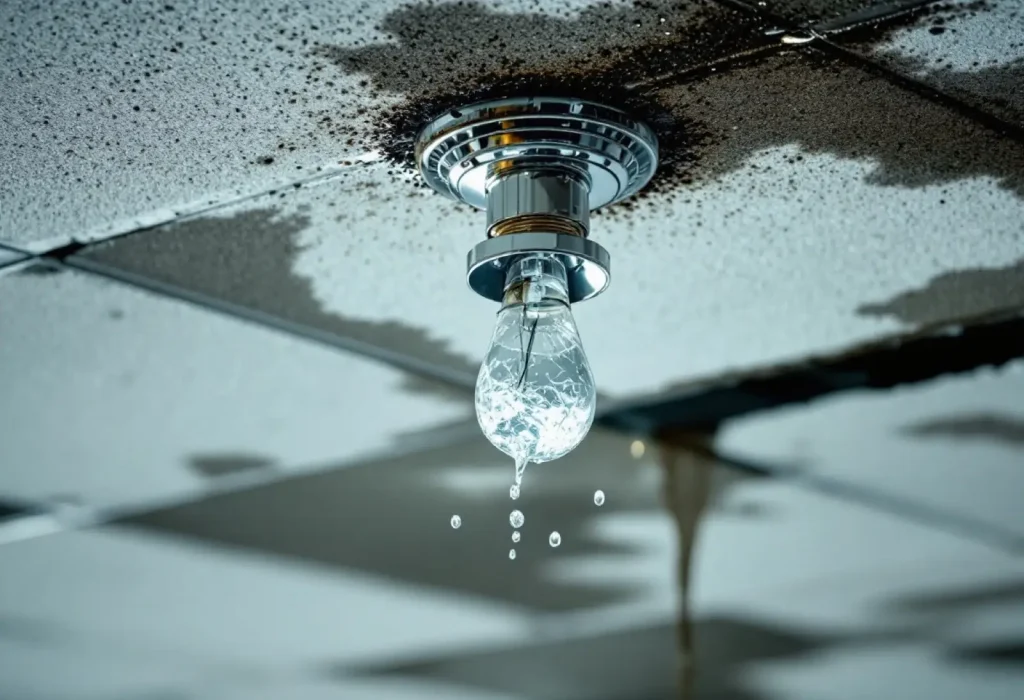
Fire sprinkler water damage usually comes from one head: a standard K5.6 sprinkler at its 7 psi minimum releases about 14.8 gallons a minute, roughly 148 gallons in 10 minutes, and it keeps flowing until someone closes the valve. NFPA reports that only one sprinkler operated in 85 percent of home fires where sprinklers activated.
How many gallons per minute does one K5.6 sprinkler head release?
A sprinkler’s flow follows one line of arithmetic. The K-factor, according to US Patent 9744390 B2, assigned to Tyco Fire Products, is the flow in gallons per minute divided by the square root of the pressure in psi, so flow Q equals K times the square root of P. The Viking VK300 data sheet lists a nominal K-factor of 5.6 and says cULus Listing, FM Approval and NFPA 13 installs require a minimum of 7 psi. Plugging those in: 5.6 times the square root of 7 is 14.8 gallons per minute.
Pressure raises flow more slowly than people expect. At 28 psi, four times the 7 psi minimum, the same K5.6 head delivers 29.6 gallons per minute: double, not quadruple. The VK300 is rated for 175 psi working pressure, so a system running well above its minimum will push more than the floor figure used in the table below. Treat 14.8 gpm as the lower bound for a standard head, not a typical value.
Reliable Bulletin 026 (August 2021) lists the same 5.6 nominal K-factor for its F1FR56 upright and pendent heads, which is why 5.6 is the reference value here. Residential and storage heads use other K-factors; the formula holds, the K changes.
Gallons released by heads open and minutes flowing
No ranking page puts a number on the water, so the table below does it. Each cell is 14.8 gpm times heads times minutes, at the 7 psi floor. 29 CFR 1910.159 requires a water supply able to provide design flow for at least 30 minutes, so a single head left running for that half hour puts down about 444 gallons.
| Time flowing | 1 head (gal) | 2 heads (gal) | 4 heads (gal) |
|---|---|---|---|
| 1 minute | 15 | 30 | 59 |
| 5 minutes | 74 | 148 | 296 |
| 10 minutes | 148 | 296 | 593 |
| 20 minutes | 296 | 593 | 1,185 |
| 30 minutes | 444 | 889 | 1,778 |
| 60 minutes | 889 | 1,778 | 3,556 |
Read the table by the clock, not the head count. The difference between a 10 minute and a 60 minute shut-off on one head is 741 gallons, more than adding a second head for 10 minutes. The valve is the variable that the building owner and the fire department control.
The NPS figure works out to 28 gallons a minute for a whole home system, about two heads’ worth at the 7 psi floor. Per the NPS data, the fire department average of 3,524 gallons equals about 238 minutes of one K5.6 head, and the NPS article credits the figures to research by FM Global and the Home Fire Sprinkler Coalition.
Why does only the head over the fire open, and at what temperature?
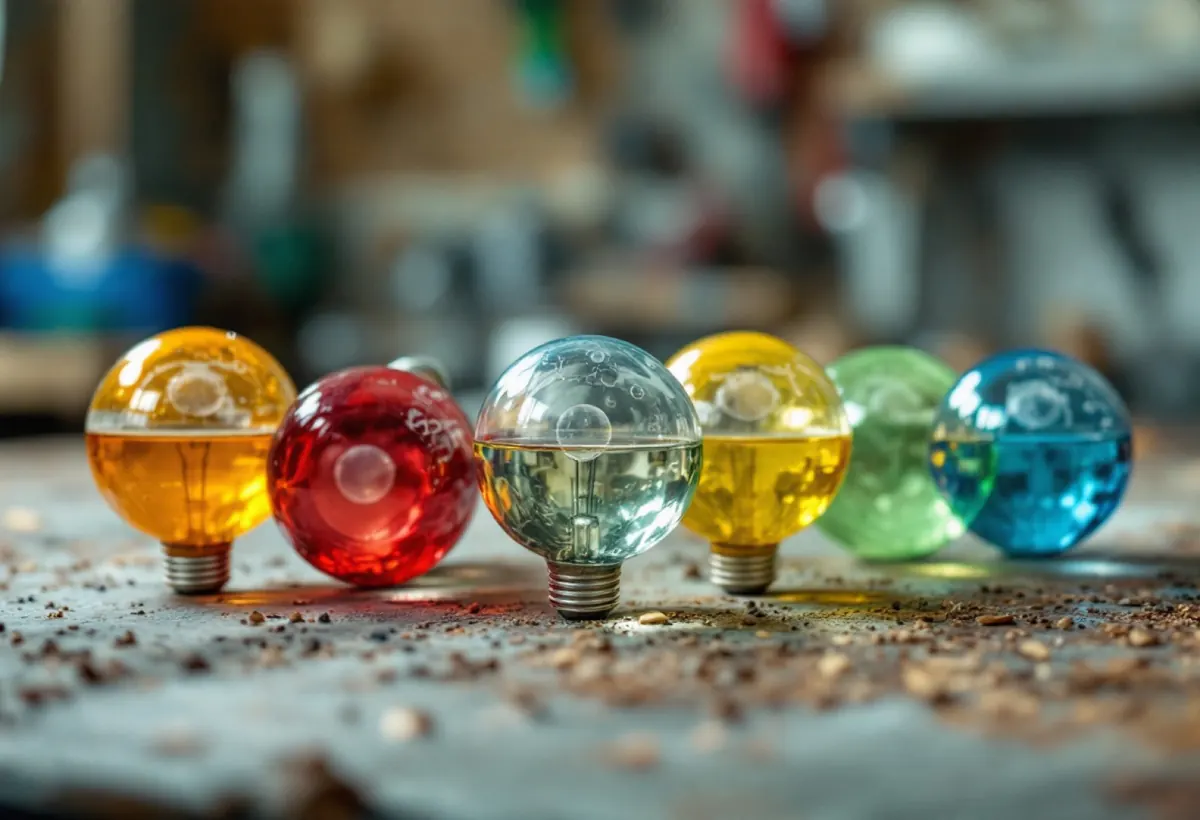
Each head is its own thermostat. The Viking VK300 data sheet describes the mechanism: heat expands the liquid in a 3 mm glass bulb until the glass shatters and releases the seal, and only that head flows. The NFPA home fire sprinkler fact sheet (June 2024) says sprinklers operate independently, typically only the one closest to the fire, and that one sprinkler turned on in 85% of home fires where they activated, according to the NFPA report.
| Bulb colour | Class | Operates at | Max ceiling temp |
|---|---|---|---|
| Orange bulb | Ordinary | 135 F | 100 F |
| Red bulb | Ordinary | 155 F | 100 F |
| Yellow bulb | Intermediate | 175 F | 150 F |
| Green bulb | Intermediate | 200 F | 150 F |
| Blue bulb | High | 286 F | 225 F |
The gap between the two numbers is the margin against a false trip. An orange 135 F head is rated for ceilings up to 100 F, a 35 degree margin. The NFPA sheet says heads respond to heat, typically 135 F to 165 F in homes, and not to smoke, cooking vapours, steam or the sound of a smoke alarm.
What sets a sprinkler off when there is no fire?
Accidental discharge has short, documented causes. The NFPA home fire sprinkler fact sheet says leaks are rare and no more likely than leaks from a home’s plumbing; when they do happen, they trace to the rows below. The Viking VK300 data sheet care and handling bulletin says never to install heads that were dropped, damaged or exposed to temperatures above their maximum ambient rating.
| Cause | Typical trigger | Rule or source |
|---|---|---|
| Freezing in a wet system | Water in pipes through unheated space | NFPA 13D carries insulation guidance (NFPA home fire sprinkler fact sheet); OSHA requires piping protected against freezing |
| Water left in a dry system | Dry pipe not fully drained | 29 CFR 1910.159 requires dry systems arranged to be totally drained |
| Head struck or damaged | Forklifts, ladders, storage stacked high | OSHA (c)(8)(iii): protect from mechanical damage; keep 18 inches clear below |
| Heat near the rating | Heater, skylight or attic above max ambient | Viking: never install heads exposed above max ambient |
| Painted or coated head | Field paint on the bulb or deflector | Viking: field painted heads must be replaced per NFPA 13 |
| Pinhole leak in pipe | Corrosion, including MIC | Leaks after 5 to 20 years of service (Automatic Sprinkler Systems Handbook supplement on MIC) |
Freeze breaks are the cause insurers ask about first, because policy language turns on heat and water supply. Frozen pipe losses in general are tracked on our frozen pipe damage statistics page.
Is the water from sprinkler pipes clean, and what category is it?
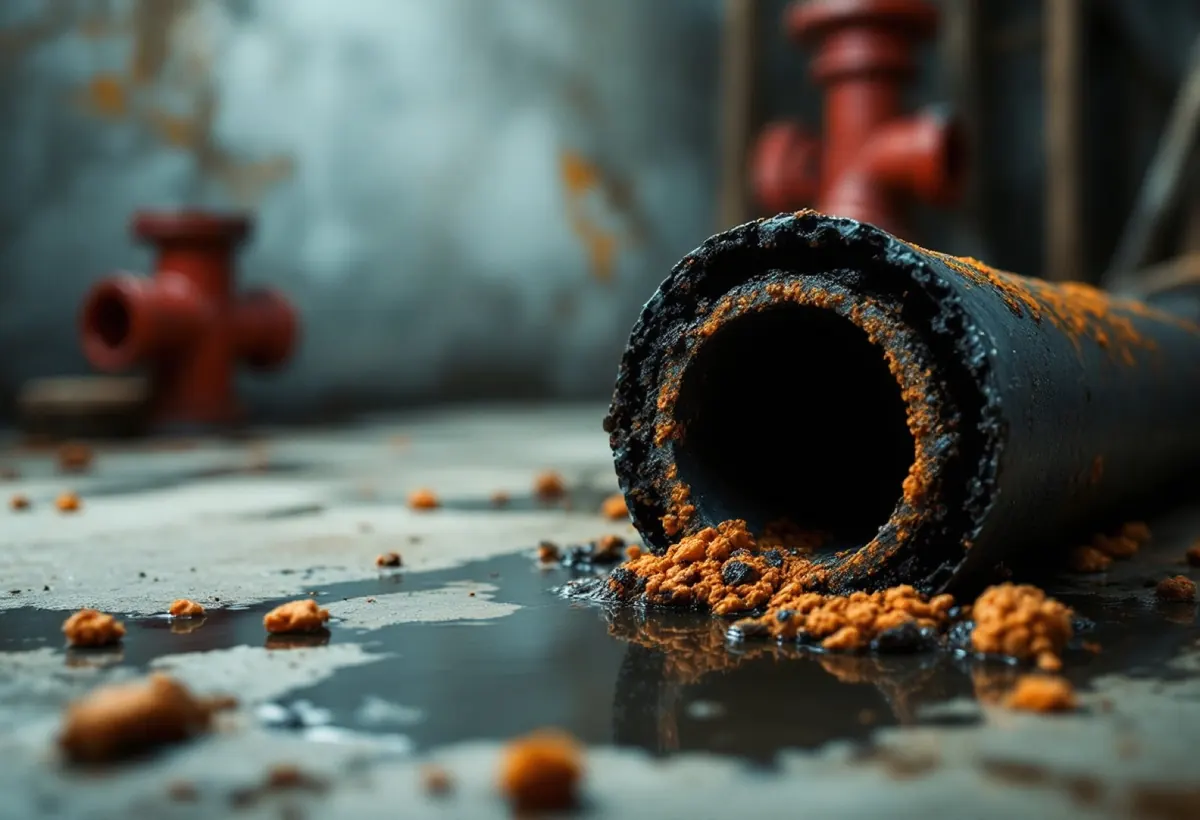
Sprinkler water is not tap water fresh from the main. It sits in steel pipe for years. The supplement on microbiologically influenced corrosion (MIC) in the 2007 Automatic Sprinkler Systems Handbook by Bruce H. Clarke and Anthony M. Aguilera describes pinhole leaks and obstructive biological growths inside pipes, and reports that in an FM study of 155 sprinkler leak cases from 1994 to 2000, MIC was present in about 40 percent. It names sulfate reducing bacteria, which convert sulfate to sulfide, among the groups involved (Automatic Sprinkler Systems Handbook supplement on MIC).
Restorers assign a water category under ANSI/IICRC S500, now in its 5th edition (2021). Category depends on contamination, not on the pipe the water came from, so sprinkler water that carried corrosion products and bacteria should be assessed rather than assumed clean. The three categories and what each requires are set out in IICRC water categories.
Is sprinkler water damage worse than a fire hose?
No, by the published numbers. According to the NFPA home fire sprinkler fact sheet, sprinklers use approximately 90% less water on a fire than a fire department hose line, and sprinkler water damage will typically be much less severe than damage from hose lines. Per the National Park Service fire prevention article figures, the ratio is 12.6 to 1: 3,524 gallons against 280.
The NPS article gives one real case. In 2012 at Minuteman National Historical Park, one head of the attic sprinkler system in the 300 year old Wayside House put out a fire 8 feet away, leaving a 5 foot by 4 foot section of damaged roof and minimal water damage. The comparison that matters after a fire is sprinkler water against the fire that kept growing without it; the fire side is covered on our fire damage page.
What to do in the first hour after a sprinkler discharge
- Close the system control valve, or have the fire department or the fire protection contractor close it. Every minute is about 15 gallons per open head at the 7 psi floor.
- Do not touch or cap a head yourself. The Viking care bulletin says damaged heads must be destroyed, not reused.
- Ask who restores the system and when. Until the head is replaced and the valve reopened, the building has no sprinkler protection.
- Photograph the head, its colour and the ceiling before anything is moved. A blue head is rated to open at 286 F, so one that opened in a cool room did not open from room heat.
- Start drying within 24 to 48 hours, the window the EPA guide to mold and moisture gives to prevent mold growth.
A single head over 30 minutes means roughly 444 gallons spread across ceiling, walls and floor, which is a drying job for structural drying methods, not a mop. Offices, warehouses and retail floors with multiple heads are scoped as commercial water damage restoration. After a real fire, the order of steps is on what to do after a house fire.
What do commercial and homeowners policy forms say about sprinkler discharge?
Two ISO forms carry most of the wording. ISO form CP 10 30 06 07 is the commercial Causes of Loss Special Form; ISO form HO 00 03 10 00 is the Homeowners 3 Special Form, in the copy published by the Maine Bureau of Insurance. Insurers file their own editions, so the wording below is the ISO baseline, not any one policy.
| Form | What the wording says | Why it matters |
|---|---|---|
| Commercial, CP 10 30 06 07 | Freezing exclusion for plumbing and heating leaks says “except fire protective systems” | Water exclusion carves back loss from resulting sprinkler leakage |
| Commercial, CP 10 30 06 07 | “Leakage from fire-extinguishing equipment” is a specified cause of loss | Pays to repair damaged parts of fire extinguishing equipment when discharge or freezing damages them |
| Commercial, CP 10 30 06 07 | Excludes seepage or leakage over 14 days or more | Slow pinhole leaks are where this matters |
| Homeowners, HO 00 03 10 00 | Covers accidental discharge or overflow of water from an automatic fire protective sprinkler system | Excludes the system itself; covers tear out needed to repair it |
| Homeowners, HO 00 03 10 00 | Freezing exclusion lifts if heat is kept or water shut off and drained | With sprinklers, the owner must keep the water supply on and maintain heat |
The homeowners freeze clause is the trap. ISO form HO 00 03 10 00 lets an owner avoid the freezing exclusion by draining the plumbing, but a house with sprinklers must keep the water supply on and the heat maintained. Bring three questions to the agent or the state insurance department: which edition of the form is on the declarations page, whether a protective safeguards endorsement is attached, and whether the deductible differs for water. Claim timing is covered on how long a water damage claim takes.
More water pages sit in the water damage hub.
Questions people actually ask
Will sprinkler water damage go away on its own?
No. Water in drywall, insulation and carpet pad does not leave by itself fast enough. The EPA says water-damaged areas and items should be dried within 24 to 48 hours to prevent mold growth, and a single K5.6 head running 10 minutes puts down about 148 gallons, which soaks into cavities a fan in the room will not reach.
Are sprinkler systems a common cause of water damage?
Not compared with plumbing. The NFPA home fire sprinkler fact sheet (June 2024) states leaks are rare and no more likely than leaks from a home’s plumbing system. When accidental discharge happens, the documented causes are freezing, a struck or damaged head, heat above the head’s rated ceiling temperature, field paint, and corrosion pinholes.
Does smoke or burnt toast set off a fire sprinkler?
No. Per the NFPA fact sheet, home sprinklers respond to a significant heat change, typically 135 F to 165 F, and do not operate in response to smoke, cooking vapours, steam or the sound of a smoke alarm. An orange bulb head opens at 135 F according to the Viking VK300 temperature table.
How far must stored items stay from a sprinkler head?
OSHA’s sprinkler rule, 29 CFR 1910.159(c)(10), sets a minimum vertical clearance of 18 inches between sprinklers and material below, and the National Park Service gives the same 18 inch figure for homes. Hanging clothes, decorations or anything else from a head is also on the NPS list of things not to do.
Can I paint over a fire sprinkler head?
No. The Viking care and handling bulletin states that sprinklers painted in the field must be replaced per NFPA 13, and that heads should be protected from paint and overspray. The same bulletin says not to try removing drywall or paint from a head, so the fix is a new head, not cleaning.
Sources
- Viking VK300 data sheet, Viking Group, Microfast Quick Response Upright Sprinkler VK300 (K5.6), Form F_052114 Rev 02, June 2025, with care and handling bulletin F_091699. Retrieved 16 November 2026.
- Reliable Bulletin 026, Reliable Automatic Sprinkler Co., Model F1FR56-300 sprinklers, August 2021. Retrieved 16 November 2026.
- US Patent 9744390 B2, Dry sprinkler with a diverter seal assembly, Tyco Fire Products LP, via Google Patents: K-factor definition. Retrieved 16 November 2026.
- NFPA home fire sprinkler fact sheet, National Fire Protection Association, The Truth About Home Fire Sprinklers, June 2024. Retrieved 16 November 2026.
- National Park Service fire prevention article, U.S. National Park Service, Fire Prevention 52: Thinking Green with Fire Sprinklers. Retrieved 16 November 2026.
- 29 CFR 1910.159, Occupational Safety and Health Administration, Automatic sprinkler systems, via Cornell Legal Information Institute. Retrieved 16 November 2026.
- Automatic Sprinkler Systems Handbook supplement on MIC, Clarke and Aguilera, Supplement 3, 2007 Automatic Sprinkler Systems Handbook (NFPA), hosted by the City of Woodland. Retrieved 16 November 2026.
- ISO form CP 10 30 06 07, Insurance Services Office, Causes of Loss Special Form, copy hosted by the Independent Insurance Agents and Brokers of America. Retrieved 16 November 2026.
- ISO form HO 00 03 10 00, Insurance Services Office, Homeowners 3 Special Form, copy hosted by the Maine Bureau of Insurance. Retrieved 16 November 2026.
- EPA guide to mold and moisture, United States Environmental Protection Agency. Retrieved 16 November 2026.
- ANSI/IICRC S500, Institute of Inspection, Cleaning and Restoration Certification, S500 standard page. Retrieved 16 November 2026.
- The gallons table and chart are arithmetic on the K-factor formula and the published K5.6 and 7 psi values, computed when this page was built; no flow figure was estimated or invented. Our methodology sets out the standing rules.
Policy language is quoted from ISO baseline forms; your insurer’s edition and endorsements govern. Ask your agent, the policy and your state insurance department, not this page, what a claim will pay.