The short answer
Does tea tree oil kill mold? In the lab, yes: a 2006 review reports fungicidal doses of 0.5% to 2% oil for Penicillium and up to 8% for Aspergillus niger. Per the NIST conversion, a 1 teaspoon per cup spray is about 2%, the oil barely dissolves in water, and undiluted oil on pine was fully overgrown by week 10. Scrub, dry and fix the moisture instead.
How much tea tree oil kills Aspergillus, Penicillium and Cladosporium in a lab dish?
Between 0.06% and 8% oil by volume, according to published lab tables, depending on the mold. The largest data set is Hammer, Carson and Riley, 2002, which tested 106 dermatophytes and 78 other filamentous fungi and reports minimum inhibitory concentrations (MIC) of 0.004% to 0.25% and minimum fungicidal concentrations (MFC) from under 0.03% to 8%. The MIC stops growth while the oil is present; the MFC is the dose that leaves nothing alive to regrow, and it is the number that matters for a kill question.
| Mold genus | MIC, % oil (stops growth) | MFC, % oil (kills) |
|---|---|---|
| Aspergillus niger | 0.016 to 0.4 | 2 to 8% |
| Aspergillus flavus | 0.31 to 0.7 | 2 to 4% |
| Cladosporium spp. | 0.008 to 0.12 | 0.12 to 4% |
| Aspergillus fumigatus | 0.06 to over 2 | 1 to 2% |
| Penicillium spp. | 0.03 to 0.06 | 0.5 to 2% |
| Fusarium spp. | 0.008 to 0.25 | 0.25 to 2% |
| Alternaria spp. | 0.016 to 0.12 | 0.06 to 2% |
The outlier is Aspergillus niger. Carson, Hammer and Riley, Clinical Microbiology Reviews 2006 reports MFCs as high as 8% for it and explains why: the assays used conidia, which the authors call relatively impervious to chemical agents, and germinated conidia proved significantly more susceptible than dormant ones. That is the gap between lab and wall: dormant spores on a dry surface are the hardest target in the table.
No MFC for Stachybotrys, the mold usually called black mold, appears in Carson, Hammer and Riley, Clinical Microbiology Reviews 2006 or the Hammer, Carson and Riley, 2002 abstract, and no other measured value was found for this page. Any claim online that tea tree oil kills Stachybotrys at a household dilution is ahead of the published numbers read here.
Does a 1 or 2 teaspoon per cup spray reach the 2% to 8% kill line?
Guides online give recipes from 1 teaspoon of oil in 2 cups of water to 2 teaspoons in 1 cup, without stating the strength. Converted according to NIST's US customary to metric conversion table, 4.93 mL per teaspoon and 0.24 L per cup, those mixes land at about 1%, 2% and 3.9% oil. The table counts how many of the seven genus MFC ranges each mix reaches at the top end, meaning the dose that killed the toughest isolate tested.
| Recipe | Oil in water | Nominal strength | Genera whose top MFC it reaches |
|---|---|---|---|
| 1 tsp in 2 cups water | 4.93 mL in 480 mL | 1.02% | 0 of 7 |
| 1 tsp in 1 cup water | 4.93 mL in 240 mL | 2.01% | 4 of 7 |
| 2 tsp in 1 cup water | 9.86 mL in 240 mL | 3.95% | 4 of 7 |
| Undiluted oil, as in the lab disc and wood tests | n/a | 100% | 7 of 7 |
Per the table above, even the strongest recipe reaches only 4 of 7 genera at the top of their range, and Aspergillus niger’s 8% is about 2 times the 3.9% mix. The bigger catch is that the percentage is nominal. According to Table 2 of the same review, terpinen-4-ol, the main active component, dissolves in water to only 1,491 ppm, about 0.15%, and the review calls the whole oil only sparingly soluble in water. With a relative density of 0.885 to 0.906, per the review, the oil floats, so what leaves the nozzle swings between mostly water and mostly oil unless the bottle is shaken before every pass.
Carson, Hammer and Riley, Clinical Microbiology Reviews 2006 adds two packaging notes that bear on a home spray: the oil’s lipophilicity causes miscibility problems in water based products, and the oil is readily absorbed into plastics. Both point the same way: a premixed plastic bottle is the least predictable way to deliver a measured dose.
Why does undiluted tea tree oil win on agar but lose on pine by week 10?
Because a dish and a wall are different tests. According to Rogawansamy and colleagues, 2015, 20 microlitres of 100% oil went on a 9 mm paper disc on agar seeded with mold from indoor air, and after 7 days the clear zone measured 83 mm for Aspergillus fumigatus and 43.5 mm for Penicillium chrysogenum; as vapour the figures were 81 mm and 20.6 mm. The authors called it the most effective of the five agents. They also report sporulation on day 14 on every tea tree treated culture and say real building materials still needed testing. The full five agent comparison sits on our does vinegar kill mold page.
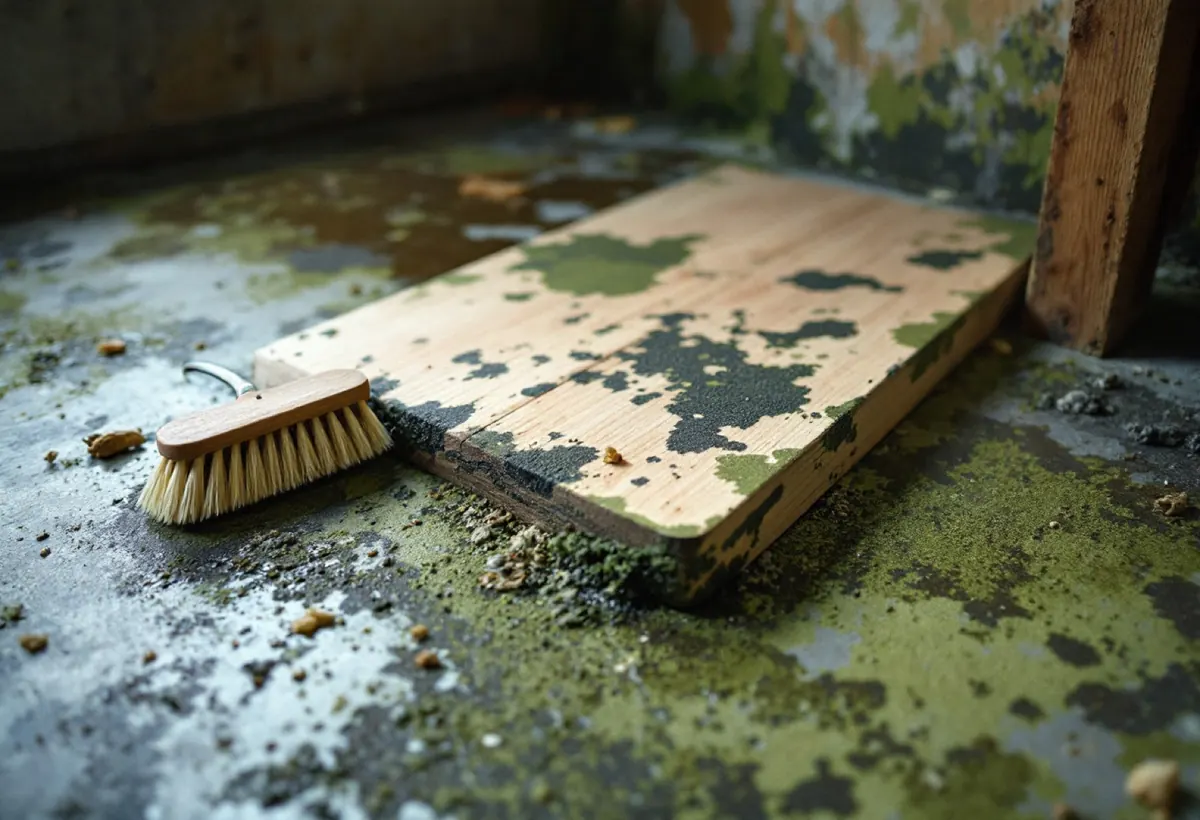
Wood is where a USDA Forest Service study by Yang and Clausen, 2007 picks up. Southern pine stakes were dipped 15 seconds in full strength oil, then inoculated with Aspergillus niger, Penicillium chrysogenum and Trichoderma viride. The report says tea tree stakes were about 80% covered with mold at week 6 and 100% at week 10. Thyme and geranium Egyptian oils held mold off for at least 20 weeks, and mixing thyme with tea tree made thyme less effective, per the authors.
One detail in that report runs the other way: tea tree oil diluted 1:2 showed no mold growth for 6 weeks, according to the USDA text, while full strength oil was mostly covered by then. The paper does not explain the difference, so neither reading supports a promise that a sprayed board stays clean. Wood cleanup steps are on our mold on wood page.
Does tea tree oil kill mold in minutes, or does it need 24 hours wet?
Closer to 24 hours, at the lab dose. Hammer, Carson and Riley, 2002 reports time kill experiments at 1 to 4 times the MFC in which three of four test organisms were still detected after 8 hours of treatment, but not after 24 hours. That is fungus held in liquid at a known strength for a full day, a condition a misted wall never meets.
A sprayed film evaporates, runs and soaks into the substrate. Carson, Hammer and Riley, Clinical Microbiology Reviews 2006 describes the oil as volatile, which is why packaging has to block volatilization, and the same property shortens how long a surface stays at any strength. Rewetting a small, nonporous item such as a plastic bin lid is the only home setup that comes near the 24 hour figure, and even then no dwell time for tea tree oil on any household surface appears in the sources read here.
Compare that with registered products, which must print a contact time on the label. Those dwell times, and the EPA registration numbers behind them, are on our mold killer page.
Can tea tree oil kill mold in drywall, carpet or concrete, or only on tile?
Only the surface you can wet, and on porous materials EPA says replacement may be the answer. EPA's Mold Cleanup in Your Home page states that absorbent or porous materials such as ceiling tiles and carpet may have to be thrown away if they become moldy, and that hard surfaces should be scrubbed with detergent and water and dried completely. It treats a patch under about 10 square feet, roughly 3 ft by 3 ft, as a job most people can handle themselves.
Painted drywall is the clearest mismatch. The lab MFCs in Carson, Hammer and Riley, Clinical Microbiology Reviews 2006 come from fungus suspended in or plated on the oil, while growth on drywall can sit in the paper and core behind the paint, out of reach of a surface mist. How to judge a wall, including when to cut it out, is on our mold on walls page.
Concrete and carpet add a third problem: neither dries fast. EPA's Brief Guide to mold sets a 24 to 48 hour window to dry wet materials, after which mold can grow, and a water based tea tree spray adds water to a surface that was already wet enough to grow mold.
Is tea tree oil on EPA’s minimum risk list, and why is clove oil there instead?
No. Table 1 of 40 CFR 152.25(f) lists the active ingredients allowed in minimum risk pesticides that are exempt from registration; clove oil (CAS 8000-34-8), thyme oil, rosemary oil, peppermint oil and cinnamon oil are on it, and tea tree oil is not, in the text as of 16 November 2026. EPA's list of minimum risk active ingredients describes that table as the full list of eligible active ingredients.
That matters for labels. Under 40 CFR 152.15, a product sold to prevent, destroy or mitigate a pest must be registered unless an exemption in 152.20, 152.25 or 152.30 applies. A tea tree oil bottle that claims to kill mold therefore needs an EPA registration number, which a plain essential oil does not carry. Even exempt clove oil products face a limit in 40 CFR 152.25(f): no claim to control microorganisms that pose a threat to human health.
Bottle quality varies too. The ISO 4730 standard for oil of Melaleuca, terpinen-4-ol type, according to the 2004 edition as tabulated by Carson, Hammer and Riley, Clinical Microbiology Reviews 2006, requires at least 30% terpinen-4-ol with no upper limit set, though 48% has been proposed, and caps 1,8-cineole at 15%. The review reports a typical oil as 40.1% terpinen-4-ol. A label citing ISO 4730 tells you the oil matches the type tested in these studies; it does not make it a registered mold killer.
What clears a moldy shower wall or window sill if tea tree oil will not?
Detergent, scrubbing and drying, per EPA. EPA's biocide page says killing mold with a biocide is not recommended as a routine practice, that a background level of spores will remain and will not grow if the moisture problem is resolved, and that dead mold may still cause allergic reactions, so it must be removed, not just killed. EPA's Brief Guide to mold adds a target of indoor humidity below 60%, ideally 30% to 50%.
If a kill step is still wanted on a hard, nonporous surface, the comparison pages cover the options with their contact times: our hydrogen peroxide page and our rubbing alcohol page set out what each one does on hard surfaces. More is collected on the mold hub.
Pets are the last check before diffusing or spraying any essential oil indoors. The ASPCA Animal Poison Control Center says concentrated tea tree oil may cause issues for pets with only 7 or 8 drops; ask your veterinarian before using it in a room a cat or dog uses.
Out of scope: this page covers lab doses, sprays, surfaces and regulation. For mold and health questions, start with EPA’s Brief Guide or CDC.
Questions people actually ask
What essential oil kills black mold?
No essential oil has a published kill dose for Stachybotrys in the sources read here. Against Aspergillus niger, the 2006 Clinical Microbiology Reviews table reports tea tree oil MFCs of 2% to 8%. In a 2007 USDA Forest Service wood test with A. niger, thyme and geranium Egyptian oils kept pine mold free for at least 20 weeks, while tea tree oil was fully overgrown by week 10.
Does tea tree oil kill mold in the air?
No study read for this page measured airborne spores in a room after diffusing tea tree oil. The 2015 University of Adelaide study reports tea tree vapour in a sealed agar dish gave an 81 mm clear zone against Aspergillus fumigatus but only 20.6 mm against Penicillium chrysogenum. A sealed dish holds vapour for 7 days; a ventilated room does not.
What kills black mold immediately?
Nothing kills it on contact in a way that matters, per EPA, because dead mold may still cause allergic reactions and must be removed. EPA’s home method is scrubbing hard surfaces with detergent and water, drying completely, and replacing porous items such as ceiling tiles and carpet. Dry wet materials within 24 to 48 hours to stop regrowth.
How long does tea tree oil last on a surface before mold returns?
In the only wood test found, not long. According to the 2007 USDA Forest Service report, pine stakes dipped 15 seconds in undiluted tea tree oil were about 80% covered with mold at week 6 and fully covered at week 10, held at 70% relative humidity. Moisture decides regrowth: EPA says spores will not grow once the moisture problem is fixed.
How many drops of tea tree oil go in a spray bottle?
Recipes are usually given in teaspoons, not drops. Per the NIST conversion factors, 1 teaspoon in 1 cup of water is about 2% oil and 2 teaspoons in 1 cup about 3.9%. Lab reports put fungicidal doses up to 8% for Aspergillus niger, and the oil separates from water, so shake before every pass and still scrub and dry.
Sources
- Carson, Hammer and Riley, Clinical Microbiology Reviews 2006, Melaleuca alternifolia (Tea Tree) Oil: a Review of Antimicrobial and Other Medicinal Properties, Clinical Microbiology Reviews 19(1): 50 to 62, via PubMed Central (Tables 1, 2 and 4). Retrieved 16 November 2026.
- Hammer, Carson and Riley, 2002, In vitro activity of Melaleuca alternifolia (tea tree) oil against dermatophytes and other filamentous fungi, Journal of Antimicrobial Chemotherapy 50: 195 to 199, abstract via Europe PMC. Retrieved 16 November 2026.
- Rogawansamy and colleagues, 2015, An Evaluation of Antifungal Agents for the Treatment of Fungal Contamination in Indoor Air Environments, International Journal of Environmental Research and Public Health 12(6): 6319, University of Adelaide, via PubMed Central. Retrieved 16 November 2026.
- a USDA Forest Service study by Yang and Clausen, 2007, Inhibitory effect of essential oils on decay fungi and mold growth on wood, Proceedings of the American Wood Protection Association volume 103, pages 62 to 70, USDA Forest Service Treesearch record and PDF. Retrieved 16 November 2026.
- NIST's US customary to metric conversion table, National Institute of Standards and Technology, Office of Weights and Measures. Retrieved 16 November 2026.
- 40 CFR 152.25(f), Exemptions for pesticides of a character not requiring FIFRA regulation, via Cornell Legal Information Institute. Retrieved 16 November 2026.
- 40 CFR 152.15, Pesticide products required to be registered, via Cornell Legal Information Institute. Retrieved 16 November 2026.
- EPA's list of minimum risk active ingredients, United States Environmental Protection Agency, last updated 10 August 2026. Retrieved 16 November 2026.
- EPA's Mold Cleanup in Your Home page, EPA, last updated 4 June 2026. Retrieved 16 November 2026.
- EPA's Brief Guide to mold, A Brief Guide to Mold, Moisture and Your Home, EPA. Retrieved 16 November 2026.
- EPA's biocide page, Should I use bleach to clean up mold?, EPA, last updated 8 September 2026. Retrieved 16 November 2026.
- ASPCA Animal Poison Control Center, The Essentials of Essential Oils Around Pets, 23 June 2022. Retrieved 16 November 2026.
- Recipe strengths are nominal arithmetic computed when this page was built from NIST conversion factors; no figure on this page was estimated or invented. Our methodology sets out the standing rules.
Lab MIC and MFC values come from broth and agar tests on isolated fungi and do not predict results on building materials.