The short answer
French drain cost runs about $2,000 to $5,000 for a partial interior perimeter run, $5,000 to $9,000 for a full interior perimeter, $6,000 to $10,000 for a partial exterior run and $10,000 to $20,000 or more for a full exterior system requiring excavation to footing depth. A yard or landscape drain sits lower, roughly $1,500 to $4,000. The interior against exterior decision moves the price far more than linear footage does.
Key takeaways
- An exterior drain intercepts water before it reaches the foundation. An interior drain collects water that has already entered and routes it to a sump. One addresses the cause, the other manages the symptom.
- Neither approach is wrong. They solve different problems, and a contractor who only ever sells one of them is describing their own crew rather than your building.
- Per linear foot pricing runs roughly $50 to $100 interior and $100 to $200 exterior, both indicative. Excavation depth and access, not pipe, carry most of that gap.
- Discharge is the constraint people forget. The water has to go somewhere legal, and many jurisdictions prohibit discharging into a sanitary sewer.
- Most failures are install failures: missing or wrong filter fabric, insufficient fall, pipe crushed during backfill, or a discharge point that recirculates the water back to the foundation.
On this page
- Interior and exterior are different products
- What each type costs
- The per linear foot number, and its limits
- What actually drives the price
- Excavation depth and machine access
- What has to be removed and put back
- Soil type, and why clay changes the answer
- Discharge is the constraint people forget
- What is actually in the trench
- How french drains fail
- Choosing between the two
- How to read a french drain quote
- Questions people actually ask
Almost every published french drain cost figure gives a national average and moves on. That average is close to useless here, because two jobs sold under the same name differ by a factor of five. One is a trench cut inside a basement slab that catches water after it has already come through the wall. The other is an excavation down the outside of the foundation to footing depth that stops the water reaching the wall at all. This page prices them separately and says plainly which problem each one solves.
Interior and exterior are different products sharing a name
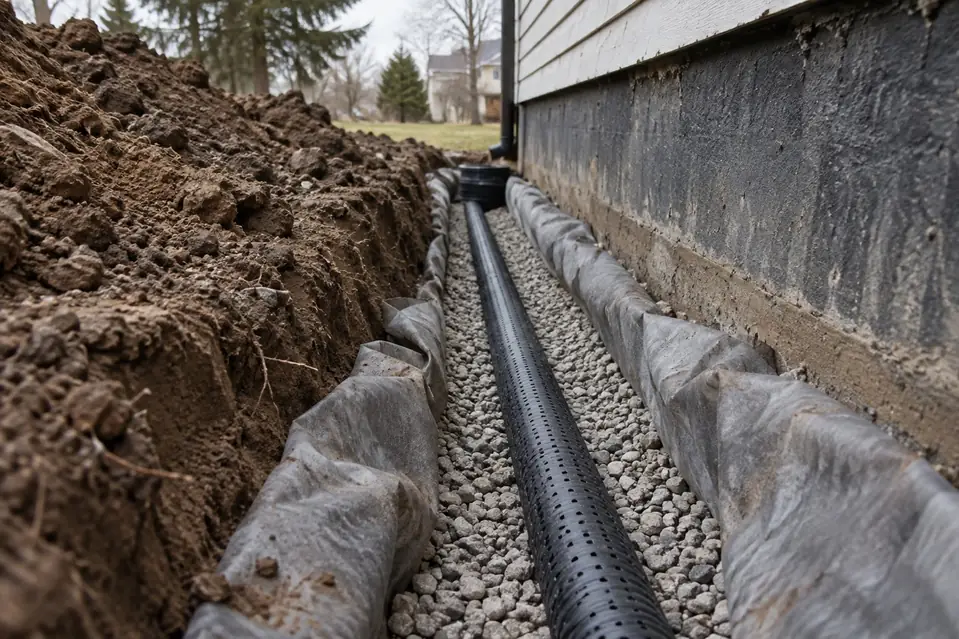
This is the distinction that almost nobody explains, and it is the whole decision. An exterior french drain, often called a footing drain or a curtain drain, sits in a trench dug down the outside of the foundation wall, usually to the level of the footing. Gravel and a perforated pipe collect groundwater as it moves down through the soil and carry it away before it can build pressure against the wall or find a crack to come through. It addresses the cause.
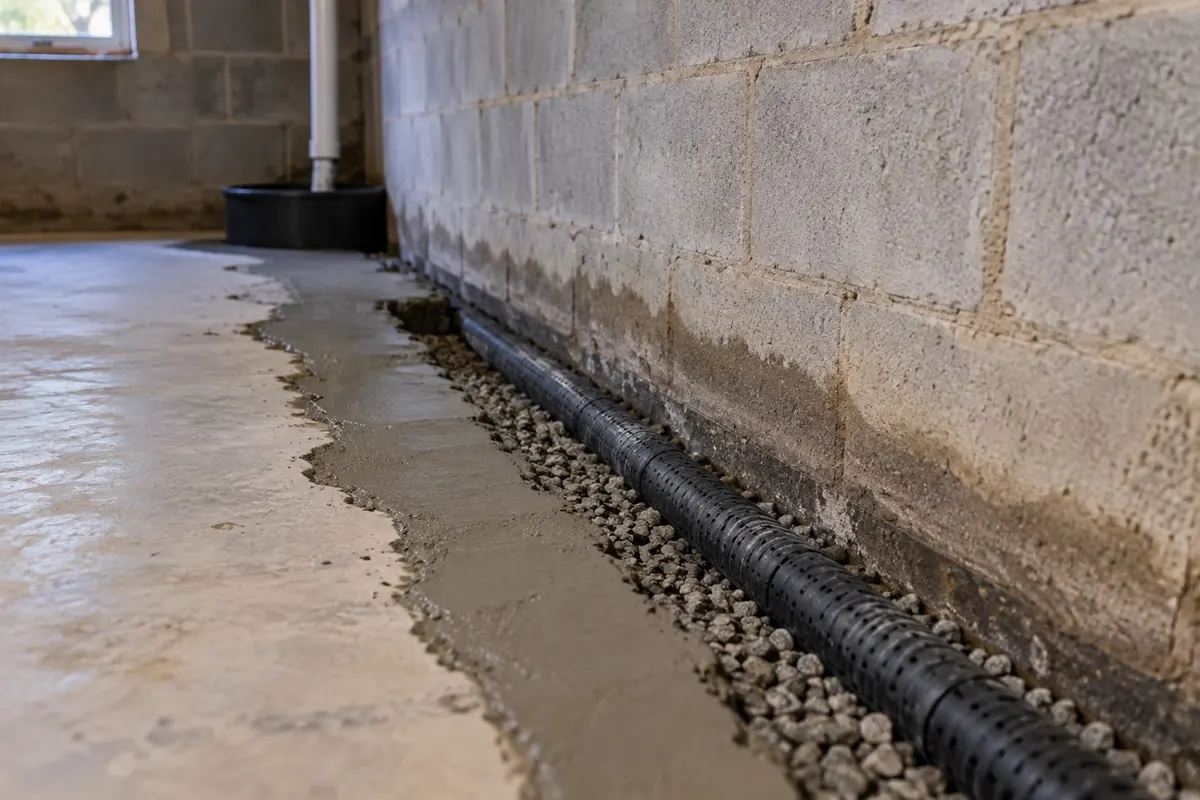
An interior perimeter drain does the opposite. It accepts that water will reach the wall, and gives it a managed route out. A channel is cut in the basement slab around the inside edge of the footing, a perforated pipe is bedded in gravel, the slab is patched, and the pipe runs to a sump basin where a pump lifts the water out. It manages the symptom, reliably and at a fraction of the cost.
Why the cheaper option is often the correct one anyway
It would be neat if the expensive fix were always the better fix. It is not. If the foundation wall is sound, the problem is seasonal groundwater rather than structural, and the building sits in a position where exterior excavation would mean removing a mature garden, a driveway and a deck, an interior system delivers a dry basement for a third of the money. The water still reaches the wall, and for a poured concrete wall in good condition that is tolerable.
The exterior job earns its price in specific situations: a wall that is already showing movement or serious cracking, a block wall filling with water in its cores, a building where the outside is open anyway for other work, or a case where exterior waterproofing membrane needs replacing and the excavation is happening regardless.
The honest version of the sales conversation
A contractor who opens with a price rather than a diagnosis is selling. The right first questions are where the water appears, when it appears relative to rainfall, whether the gutters and grading have already been dealt with, and what the wall is made of. If none of that comes up before a number does, get another opinion. Our basement waterproofing cost page covers the full method-selection question, of which a french drain is one answer among several.
What each type costs
These are whole-job ranges rather than per-foot rates, because nobody knows their linear footage before somebody walks the perimeter. The tiers are separated by scope, and the gap between tiers is larger than the spread inside any one of them.
| Type | Typical range | What it includes | When it is the right call |
|---|---|---|---|
| Yard or landscape drain | $1,500 to $4,000 | Shallow trench, gravel, perforated pipe, often a catch basin, discharge to daylight | Surface water pooling in the garden or against a patio, no basement involvement. |
| Interior perimeter, partial | $2,000 to $5,000 | Slab cut on one or two walls, pipe and gravel, slab patch, tie into an existing or new sump | Water appears reliably at one corner or one wall, and the rest of the basement stays dry. |
| Interior perimeter, full | $5,000 to $9,000 | Slab cut around the full perimeter, pipe, gravel, patch, new sump basin and pump, discharge line | Water appears in multiple locations, or the water table rises generally rather than at one point. |
| Exterior, partial run | $6,000 to $10,000 | Excavation along one or two walls to footing depth, drain, gravel, fabric, backfill, surface reinstatement | One wall faces a slope or takes the runoff, and access on that side is workable. |
| Exterior, full with excavation | $10,000 to $20,000+ | Full perimeter excavation, footing drain, filter fabric, drainage board or membrane where specified, backfill, reinstatement | Wall condition, block cores filling, or membrane replacement makes the outside the only place to fix it. |
The per linear foot number, and its limits
Contractors quote by the linear foot because that is how the work scales, and property owners find the number reassuring because it looks precise. It is a useful tool for comparing two bids on the same house and a poor tool for budgeting before anyone has looked.
| Placement | Indicative per linear foot | What is inside that rate |
|---|---|---|
| Interior perimeter | $50 to $100 | Slab cutting and removal, spoil handling, gravel, perforated pipe, slab patch, plus a share of the sump and discharge work. |
| Exterior, machine access available | $100 to $150 | Excavation, spoil storage, pipe, gravel, filter fabric, backfill and compaction, plus surface reinstatement. |
| Exterior, hand dig or restricted access | $150 to $200+ | The same scope with labour replacing the machine, which is where the rate climbs fastest. |
Why the same rate gives different totals
A rectangular 1,200 sq ft basement has roughly 140 linear feet of perimeter. At $70 per foot that is about $9,800 for a full interior run, which is above the typical band, and the reason is that real jobs are rarely full perimeter. Most water enters on the uphill side or at one or two identifiable points, so a partial run on 50 to 70 feet is the common scope. Quoting the full perimeter when a partial run would do is one of the more common ways a price inflates.
Where per-foot pricing breaks down entirely
Per-foot rates assume a repeatable trench. They stop working the moment the trench stops being repeatable: a section under a chimney footing, a run past a utility entry, a stretch where the slab is eight inches of reinforced concrete rather than four, or a corner where the excavator cannot reach and two people dig it by hand. A quote built entirely on a single per-foot number, with no allowance for any of that, is either carrying a large contingency or heading for a change order.
What actually drives the price
Eight variables move a french drain quote, and only the first one is obvious to the person paying.
| Driver | How it moves the price | What to ask |
|---|---|---|
| Linear footage | Roughly linear, and the easiest thing to reduce by scoping a partial run instead of a full perimeter. | Which walls are you running, and why those? |
| Interior or exterior placement | The largest single factor. Exterior work carries excavation, spoil handling, backfill and reinstatement that interior work does not. | Why this placement for this building? |
| Excavation depth | Exterior cost climbs with depth because spoil volume, shoring considerations and machine time all climb with it. | How deep to the footing, and have you confirmed it? |
| Sump and pump inclusion | An interior system almost always needs one. Whether it is in the quoted figure or listed separately is a frequent source of surprise. | Is the basin, pump, check valve and discharge line in this price? |
| Machine access | Hand digging costs far more than machine digging for the same trench. A narrow side passage or a fence that cannot be removed can double a section. | Can a machine reach every run you are quoting? |
| Removal and reinstatement | Concrete slab, patio, driveway, deck, mature planting and irrigation all have to come out and go back. Reinstatement is sometimes excluded entirely. | What is being removed, and who puts it back? |
| Soil type | Clay holds water and drains slowly, which argues for drainage but also makes excavation heavier. Rock changes the job completely. | What did the test hole show? |
| Discharge route | If there is nowhere legal and workable for the water to go, a dry well or a long run to daylight becomes its own project. | Where exactly does the water end up, and is that permitted here? |
Excavation depth and machine access
On an exterior job, excavation is most of the cost and almost all of the risk. The trench has to reach the footing, because a drain that sits above the footing leaves the bottom of the wall in the water it was meant to relieve. On a full basement that is commonly seven to nine feet of depth, which is a serious hole against a building.
| Condition | Effect on cost | Why |
|---|---|---|
| Machine access on all sides | Baseline | An excavator digs in hours what hand labour digs in days. |
| One restricted side | Materially above baseline on that run | Hand digging, wheelbarrow spoil handling, and slower backfill. |
| No machine access at all | Can approach double | The whole job becomes labour, and spoil has to be moved twice. |
| Deep footing, 8 ft or more | Above baseline | More spoil volume, more time, and shoring or benching considerations for anyone working in the trench. |
| Rock or heavy cobble | Highly variable, often a change order | Breaking rock is a different operation with different plant. |
| Utilities crossing the run | Above baseline | Hand digging around services, and locate work before starting. |
Spoil is a line item, not an afterthought
A 100 foot trench at two feet wide and eight feet deep is roughly 59 cubic yards of soil. It has to go somewhere while the drain is installed, and a good deal of it usually has to be removed and replaced with clean backfill rather than shovelled straight back. Where there is no yard to stockpile it, the material goes into trucks twice. That is a real cost, and it is one of the reasons the same linear footage prices very differently on a suburban lot and a terraced city street.
What has to be removed and put back
The trench is the visible part. Reinstatement is frequently the part that surprises people, because it is quoted separately, excluded, or described in a single line that turns out to mean backfill only.
| What is in the way | Typical handling | Reinstatement question |
|---|---|---|
| Lawn and topsoil | Stripped and stockpiled, relaid after backfill | Is seeding or turfing included, and who waters it? |
| Mature shrubs and trees | Small plants can be lifted and heeled in. Mature specimens are generally lost, and roots inside the trench line may force a route change. | Which plants are you writing off, in writing? |
| Concrete patio or walkway | Cut and broken out, disposed of, poured back | Is the concrete replacement in this price or a separate trade? |
| Driveway | The most expensive thing to cross. Sometimes the drain is routed to avoid it entirely. | Can the run avoid it, and what does avoiding it cost? |
| Deck or porch | Often has to be partly dismantled, and sometimes cannot be without structural work | Who dismantles and rebuilds, and is the footing affected? |
| Interior slab | Cut, broken out, spoil carried out by hand, patched with new concrete | How is dust controlled, and what is the patch finish? |
| Irrigation and low voltage lines | Cut and rejoined, commonly excluded from the quote | Is repair of these included or are they my problem? |
Interior work has its own disruption, it is just indoors
Cutting a channel around the inside perimeter of a basement slab produces concrete dust in quantity, and the spoil comes out through the house unless there is a walkout. Finished basements have to be opened along the base of the wall, which usually means the bottom courses of drywall and any base trim come off. If the basement is finished, the reinstatement cost of that finish belongs in the comparison against the exterior option, and it is often left out.
Soil type, and why clay changes the answer
Soil decides how water arrives at the foundation, which decides whether a drain will do what it is being bought to do.
| Soil | Drainage behaviour | Implication for a french drain |
|---|---|---|
| Sand and gravel | Water moves through quickly | Water reaches a drain readily. Excavation is easier but sides are less stable. |
| Loam | Moderate | Generally the straightforward case. |
| Clay | Very slow. Water perches above it and moves sideways | A drain works, but it must be surrounded by properly graded stone and the correct fabric, or the clay fines will blind it. |
| Expansive clay | Swells wet, shrinks dry | Movement against the wall is itself a problem, and drainage is part of a larger conversation that may need an engineer. |
| Fill of unknown origin | Unpredictable | Common around houses. Worth a test hole before pricing, because buried debris changes the excavation. |
The clay case is worth stating clearly, because it is the one where a correctly specified drain and a badly specified one look identical on the day of install and diverge completely within a few years. In clay, the fines are the enemy. Stone that is too fine, or fabric that is wrong or absent, lets clay particles migrate into the voids between the stones and eventually into the pipe. The drain silts up from the outside in, and nothing about the surface suggests it until the basement is wet again.
Discharge is the constraint people forget
A french drain does not consume water. It moves it. Everything in the quote up to this point is about collecting the water, and then it has to go somewhere, legally, that is far enough away and low enough that it does not come back. This is the part most often left vague in a quote and most often responsible for a system that technically works and practically does not.
| Discharge route | How it works | Cost and permit considerations |
|---|---|---|
| Gravity to daylight | The pipe runs downhill to an open outlet on the property | The cheapest option when the ground falls away. Needs continuous fall, an outlet that will not be buried or blocked, and a rodent grate. |
| Sump pump to grade | A pump lifts the water and discharges it at the surface away from the building | Standard for interior systems. Adds the pump, the electrical supply, the discharge line and the ongoing maintenance of both. |
| Dry well | A buried chamber that holds the water and lets it soak away | Used where there is no fall and no legal connection. Needs soil that actually percolates, sizing that matches the catchment, and placement well away from the foundation. |
| Storm sewer connection | The line ties into a municipal storm system | Where permitted, this is clean and permanent. It generally requires a permit, an approved connection method and sometimes an inspection. |
| Sanitary sewer | Tying groundwater into the foul drain | Commonly prohibited. Many jurisdictions ban it because clean groundwater overloads treatment capacity during storms. |
Why the sanitary sewer ban matters to your quote
Many jurisdictions prohibit discharging foundation drainage or sump output into a sanitary sewer, and some run active programmes to disconnect existing illegal connections. The practical effect on a quote is simple: if there is no fall to daylight and no storm connection available, the discharge becomes a dry well or a long surface run, and that is a real cost line that a quote may have quietly assumed away. Ask where the water goes, and ask whether that route is permitted in that specific jurisdiction, because the rules genuinely vary.
The outlet is the part that fails in winter
A discharge line that ends in a low spot, a flower bed, or anywhere the outlet can be covered by snow, leaves or ice will back up at exactly the moment the system is needed. In cold climates the outlet end of a pumped discharge freezes routinely, which stops the pump from clearing and leaves the basement wet with a working pump installed. Our sump pump installation cost page covers the pump side of that in detail.
What is actually in the trench
The materials are cheap relative to the labour, which is why cutting corners on them makes so little commercial sense and happens anyway.
| Component | Function | Where it goes wrong |
|---|---|---|
| Perforated pipe | Carries the collected water to the discharge point | Corrugated flexible pipe crushes and sags more readily than rigid pipe. Sags hold water and silt. |
| Washed drainage stone | Creates void space so water can reach the pipe freely | Unwashed or too-fine stone brings its own fines and blinds the system from day one. |
| Filter fabric | Keeps soil fines out of the stone and the pipe while letting water through | Omitted entirely, or a low permeability fabric used that blocks as readily as the soil would have. |
| Bedding and fall | A continuous slope so water always moves toward the outlet | Flat sections or reverse falls, which create standing water inside the system. |
| Cleanouts | Access points for inspecting and flushing the line | Frequently omitted, which makes future maintenance a matter of digging rather than a hose. |
| Backfill | Restores the ground above the drain | Heavy compaction directly over the pipe, or dumping backfill from height, which crushes it. |
Sock pipe is not a substitute for fabric done properly
Pipe supplied with a fabric sock already fitted is convenient and it has a place, particularly in clean sandy soil. In fine soil it can become the failure point rather than the protection, because the sock sits directly against the pipe with no stone buffer, so once it blinds there is no path left. The better arrangement in difficult soil is fabric lining the trench itself, so the whole stone envelope is protected and the effective filter area is far larger.
How french drains fail
A correctly built french drain is close to maintenance free for decades. The failures are almost all install failures, and they share a characteristic: nothing is visible at handover, and the symptom returns years later when the crew is long gone.
| Failure | What causes it | What it looks like later |
|---|---|---|
| Silting up | No filter fabric, the wrong fabric, or stone too fine | The system works for a few seasons, then water returns. Flushing a cleanout may recover it; often it does not. |
| Insufficient fall | Trench bottom laid flat or with reverse sections | Standing water inside the pipe, accelerated silting, and in cold climates a frozen section. |
| Crushed pipe | Backfill dumped from height, machine tracking over the line, or flexible pipe in a high load area | A blockage at one point that backs the whole run up. |
| Recirculating discharge | The outlet is too close to the house or discharges to a low spot that drains back toward the foundation | The system runs constantly and the basement stays damp. The pump works, the drain works, and the water never leaves. |
| Frozen outlet | The discharge end is buried, submerged, or unprotected in a cold climate | Winter backup during a thaw, which is one of the higher risk moments of the year. |
| Wrong diagnosis | A drain installed where the real problem was gutters, grading or condensation | A large invoice and a basement that is still wet, because the water was never groundwater. |
The consequence of a failure is rarely just water
A drain that silts up quietly over five years does not announce itself with a flood. It shows up as raised humidity, a musty smell, and eventually growth on stored material and on the back of finished walls. The EPA mold cleanup guidance is explicit that controlling moisture is the controlling factor in preventing mould growth, which is the reason a drainage failure becomes a remediation job rather than a plumbing one. Our water damage restoration cost page sets out what that costs once it has happened.
Choosing between the two
The decision is not about budget first. It is about what the water is doing and what the wall can tolerate.
| Situation | Usually points to | Why |
|---|---|---|
| Seasonal water at the floor and wall joint, sound wall | Interior perimeter with sump | The wall is coping. The water needs a managed exit, and that is cheaper indoors. |
| Block wall with water visible in the cores | Exterior, or interior with core weep holes | Water inside the block is a pressure and deterioration problem, not just a wetness problem. |
| Visible wall movement, bowing or stepped cracking | Structural assessment first, then likely exterior | Relieving lateral pressure is a structural objective. Anything load bearing wants an engineer, not a drainage salesperson. |
| Water only after heavy rain, gutters overflowing | Neither, yet | Fix the gutters, extend the downspouts and correct the grading first. A real share of wet basements end there for a few hundred dollars. |
| Damp with no visible entry, high humidity | Neither, yet | This can be condensation rather than groundwater. Diagnosing it as drainage buys an expensive trench for the wrong problem. |
| Exterior is already open for other work | Exterior | The excavation is the cost. If it is happening anyway, the incremental price of the drain is small. |
| Finished basement, mature landscaping, tight site | Interior | Exterior reinstatement can exceed the drain itself. |
Cheap legitimate fixes come first, every time
Before any trench is priced, the gutters should be clear, the downspouts should discharge at least several feet from the wall, and the ground should fall away from the building rather than toward it. These cost a few hundred dollars and they resolve a meaningful share of wet basement complaints. A contractor who skips that conversation and goes straight to a drainage quote is telling you something about how they work.
How to read a french drain quote
Six questions separate a defensible quote from a number on a page.
- Interior or exterior, and why this one for this building? If the answer is about the crew rather than the wall, that is the answer.
- How many linear feet, on which walls? A partial run is often correct and should be justified by where water actually appears.
- Where does the water discharge, and is that permitted here? Get the route named, not implied. Rules vary by jurisdiction.
- Is the sump basin, pump, check valve and discharge line in this figure? On an interior system these are not optional, and they are commonly quoted separately.
- What fabric and what stone? The answer should be specific. Vagueness here is the single best predictor of a system that silts up.
- What is excluded? Reinstatement of hardscape, planting, interior finishes, irrigation, electrical for the pump and any permit fees are the usual exclusions.
Before committing to a drainage system, rule out the cheaper causes. Blocked gutters, downspouts discharging at the wall and ground sloping back toward the building produce the same wet basement as groundwater does, and they cost a fraction to fix. A drain installed against surface water that could have been graded away is money spent on the wrong problem.
Questions people actually ask
How much does a french drain cost?
Roughly $2,000 to $5,000 for a partial interior perimeter run, $5,000 to $9,000 for a full interior perimeter, $6,000 to $10,000 for a partial exterior run, and $10,000 to $20,000 or more for a full exterior system with excavation to footing depth. A yard drain sits lower at roughly $1,500 to $4,000. These are indicative ranges compiled from published price guides, not quotes.
Is an interior or exterior french drain better?
They solve different problems. An exterior drain intercepts water before it reaches the foundation and addresses the cause. An interior drain collects water that has already entered and routes it to a sump, managing the symptom at a fraction of the cost. Exterior is generally the right answer where the wall itself is under pressure or deteriorating; interior is often correct where the wall is sound and the issue is seasonal water at the floor joint.
How much is a french drain per linear foot?
Indicatively $50 to $100 per linear foot interior and $100 to $200 exterior. The exterior gap is excavation, spoil handling, backfill and reinstatement rather than materials. Restricted access that forces hand digging pushes the exterior rate toward the top of that band and past it.
Do I need a sump pump with a french drain?
Almost always with an interior system, because the collected water sits below the level it needs to reach. An exterior drain can sometimes fall to daylight by gravity, which avoids the pump entirely and removes a mechanical failure point. Whether the basin, pump, check valve and discharge line are inside the quoted figure is worth confirming in writing.
Where does the water from a french drain go?
To daylight by gravity, to a sump that pumps it away from the building, to a dry well, or into a storm sewer where a connection is permitted. Many jurisdictions prohibit discharging into a sanitary sewer. Rules vary, so confirm the permitted route with the local building or public works authority before the work is scoped.
How long does a french drain last?
A correctly built system with proper filter fabric, washed stone and continuous fall can run for decades with little attention. A system built without fabric, or with fines in the stone, can begin silting within a few years. Where a sump pump is part of the system, the pump is a consumable with a service life of its own and will be replaced several times over the life of the drain.
Will a french drain fix my wet basement on its own?
Only if the water is groundwater. Wet basements are also caused by surface water from blocked gutters or grading that falls toward the house, and by condensation on cold surfaces. Those look similar from inside and need completely different fixes, so the diagnosis has to come before the trench.
Sources
- EPA mold cleanup guidance. United States Environmental Protection Agency, on moisture control as the controlling factor in preventing mould growth. Retrieved 23 September 2026.
- Cost tiers ($1,500 to $4,000 yard drain; $2,000 to $5,000 interior partial; $5,000 to $9,000 interior full perimeter; $6,000 to $10,000 exterior partial; $10,000 to $20,000 and above exterior full) and the per linear foot bands ($50 to $100 interior, $100 to $200 exterior) are compiled from published contractor and aggregator price guides current in 2026. They are indicative rather than survey results. We compile published guides and public datasets; we have not conducted a contractor pricing survey.
- Installation components, filter fabric practice and failure modes are compiled from published contractor and manufacturer installation guidance current in 2026. We compare published specifications rather than testing materials.
- Discharge rules, including restrictions on connecting foundation drainage or sump output to a sanitary sewer, vary by jurisdiction and code edition. Local requirements govern, and the local building or public works authority is the authority on what is permitted at a given address.
- Anything involving foundation movement, bowing walls or load bearing elements is outside the scope of a drainage quote and needs a qualified structural assessment. Nothing here substitutes for local code or an engineer’s judgement.